
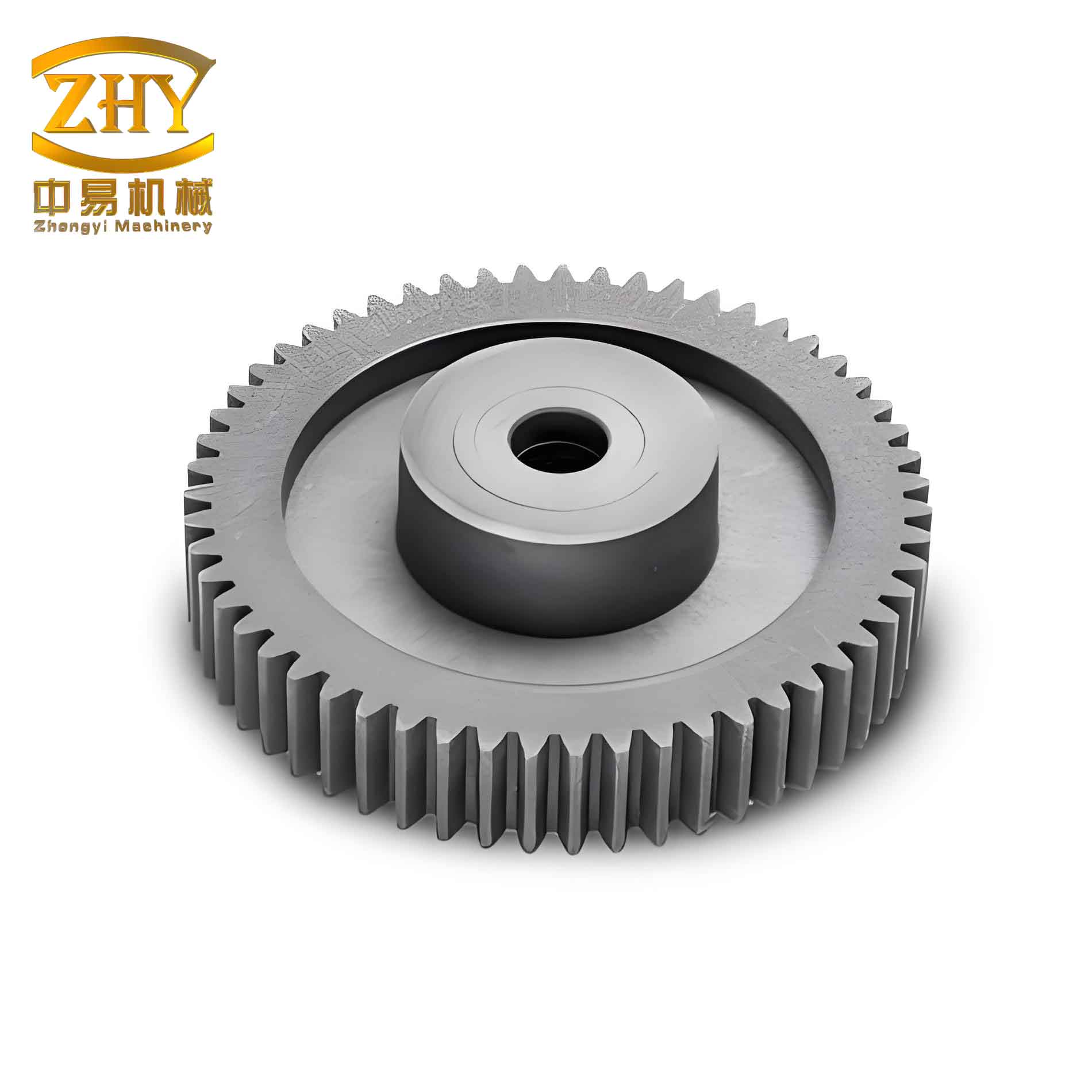
The cylindrical gear stands as one of the most fundamental and widely utilized components in mechanical power transmission systems. The search for a cylindrical gear that combines high load capacity, smooth operation, and ease of manufacturing is a persistent goal in gear design. Traditional forms, such as spur, helical, and herringbone gears, each present a compromise between these desirable characteristics. The spur cylindrical gear, while simple to manufacture and measure, suffers from a low contact ratio leading to increased noise and vibration. The helical cylindrical gear offers smoother engagement due to a gradually changing contact area, but introduces detrimental axial forces. The herringbone cylindrical gear cancels these axial forces but requires a wide central groove, which wastes potential contact area and complicates the machining process.
This study presents an alternative geometry for a cylindrical gear: one where the tooth trace in the axial direction follows a cycloidal curve. This fundamental shift in topology enables a manufacturing paradigm known as continuous-index milling, offering dramatic gains in production efficiency while simultaneously conferring superior performance attributes such as a high contact ratio, smooth transmission, and the absence of axial thrust forces. The design is realized using a standard disc milling cutter equipped with adjustable, replaceable blades, promoting standardization and cost-effectiveness. This article details the generative principle, mathematical foundation, three-dimensional modeling, and machining methodology for this innovative cylindrical gear.
The core concept begins with defining the imaginary generating rack, whose flank surface is key to creating the conjugate gear pair. Unlike a standard rack with a straight tooth trace, the tooth flank of this specialized rack is generated by sweeping a straight line along a two-dimensional cycloidal path. The generation of this base cycloid is illustrated below. A circle C of radius $R_b$ rolls without slipping along a straight line P. A point M, fixed at a distance $R_t$ from the circle’s center O0, traces out a cycloid. The coordinate system S0 (O0, X0, Y0) is fixed, while St (Ot, Xt, Yt) is attached to the rolling circle.
The position vector of point M in St is:
$$ \mathbf{r}_t = \begin{pmatrix} 0 \\ -R_t \\ 1 \end{pmatrix} $$
After the circle rolls through an angle $\theta$, the transformation from St to S0 is given by the matrix $\mathbf{M}_{0t}$:
$$ \mathbf{M}_{0t} = \begin{bmatrix} \cos \theta & -\sin \theta & 0 \\ \sin \theta & \cos \theta & 0 \\ 0 & 0 & 1 \end{bmatrix} \begin{bmatrix} 1 & 0 & -L_1 \\ 0 & 1 & -R_b \\ 0 & 0 & 1 \end{bmatrix} $$
where $L_1 = \theta R_b$. The cycloid trajectory in S0 is then:
$$ \mathbf{r}_0 = \mathbf{M}_{0t} \mathbf{r}_t \quad \Rightarrow \quad \begin{cases} X_0 = R_b \theta – R_t \sin \theta \\ Y_0 = -R_t \cos \theta \end{cases} $$
To position this curve as a rack tooth flank, we translate to a coordinate system S1 fixed at the center of the rack’s reference line. The resulting equation for one flank of the generating rack in S1 is:
$$ \begin{cases} X_1 = R_b \theta – R_t \sin \theta + L_2 \\ Y_1 = R_b – R_t \cos \theta \end{cases} $$
where $L_2 = R_b / \tan[\arcsin(R_b/R_t)] – R_b \arccos(R_b/R_t)$.
To form the three-dimensional rack surface $\Sigma_1$, the two-dimensional cycloid is swept along the Z-axis direction, with the profile angle $\alpha$ defining the inclination of the straight-line generator. Introducing parameter $u$ for the Z-direction and parameter $\theta$ for the cycloid, the rack tooth surface is defined as:
$$ \mathbf{r}_1(u, \theta) = \begin{pmatrix} R_b \theta – (R_t + u \tan \alpha) \sin \theta + L_2 \\ R_b – (R_t + u \tan \alpha) \cos \theta \\ u \end{pmatrix} $$
This surface represents the imaginary tool that will envelop the gear tooth.
The mathematical model of the conjugate cylindrical gear tooth surface $\Sigma_2$ is derived using the theory of gearing. The fundamental law of contact requires that the common normal vector $\mathbf{n}$ at the point of contact between the rack $\Sigma_1$ and the gear $\Sigma_2$ is perpendicular to their relative velocity $\mathbf{v}_{12}$:
$$ \mathbf{v}_{12} \cdot \mathbf{n} = 0 $$
This is the essential meshing equation. To apply it, we consider the rack surface moving with a linear velocity $v = r_p \omega$ along the negative X1 direction (simulating the generating process), where $r_p$ is the gear’s pitch radius. The gear rotates with an angular velocity $\boldsymbol{\omega} = (0, 0, 1)^T$ around its axis. The transformation from the moving rack coordinate system S1 to a fixed frame Sf, and then to the gear coordinate system S2, is established.
The rack surface in the fixed frame Sf at time $t$ is:
$$ \mathbf{r}_f(u, \theta, t) = \begin{pmatrix} R_b \theta – (R_t + u \tan \alpha) \sin \theta + L_2 + r_p t \\ R_b – (R_t + u \tan \alpha) \cos \theta \\ u \end{pmatrix} $$
The normal vector $\mathbf{n}$ is computed from the partial derivatives of $\mathbf{r}_f$ with respect to $u$ and $\theta$. The relative velocity $\mathbf{v}_{12}$ at a point on the surface is $\mathbf{v}_{12} = \boldsymbol{\omega} \times \mathbf{r}_f$. Substituting into the meshing equation $\mathbf{v}_{12} \cdot \mathbf{n} = 0$ yields a quadratic equation in $u$:
$$ A u^2 + B u + C = 0 $$
where:
$$ \begin{aligned}
A &= (-\sin \theta \tan^3 \alpha – \sin \theta \tan \alpha) \\
B &= \tan^2 \alpha (L_2 + r_p t + R_b \theta – R_t \sin \theta) – R_t \sin \theta – \tan^2 \alpha \sin \theta (R_t – R_b \cos \theta) \\
C &= \tan \alpha (R_t – R_b \cos \theta)(L_2 + r_p t + R_b \theta – R_t \sin \theta)
\end{aligned} $$
Solving for $u$ gives the relation $u = u(\theta, t)$, representing the contact line on the rack surface at time $t$:
$$ u(\theta, t) = \frac{-B \pm \sqrt{B^2 – 4AC}}{2A} $$
The “$\pm$” indicates two potential contact lines, corresponding to both sides of the rack tooth space. Substituting $u(\theta, t)$ back into $\mathbf{r}_f$ gives the family of contact lines in Sf. Finally, transforming these lines into the gear coordinate system S2 via the operator $\mathbf{M}_{2f}(t)$ yields the complete tooth surface of the cycloidal cylindrical gear:
$$ \mathbf{r}_2(\theta, t) = \mathbf{M}_{2f}(t) \, \mathbf{r}_f(u(\theta, t), \theta, t) $$
According to the Camus theorem, any two cylindrical gears generated by the same imaginary rack under pure rolling conditions will be conjugate to each other, ensuring correct meshing.
To illustrate the design, a pair of meshing cylindrical gears and their common generating rack are modeled. The primary gear design parameters are listed below:
| Item | Gear 1 | Gear 2 | Generating Rack |
|---|---|---|---|
| Number of Teeth, z | 30 | 20 | – |
| Module, mn (mm) | 5 | 5 | 5 |
| Pressure Angle, α (°) | 20 | 20 | 20 |
| Helix Angle at Ref. Circle, β (°) | 16.2 | 16.2 | 16.2 |
| Center Distance, a (mm) | 125 | 125 | – |
| Addendum Coefficient | 1.0 | 1.0 | 1.25 |
| Dedendum Coefficient | 1.25 | 1.25 | 1.25 |
| Pitch Diameter, d (mm) | 150 | 100 | – |
| Face Width, b (mm) | 50 | 52 | 60 |
| Backlash, j (mm) | 0.18 | 0.18 | – |
| Contact Ratio, ε | 2.34 | 2.34 | – |
The cycloid parameters, which determine the nominal helix angle and influence manufacturing, are selected as $R_b = 30 \text{ mm}$ and $R_t = 105 \text{ mm}$. Based on the derived equations and these parameters, discrete point clouds for the rack and gear surfaces are calculated using developed software. These points are then imported into CAD software (e.g., SolidWorks) to generate surfaces and solid models through fitting and Boolean operations. The table below summarizes the parameter ranges used for generating the 3D point cloud for the cylindrical gear tooth surface.
| Parameter | Symbol | Range/Value |
|---|---|---|
| Z-coordinate parameter | $u$ | -7 mm to 7 mm |
| Cycloid generation angle | $\theta$ | 52° to 92° |
| Time (motion parameter) | $t$ | -25 s to 25 s |
| Profile pressure angle | $\alpha$ | 20° |
The true advantage of this cylindrical gear geometry lies in its manufacturability via continuous-index milling. The machining setup employs a disc milling cutter whose rotating cutting edges replicate the moving generating rack. The disc cutter body holds a set of adjustable insert blades (inner and outer sets for the two flanks of the tooth space). The geometric placement of these blades is calculated so that their swept volume, as the cutter rotates, matches the space swept by the imaginary rack surface. Key cutter parameters include disc diameter $D_d$, arbor diameter $D_e$, disc thickness $H_d$, blade mounting diameter $D_m$, number of blades $Z_b$, blade inclination angle $\alpha$, radial adjustment $d_r$, and circumferential adjustment $d_c$.
During the cutting process for the cylindrical gear, three synchronized motions occur: the cutter rotates about its own axis with angular speed $\omega$, the workpiece (gear blank) rotates about its axis with angular speed $\omega_1$, and the cutter feeds radially inward (or the workpiece feeds axially) to complete the full tooth depth. The synchronized rotation simulates the pure rolling of the pitch circle of the cylindrical gear on the rack’s pitch line, governed by the ratio:
$$ \frac{\omega_1}{\omega} = \frac{r_p}{R_b} $$
This continuous, simultaneous rotation of the cutter and workpiece, without any retraction or indexing pauses, is what defines the continuous-index method and leads to significantly higher productivity compared to traditional gear hobbing or shaping for similar complex tooth traces.
In summary, the cycloidal cylindrical gear presents a compelling alternative within the family of cylindrical gears. Its performance bridges the gap between existing types: it operates more smoothly than a spur cylindrical gear due to a favorable and gradually changing contact pattern, it carries higher loads than a helical cylindrical gear because it generates no axial thrust, and it utilizes the full face width more effectively than a herringbone cylindrical gear by eliminating the central groove. The most significant advancement is in manufacturing. The adoption of the continuous-index milling strategy enables rapid production, making this high-performance cylindrical gear geometry economically viable. Furthermore, the use of a standard disc cutter with replaceable blades for a given module promotes tooling standardization. It is acknowledged that this machining approach may be less suitable for cylindrical gears of very large diameter (e.g., >1 m) due to potential cutter size and interference constraints. Nevertheless, this research provides a novel and practical foundation for the design and efficient mass production of an advanced cylindrical gear type, opening new avenues for high-performance power transmission systems.