
In my extensive experience working with bevel gears, I have consistently found that straight bevel gears, particularly miter gears used for 1:1 ratio power transmission between intersecting shafts, are highly susceptible to misalignment in practical applications. Manufacturing inaccuracies, heat treatment distortions causing tooth alignment errors, as well as errors in the shaft angle and axial positioning of the gears, all significantly deteriorate the contact pattern on the tooth flanks. Poor contact leads to noise, vibration, reduced load capacity, and premature failure. To mitigate the adverse effects of these inevitable errors and to localize the contact area for more favorable stress distribution, I have developed and refined a method for introducing crown, or “barreling,” to the tooth profile of straight beeter gears. This crowning ensures that contact occurs preferentially at the center of the tooth face width, tapering off towards the ends, which allows the gears to accommodate misalignment and improve their operational performance.
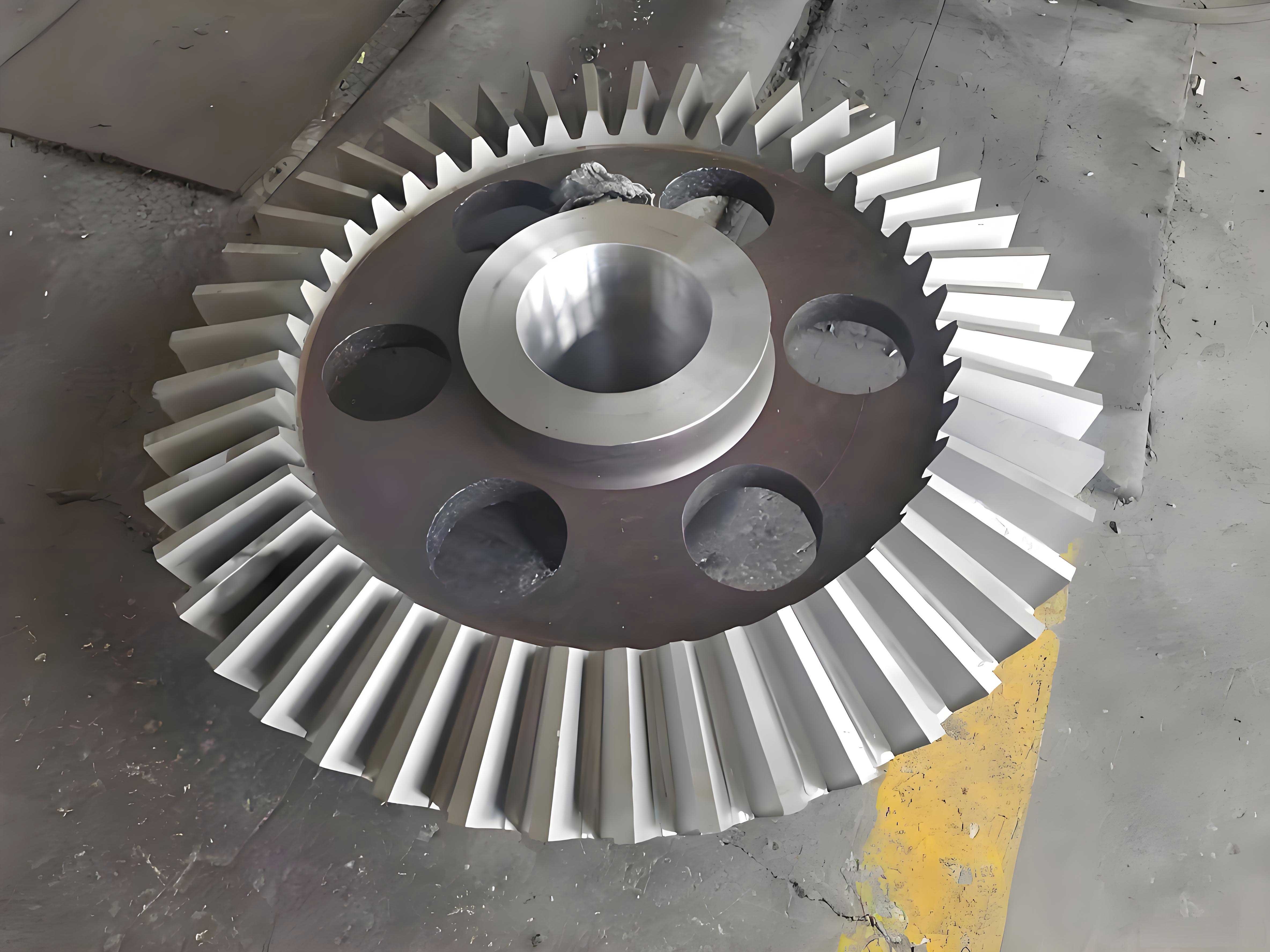
This article details a practical crowning method I employ using a standard gear planer and its conventional tools, operating on the generating principle. The core of the method lies in a calculated modification of the machine setup to create a virtual crown gear with a specific profile deviation from the theoretical one. By controlling this deviation, I can precisely determine the amount of crown and the position of the highest point on the tooth flank. The following sections will elaborate on the underlying principle, the step-by-step adjustment calculations, and the verification through a practical test.
Fundamental Principle of Generating Crowning
The generation of a straight bevel gear on a planer involves simulating the meshing of the workpiece with a virtual crown gear, whose apex coincides with that of the workpiece. During the rolling motion, two tool blades, representing one tooth space of this crown gear, cut a single tooth on the workpiece. In standard, non-crowned generation, the module of the virtual crown gear is equal to the module of the workpiece at every point along the face width. For crowning, I deliberately introduce a disparity.
Consider a workpiece with a large-end module $m_l$, pitch cone distance $L$, and face width $b$. The modules at the small end $m_s$ and at any point $X$ located at a distance $l_x$ from the large end can be calculated as:
$$m_s = m_l \frac{L-b}{L}$$
$$m_x = m_l \frac{L – l_x}{L}$$
For crowned miter gears, I first define the module $m’_c$ of the virtual crown gear at the face width center point $C$ to be equal to the workpiece module at that point, $m_c$. However, I then set the virtual crown gear’s large-end module $m’_l$ to be greater than $m_l$, and its small-end module $m’_s$ to be less than $m_s$. Because the modules at the ends are not equal, the pitch cone distance of this modified virtual crown gear, $L’$, becomes smaller than the workpiece pitch cone distance $L$. The difference $\Delta L$ is the crucial “apex offset” or eccentricity:
$$\Delta L = L – L’$$
When the workpiece and this modified virtual crown gear are rolled together with their apices offset by $\Delta L$, the cutting tools generate a tooth on the workpiece that is slightly thinner at both ends compared to its theoretical dimension, resulting in a crowned profile. The highest point of the crown corresponds to point $C$ where the modules are equal.
To quantify the end-thinning, I analyze the process by projecting the gear’s large end onto a transverse plane. In this plane, the cutting tool edges are treated as sides of a basic rack cutter with a pressure angle $\alpha_0$ and a module $m’_l$. The workpiece is treated as an equivalent spur gear with module $m_l$, pressure angle $\alpha$, and equivalent tooth number $z_v$. The condition for proper meshing between this rack (tool) and the spur gear (workpiece projection) requires that the pitch line of the rack is tangent to a specific reference circle on the gear. The pressure angle $\alpha’_l$ on this reference circle of the gear, induced by the rack with pressure angle $\alpha_0$, is given by:
$$\text{inv} \alpha’_l = \text{inv} \alpha + \frac{2 (x_l) \tan \alpha_0}{z_v}$$
Where $x_l$ is the profile shift coefficient at the large end, derived from the module mismatch:
$$x_l = \frac{m’_l – m_l}{m_l}$$
The arc tooth thickness $s’_l$ generated on this reference circle is equal to the space width of the rack on its pitch line. After calculation, the generated arc tooth thickness $s_{gen,l}$ on the gear’s standard pitch circle (module $m_l$) is found to be:
$$s_{gen,l} = m_l \left( \frac{\pi}{2} + 2 x_l \tan \alpha_0 \right)$$
The theoretical arc tooth thickness at the large end is simply $s_{theo,l} = m_l \pi / 2$. Therefore, the thinning amount $\Delta s_l$ at the large end is:
$$\Delta s_l = s_{theo,l} – s_{gen,l} = -2 m_l x_l \tan \alpha_0 = 2 (m_l – m’_l) \tan \alpha_0$$
A similar derivation for the small end yields the thinning amount $\Delta s_s$:
$$\Delta s_s = 2 (m_s – m’_s) \tan \alpha_0$$
At the center point $C$, where $m’_c = m_c$, the generated thickness equals the theoretical thickness ($\Delta s_c = 0$). Thus, by selecting appropriate values for $m’_l$ and $m’_s$ relative to $m_l$ and $m_s$, I can control the crowning magnitude. The key relationship between the modules of the modified crown gear over its face width $b$ is:
$$m’_c = \frac{m’_l + m’_s}{2}$$
This allows me to calculate $m’_s$ once $m’_l$ and $m’_c (=m_c)$ are chosen.
Process Trial and Machine Adjustment Calculation
To validate this method, I conducted a complete process trial. The workpiece was a pair of miter gears with the following parameters:
Module (large end) $m_l = 5\text{mm}$ | Pressure Angle $\alpha = 20^\circ$ | Shaft Angle $\Sigma = 90^\circ$ | Number of Teeth $z = 24$ | Pitch Cone Distance $L = 84.852\text{mm}$ | Face Width $b = 28\text{mm}$ | Material: 45 Steel, Grade 8-8-7.
Step 1: Determine Crown Amount and Virtual Crown Gear Parameters.
First, I calculated the workpiece modules at the small end ($m_s$) and center point ($m_c$ at $b/2$).
$$m_s = m_l \frac{L-b}{L} = 5 \times \frac{84.852 – 28}{84.852} \approx 3.350\text{mm}$$
$$m_c = m_l \frac{L-b/2}{L} = 5 \times \frac{84.852 – 14}{84.852} \approx 4.175\text{mm}$$
I set the virtual crown gear’s center module equal to this: $m’_c = m_c = 4.175\text{mm}$.
To achieve a desired crowning, I selected a trial value for the virtual crown gear’s large-end module: $m’_l = 5.1\text{mm}$. Using the linear relationship, the corresponding small-end module is:
$$m’_s = 2 m’_c – m’_l = 2 \times 4.175 – 5.1 = 3.25\text{mm}$$
Step 2: Calculate Theoretical Thinning Amounts.
Using the formulas derived earlier, with $\alpha_0 = \alpha = 20^\circ$:
$$\Delta s_l = 2 (m_l – m’_l) \tan \alpha = 2 \times (5 – 5.1) \times \tan 20^\circ \approx -0.0728\text{mm}$$
$$\Delta s_s = 2 (m_s – m’_s) \tan \alpha = 2 \times (3.350 – 3.25) \times \tan 20^\circ \approx 0.0728\text{mm}$$
The negative sign for $\Delta s_l$ indicates the generated thickness is less than theoretical (thinning). These values defined my target crown shape.
Step 3: Calculate Virtual Crown Gear Pitch Cone Distance and Apex Offset.
The pitch cone distance of the virtual crown gear $L’$ is proportional to its large-end module relative to the workpiece’s geometry. For a standard setup, the ratio is constant. The derived formula is:
$$L’ = L \times \frac{m’_l}{m_l} \times \frac{\sin \delta}{\sin \delta’}$$
Where $\delta$ is the workpiece pitch cone angle ($45^\circ$ for miter gears) and $\delta’$ is the virtual crown gear’s pitch cone angle. For the virtual crown gear (with a $90^\circ$ shaft angle), $\tan \delta’ = z / (z \times (m_l / m’_l)) = m’_l / m_l$. Therefore:
$$\delta’ = \arctan(m’_l / m_l) = \arctan(5.1 / 5) \approx 45.573^\circ$$
$$L’ = L \times \frac{m’_l}{m_l} \times \frac{\sin \delta}{\sin \delta’} = 84.852 \times \frac{5.1}{5} \times \frac{\sin 45^\circ}{\sin 45.573^\circ} \approx 86.322\text{mm}$$
The apex offset is then:
$$\Delta L = L’ – L \approx 86.322 – 84.852 = 1.470\text{mm}$$
Note: In the generation model, the workpiece apex is offset from the machine center (crown gear apex) by this amount.
Step 4: Key Machine Adjustments.
The machine setup differs from standard planning in three main aspects: the generating ratio, the carriage position, and the head (workpiece) setting.
1. Generating Change Gears: These are calculated based on the virtual crown gear’s parameters $L’$ and $m’_l$ using the machine’s specific formula. For the machine used, the ratio $i_{roll}$ is:
$$i_{roll} = \frac{L’}{m’_l \times K}$$
Where $K$ is a machine constant (e.g., 7.5). Thus,
$$i_{roll} = \frac{86.322}{5.1 \times 7.5} \approx 2.256$$
The change gears are selected to approximate this ratio.
2. Carriage Adjustment ($\Delta V$): To achieve the apex offset $\Delta L$ during the cutting stroke, the carriage is moved outward by a distance $\Delta V$.
$$\Delta V = \Delta L \times \frac{\sin \theta_a}{\sin(\delta – \theta_a)}$$
Where $\theta_a$ is the virtual crown gear’s addendum angle, $\tan \theta_a = h_a’ / L’$, and $h_a’$ is its addendum ($\sim 1.2 m’_l$). For this trial, $\theta_a \approx 4.0^\circ$.
$$\Delta V \approx 1.470 \times \frac{\sin 4.0^\circ}{\sin(45^\circ – 4.0^\circ)} \approx 0.168\text{mm}$$
3. Work Head (Dividing Head) Tilt Adjustment ($\Delta H$): The workpiece axis must be tilted so its theoretical apex is offset from the machine center by $\Delta L$. This is done by adjusting the head setting angle.
$$\Delta H = \Delta L \times \frac{\sin \delta’}{\sin(\delta – \delta’)}$$
$$\Delta H \approx 1.470 \times \frac{\sin 45.573^\circ}{\sin(45.573^\circ – 45^\circ)} \approx 172.5\text{mm}$$
This means the workpiece axis is pivoted to move its apex “forward” by this amount relative to the machine center.
4. Work Installation Angle ($\delta’_f$): The angle at which the workpiece is set on the machine is no longer its root angle $\delta_f$, but a slightly smaller angle $\delta’_f$ due to the apex offset. It is calculated considering the tool tip clearance path.
$$\delta’_f = \delta_f – \arcsin\left(\frac{\Delta L \sin \delta}{L – h_f}\right)$$
Where $h_f$ is the dedendum. For this gear, $\delta_f \approx 40.5^\circ$, leading to $\delta’_f \approx 40.4^\circ$. This slight change results in a variable dedendum along the face width, but the resulting clearance at the small end remains fully acceptable (calculated to be >0.2$m_s$).
| Parameter | Symbol | Formula / Derivation | Calculated Value |
|---|---|---|---|
| Workpiece Small-End Module | $m_s$ | $m_s = m_l (L-b)/L$ | 3.350 mm |
| Workpiece Center Module | $m_c$ | $m_c = m_l (L-b/2)/L$ | 4.175 mm |
| Chosen Crown Gear Large-End Module | $m’_l$ | (Selected for desired crown) | 5.100 mm |
| Crown Gear Center Module | $m’_c$ | Set equal to $m_c$ | 4.175 mm |
| Crown Gear Small-End Module | $m’_s$ | $m’_s = 2m’_c – m’_l$ | 3.250 mm |
| Large-End Thinning | $\Delta s_l$ | $2(m_l – m’_l)\tan\alpha$ | -0.0728 mm |
| Small-End Thinning | $\Delta s_s$ | $2(m_s – m’_s)\tan\alpha$ | +0.0728 mm |
| Crown Gear Pitch Cone Dist. | $L’$ | $L’ = L \cdot (m’_l/m_l) \cdot (\sin\delta/\sin\delta’)$ | 86.322 mm |
| Apex Offset | $\Delta L$ | $\Delta L = L’ – L$ | 1.470 mm |
| Carriage Adjustment | $\Delta V$ | $\Delta V = \Delta L \sin\theta_a / \sin(\delta-\theta_a)$ | 0.168 mm |
| Head Tilt Adjustment | $\Delta H$ | $\Delta H = \Delta L \sin\delta’ / \sin(\delta’-\delta)$ | 172.5 mm |
| Work Installation Angle | $\delta’_f$ | $\delta’_f = \delta_f – \arcsin(\Delta L \sin\delta / (L-h_f))$ | ~40.4° |
Measurement and Verification of Crowned Gears
I machined two sets of miter gears using the same machine and tools: one set with standard (non-crowned) setup and one set with the crowning adjustments described above. To verify the crowning, I performed a precise measurement using pin rolls (wires) placed in the tooth spaces.
The gear was mounted on a dividing head set to its pitch cone angle. A calibrated pin was placed in a tooth space, carefully aligned so that a specific segment of the pin was flush with the toe and heel of the gear (ensuring it sat correctly across the conical tooth space). This pin segment was marked at five equidistant points (A, B, C, D, E), with C at the center. For each gear (crowned and non-crowned), I measured the vertical height difference of these points relative to a reference surface. Measurements were taken for 4 teeth spaced 90 degrees apart, and the average values were recorded.
| Measurement Point | Non-Crowned Gear (mm) | Crowned Gear (mm) | Positional Difference (mm) |
|---|---|---|---|
| A (Large End) | +0.246 | +0.265 | +0.019 |
| B | +0.118 | +0.122 | +0.004 |
| C (Center) | 0.000 | 0.000 | 0.000 |
| D | -0.116 | -0.120 | -0.004 |
| E (Small End) | -0.238 | -0.255 | -0.017 |
These measured height differences, combined with the known pin diameter, gear parameters (module, pressure angle, equivalent tooth count), allow for the back-calculation of the actual arc tooth thickness at points near the large and small ends. The calculation involves determining the distance from the gear’s equivalent spur gear center to the center of the pin ($M$ value in spur gear measurement theory), which is related to the transverse tooth thickness.
The formula for the distance $E$ from the pin center to the gear center in the transverse plane is:
$$E = \frac{r_b}{\cos \alpha_E} + r_p$$
Where $r_b$ is the base circle radius of the equivalent spur gear at the measurement point, $r_p$ is the pin radius, and $\alpha_E$ is the involute pressure angle at the pin center location, found by solving:
$$\text{inv} \alpha_E = \text{inv} \alpha + \frac{s_t}{2r} + \frac{r_p}{r_b} – \frac{\pi}{z_v}$$
Here, $s_t$ is the transverse arc tooth thickness at the standard pitch radius $r$. By using the measured height differences to adjust the known $M$ value of the non-crowned gear, I could solve for the actual $s_t$ of the crowned gear at points A and E. The results were then compared to the theoretical non-crowned thickness.
| Location | Theoretical Non-Crowned $s_{theo}$ (mm) | Calculated Crowned $s_{calc}$ (mm) | Measured Thinning $\Delta s_{meas}$ (mm) | Target Thinning $\Delta s_{target}$ (mm) |
|---|---|---|---|---|
| Near Large End (A) | 7.854 | 7.781 | 0.073 | 0.073 |
| Near Small End (E) | 5.261 | 5.333 | -0.072 | -0.073 |
The excellent agreement between the measured thinning amounts and the target values calculated from the machine setup confirms the accuracy and effectiveness of this crowning method for miter gears.
Conclusion and Advantages
The method I have presented for generating crowned teeth on straight bevel and miter gears using a standard gear planer is highly practical and effective. Its primary strength lies in its flexibility and reliance on standard equipment. Unlike specialized crowning methods that require modified cutters or complex attachments, this approach only requires calculated adjustments to the machine’s standard setup parameters—specifically, the generating ratio, carriage position, and workpiece head tilt.
This calculative control allows me to precisely determine both the magnitude of the crowning and the longitudinal location of the crown’s highest point. This is superior to methods like dual-cutter blade flexing, which offer less control. By tailoring the crown to the specific support conditions and expected load distribution of the gear pair, optimal contact patterns can be achieved.
Furthermore, introducing a deliberate crown is highly beneficial for the running-in process. A localized initial contact area promotes controlled wear and polishing during initial operation, allowing the gears to settle into an optimal contact pattern under load. This often results in better noise performance and load-bearing characteristics compared to uncrowned gears or even ground gears that may have a perfectly aligned but non-conformal pattern from the start. In summary, this method provides a reliable, low-cost, and highly controllable means to significantly enhance the performance and durability of straight bevel and miter gears in real-world applications where misalignment is inevitable.