
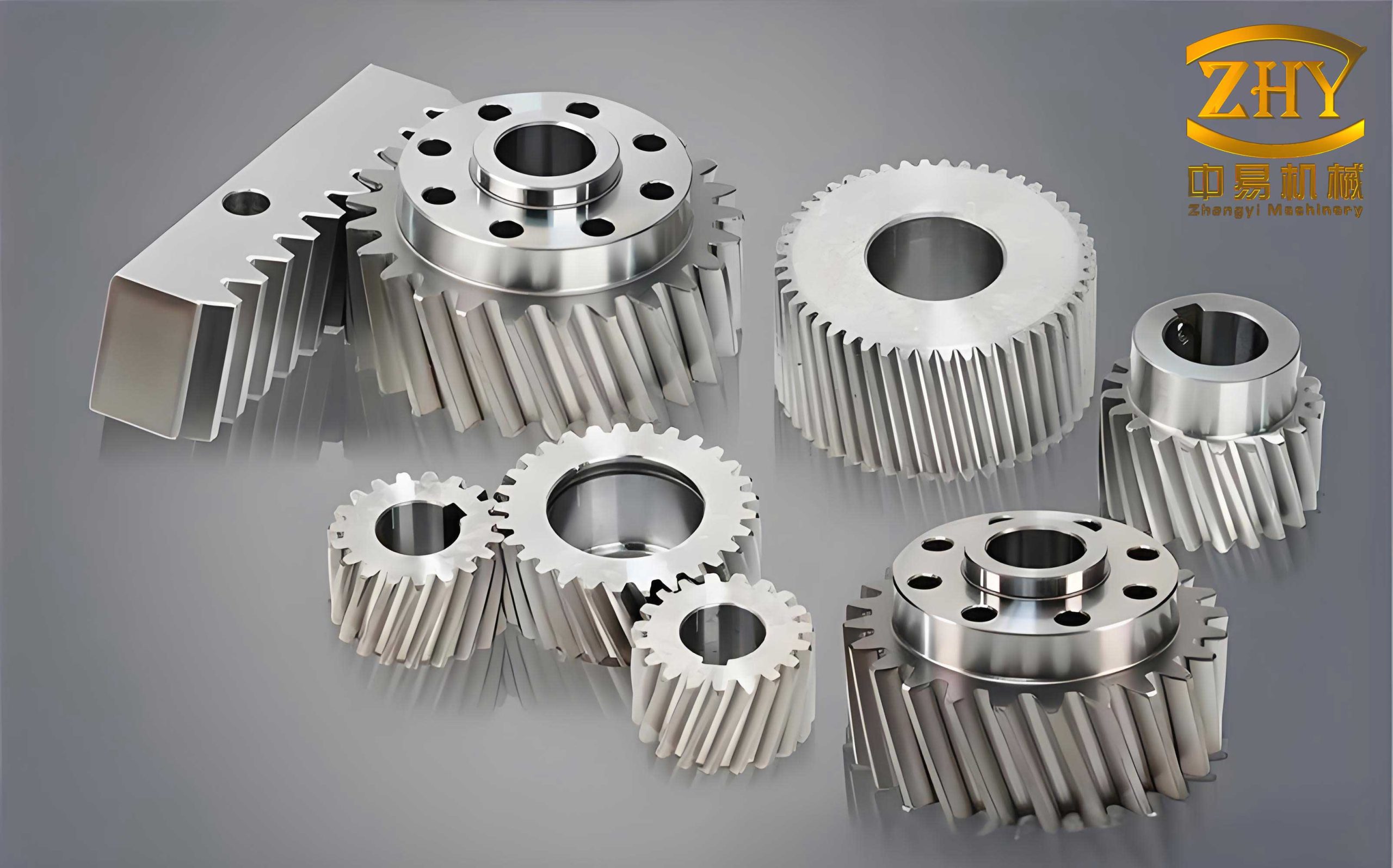
The study of elastohydrodynamic lubrication (EHL) in gear contacts is fundamental to understanding and predicting the performance, efficiency, and durability of power transmission systems. Among the various gear types, the helical spur gear is exceptionally prevalent due to its smooth operation, high load-carrying capacity, and flexibility in meeting center distance requirements. However, the EHL analysis of a helical spur gear pair presents significantly greater challenges than that of its spur gear counterpart. This article delves into the development of a specialized physical model and the derivation of the corresponding film thickness equation for analyzing the EHL conditions in helical spur gear contacts.
1. Introduction and Challenges in Helical Gear EHL
EHL theory has been successfully applied to simulate the lubricant film formation in concentrated contacts like those found in rolling element bearings and gears. For spur gears, the contact is typically modeled as a line contact with constant load, curvature, and sliding/rolling velocities along the contact line at any instant. This simplification allows for the application of classical line-contact EHL solutions.
The situation is markedly more complex for a helical spur gear. The inherent helix angle introduces a three-dimensional nature to the contact. The contact line between two mating teeth is not parallel to the gear axes but is inclined across the face width. This orientation leads to several critical complications for EHL analysis:
- Non-Uniform Load Distribution: The load is not uniformly distributed along the oblique contact line due to effects of bending and contact deflection.
- Varying Effective Radius of Curvature: The principal radii of curvature at the contact point change significantly along the length of the contact line, influencing the geometry of the Hertzian contact zone.
- Varying Entrainment and Slide-to-Roll Ratio (SRR): The surface velocities of the two gears have components both parallel and perpendicular to the contact line. This results in entrainment velocity (the average surface speed) and the slide-to-roll ratio varying from one end of the contact line to the other.
These factors collectively make the EHL problem for a helical spur gear a genuinely two-dimensional challenge, requiring a model that accounts for variations along both the direction of entrainment and the axial (face width) direction.
2. Proposed Physical Model: Equivalent Counter-Tapered Rollers
To effectively tackle this complex problem, a simplified yet physically representative model is essential. The proposed model is based on the fundamental kinematics of an involute helical spur gear pair. According to gear theory, two mating involute helical tooth surfaces contact each other along a straight line within the plane of action. This plane is tangent to the base cylinders of both gears.
This contact characteristic can be ingeniously modeled by a pair of opposing, finite-width, tapered rollers. The key parameters of this model are derived directly from the gear geometry:
- The half-apex angle of each tapered roller, $\beta_b$, is set equal to the base circle helix angle of the helical spur gear.
- The average radius of each roller, $R_1$ and $R_2$, relates to the curvature at the specific point of contact on the gear tooth profile.
- The width of the rollers, $L$, corresponds to the effective contact length along the gear face width.
In this configuration, the two tapered rollers make contact along a line, simulating the instantaneous contact line in the helical spur gear mesh. From a numerical analysis perspective, this pair of contacting tapered rollers can be equivalently represented by a single “equivalent” tapered roller pressing against a rigid flat plane. The radius of curvature for this equivalent roller, $R_x$, is given by the harmonic mean of the principal curvatures:
$$
\frac{1}{R_x} = \frac{1}{R_1} + \frac{1}{R_2}
$$
or, using the equivalent radius notation common in contact mechanics:
$$
R = \frac{R_1 R_2}{R_1 + R_2}
$$
This transformation simplifies the problem geometry while preserving the essential features affecting oil film formation.
3. Derivation of the Film Gap/Geometry Equation
The core of any EHL analysis is the equation describing the gap between the two contacting surfaces. For the equivalent tapered roller model, this gap has a distinct two-dimensional character. Consider the coordinate system where the x-axis is along the direction of rolling/entrainment (transverse to the roller axis), and the y-axis is along the axial direction of the roller (parallel to the gear face width).
A critical step is examining the cross-section of the equivalent tapered roller taken perpendicular to its axis (or generator line). This sectioning angle, $\varphi = 90^\circ – \beta_b$, results in an elliptical profile for typical helical spur gear helix angles ($\beta_b$ between 10° and 30°).
The geometry of this elliptical section defines the undeformed shape of the contact. The principal radii of this ellipse, $a$ (semi-major axis) and $b$ (semi-minor axis), are functions of the base helix angle $\beta_b$ and the local equivalent radius $R(y)$. The local equivalent radius itself varies along the y-axis due to the taper:
$$
R(y) = R_m + y \cdot \sin \beta_b
$$
where $R_m$ is the equivalent radius at the mid-point of the contact (y=0).
The elliptical cross-section at any axial location ‘y’ can be described by:
$$
\frac{x^2}{a(y)^2} + \frac{z^2}{b(y)^2} = 1
$$
where $z$ is the coordinate normal to the contact plane. The semi-axes are given by:
$$
a(y) = \frac{R(y)}{\sin \beta_b}, \quad b(y) = \frac{R(y)}{\cos \beta_b}
$$
From this elliptical geometry, the gap formed purely by the geometry of the equivalent tapered roller and the flat plane, $h_g(x,y)$, can be derived. For points close to the center of the contact (small x), this geometric gap is approximately parabolic in x and varies with y:
$$
h_g(x,y) = \frac{x^2}{2 R_x(y)} + \frac{y^2 \cos^2 \beta_b}{2 R_x(y) \sin^2 \beta_b}
$$
Where the equivalent radius in the entrainment direction, $R_x(y)$, is a key parameter that changes axially:
$$
\frac{1}{R_x(y)} = \frac{\sin^2 \beta_b}{R_1} + \frac{\sin^2 \beta_b}{R_2} = \frac{\sin^2 \beta_b}{R(y)/\sin \beta_b} = \frac{\sin^3 \beta_b}{R_m + y \sin \beta_b}
$$
Therefore, the final expression for the geometric gap incorporates the influence of the helix angle $\beta_b$ and the axial variation of curvature:
$$
h_g(x,y) = \frac{x^2 \sin^3 \beta_b}{2 (R_m + y \sin \beta_b)} + \frac{y^2 \cos^2 \beta_b \sin \beta_b}{2 (R_m + y \sin \beta_b)}
$$
This equation is fundamental as it describes how the undeformed geometry of the helical spur gear contact contributes to the lubricant film shape, highlighting its inherent two-dimensional nature.
| Geometric Parameter | Symbol | Relation in Helical Gear Model |
|---|---|---|
| Base Circle Helix Angle | $\beta_b$ | Equals the half-apex angle $\beta$ of the tapered rollers. |
| Equivalent Radius (Mid-point) | $R_m$ | $R_m = \frac{R_{1m} R_{2m}}{R_{1m} + R_{2m}}$, where $R_{im}$ is the local radius on gear ‘i’. |
| Local Equivalent Radius | $R(y)$ | $R(y) = R_m + y \cdot \sin \beta_b$. Varies linearly along face width. |
| Effective Radius in Entrainment Direction | $R_x(y)$ | $R_x(y) = \frac{R(y)}{\sin^3 \beta_b} = \frac{R_m + y \sin \beta_b}{\sin^3 \beta_b}$. |
| Contact Width (Theoretical) | $L$ | Related to the active face width of the helical spur gear and contact ratio. |
4. The Complete EHL System for the Helical Gear Model
The total film thickness $h(x,y)$ in the EHL contact is not just the geometric gap $h_g(x,y)$. It must also include the elastic deformation $\delta(x,y)$ of the contacting surfaces caused by the hydrodynamic pressure $p(x,y)$. Therefore, the general film thickness equation is:
$$
h(x,y) = h_0 + h_g(x,y) + \delta(x,y)
$$
where $h_0$ is a constant representing the rigid body separation.
The elastic deformation $\delta(x,y)$ at any point is the result of the pressure distribution over the entire contact area, calculated using the Boussinesq integral for a semi-infinite elastic solid:
$$
\delta(x,y) = \frac{2}{\pi E’} \iint_{\Omega} \frac{p(x’,y’) \, dx’ \, dy’}{\sqrt{(x-x’)^2 + (y-y’)^2}}
$$
Here, $E’$ is the effective elastic modulus:
$$
\frac{2}{E’} = \frac{1-\nu_1^2}{E_1} + \frac{1-\nu_2^2}{E_2}
$$
where $E_i$ and $\nu_i$ are the Young’s modulus and Poisson’s ratio of the two gear materials.
The pressure distribution is governed by the two-dimensional Reynolds equation, which for a steady-state, incompressible, isothermal lubricant with piezo-viscous behavior can be written as:
$$
\frac{\partial}{\partial x} \left( \frac{\rho h^3}{\eta} \frac{\partial p}{\partial x} \right) + \frac{\partial}{\partial y} \left( \frac{\rho h^3}{\eta} \frac{\partial p}{\partial y} \right) = 12 u_e \frac{\partial (\rho h)}{\partial x}
$$
Where:
- $\rho = \rho(p)$ is the lubricant density, pressure-dependent (e.g., Dowson-Higginson relation).
- $\eta = \eta(p)$ is the lubricant viscosity, pressure-dependent (e.g., Barus or Roelands law).
- $u_e = (u_1 + u_2)/2$ is the entrainment velocity in the x-direction. Crucially, for a helical spur gear, $u_e$ is also a function of the y-coordinate because the surface velocity components vary along the oblique contact line. If $U_{1,2}$ are the pitch line velocities, then $u_e(y) \approx \frac{1}{2}(U_1 + U_2) \cos \beta_b$, though a more precise local calculation based on contact point radius is needed.
The system is closed with boundary conditions: pressure is ambient at the edges of the computational domain, and the cavitation condition ($p \geq 0$) is enforced. The load balance equation ensures the integrated pressure supports the applied normal load $W$ per unit face width:
$$
\iint_{\Omega} p(x,y) \, dx \, dy = W
$$
| Equation | Form | Primary Variables & Notes |
|---|---|---|
| Film Thickness | $h(x,y) = h_0 + h_g(x,y) + \delta(x,y)$ | $h_g(x,y)$ from tapered roller geometry. $\delta(x,y)$ from elastic deformation integral. |
| Reynolds Equation | $\nabla \cdot \left( \frac{\rho h^3}{\eta} \nabla p \right) = 12 u_e(y) \frac{\partial (\rho h)}{\partial x}$ | 2D, steady-state. $u_e(y)$ varies axially. $\rho(p)$ and $\eta(p)$ are non-linear. |
| Elastic Deformation | $\delta(x,y) = \frac{2}{\pi E’} \iint \frac{p(x’,y’)}{\sqrt{(x-x’)^2+(y-y’)^2}} dx’dy’$ | Boussinesq integral for semi-infinite body. Computationally intensive. |
| Viscosity-Pressure | $\eta(p) = \eta_0 \exp(\alpha p)$ (Barus) or Roelands law | $\eta_0$: ambient viscosity. $\alpha$: pressure-viscosity coefficient. |
| Density-Pressure | $\rho(p) = \rho_0 \frac{0.59 \times 10^9 + 1.34 p}{0.59 \times 10^9 + p}$ (D-H) | $\rho_0$: ambient density. Approximate compressibility model. |
| Load Balance | $\iint p(x,y) \, dx \, dy = W$ | Determines the constant $h_0$ in the film thickness equation. |
5. Numerical Solution Strategy and Expected Film Characteristics
Solving the coupled, non-linear system of equations described above requires robust numerical methods. A common approach is the “forward” or “direct” iterative method, which involves the following steps within a discrete grid over the computational domain:
- Initialization: Start with an initial guess for pressure $p(x,y)$, often the Hertzian dry contact pressure distribution for the equivalent elliptical contact at the mid-plane.
- Elastic Deformation Calculation: Compute the deformation $\delta(x,y)$ for the current pressure field using the discretized Boussinesq integral, often accelerated by methods like the Multi-Level Multi-Integration (MLMI) or Discrete Convolution Fast Fourier Transform (DC-FFT).
- Film Thickness Update: Assemble the total film thickness $h(x,y)$ using the current $h_0$, the fixed geometric gap $h_g(x,y)$, and the newly calculated $\delta(x,y)$.
- Reynolds Equation Solution: Solve the 2D Reynolds equation for an updated pressure $p_{new}(x,y)$, incorporating the current $h(x,y)$ and the pressure-dependent $\rho$ and $\eta$. Finite difference or finite volume methods are used, with careful treatment of the cavitation boundary.
- Load Balance Check: Integrate $p_{new}(x,y)$ and compare to the applied load $W$. Adjust the constant $h_0$ accordingly (e.g., $h_0 = h_0 + \gamma (W_{calc} – W)/W$).
- Relaxation and Iteration: Under-relax the new pressure field ($p = (1-\omega)p_{old} + \omega p_{new}$) and return to Step 2. The process repeats until changes in pressure and film thickness between iterations fall below specified tolerances and the load is balanced.
For the helical spur gear model, the varying $R_x(y)$ and $u_e(y)$ along the y-axis are critical inputs at each grid point. The solution is expected to reveal characteristic EHL features adapted to the tapered geometry:
- Asymmetric Pressure Spike: The maximum hydrodynamic pressure spike will not be centrally located but will shift towards the end of the contact with the smaller effective radius (higher contact pressure) and/or lower entrainment velocity.
- Wedge-Shaped Film Thickness: The central and minimum film thickness will vary along the face width (y-direction). The film is typically thicker where the equivalent radius $R_x(y)$ is larger and the entrainment velocity $u_e(y)$ is higher.
- Side Constriction & Flow: Significant side flow of lubricant occurs in the y-direction due to pressure gradients, which is a key difference from infinite line contact models.
The successful acquisition of a numerical solution with these features validates the physical soundness of the tapered roller model for the helical spur gear EHL problem.
6. Conclusion and Implications
The development of a finite-width, counter-tapered roller pair as a physical model provides a robust and effective framework for analyzing the elastohydrodynamic lubrication in helical spur gear contacts. This model explicitly accounts for the defining features of helical gear meshing: the oblique contact line, the axial variation of surface curvature, and the consequent variation in rolling/sliding conditions.
The derivation of the two-dimensional film gap equation, $h_g(x,y)$, which incorporates the base helix angle $\beta_b$ and the axial position $y$, is the foundational step. When integrated into the full EHL equation system—comprising the 2D Reynolds equation, the elastic deformation integral, and the appropriate rheological models—it enables a realistic simulation of the pressure distribution and film thickness profile.
This theoretical approach moves beyond the limitations of simple line contact analyses for spur gears. It offers gear designers and researchers a more accurate tool to predict lubricant film formation in helical spur gear applications. Understanding these detailed EHL conditions is vital for predicting surface fatigue life (pitting), wear, and efficiency losses due to friction, ultimately contributing to the design of more reliable, efficient, and durable gear transmissions. Future work may involve coupling this EHL model with dynamic load distribution calculations and thermal analysis to achieve an even more comprehensive simulation of helical spur gear performance under real operating conditions.