
In my extensive work on automotive transmission design, I have found that the precise three-dimensional modeling of helical gears is paramount for achieving reliable simulation results. Helical gears, with their angled teeth, offer smoother and quieter operation compared to spur gears, but their complex geometry necessitates meticulous attention to detail during the modeling phase. This article delves into my methodology for creating accurate helical gear models using Pro/Engineer (Pro/E) and performing dynamic meshing simulations with ADAMS, emphasizing the critical calculations involved in defining the gear tooth profile.
The foundation of this process lies in understanding the generation of the involute tooth surface in helical gears. Unlike spur gears, where the tooth trace is straight, helical gears feature a helix angle that introduces a twist along the gear axis. The involute surface is formed by a line on a plane tangent to the base cylinder. As this plane rolls without slipping around the base cylinder, points on this line trace out involute curves. For a helical gear, this generating line is inclined at the helix angle relative to the gear axis. A key challenge in accurate modeling is determining the precise angular offset between the involute profiles at the two end faces of the gear. This offset, often overlooked in simplified approaches, is essential for correctly representing the helical twist.
To calculate this angular offset, denoted by $\theta$, I derive it from the fundamental geometry of the helical gear. The offset arises because the generating line contacts the base cylinder along a helical path. The relationship is given by the following formula, which I consistently use in my projects:
$$ \theta = \frac{360}{\pi} \cdot \frac{B \cdot \tan(\beta)}{m_t \cdot z \cdot \cos(\alpha_t)} $$
Where:
$\theta$ is the angular offset between end-face involutes (in degrees),
$B$ is the face width of the helical gear (in mm),
$\beta$ is the helix angle (in degrees),
$m_t$ is the transverse module (in mm),
$z$ is the number of teeth,
$\alpha_t$ is the transverse pressure angle (in degrees).
The transverse pressure angle $\alpha_t$ itself is derived from the normal pressure angle $\alpha$ using the helix angle:
$$ \alpha_t = \arctan\left(\frac{\tan(\alpha)}{\cos(\beta)}\right) $$
Similarly, the transverse module $m_t$ is related to the normal module $m_n$ by:
$$ m_t = \frac{m_n}{\cos(\beta)} $$
These formulas are integrated into my parametric modeling workflow to ensure that every helical gear model is geometrically precise. The base circle diameter $d_b$, a crucial parameter for involute generation, is calculated as:
$$ d_b = m_t \cdot z \cdot \cos(\alpha_t) $$
In my practical application for an electric vehicle transmission, I defined the parameters for multiple helical gears. The following table summarizes the key geometric parameters for the gear set I modeled, all based on a common normal module and helix angle. This table is central to organizing the design data and ensuring consistency across all helical gear components in the assembly.
| Parameter | Formula | Gear Z1 | Gear Z2 | Gear Z3 | Gear Z4 | Gear Z5 | Gear Z6 |
|---|---|---|---|---|---|---|---|
| Number of Teeth, $z$ | – | 17 | 38 | 22 | 33 | 19 | 82 |
| Normal Module, $m_n$ (mm) | – | 2.5 | |||||
| Normal Pressure Angle, $\alpha$ (°) | – | 20 | |||||
| Helix Angle, $\beta$ (°) | – | 24 | |||||
| Face Width, $B$ (mm) | – | 20 | 20 | 20 | 20 | 25 | 25 |
| Transverse Module, $m_t$ (mm) | $m_t = m_n / \cos(\beta)$ | 2.7366 | |||||
| Transverse Pressure Angle, $\alpha_t$ (°) | $\alpha_t = \arctan(\tan(\alpha)/\cos(\beta))$ | 21.880 | |||||
| Pitch Diameter, $d$ (mm) | $d = m_t \cdot z$ | 46.52 | 103.99 | 60.21 | 90.31 | 52.00 | 224.40 |
| Base Circle Diameter, $d_b$ (mm) | $d_b = d \cdot \cos(\alpha_t)$ | 43.22 | 96.61 | 55.93 | 83.89 | 48.30 | 208.46 |
| Addendum Diameter, $d_a$ (mm) | $d_a = d + 2 \cdot h_a^* \cdot m_n$ | 51.52 | 108.99 | 65.21 | 95.31 | 57.00 | 229.40 |
| Dedendum Diameter, $d_f$ (mm) | $d_f = d – 2 \cdot (h_a^* + c^*) \cdot m_n$ | 40.27 | 97.74 | 53.96 | 84.06 | 45.75 | 218.15 |
| Center Distance (I-II), $A_1$ (mm) | $A_1 = m_t \cdot (z_1 + z_2) / 2$ | 75.255 | – | ||||
| Center Distance (II-III), $A_2$ (mm) | $A_2 = m_t \cdot (z_5 + z_6) / 2$ | – | 138.200 | ||||
For the three-dimensional modeling of these helical gears, I utilize Pro/Engineer Wildfire 3.0. Pro/E is a powerful parametric CAD software that allows for feature-based and associative modeling. The parametric capability is vital because it lets me define the helical gear dimensions through mathematical relations and parameters, such as those in the table above. When I modify a fundamental parameter like the helix angle or module, all related features—diameters, angles, and the tooth profile—update automatically. This parametric approach ensures model consistency and saves significant time during design iterations. However, a critical consideration in my workflow is software compatibility for subsequent dynamic simulation. To interface with ADAMS, I employ the Mechpro2005 plugin, which serves as a dedicated bridge between Pro/E Wildfire 3.0 and ADAMS 2005. This combination is carefully chosen; newer versions of Pro/E or ADAMS can cause compatibility issues with the Mechpro2005 interface, potentially leading to failed data transfer or loss of model integrity. Therefore, I always verify software versions before commencing any project involving helical gear simulation.
The core of my helical gear modeling process in Pro/E involves creating a precise involute tooth profile that correctly incorporates the helix angle. I start by creating a solid cylindrical blank with a diameter equal to the addendum diameter $d_a$. Then, I sketch concentric circles on one end face representing the addendum circle ($d_a$), dedendum circle ($d_f$), base circle ($d_b$), and pitch circle ($d$). The next step is to generate the involute curve. I use a parametric equation within Pro/E to create the involute profile based on the base circle diameter. For a single tooth space, I need two mirror-image involute curves. I create the first involute curve and then use pattern and mirror features to obtain the complete boundaries for one tooth slot. The critical step for a helical gear is extruding this tooth slot along the gear axis with a twist. Instead of a simple extrusion, I use the “Blend” feature with “General” sections. This allows me to create a cut that follows a helical path. I define multiple cross-sections along the gear’s face width. Each cross-section is identical in shape—the 2D tooth slot profile—but each successive section is rotated by an incremental angle relative to the previous one. The total rotation across the full face width $B$ must equal the calculated angular offset $\theta$. For instance, if I use four sections, the rotation between consecutive sections is $\theta/4$. This method accurately simulates the way the involute profile twists along the helix. The following formula summarizes the key angular parameter needed for patterning the tooth space in the unwound view, which I also calculate parametrically:
$$ \text{angle} = \frac{90}{z} – \frac{180}{\pi} \cdot \tan(\alpha_t) + \alpha_t $$
This angle, often called the tooth space offset angle, ensures the involute curves are correctly positioned relative to the gear’s datum planes for the cutting operation. After creating one helical tooth slot, I pattern it around the gear axis using a circular pattern with $z$ instances to complete the entire helical gear. The process is repeated for each helical gear in the transmission, such as the input shaft (I) and counter shaft (II) assemblies.
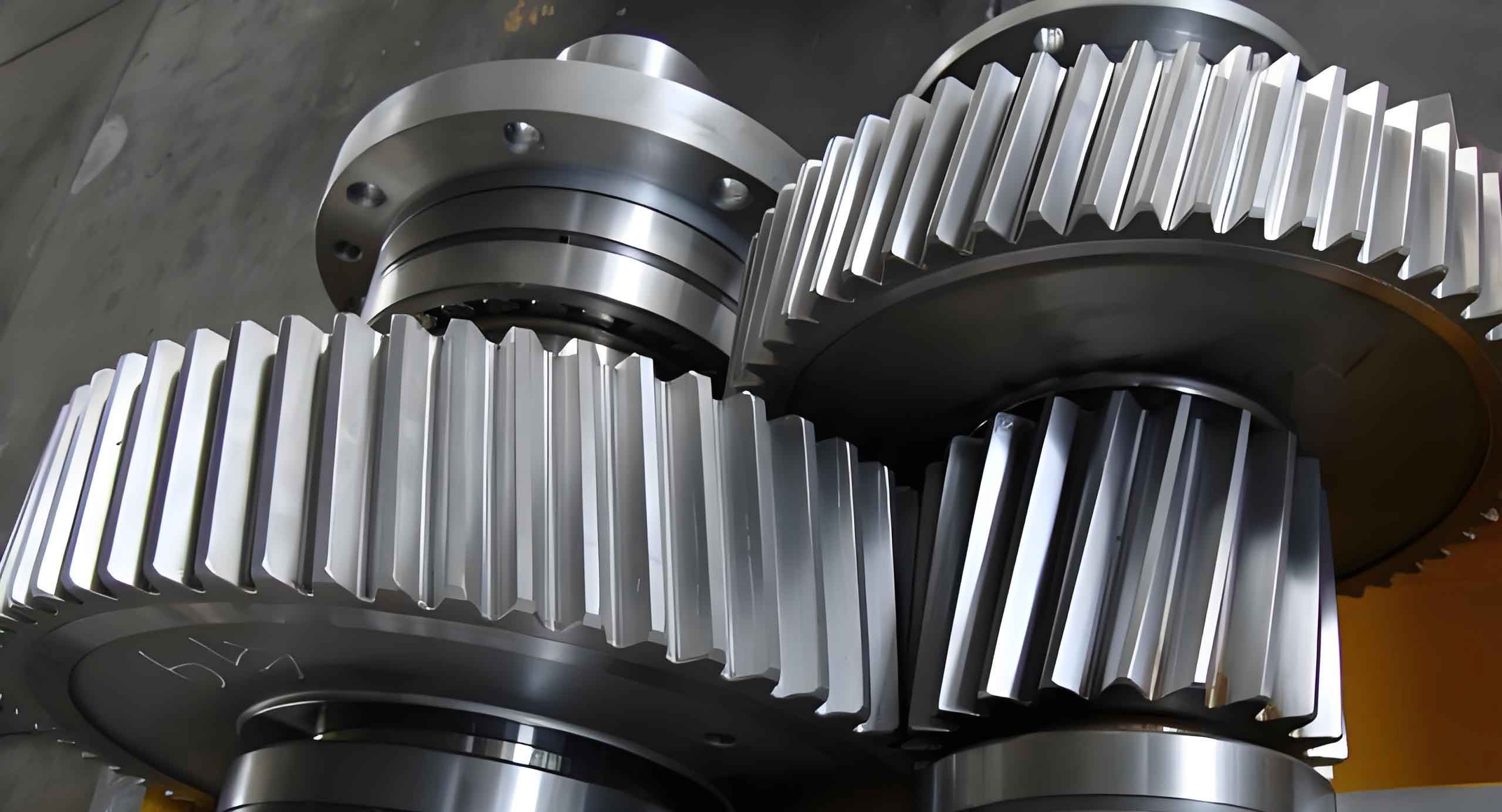
Once all helical gear components are modeled, I assemble them into the transmission housing within Pro/E, ensuring proper axial alignment and center distances as per the design table. The next phase is preparing the model for dynamic simulation. Using the Mechpro2005 interface within the Pro/E environment, I assign material properties (like steel density) to each component, define them as rigid bodies, and establish kinematic joints and constraints. For example, I define revolute joints for gear shafts, fixed joints for the housing, and contact forces between meshing helical gear teeth. The interface allows me to specify marker points and coordinate systems directly on the Pro/E geometry, which are faithfully transferred to ADAMS. This seamless integration is crucial because it preserves the geometric accuracy of the complex helical gear tooth surfaces. After the model is fully defined in Mechpro, I export it directly to ADAMS 2005. In ADAMS, the model appears as a fully constrained mechanical system. I then set up simulation parameters such as time, step size, and driving motions—for instance, applying a rotational velocity to the input shaft helical gear. ADAMS solves the equations of motion dynamically, calculating forces, velocities, and displacements. The contact algorithm in ADAMS handles the interaction between the meshing teeth of the helical gears, allowing me to observe the transmission of torque, identify potential meshing interference, and analyze dynamic loads. The simulation provides visual feedback on the smoothness of engagement and quantitative data on contact forces, which are critical for assessing gear durability and noise-vibration-harshness (NVH) performance.
Through numerous simulations, I have observed that the accuracy of the helical gear tooth geometry directly impacts the simulation results. Approximate modeling methods that neglect the precise calculation of the involute offset $\theta$ can lead to incorrect contact patterns, aberrant force spikes, and unrealistic dynamic behavior. The method I employ, which rigorously calculates $\theta$ based on the helix angle and base circle geometry, ensures that the virtual helical gears in ADAMS mesh in a manner consistent with physical principles. This fidelity is essential when using simulation to predict real-world performance, reduce prototyping costs, and optimize gear design parameters like helix angle, pressure angle, and module for specific applications. The interplay between precise CAD modeling and robust multi-body dynamics simulation forms a powerful toolset for modern transmission engineering.
In conclusion, my approach to helical gear modeling and simulation emphasizes geometric precision from the ground up. The parametric and feature-based capabilities of Pro/E, combined with the detailed kinematic and dynamic analysis of ADAMS, create a robust digital prototyping environment. The key to success lies in the correct mathematical formulation of the helical gear tooth geometry, particularly the angular relationship between end-face involutes defined by the helix angle. By meticulously calculating parameters like $\theta$ and integrating them into the 3D model, I ensure that the subsequent meshing simulation in ADAMS yields reliable and actionable insights. This methodology is not limited to electric vehicle transmissions but is applicable to any system utilizing helical gears, from industrial machinery to aerospace applications. As computational power increases and software tools evolve, the principles of accurate geometric representation remain the cornerstone of meaningful engineering simulation, especially for complex components like the helical gear.