
In the field of precision engineering, particularly in aerospace applications, the demand for compact, efficient, and high-ratio transmission systems has led to the widespread adoption of harmonic drive gears. As a researcher deeply involved in this domain, I have focused on optimizing the performance of harmonic drive gears by addressing a critical challenge: the substitution of conjugate tooth profiles with involute profiles, which often leads to interference issues affecting transmission accuracy. This article presents our comprehensive approach to ensuring that harmonic drive gears operate without interference while achieving precise motion transmission, leveraging an automated optimization algorithm based on tooth crest interference inspection. Through parametric design via a graphical interface and iterative computations, we have developed a method to rapidly and accurately calculate the minimum meshing clearance, accompanied by a visual simulation of the tooth profile engagement process. Our work not only enhances computational precision and convergence speed but also provides practical insights for the manufacturing and inspection of harmonic drive gears.
The harmonic drive gear, a type of strain wave gearing, is renowned for its exceptional characteristics: small structural size, high transmission efficiency, and large reduction ratios. These attributes make it indispensable in applications where space and weight are constrained, such as in satellite mechanisms, robotic joints, and aerospace actuators. The fundamental principle of harmonic drive gear operation involves a flexible spline (the flexspline) deformed by a wave generator, typically an elliptical cam, to engage with a rigid circular spline (the circular spline). Due to the difference in tooth counts—usually two teeth fewer on the flexspline compared to the circular spline—a single rotation of the wave generator results in a small relative rotation between the flexspline and circular spline, enabling high reduction ratios. Moreover, the simultaneous engagement of multiple teeth (approximately 30–40% of the total teeth) ensures high torque capacity and smooth operation. However, this complex engagement process, where the flexspline’s deformation varies with the wave generator’s phase, introduces significant challenges in mathematical modeling and clearance analysis. In our research, we aim to tackle these challenges by refining the tooth profile design to minimize backlash and prevent interference, thereby improving the overall performance of harmonic drive gears.
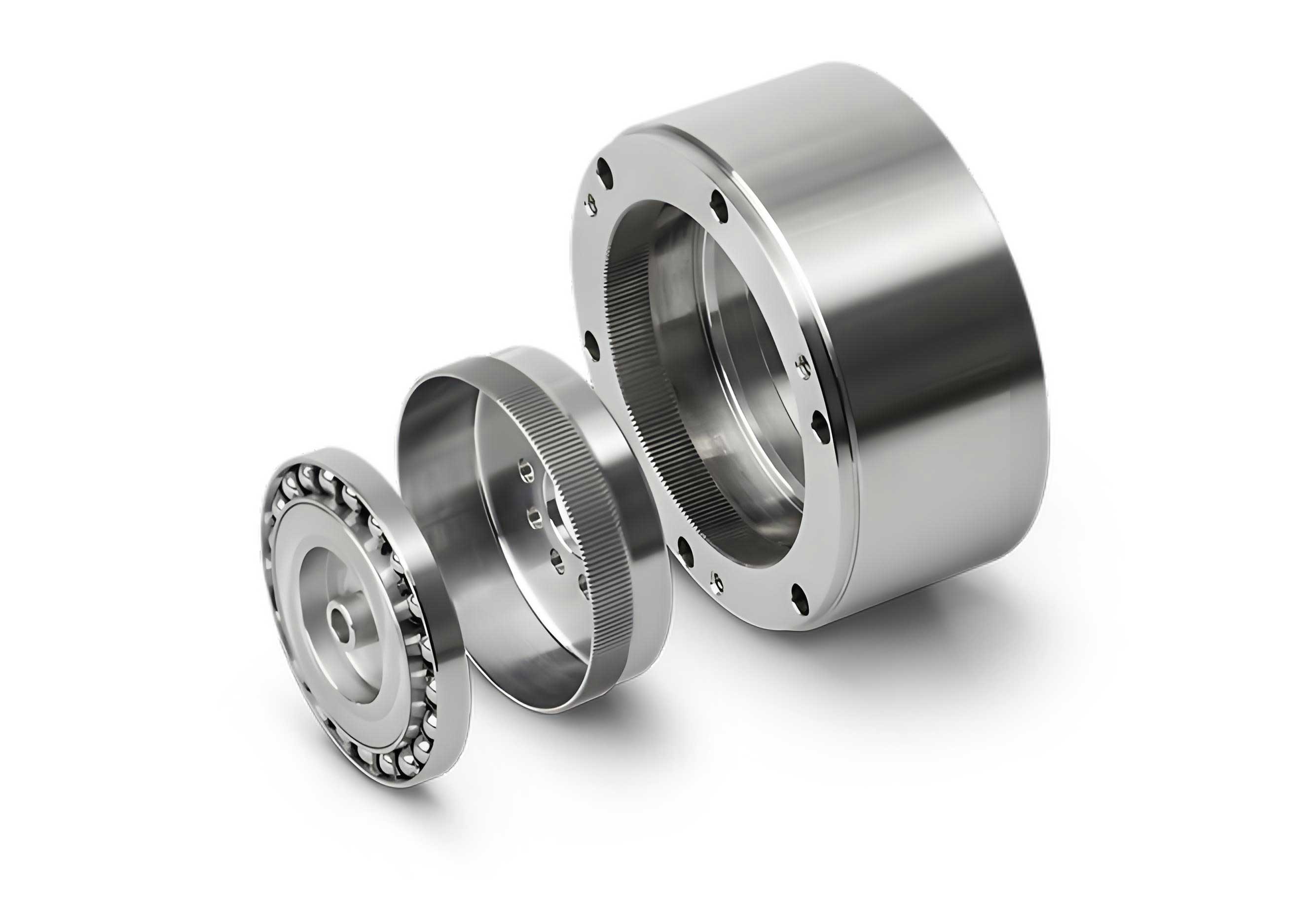
Traditionally, the design of harmonic drive gears involves deriving conjugate tooth profiles based on the kinematics of deformation. While this approach ensures theoretical correctness, the resulting profiles are often non-standard and complex, complicating manufacturing and inspection processes. To streamline production, involute tooth profiles—which are well-established in gear technology—are commonly used as approximations. However, this substitution can lead to overlap interference, particularly at the tooth crests, where the flexspline and circular spline may collide during engagement. Such interference not only reduces transmission accuracy but can also cause increased friction, wear, or even seizure. Therefore, our primary objective is to optimize the involute profile parameters, specifically the modification coefficients (also known as shift coefficients), to achieve the smallest possible meshing clearance without interference. This optimization is crucial for applications requiring high precision, such as in aerospace mechanisms where harmonic drive gears are employed for antenna positioning or solar array deployment.
Our methodology begins with establishing a precise mathematical model for the involute tooth profiles. We assume that the tooth shape remains unchanged during flexspline deformation—a valid approximation given that the moment of inertia of the tooth cross-section is significantly larger than that of the tooth slot. Additionally, we consider the flexspline’s neutral line to deform without elongation, following the contour of the wave generator, and ignore secondary effects like distortion. Under these assumptions, the involute profile for both the flexspline and circular spline can be described in a coordinate system where the y-axis aligns with the tooth’s symmetry line. The parametric equations for the involute curve are given as follows:
$$ x = r_b \left[ \sin(\alpha_x + \theta_x – \beta_b) – (\alpha_x + \theta_x) \cos(\alpha_x + \theta_x – \beta_b) \right] $$
$$ y = r_b \left[ \cos(\alpha_x + \theta_x – \beta_b) + (\alpha_x + \theta_x) \sin(\alpha_x + \theta_x – \beta_b) \right] $$
Here, $r_b$ represents the base circle radius, $\alpha_x$ is the pressure angle at any point on the involute, $\theta_x = \text{inv} \alpha_x = \tan \alpha_x – \alpha_x$ is the involute function, and $\beta_b$ is the half-angle of the base circle tooth thickness, calculated as:
$$ \beta_b = \frac{1}{2Z} (\pi + 4 x_\xi \tan \alpha) + \text{inv} \alpha $$
In this equation, $Z$ denotes the number of teeth, $\alpha$ is the standard pressure angle (typically 20°), and $x_\xi$ is the modification coefficient. These equations form the foundation for generating the tooth profiles of both the flexspline and circular spline in their respective coordinate systems. For the harmonic drive gear, we consider three components: the flexspline (with tooth count $Z_r$), the fixed circular spline (with tooth count $Z_g$), and the output circular spline (with tooth count $Z’_g$), where $Z_g = Z_r + 2$ to achieve the reduction effect. The modification coefficients for each component—denoted as $x_{\xi r}$ for the flexspline, $x_{\xi g}$ for the fixed circular spline, and $x_{\xi g’}$ for the output circular spline—are the key variables we optimize to minimize clearance.
To analyze the engagement between the flexspline and circular spline, we must transform the tooth profiles into a common coordinate system. We define two coordinate systems: $C_R$ for the flexspline and $C_G$ for the circular spline (either fixed or output). The transformation matrix from $C_R$ to $C_G$ accounts for the relative motion induced by the wave generator’s rotation. For a dual-wave generator (elliptical cam), the transformation is symmetric over 180° of rotation, so we focus on the range from 0 to $\pi$. The transformation matrix is expressed as:
$$ M_{R,G} = \begin{bmatrix} \cos \psi_G & -\sin \psi_G & -\rho \sin \gamma_G \\ \sin \psi_G & \cos \psi_G & \rho \cos \gamma_G \\ 0 & 0 & 1 \end{bmatrix} $$
Where $\rho$ is the radial distance from the flexspline’s neutral curve to the point under consideration, $\gamma_G = \phi_R – \phi_G$ is the difference in central angles between corresponding arcs on the flexspline and circular spline, and $\psi_G$ is the angle between the coordinate systems. The angles $\phi_R$ and $\phi_G$ are related to the wave generator’s contour, and $\mu = \arctan |\rho’ / \rho|$ is the acute angle between the radial vector and its normal. For the fixed circular spline, $\phi_G$ is computed as $\phi_G = \frac{1}{r_G} \int_0^{\phi_R} \sqrt{(\rho’)^2 + \rho^2} \, d\phi$, where $r_G$ is the pitch radius of the circular spline. The variation of $\gamma_G$, $\mu$, and $\psi_G$ over the wave generator’s rotation is summarized in the table below, which highlights the engagement characteristics for both the fixed and output circular splines.
| Wave Generator Angle Range | $\gamma_G$ | $\mu$ | $\psi_G$ | Component |
|---|---|---|---|---|
| 0 to π/2 | $\gamma_G = \phi_R – \phi_G$ (positive) | $\mu = \arctan |\rho’ / \rho|$ (positive) | $\psi_G = \mu + \gamma_G$ (positive) | Fixed Circular Spline |
| π/2 to π | $\gamma_G = \phi_R – \phi_G$ (positive) | $\mu = \arctan |\rho’ / \rho|$ (positive) | $\psi_G = \gamma_G – \mu$ (positive) | Fixed Circular Spline |
| 0 to π/2 | $\gamma_G = \phi_R – \phi_G$ (negative) | $\mu = \arctan |\rho’ / \rho|$ (positive) | $\psi_G = \mu + \gamma_G$ (positive) | Output Circular Spline |
| π/2 to π | $\gamma_G = \phi_R – \phi_G$ (positive) | $\mu = \arctan |\rho’ / \rho|$ (positive) | $\psi_G = \mu – \gamma_G$ (positive) | Output Circular Spline |
This coordinate transformation allows us to superimpose the flexspline and circular spline tooth profiles in the same reference frame, enabling interference checking and clearance calculation. The core of our optimization algorithm lies in the tooth crest interference inspection method. Instead of verifying the entire tooth flank, we focus on the critical points: the crest of the flexspline tooth relative to the circular spline profile, and vice versa. This approach significantly reduces computational complexity while ensuring accuracy, as interference predominantly occurs at these locations. For any given position of the wave generator, we compute the distances between the tooth crests and the opposing profiles. Let $h_{rg,\text{left}}$ be the distance from the left crest of the flexspline tooth to the circular spline profile, $h_{gr,\text{left}}$ from the left crest of the circular spline tooth to the flexspline profile, $h_{rg,\text{right}}$ from the right crest of the flexspline tooth to the circular spline profile, and $h_{gr,\text{right}}$ from the right crest of the circular spline tooth to the flexspline profile. These distances are calculated using geometric formulations based on the transformed coordinates.
The meshing clearance for a harmonic drive gear is defined as the sum of the minimum clearances on the left and right flanks within the engagement zone. Due to the symmetry of the dual-wave generator, the total backlash (or transmission error) is twice the minimum clearance found. Our goal is to adjust the modification coefficients iteratively until this clearance converges to a desired tolerance, typically on the order of micrometers, while ensuring no interference (i.e., all distances remain positive). The optimization problem can be formalized as: minimize the total clearance $C_{\text{total}} = 2 \times \min(h_{rg,\text{left}}, h_{gr,\text{left}}, h_{rg,\text{right}}, h_{gr,\text{right}})$ subject to constraints that prevent tooth tip sharpening, maintain adequate radial clearance, and ensure proper measurement conditions. The constraints are as follows:
1. Tooth Tip Thickness Constraint: The tooth tip thickness $S$ must satisfy $S \geq (0.15 \text{ to } 0.20) m$, where $m$ is the module. This prevents weakening of the tooth tip due to excessive modification.
2. Radial Clearance Constraint: The radial clearances $C_{r1}$ (between circular spline tip and flexspline root) and $C_{r2}$ (between flexspline tip and circular spline root) must satisfy $C_{r1} \leq 0.2m$ and $C_{r2} \leq 0.1m$ to avoid bottoming out and ensure smooth operation.
3. Measurement Constraint: For inspection using gauge pins (e.g., for measuring the over-pin distance $M$), the pressure angle at the pin contact point should differ from the tip pressure angle by less than 1° to avoid interference with the tip fillet.
The over-pin measurement values $M_r$ for the flexspline and $M_g$ for the circular spline are computed using standard formulas. For an even number of teeth:
$$ M_r = \frac{d_{br}}{\cos \alpha_{rm}} + d_p, \quad M_g = \frac{d_{bg}}{\cos \alpha_{g\theta}} – d_p $$
For an odd number of teeth:
$$ M_r = \frac{d_{br}}{\cos \alpha_{rm}} \cos \frac{90^\circ}{Z_r} + d_p, \quad M_g = \frac{d_{bg}}{\cos \alpha_{g\theta}} \cos \frac{90^\circ}{Z_g} – d_p $$
Here, $d_p$ is the pin diameter, $d_{br}$ and $d_{bg}$ are the base circle diameters of the flexspline and circular spline, respectively, and $\alpha_{rm}$ and $\alpha_{g\theta}$ are the pressure angles at the pin contact points. The involute functions for these angles are:
$$ \text{inv} \alpha_{rm} = \frac{d_p}{d_{br}} + \text{inv} \alpha – \frac{\pi}{2Z_r} + \frac{2 x_{\xi r} \tan \alpha}{Z_r} $$
$$ \text{inv} \alpha_{g\theta} = \frac{\pi}{2Z_g} + \text{inv} \alpha – \frac{d_p}{d_{bg}} + \frac{2 x_{\xi g} \tan \alpha}{Z_g} $$
These equations integrate the modification coefficients, linking design parameters to measurable quantities. Our optimization algorithm incorporates these constraints to ensure that the resulting harmonic drive gear design is both functional and inspectable.
To implement the optimization, we developed a graphical user interface (GUI) that allows for parametric input of gear parameters such as module, tooth counts, pressure angle, wave generator shape, and initial modification coefficients. The GUI facilitates iterative computation by automatically adjusting the modification coefficients based on the clearance evaluation. The workflow of our algorithm is depicted in the flowchart below, which outlines the steps from mathematical modeling to result output.
| Step | Description | Key Equations/Operations |
|---|---|---|
| 1 | Input parameters: $m$, $Z_r$, $Z_g$, $Z’_g$, $\alpha$, wave generator contour, etc. | User-defined via GUI |
| 2 | Generate involute profiles for flexspline and circular splines using Eqs. (1)-(3). | $$ x = r_b [\sin(\alpha_x + \theta_x – \beta_b) – (\alpha_x + \theta_x) \cos(\alpha_x + \theta_x – \beta_b)] $$ $$ y = r_b [\cos(\alpha_x + \theta_x – \beta_b) + (\alpha_x + \theta_x) \sin(\alpha_x + \theta_x – \beta_b)] $$ |
| 3 | Transform flexspline profiles to circular spline coordinate system using matrix $M_{R,G}$. | $$ M_{R,G} = \begin{bmatrix} \cos \psi_G & -\sin \psi_G & -\rho \sin \gamma_G \\ \sin \psi_G & \cos \psi_G & \rho \cos \gamma_G \\ 0 & 0 & 1 \end{bmatrix} $$ |
| 4 | For each wave generator angle (0 to π in steps), compute distances $h_{rg,\text{left}}$, $h_{gr,\text{left}}$, $h_{rg,\text{right}}$, $h_{gr,\text{right}}$. | Geometric distance formulas based on transformed coordinates |
| 5 | Determine minimum clearance $C_{\min} = \min(h_{rg,\text{left}}, h_{gr,\text{left}}, h_{rg,\text{right}}, h_{gr,\text{right}})$ for engagement zone. | Engagement zone defined by half-angle of contact |
| 6 | Check constraints: tooth tip thickness, radial clearance, measurement conditions. | $$ S \geq 0.15m, \quad C_{r1} \leq 0.2m, \quad C_{r2} \leq 0.1m, \quad |\alpha_{\text{tip}} – \alpha_{\text{pin}}| < 1^\circ $$ |
| 7 | If constraints violated, adjust modification coefficients $x_{\xi r}$, $x_{\xi g}$, $x_{\xi g’}$ and iterate from Step 2. | Adjustment via gradient-based or heuristic optimization |
| 8 | If constraints satisfied and clearance converges to tolerance (e.g., $10^{-4}$ mm), output results: $x_{\xi r}$, $x_{\xi g}$, $x_{\xi g’}$, $M_r$, $M_g$, $C_{\min}$, and engagement plots. | Convergence criterion: $|C_{\min}^{(k+1)} – C_{\min}^{(k)}| < \epsilon$ |
This automated process significantly accelerates the design cycle for harmonic drive gears, allowing engineers to quickly converge on optimal parameters without manual trial-and-error. The integration of visual simulation further enhances understanding by dynamically displaying the tooth engagement throughout the wave generator’s rotation. We implemented the simulation using computational geometry techniques to render the tooth profiles and their relative positions at incremental angles. This not only verifies the absence of interference but also illustrates the meshing behavior, such as the transition from engagement to disengagement and the effect of modification on clearance distribution.
To validate our approach, we conducted a case study based on a typical harmonic drive gear configuration used in aerospace applications. The parameters are as follows: module $m = 0.3$ mm, pressure angle $\alpha = 20^\circ$, flexspline tooth count $Z_r = 134$, fixed circular spline tooth count $Z_g = 136$, output circular spline tooth count $Z’_g = 134$, pin diameter $d_p = 0.572$ mm, wave generator is a standard elliptical cam with a deformation coefficient $\omega^* = 1$ (where $\omega^*$ characterizes the flexspline’s deformation amplitude), and the wave generator rotates clockwise. We applied our optimization algorithm to determine the modification coefficients and the resulting clearances. The computation was performed over 0 to $\pi$ for the wave generator angle, with a step size of 0.1°, ensuring high resolution. The results are summarized in the table below.
| Component | Modification Coefficient ($x_\xi$) | Over-Pin Measurement $M$ (mm) | Minimum Clearance (mm) | Location of Minimum Clearance (Wave Generator Angle) |
|---|---|---|---|---|
| Flexspline | 3.019 | 42.668 | – | – |
| Fixed Circular Spline | 3.094 | 41.559 | 6.84 × 10⁻⁴ | Near disengagement (≈175°) |
| Output Circular Spline | 4.743 | 41.738 | 4.694 × 10⁻⁵ | 19° |
The results demonstrate that our algorithm successfully achieved minimal clearances on the order of 10-4 to 10-5 mm, which is acceptable for high-precision applications. For the engagement between the flexspline and fixed circular spline, the minimum clearance occurs near the point of disengagement (around 175°), indicating that interference is most likely as teeth exit mesh. This aligns with theoretical expectations: as the flexspline deformation decreases toward the minor axis of the wave generator, the tooth overlap reduces, but slight mismatches can cause near-contact. For the engagement between the flexspline and output circular spline, which has a 1:1 transmission ratio (no tooth count difference), the minimum clearance is even smaller and occurs at a specific angle (19°), highlighting the sensitivity of the meshing to the wave generator’s phase. These findings emphasize the importance of precise modification to avoid interference in harmonic drive gears.
The visual simulation generated from our algorithm provides intuitive insights into the meshing dynamics. Below, we present key plots that illustrate the angular relationships and clearance variations over the wave generator’s rotation. These plots are derived from the coordinate transformation and clearance calculations, offering a comprehensive view of the harmonic drive gear behavior.
First, the angles $\psi_G$, $\mu$, and $\gamma_G$ for the flexspline and fixed circular spline engagement vary as shown in the following functional representations. For $0 \leq \phi \leq \pi/2$, we have $\gamma_G = \phi_R – \phi_G$ (positive), $\mu = \arctan(|\rho’/\rho|)$ (positive), and $\psi_G = \mu + \gamma_G$. For $\pi/2 \leq \phi \leq \pi$, $\gamma_G$ remains positive, but $\psi_G = \gamma_G – \mu$. These relationships ensure proper coordinate alignment during simulation. The engagement zone, defined by the half-angle $\psi_N$, depends on the deformation coefficient $\omega^*$; for $\omega^* = 1$, $\psi_N$ is approximately 45° to 60°, covering a significant portion of the tooth flank. Within this zone, we computed the clearances on both left and right flanks. The plots of clearance versus wave generator angle reveal critical trends: the left flank clearance for the flexspline-fixed circular spline pair approaches zero near disengagement, while the right flank clearance for the flexspline-output circular spline pair shows a sharp minimum at 19°. This information is invaluable for identifying potential interference hotspots and guiding design adjustments.
To further analyze the clearance distribution, we can express the clearance functions mathematically. Let $C_L(\phi)$ and $C_R(\phi)$ denote the left and right flank clearances, respectively, as functions of the wave generator angle $\phi$. Based on our computations, these functions can be approximated by polynomial fits for design purposes. For instance, for the flexspline-fixed circular spline engagement, we observed:
$$ C_L(\phi) \approx a_0 + a_1 \phi + a_2 \phi^2 + \cdots + a_n \phi^n, \quad \text{for } \phi \in [0, \pi] $$
$$ C_R(\phi) \approx b_0 + b_1 \phi + b_2 \phi^2 + \cdots + b_n \phi^n, \quad \text{for } \phi \in [0, \pi] $$
Where coefficients $a_i$ and $b_i$ depend on the modification coefficients. By minimizing the peak-to-valley amplitude of these functions, we can optimize for uniform clearance distribution, reducing transmission error. Our algorithm inherently incorporates this by iterating on $x_\xi$ to flatten the clearance curves. Additionally, the total backlash $B$ is given by $B = 2 \times \min_{\phi} (C_L(\phi), C_R(\phi))$, which for our case study is $B = 2 \times 6.84 \times 10^{-4} = 1.368 \times 10^{-3}$ mm for the fixed circular spline and $B = 9.388 \times 10^{-5}$ mm for the output circular spline. These values are well within acceptable limits for precision harmonic drive gears.
The effectiveness of our method is also evident in the manufacturing and inspection aspects. The derived modification coefficients yield standard involute profiles that can be produced using conventional gear cutting machines, reducing cost and complexity. The over-pin measurements $M_r$, $M_g$, and $M_{g’}$ provide straightforward inspection criteria, ensuring that produced gears conform to the design. For example, with $M_r = 42.668$ mm, inspectors can use gauge pins to verify the flexspline tooth thickness, confirming that the modification is correctly implemented. Moreover, the visual simulation serves as a virtual prototype, allowing designers to assess meshing performance before physical production, thereby saving time and resources.
In practice, harmonic drive gears often undergo further optimization based on load distribution and stress analysis. Our clearance optimization complements these efforts by ensuring kinematic correctness. For instance, the deformation coefficient $\omega^*$ influences the engagement zone; lower $\omega^*$ values increase the half-angle $\psi_N$, potentially leading to interference at disengagement. This necessitates larger modification coefficients for the circular spline, as observed in our results where $x_{\xi g} = 3.094$ and $x_{\xi g’} = 4.743$. We can generalize this relationship through empirical formulas derived from multiple case studies. Let $\Delta x_\xi = x_{\xi g} – x_{\xi r}$ represent the modification difference between circular spline and flexspline. Based on our simulations, we found that $\Delta x_\xi$ correlates with $\omega^*$ and the tooth count difference $\Delta Z = Z_g – Z_r$ (usually 2). A linear approximation is:
$$ \Delta x_\xi \approx c_0 + c_1 (1 – \omega^*) + c_2 \Delta Z $$
Where $c_0$, $c_1$, and $c_2$ are constants determined via regression analysis. Such formulas can expedite initial design iterations for harmonic drive gears. Furthermore, the wave generator shape (elliptical, trigonometric, etc.) affects the function $\rho(\phi)$, altering the transformation matrix and clearance outcomes. Our algorithm is flexible to accommodate different wave generator profiles by modifying the calculation of $\rho$ and its derivative $\rho’$.
Looking beyond single-stage harmonic drive gears, our methodology can be extended to multi-stage or customized configurations. For example, in strain wave gearing with non-standard tooth profiles or hybrid designs, the same principles of coordinate transformation and crest interference checking apply. The key is to adapt the tooth profile equations and engagement kinematics accordingly. Additionally, with advancements in additive manufacturing, complex harmonic drive gear geometries become feasible, and our optimization tool can aid in designing lightweight, high-performance variants. The integration of real-time simulation with finite element analysis (FEA) for stress validation could further enhance the design pipeline, creating a holistic approach to harmonic drive gear development.
In conclusion, our research presents a robust framework for the accurate clearance analysis and visual simulation of harmonic drive gears. By employing an automated optimization algorithm centered on tooth crest interference inspection, we have demonstrated that involute tooth profiles can be effectively used in harmonic drive gears without sacrificing precision. The use of a graphical interface for parametric design streamlines the iteration process, yielding optimal modification coefficients and minimal clearances rapidly. Our case study confirms that the algorithm achieves clearances on the order of 10-4 mm, with identified critical angles where interference is most probable. The visual simulations vividly depict the meshing process, aiding in design validation and education. This work not only advances the theoretical understanding of harmonic drive gear engagement but also provides practical tools for engineers to manufacture and inspect high-quality gears. Future directions include incorporating thermal and elastic deformation effects, as well as expanding the algorithm to other gear types, ensuring that harmonic drive gears continue to meet the evolving demands of precision engineering in aerospace and beyond.
Throughout this article, we have emphasized the importance of harmonic drive gears in modern machinery, and our contributions aim to enhance their reliability and performance. The harmonic drive gear, with its unique combination of compactness and high reduction ratio, remains a cornerstone of precision motion control, and through continuous optimization efforts like ours, its potential can be fully realized in even more challenging applications.