
In modern engineering, helical gears play a crucial role due to their superior performance in terms of load capacity, noise reduction, and efficiency. As a mechanical engineer specializing in gear design, I have extensively studied precise modeling techniques for helical gears. This article presents a detailed method for accurate modeling of cylindrical helical gears, focusing on the derivation of mathematical equations, parameter calculation, and evaluation of modeling accuracy. The approach leverages CATIA’s macro functionality, ensuring high precision and practicality for applications such as finite element analysis and CNC machining simulation. Throughout this discussion, the term helical gears will be emphasized to highlight their significance in industrial applications.
The foundation of helical gear modeling lies in understanding the involute curve, which forms the tooth profile. An involute is generated by a point on a straight line as it rolls without slipping on a base cylinder. Consider a base cylinder with radius $R_b$ and a plane tangent to it. When the plane unwraps from the cylinder, a point on the plane traces an involute curve. To derive the involute equation, let’s define coordinate systems. Let $O_1X_1Y_1Z_1$ be the initial coordinate system where the $X_1$-axis is tangent to the base cylinder at the starting point, and the $Y_1$-axis aligns with the radial direction. After rolling through an angle $\theta$, the point’s coordinates transform to system $OXYZ$. Through translational and rotational transformations, the involute equations in the $OXYZ$ system are:
$$X = \theta \cdot R_b \cdot \sin\theta + R_b \cdot \cos\theta$$
$$Y = \theta \cdot R_b \cdot \cos\theta – R_b \cdot \sin\theta$$
$$Z = 0$$
Here, $\theta$ is the unwrapping angle in radians. These equations describe the planar involute, which is essential for defining the tooth profile of helical gears. The derivation ensures accuracy by considering pure rolling conditions, a key aspect for precise gear modeling.
For helical gears, the tooth surface is a three-dimensional entity formed by sweeping the involute along a helical path on the base cylinder. This helical path results from the twist of the gear teeth, characterized by the helix angle. To derive the tooth surface equation, we start by unfolding the base cylinder into a rectangular plane. In this plane, the helix becomes a straight line inclined at the base helix angle $\beta_0$. Let $h$ be the height of the cylinder, and $t$ be a parameter ranging from 0 to 1 along the height. The helical motion introduces an angular shift $\gamma$ related to $t$ and $\beta_0$. By applying coordinate transformations from the local involute system to the global system, the tooth surface equation for a right-hand helical gear is expressed as:
$$\begin{bmatrix} x \\ y \\ z \end{bmatrix} = \begin{bmatrix} a – b \\ c + d \\ t \cdot h \end{bmatrix}$$
where:
$$a = (\theta \cdot R_b \cdot \sin\theta + R_b \cdot \cos\theta) \cos\gamma$$
$$b = (\theta \cdot R_b \cdot \cos\theta – R_b \cdot \sin\theta) \sin\gamma$$
$$c = (\theta \cdot R_b \cdot \sin\theta + R_b \cdot \cos\theta) \sin\gamma$$
$$d = (\theta \cdot R_b \cdot \cos\theta – R_b \cdot \sin\theta) \cos\gamma$$
$$\gamma = t \cdot \frac{h \cdot \tan\beta_0}{R_b}$$
For left-hand helical gears or different tooth sides, the signs of $\theta$ and $\gamma$ are adjusted accordingly. This equation comprehensively defines the tooth surface of helical gears, enabling precise modeling.
To illustrate the modeling process, let’s design a specific helical gear. The initial parameters are chosen based on standard gear design principles. Below is a table summarizing the initial parameters for a right-hand helical gear:
| Parameter | Symbol | Value |
|---|---|---|
| Number of Teeth | $n$ | 20 |
| Normal Module | $m_n$ | 1 mm |
| Normal Pressure Angle | $\alpha_n$ | 20° |
| Helix Angle at Pitch Circle | $\beta$ | 10° |
| Face Width | $h_k$ | 10 mm |
| Addendum Coefficient | $h_{an}$ | 1 |
| Dedendum Coefficient | $h_{fn}$ | 1.25 |
| Handedness | – | Right-hand |
Using these parameters, we calculate additional gear dimensions. The transverse pressure angle $\alpha_t$ is derived from the normal pressure angle and helix angle:
$$\alpha_t = \tan^{-1}\left( \frac{\tan \alpha_n}{\cos \beta} \right) = 20.2836^\circ$$
The base helix angle $\beta_0$ is computed as:
$$\beta_0 = \tan^{-1} (\tan \beta \cdot \cos \alpha_t) = 9.3913^\circ$$
The pitch diameter $d$ is given by:
$$d = n \cdot \frac{m_n}{\cos \beta} = 20.3085 \text{ mm}$$
The base circle radius $R_b$ is:
$$R_b = \frac{d \cdot \cos \alpha_t}{2} = 9.5246 \text{ mm}$$
Other key dimensions include the addendum diameter $d_a$ and dedendum diameter $d_f$:
$$d_a = d + 2 m_n \cdot h_{an} = 22.3085 \text{ mm}$$
$$d_f = d – 2 m_n \cdot h_{fn} = 17.8085 \text{ mm}$$
The transverse tooth thickness $s_t$ at the pitch circle is:
$$s_t = \frac{\pi \cdot m_n}{2 \cos \beta} = 1.5950 \text{ mm}$$
The unwrapping angle $\theta$ for the involute up to the addendum circle is:
$$\theta = \frac{\sqrt{ \left( \frac{d_a}{2} \right)^2 – R_b^2 }}{R_b} = 0.6095 \text{ rad}$$
These calculations provide the boundary conditions for modeling the helical gear tooth surface. To ensure accuracy, all values are computed with high precision, which is critical for helical gears used in demanding applications.
The modeling process utilizes CATIA software, specifically its Generative Shape Design module. The tooth surface equation is discretized into points for both the left and right tooth flanks. For the right-hand helical gear, the left flank uses negative $\theta$ values, and the right flank uses positive $\theta$ values. The parameter $t$ is varied from 0 to 1 along the face width, and $\theta$ ranges from 0 to the computed limit. By dividing both parameters into 20 intervals, a grid of points is generated. These points are imported into CATIA via a macro program that automates point creation and surface generation. The macro, accessed through CATIA’s tools, processes the data and constructs spline curves and lofted surfaces to form the tooth flanks.
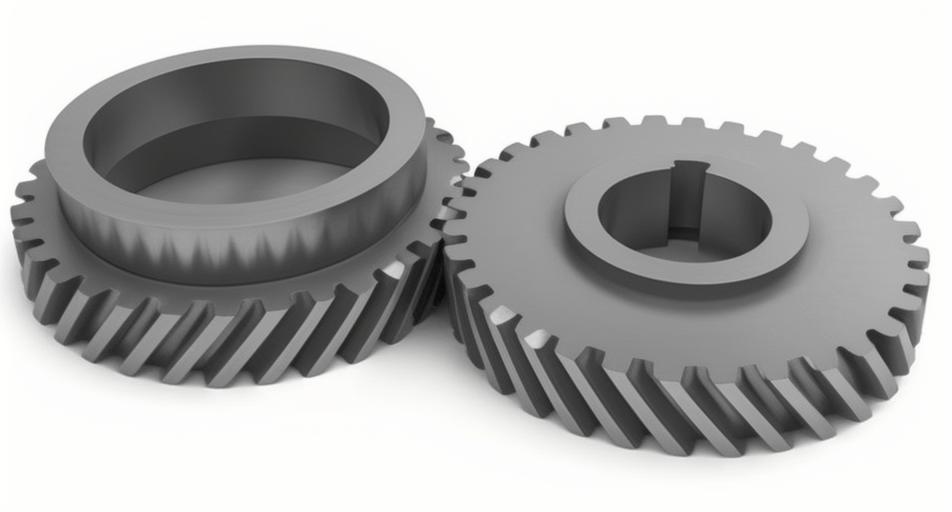
Once the tooth surfaces are created, they are assembled based on the gear geometry. For a non-modified helical gear, the tooth thickness at the pitch circle equals the space width. Thus, one tooth surface is rotated to achieve proper alignment. Subsequent operations, such as combining surfaces, filling gaps, and extruding solids, yield a single tooth model. This model is then replicated using circular patterning to form the complete helical gear. The entire process ensures that the helical gear model is accurate and suitable for further analysis.
To evaluate the modeling accuracy, the generated helical gear is compared with a reference model from specialized gear design software, KISSsoft. The comparison involves aligning the two gears at their axes and pitch circles. The deviation between corresponding tooth surfaces, denoted as $\delta$, is measured. Since the involute profile exists only above the base circle, the evaluation focuses on that region. The maximum deviation for both flanks is found to be minimal, indicating high precision. The results are summarized in the table below:
| Tooth Flank | Maximum Deviation $\delta$ (mm) |
|---|---|
| Left Flank | 0.0004 |
| Right Flank | 0.0002 |
Such small deviations confirm that the modeling method is highly accurate for helical gears. The deviations arise from discrete point sampling and numerical approximations but remain within acceptable limits for engineering applications. This precision is vital for helical gears in transmission systems, where even minor errors can affect performance and noise levels.
The mathematical framework for helical gears can be extended to include modifications such as profile shifting or crowning. For instance, the tooth surface equation can be adjusted by modifying the involute parameter $\theta$ or adding correction terms. Additionally, the helix angle $\beta$ influences the contact pattern and load distribution in helical gears. A deeper analysis might involve calculating the contact ratio, which for helical gears is higher than for spur gears due to the helical overlap. The transverse contact ratio $\epsilon_{\alpha}$ and overlap ratio $\epsilon_{\beta}$ are given by:
$$\epsilon_{\alpha} = \frac{\sqrt{d_{a1}^2 – d_{b1}^2} + \sqrt{d_{a2}^2 – d_{b2}^2} – a \sin \alpha_t}{\pi m_t \cos \alpha_t}$$
$$\epsilon_{\beta} = \frac{h_k \tan \beta}{\pi m_t}$$
where $d_{a1}$, $d_{b1}$ are addendum and base diameters of gear 1, $a$ is the center distance, $m_t$ is the transverse module, and $\alpha_t$ is the transverse pressure angle. For helical gears, the total contact ratio $\epsilon_{\gamma} = \epsilon_{\alpha} + \epsilon_{\beta}$ often exceeds 2, enhancing smoothness and load capacity.
In practice, helical gears are subjected to various loads, and finite element analysis (FEA) is used to assess stress and deformation. The accurate model generated by this method serves as input for FEA, ensuring reliable results. For example, the bending stress at the tooth root can be evaluated using the Lewis formula modified for helical gears:
$$\sigma_b = \frac{F_t}{b m_n Y} K_a K_v K_{\beta}$$
where $F_t$ is the tangential force, $b$ is the face width, $Y$ is the form factor, and $K_a$, $K_v$, $K_{\beta}$ are application, dynamic, and helix factors, respectively. The helix factor $K_{\beta}$ accounts for the load distribution along the tooth due to the helical angle. For helical gears, $K_{\beta}$ is often derived from empirical data or advanced simulations.
Another critical aspect is the manufacturing simulation of helical gears. The model can be used in CNC machining software to generate tool paths for gear cutting or grinding. The tooth surface equation provides precise coordinates for tool positioning, reducing errors in production. For instance, in hobbing or shaping processes, the relative motion between the tool and gear blank is simulated based on the gear geometry. The accuracy of the model directly affects the quality of manufactured helical gears, impacting their performance in real-world applications such as automotive transmissions or industrial machinery.
To further illustrate the parameter relationships, consider the following table showing the effect of helix angle variation on key dimensions for a set of helical gears with fixed normal module and pressure angle:
| Helix Angle $\beta$ (°) | Pitch Diameter $d$ (mm) | Base Helix Angle $\beta_0$ (°) | Transverse Pressure Angle $\alpha_t$ (°) |
|---|---|---|---|
| 5 | 20.102 | 4.72 | 20.07 |
| 10 | 20.308 | 9.39 | 20.28 |
| 15 | 20.710 | 14.02 | 20.64 |
| 20 | 21.338 | 18.59 | 21.17 |
This table highlights how increasing the helix angle enlarges the pitch diameter and alters the pressure angle, which in turn affects the tooth strength and meshing conditions for helical gears. Designers must balance these factors to optimize performance.
In conclusion, the method presented here offers a robust approach for accurate modeling of helical gears. By deriving the involute and tooth surface equations, calculating precise parameters, and utilizing CATIA’s macro capabilities, high-fidelity models are achieved. The evaluation shows deviations as low as 0.0004 mm, confirming the method’s reliability for helical gears. This approach facilitates advanced analyses like FEA and CNC simulation, contributing to the development of efficient and durable helical gear systems. Future work could explore adaptive meshing for dynamic simulations or integration with IoT for smart gear monitoring. Ultimately, mastering such modeling techniques is essential for advancing gear technology and meeting the growing demands of modern machinery.
The mathematical rigor applied in this study ensures that the models are not only accurate but also adaptable to various design scenarios. For instance, the tooth surface equation can be extended to include manufacturing errors or wear profiles by introducing perturbation terms. Additionally, the use of parametric design allows for quick modifications, enabling iterative optimization for specific applications. Helical gears, with their inherent advantages, continue to be a focal point in mechanical engineering, and precise modeling is key to unlocking their full potential.
From a practical standpoint, the modeling process can be automated further by scripting the entire workflow in CATIA or other CAD software. This would involve writing macros that directly compute the tooth surface points and generate the geometry without manual intervention. Such automation is particularly beneficial for companies producing custom helical gears, as it reduces design time and minimizes human error. Moreover, the models can be exported in standard formats like STEP or IGES for collaboration with suppliers or clients.
In terms of educational value, this method provides a clear understanding of the geometry underlying helical gears. Students and engineers can use the derived equations to visualize how changes in parameters affect the tooth shape and performance. For example, increasing the helix angle enhances smoothness but also increases axial thrust, which must be managed in bearing selection. These trade-offs are critical in gear design and are best explored through accurate models.
Finally, the importance of helical gears in sustainable engineering cannot be overstated. Their high efficiency contributes to energy savings in transportation and industrial systems. By enabling precise modeling, this method supports the development of optimized helical gears that reduce material usage and improve longevity. As industries move towards greener technologies, such advancements in gear design will play a pivotal role. Thus, the continued refinement of modeling techniques for helical gears remains a valuable pursuit for engineers worldwide.