
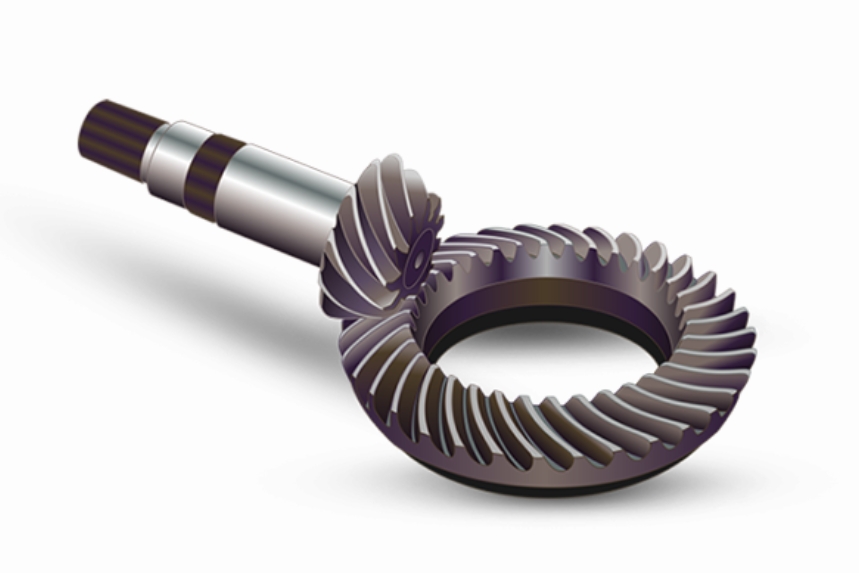
This study presents a comprehensive methodology for the precise modeling and metal powder injection molding (MIM) of equal-distance spiral bevel gears. These gears feature a unique normal equidistant spiral tooth surface, enabling efficient batch production through MIM. The mathematical foundation, numerical simulation, and manufacturing validation are systematically explored.
1. Geometric Design Parameters
The geometric parameters of equal-distance spiral bevel gears are optimized for MIM compatibility and meshing performance:
| Parameter | Pinion | Gear |
|---|---|---|
| Handedness | Left | Right |
| Number of Teeth | 16 | 23 |
| Shaft Angle (°) | 90 | |
| Pitch Cone Angle (°) | 34.824 | 55.176 |
| Midpoint Spiral Angle (°) | 30 | |
| Pressure Angle (°) | 20 | |
| Tooth Width (mm) | 5 | |
2. Mathematical Modeling of Tooth Surface
2.1 Spherical Involute Generation
The spherical involute forms the tooth profile, derived through coordinate transformation theory. The parametric equations in the moving coordinate system are:
$$
\begin{cases}
X’ = l\sin\psi \\
Y’ = 0 \\
Z’ = l\cos\psi
\end{cases}
$$
Transformed to the fixed coordinate system using rotation matrix M:
$$
M = \begin{bmatrix}
\sin t\cos\delta_b & \cos t & \sin\delta_b\cos t \\
-\cos t\cos\delta_b & \sin t & \sin\delta_b\sin t \\
0 & -\sin\delta_b & \cos\delta_b
\end{bmatrix}
$$
Resulting in the final spherical involute equations:
$$
\begin{cases}
X = l(\sin\delta_b\cos\psi\cos t + \sin\psi\sin t) \\
Y = l(\sin\delta_b\cos\psi\sin t – \sin\psi\cos t) \\
Z = l\cos\delta_b\cos\psi
\end{cases}
$$
2.2 Equal-Distance Conical Spiral
The tooth trace follows an equal-distance spiral with constant normal pitch:
$$
\begin{cases}
x = \frac{p}{2\pi}\varphi\sin\delta\cos\varphi \\
y = \frac{p}{2\pi}\varphi\sin\delta\sin\varphi \\
z = \frac{p}{2\pi}\varphi\cos\delta
\end{cases}
$$
Where the lead p is determined through kinematic constraints:
$$
p = \frac{2\pi(R_1 + R_2)}{N\tan\beta_m}
$$
2.3 Tooth Surface Synthesis
The complete tooth surface model combines spherical involutes distributed along the spiral path:
$$
\begin{bmatrix}
x’ \\ y’ \\ z’
\end{bmatrix}
=
\begin{bmatrix}
\cos\varphi & -\sin\varphi & 0 \\
\sin\varphi & \cos\varphi & 0 \\
0 & 0 & 1
\end{bmatrix}
\cdot
\begin{bmatrix}
x_1 \\ y_1 \\ z_1
\end{bmatrix}
$$
3. Numerical Implementation
The modeling workflow integrates multiple software platforms:
| Process | Tool | Key Parameters |
|---|---|---|
| Discrete Point Calculation | MATLAB | Step size: 0.1° angular resolution |
| Surface Reconstruction | UG NX | NURBS tolerance: 1μm |
| Mesh Generation | HyperMesh | Element size: 0.2mm |
4. Meshing Performance Analysis
Finite element analysis reveals critical performance metrics:
| Parameter | Value |
|---|---|
| Maximum Contact Stress | 435.68 MPa |
| Transmission Error | < 4×10⁻⁴ rad |
| Speed Fluctuation | ±0.18% |
The stress distribution follows Hertzian contact theory:
$$
\sigma_{\text{max}} = \frac{3F}{2\pi a^2}\sqrt{\frac{a}{b}}
$$
Where a and b represent the contact ellipse semi-axes.
5. MIM Process Optimization
Key parameters for successful spiral bevel gear production:
| Stage | Parameters |
|---|---|
| Feedstock | 60 vol% Fe8Ni powder, 3.95μm D50 |
| Injection | 190°C, 50MPa, 50mm/s |
| Debinding | 120°C catalytic, 600°C thermal |
| Sintering | 1260°C, N2-Ar atmosphere |
The dimensional shrinkage is controlled through:
$$
\epsilon = \alpha(T)\cdot\Delta T + \beta(\phi)\cdot\Delta\phi
$$
Where α and β represent thermal and phase change coefficients.
6. Conclusion
This research demonstrates that equal-distance spiral bevel gears can be accurately modeled through parametric surface synthesis and efficiently manufactured via MIM. The mathematical framework ensures precise tooth geometry, while the optimized MIM parameters enable net-shape production of complex spiral bevel gear forms. The combination of numerical simulation and experimental validation establishes a complete methodology for high-performance spiral bevel gear development.