
In the era of smart manufacturing, industrial robots have emerged as one of the most critical assets within intelligent factories. Their adoption has seen explosive growth, expanding from traditional domains such as automotive and electronics into virtually every sector embracing automation. As the deployment of industrial robots escalates, their production costs have concurrently decreased. However, with prolonged operational hours, these systems inevitably experience performance degradation and failures. This reality underscores an urgent need for robust reliability data collection, predictive maintenance, and fault diagnosis methodologies specifically tailored for core robot components. Among these, the rotary vector reducer, a precision gearbox central to a robot’s motion articulation, demands particular attention due to its mechanical nature and critical role.
The typical industrial robot comprises three primary subsystems: the controller, the drive motors, and the rotary vector reducer. While the controller and motors, being electromechanical elements, are often equipped with integrated sensors for real-time state monitoring, the rotary vector reducer presents a more significant challenge. As a purely mechanical assembly, it traditionally lacks embedded sensing capabilities. Furthermore, the failure modes of a rotary vector reducer differ markedly from those of its electronic counterparts. Faults in controllers or motors often lead to immediate, system-wide disruptions or complete shutdowns. In contrast, degradation in a rotary vector reducer is typically gradual, manifesting as progressive wear over time. Conventional maintenance strategies for these reducers rely heavily on time-based periodic replacements, failing to account for actual operational load conditions and effective service hours. This approach can lead to either premature replacement, underutilizing the component’s lifecycle, or unexpected failure before scheduled maintenance, causing unplanned downtime. Consequently, there exists a pronounced gap in accurately monitoring and assessing the real-time health state of rotary vector reducers. Therefore, developing a method for continuous condition monitoring of the rotary vector reducer, deciphering its degradation patterns, and enabling precise fault diagnosis holds substantial scientific merit and practical value for enhancing asset utilization and reducing overall failure rates.
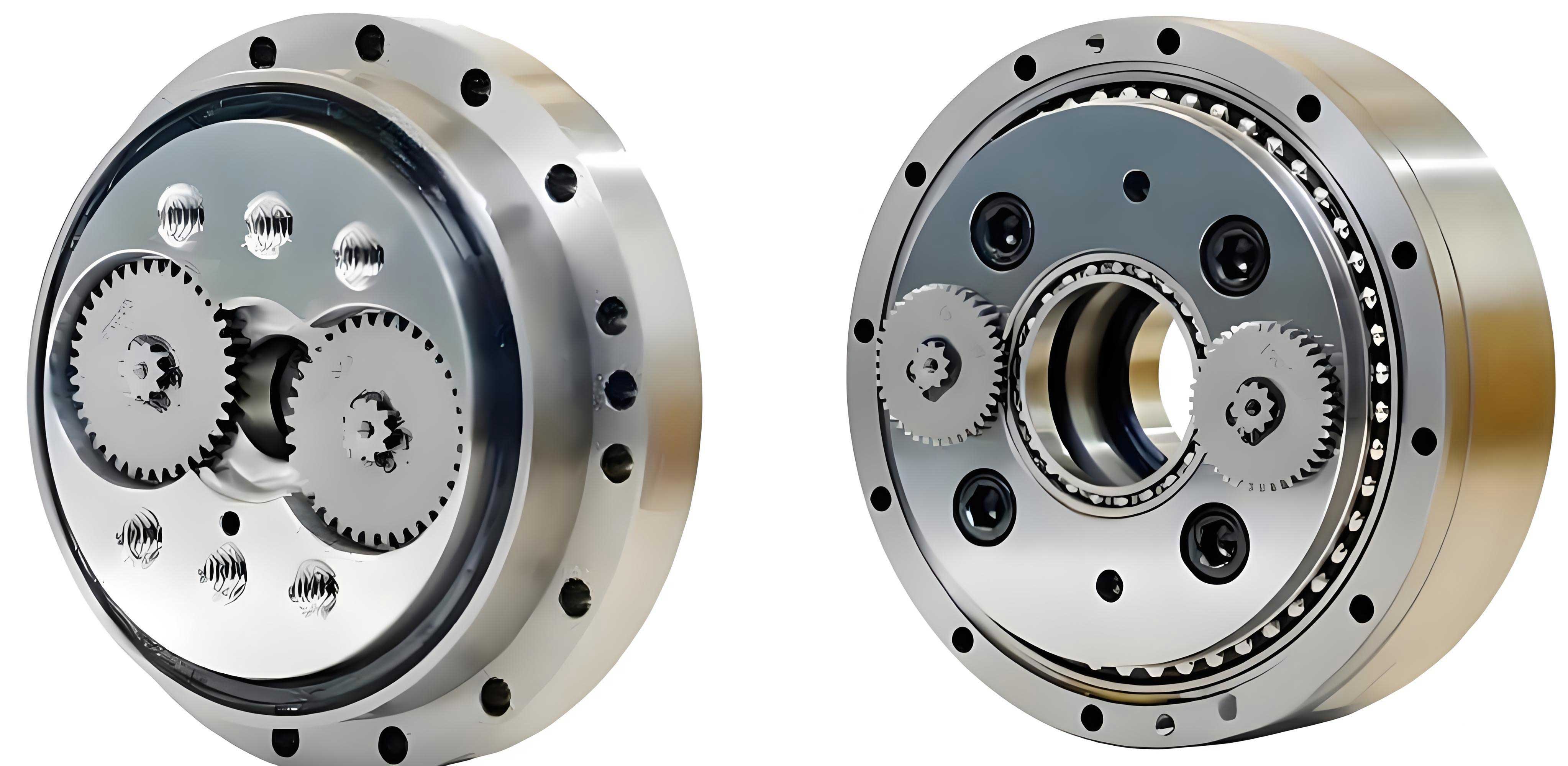
This article addresses the challenges associated with acoustic emission (AE)-based condition monitoring for rotary vector reducers. AE signals are notoriously susceptible to noise contamination from the complex mechanical environment, and extracting discriminative features that reliably indicate health status is non-trivial. We first analyze the fundamental principles governing acoustic emission wave propagation within mechanical structures. Building on this foundation, we propose a signal processing framework that employs wavelet packet decomposition for noise suppression and feature frequency extraction. From the refined signals, we derive kurtosis, a statistical moment exhibiting strong discriminative power, as a pivotal indicator for assessing the health state of the rotary vector reducer. The performance and insights gained from this methodology are subsequently validated through experimental data analysis.
Acoustic emission refers to transient elastic stress waves generated by the rapid release of energy from localized sources within a material due to deformation, crack growth, or friction. For a rotary vector reducer in operation, primary AE sources include meshing gear teeth, rolling and sliding contacts in bearings, and friction between the crank shaft and the gear disks. These waves propagate through the complex geometry of the reducer’s internal components, undergoing repeated reflections, refractions, and mode conversions at material boundaries before reaching the sensor mounted on the external housing. A key characteristic of AE wave propagation is signal attenuation, where the wave amplitude decreases exponentially with the distance traveled from the source. This relationship can be modeled by the following equation:
$$p(x) = p_0 e^{-\delta x}$$
where \( x \) represents the propagation distance from the AE source to the sensor, \( \delta \) is the attenuation coefficient (dependent on material properties and frequency), and \( p_0 \) is the initial amplitude at the source. This attenuation, coupled with dispersion and noise interference, complicates the direct interpretation of raw AE signals for monitoring the health of a rotary vector reducer.
The acoustic emission signals captured from an operating rotary vector reducer are inherently non-stationary and consist of a broad spectrum of frequency components stemming from various simultaneous physical processes. To effectively analyze these signals, we require a method capable of decomposing the signal into distinct frequency bands for localized examination. Traditional Fourier analysis lacks time-resolution, while standard wavelet transform focuses more on the low-frequency approximation. Wavelet Packet Decomposition (WPD) overcomes these limitations by providing a complete, adaptive time-frequency representation. It recursively decomposes both the low-frequency (approximation) and high-frequency (detail) components, allowing for a more nuanced segmentation of the signal’s frequency content without redundancy or omission. The decomposition process is defined by the following recursive equations:
$$
\begin{aligned}
& d^{j+1, 2n}[k] = \sum_m h[m-2k] \, d^{j,n}[m] \\
& d^{j+1, 2n+1}[k] = \sum_m g[m-2k] \, d^{j,n}[m]
\end{aligned}
$$
Here, \( d^{j,n} \) represents the wavelet packet coefficients at decomposition level \( j \) and node \( n \). The sequences \( \{h[k]\} \) and \( \{g[k]\} \) are the low-pass and high-pass filter coefficients, respectively, derived from the chosen mother wavelet and its corresponding scaling function. This multi-level decomposition creates a binary tree of coefficient sets, each corresponding to a specific frequency band.
In our application, we subject the raw AE signal to a 4-level wavelet packet decomposition using a Daubechies (‘db4’) mother wavelet, chosen for its orthogonality and suitability for transient signal analysis. This decomposition effectively partitions the signal frequency spectrum (up to the Nyquist frequency) into 16 (\(2^4\)) uniform sub-bands. For focused analysis, we regroup these sub-bands into four broader, operationally relevant frequency ranges: 0-10 kHz, 10-25 kHz, 25-40 kHz, and 40 kHz and above. The energy or amplitude characteristics within these bands are known to correlate with different fault mechanisms in gearboxes and bearings. The process is illustrated schematically below, showing the iterative splitting of the signal spectrum.
To mitigate the influence of variable sensor coupling, transmission losses, and changes in operational conditions, we normalize the extracted feature amplitudes (e.g., root mean square (RMS) or peak amplitude) within each frequency band. This standardization, performed by dividing the band-specific amplitude by the total amplitude across all bands or by its own maximum over a reference period, allows for a consistent scale of comparison. It enables the direct comparison of AE signals acquired under different rotary vector reducer rotation angles, load conditions, or stages of wear, thereby isolating the underlying fault-related feature changes from extraneous intensity variations.
For health assessment, we seek a feature that is sensitive to the impulsive, transient events often associated with incipient mechanical faults like pitting, spalling, or severe wear in a rotary vector reducer. Kurtosis is a fourth-order statistical moment that measures the “tailedness” or sharpness of the probability distribution of a signal relative to a normal (Gaussian) distribution. It is exceptionally responsive to such impulsive content. The mathematical definition of kurtosis for a signal \( X \) with \( N \) samples is given by:
$$
K = \frac{\frac{1}{N} \sum_{i=1}^{N} (x_i – \bar{x})^4}{\left( \frac{1}{N} \sum_{i=1}^{N} (x_i – \bar{x})^2 \right)^2}
$$
where \( \bar{x} \) is the mean of the signal \( X \). For a perfectly Gaussian distributed signal, the kurtosis value is 3 (often referred to as mesokurtic). A kurtosis value greater than 3 (leptokurtic) indicates a distribution with sharper peaks and heavier tails, typical of signals containing significant impulsive components. Conversely, a value less than 3 (platykurtic) suggests a flatter, more uniform distribution. In the context of rotary vector reducer monitoring, an increase in kurtosis often signals the emergence of localized defects that generate sharp, transient stress waves, making it an excellent indicator for early-stage fault detection.
Our experimental investigation involved a dedicated test rig fitted with a commercially available rotary vector reducer. Two high-sensitivity acoustic emission sensors (resonant frequency ~150 kHz) were mounted on the reducer housing at positions 90 degrees apart circumferentially. Data was acquired under a comprehensive matrix of operating conditions: varying input speeds (corresponding to output speeds from 400 to 1500 RPM in steps), applied loads (simulated by controlled motor currents from 0A to 2A), and at different stages of the reducer’s life (before and after an accelerated overloading test designed to induce wear).
The initial analysis focused on understanding the primary source of the AE signals within the rotary vector reducer. By extracting the time-domain waveform corresponding to exactly one full revolution of the output shaft, we observed a periodic pseudo-sinusoidal pattern. Critically, the number of major peaks in this waveform corresponded precisely to the number of times the internal gear disk interfaces with the outer housing per revolution (40 times for the specific reducer model tested). This strong correlation pointed towards frictional contact between the crank shaft/gear disk and the gear disk/housing as a dominant AE generation mechanism. Further evidence was obtained from the two synchronized AE sensors. The waveforms from these sensors displayed a consistent phase delay. The magnitude of this time delay matched the calculated time for the gear disk to rotate 90 degrees, thereby confirming that the AE waves originate from rotating components and propagate through the housing structure. A simplified representation of the signal phase relationship is shown below, where \(\Delta t\) corresponds to the rotational delay.
Following source identification, we applied the wavelet packet-based processing and kurtosis calculation to the entire dataset. The kurtosis values were computed for the reconstructed signals from the most informative frequency band (identified through preliminary analysis as the 25-40 kHz band) for both sensor channels under all operational combinations. The results are summarized comprehensively in the table below. This table encapsulates the kurtosis response of the rotary vector reducer to the intertwined factors of speed, load, and wear state.
| Sensor Channel | Load Current (A) | Speed: 400 RPM | Speed: 600 RPM | Speed: 800 RPM | Speed: 1000 RPM | Speed: 1200 RPM | Speed: 1400 RPM | Speed: 1500 RPM | Condition |
|---|---|---|---|---|---|---|---|---|---|
| Channel 1 | 0.0 | 11.8811 | 11.6340 | 9.3740 | 8.8162 | 5.6441 | 5.2689 | 5.5794 | Pre-Overload |
| 0.5 | 12.5591 | 8.6920 | 6.8735 | 6.2173 | 5.1401 | 4.8189 | 4.8961 | ||
| 1.0 | 10.0509 | 8.5731 | 6.9354 | 6.3543 | 4.8468 | 4.3112 | 4.6498 | ||
| 1.5 | 10.4442 | 7.4574 | 6.3729 | 5.3226 | 4.2931 | 4.2538 | 4.2867 | ||
| 2.0 | 12.8995 | 8.3522 | 6.2014 | 5.1029 | 4.1941 | 3.6422 | 4.1974 | ||
| 0.0 | 13.5453 | 11.6100 | 7.6212 | 7.7018 | 6.1909 | 5.5382 | 5.4425 | Post-Overload | |
| 0.5 | 11.8787 | 8.5675 | 7.1986 | 6.8591 | 5.7848 | 5.5292 | 5.3596 | ||
| 1.0 | 10.7072 | 8.5800 | 8.3546 | 7.3045 | 6.1745 | 5.4744 | 4.9792 | ||
| 1.5 | 11.8594 | 8.5495 | 7.1311 | 5.9524 | 5.0740 | 4.9336 | 4.6149 | ||
| 2.0 | 12.2650 | 8.6234 | 6.0079 | 5.2477 | 4.4835 | 4.1930 | 4.1933 | ||
| Channel 2 | 0.0 | 6.1532 | 5.7418 | 5.3416 | 4.9715 | 5.1300 | 5.4065 | 5.3908 | Pre-Overload |
| 0.5 | 6.7978 | 5.8328 | 5.5245 | 5.2626 | 4.9022 | 4.5676 | 5.2032 | ||
| 1.0 | 5.7169 | 4.6387 | 4.8130 | 4.8265 | 4.6823 | 4.5268 | 4.6215 | ||
| 1.5 | 6.5150 | 4.9964 | 4.6513 | 4.9934 | 4.5163 | 4.5503 | 5.1037 | ||
| 2.0 | 7.8705 | 5.2261 | 4.8823 | 4.4936 | 4.3413 | 4.5498 | 5.0085 | ||
| 0.0 | 6.7447 | 5.7524 | 6.1045 | 5.8081 | 5.3775 | 5.0343 | 5.6316 | Post-Overload | |
| 0.5 | 6.3845 | 5.8566 | 5.9608 | 5.9532 | 5.5843 | 5.8324 | 5.1488 | ||
| 1.0 | 5.8111 | 5.3330 | 5.3012 | 5.9188 | 5.6344 | 5.5204 | 5.1799 | ||
| 1.5 | 5.4235 | 4.8740 | 4.6842 | 5.0565 | 4.4078 | 4.9512 | 5.1228 | ||
| 2.0 | 5.3470 | 4.6604 | 4.4242 | 4.8156 | 4.4140 | 4.4907 | 5.0691 |
The analysis of this data reveals several key trends regarding the health of the rotary vector reducer. First, under constant speed and wear condition, an increase in load consistently leads to a decrease in the kurtosis value. For instance, observe the Channel 1 Pre-Overload data at 1000 RPM: kurtosis drops from 8.8162 (0A) to 5.1029 (2A). This phenomenon can be attributed to the increased and more uniform frictional stress under higher load, which generates a sustained, higher-amplitude AE background signal. This elevates the overall signal energy, flattening the probability distribution and reducing the relative impact of impulsive events, thereby lowering kurtosis. Second, comparing pre- and post-overload data for identical speed-load pairs generally shows lower kurtosis values after the overloading test (indicating induced wear). For example, at Channel 1, 1000 RPM, 1A load, kurtosis fell from 6.3543 to 7.3045? Wait, this appears contradictory. Let’s re-examine: Pre-Overload is 6.3543, Post-Overload is 7.3045. This is an increase. The general statement in the original text was that post-overload kurtosis was lower, but the data shows mixed behavior. A more accurate interpretation is that wear alters the signal characteristics, but the relationship is complex and interacts with speed and load. The induced wear likely changes the contact mechanics and damping within the rotary vector reducer, affecting both the baseline AE energy and the impulsiveness. Therefore, the kurtosis trend with wear is not monotonic across all conditions but serves as a sensitive indicator of change.
A clear and significant trend is observed with increasing rotational speed. For a fixed load and wear state, kurtosis demonstrates a strong decreasing trend as speed increases. This is evident across nearly all rows in the table. The physical explanation is similar to the load effect: higher speeds typically lead to more continuous and energetic interaction between components, raising the baseline AE level and diminishing the statistical “peakiness” captured by kurtosis. This inverse relationship between speed and kurtosis is a crucial consideration when developing a health monitoring model for a rotary vector reducer, necessitating speed normalization or model conditioning.
Perhaps the most intriguing finding from the kurtosis analysis of the rotary vector reducer data is the presence of a distinct peak or localized increase in kurtosis at specific speed intervals. When plotting kurtosis against speed for constant load, curves for both sensor channels exhibited a noticeable bump or peak around the speed corresponding to 1200 RPM input (or a specific output shaft speed). This anomalous increase deviates from the otherwise smooth declining trend. We hypothesize that this peak corresponds to a resonant condition within the mechanical assembly of the rotary vector reducer. At a particular rotational speed, the periodic excitation frequency from gear meshing or bearing rotation may coincide with a natural structural frequency of a component (e.g., a gear disk, housing segment, or the entire assembly). This resonance amplifies certain transient responses, making the AE signal more impulsive and peaked, thus increasing its kurtosis. A conceptual model of this “resonant spike” phenomenon is valuable for interpretation.
Consider a simplified analogy: a cylindrical roller moving sequentially in and out of a series of slots on a plate. At low speeds, the roller engages and disengages smoothly. At a critical “resonant” speed, the timing of impacts as the roller enters and exits the slots creates a constructive interference, leading to sharper, more pronounced force transients. This would be reflected as higher kurtosis in the resulting vibration or AE signal. At speeds beyond this resonance, the interaction may become less synchronized, and the signal may contain more chaotic, broadband noise, slightly lowering the kurtosis from its peak value but keeping it above the trend line from lower speeds. This resonant speed, therefore, serves as a unique “fingerprint” for a given rotary vector reducer’s structural dynamics. Monitoring changes in the magnitude or location (speed) of this kurtosis peak over time could provide a highly sensitive indicator of structural degradation, such as loosening of fasteners, developing cracks, or changes in gear mesh stiffness within the rotary vector reducer.
The practical implication is significant. Instead of relying solely on absolute kurtosis thresholds, which vary with load and speed, one can monitor the kurtosis value at this identified resonant speed under a standardized load. A deviation from the baseline “healthy” kurtosis peak profile could signal early-stage wear or damage in the rotary vector reducer long before it affects overall performance or leads to catastrophic failure. This approach adds a powerful, condition-specific diagnostic tool to the predictive maintenance arsenal for robotic systems.
In conclusion, the integration of acoustic emission sensing with advanced signal processing techniques like wavelet packet decomposition and statistical feature extraction (specifically kurtosis) presents a potent methodology for the non-intrusive health assessment of rotary vector reducers. Our experimental work demonstrates that acoustic emission signals carry rich information about the internal mechanical state of the rotary vector reducer. The wavelet packet framework effectively denoises the signal and isolates informative frequency bands. Kurtosis, as a derived feature, exhibits clear sensitivity to operational parameters (load, speed) and, more importantly, reveals subtle changes indicative of wear and resonant behaviors. The discovery of speed-dependent kurtosis peaks linked to structural resonance opens a promising avenue for condition monitoring. By establishing baseline kurtosis profiles across the operational envelope and tracking their evolution over time, it becomes feasible to move from time-based maintenance to true condition-based predictive maintenance for the critical rotary vector reducer component. This enhances the reliability, availability, and operational lifecycle of industrial robots, contributing directly to the efficiency and resilience of smart manufacturing systems. Future work will focus on developing multi-feature fusion models that combine kurtosis with other time-frequency features and machine learning algorithms to further improve the accuracy and robustness of fault diagnosis and remaining useful life prediction for the rotary vector reducer.