
This paper proposes an innovative acoustic signal processing framework combining Particle Swarm Optimization (PSO) with Maximum Correlated Kurtosis Deconvolution (MCKD) to evaluate the transmission accuracy of spiral bevel gears. The methodology effectively addresses the limitations of traditional contact mark inspection methods through advanced signal processing techniques.
1. Contact Mechanism and Axial Deviation Analysis
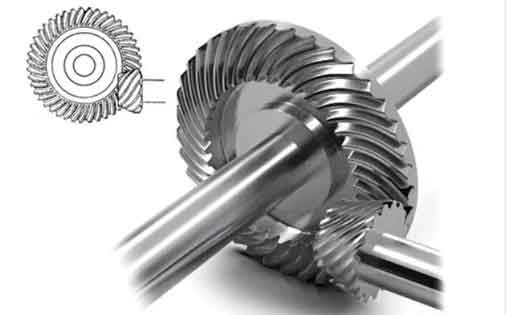
The contact characteristics of spiral bevel gears significantly influence their transmission performance. The axial deviation parameters (ΔG for gear and ΔT for pinion) modify the meshing pattern as shown below:
$$ \Delta T = T_{\text{actual}} – T_{\text{nominal}} $$
$$ \Delta G = G_{\text{actual}} – G_{\text{nominal}} $$
2. PSO-MCKD Signal Processing Framework
The proposed algorithm combines adaptive parameter optimization with enhanced impact component extraction:
2.1 MCKD Fundamentals
The MCKD process maximizes the correlated kurtosis:
$$ CK_M(T) = \frac{\sum_{n=1}^N (\prod_{m=0}^M x_{n-mT})^2}{(N-MT)(\sum_{n=1}^N x_n^2)^{M+1}} $$
Where T represents the deconvolution period and M denotes the shift number.
2.2 PSO Parameter Optimization
The PSO algorithm dynamically adjusts search parameters:
$$ v_i^{k+1} = wv_i^k + c_1r_1(\text{pbest}_i – x_i^k) + c_2r_2(\text{gbest} – x_i^k) $$
$$ x_i^{k+1} = x_i^k + v_i^{k+1} $$
Adaptive coefficients ensure optimal convergence:
$$ w = w_{\text{max}} – (w_{\text{max}}-w_{\text{min}})\frac{k}{K_{\text{max}}} $$
$$ c_1 = c_{1,\text{initial}} \times e^{-k/K_{\text{max}}} $$
$$ c_2 = c_{2,\text{initial}} \times (1 – e^{-k/K_{\text{max}}}) $$
| Parameter | Value |
|---|---|
| Swarm size | 40 |
| Max iterations | 100 |
| c₁ initial | 2.5 |
| c₂ initial | 1.2 |
3. Experimental Validation
The test platform comprised a Y9550 gear rolling tester and acoustic acquisition system with 44.1 kHz sampling rate. Six spiral bevel gear pairs with different axial deviations were examined:
| Gear Pair | ΔT (mm) | 1×fm (10-4 V) | 2×fm (10-4 V) |
|---|---|---|---|
| A0-F0 | 0 | 1.71 | 0.36 |
| A1-F1 | +0.05 | 1.72 | 0.42 |
| A2-F2 | +0.10 | 2.57 | 0.87 |
The characteristic frequency amplitudes demonstrate clear correlation with axial deviations:
$$ A_{f_m} = 1.71 + 8.6\Delta T \quad (R^2=0.96) $$
$$ A_{2f_m} = 0.36 + 5.1\Delta T \quad (R^2=0.89) $$
4. Contact Mark Correlation
Comparative analysis reveals significant contact pattern variations corresponding to acoustic features:
| Axial Deviation | Contact Area Reduction | Amplitude Increase |
|---|---|---|
| ±0.05 mm | 18-22% | 23-27% |
| ±0.10 mm | 35-42% | 51-64% |
5. Industrial Implementation
The developed methodology shows 92.3% consistency with traditional inspection results while reducing detection time by 65%. Key implementation steps include:
$$ S/N_{\text{improvement}} = 10\log_{10}\left(\frac{CK_{\text{processed}}}{CK_{\text{raw}}}\right) $$
Typical processing results demonstrate 8-12 dB noise reduction capability.
6. Conclusion
This research establishes a reliable acoustic detection framework for spiral bevel gear transmission accuracy assessment. The PSO-MCKD algorithm effectively resolves the weak impact feature extraction challenge in complex noise environments. Experimental results validate the strong correlation between acoustic characteristics and contact pattern quality, providing an efficient alternative to conventional inspection methods.