
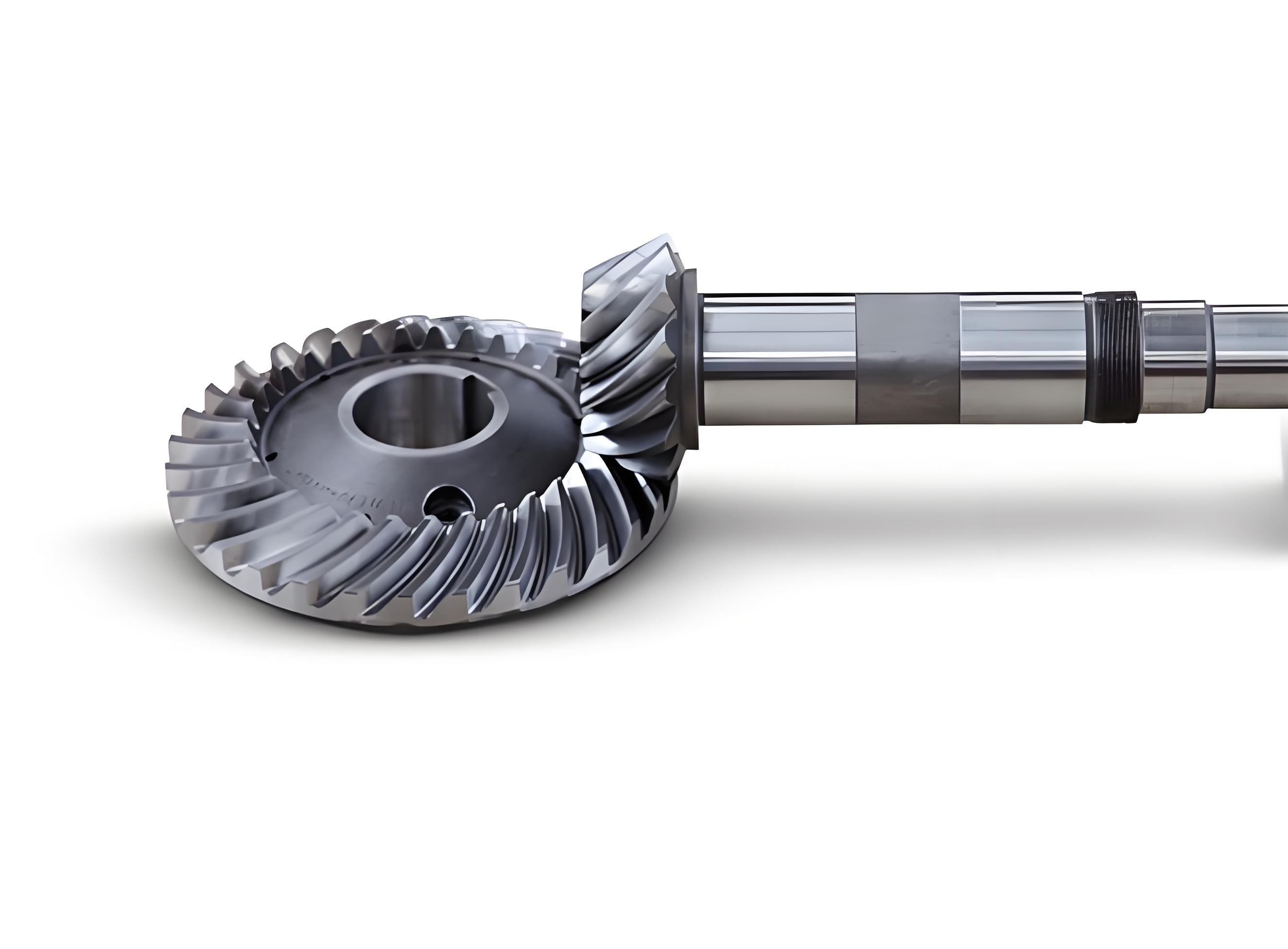
In the realm of mechanical transmission systems, spiral bevel gears serve as critical foundational components, enabling efficient power transfer between intersecting shafts under high-speed and heavy-load conditions. The precision of these spiral bevel gears directly influences the performance, noise levels, and service life of the entire transmission assembly. Consequently, the machine tools dedicated to manufacturing these gears, such as spiral bevel gear milling machines, are themselves pivotal pieces of manufacturing equipment. Their accuracy fundamentally dictates the quality of the final spiral bevel gear product. Traditional precision design methods for such machine tools often rely on empirical knowledge and general standards, which may not optimally align the machine’s capabilities with the specific accuracy requirements of the spiral bevel gears being produced. This can lead to either over-engineering, with unnecessarily high costs, or under-engineering, resulting in parts that fail to meet functional specifications. This article presents an active precision design methodology. We approach the problem from the perspective of the part’s required machining accuracy, establishing a direct mapping between the tolerances of the spiral bevel gear and the positioning accuracy of the numerical control (NC) axes on the milling machine. Our goal is to achieve a rational, need-based “customization” of machine tool accuracy, enhancing cost-effectiveness while ensuring performance.
The core innovation of our active precision design lies in its reverse-mapping philosophy. Instead of starting from the machine’s mechanical chain, we begin with the desired outcome: a high-precision spiral bevel gear. The methodology comprises two primary phases: error analysis and precision design. In the error analysis phase, we develop a mathematical model that links the geometric errors on the finished spiral bevel gear to the positioning errors of the machine’s NC axes. In the precision design phase, we translate the part’s specified tolerance grade into quantitative requirements for the repeatability of each NC axis. This process involves establishing a machining error model and a machining precision model, followed by an allocation of tolerances based on the principle of equal effect.
The manufacturing of spiral bevel gears, especially those conforming to the Gleason system, is typically based on the “imaginary crown gear” or generating principle. A fictitious crown gear, concentric with the machine’s cradle, is conceptually meshed with the workpiece gear blank. A cutting tool, usually a face-milling cutter head, is mounted eccentrically on the cradle. As the cradle rocks and the workpiece rotates with a specific ratio, the cutter blades sweep out the tooth slot, generating the complex curved surface of the spiral bevel gear. Modern CNC spiral bevel gear milling machines replace the complex mechanical linkages of traditional machines with independently controlled servo axes. Typically, five or six axes are involved: three linear axes (X, Y, Z) and two or three rotational axes (A, B, and sometimes C for cutter rotation). The synchronized motion of these axes simulates the generating motion required to produce the correct tooth geometry on the spiral bevel gear.
To establish the relationship between machine motion and gear geometry, we first define the coordinate systems. Let Σm denote the machine bed coordinate system, Σc the imaginary crown gear (generator) system, Σk the cutter coordinate system, and Σw the workpiece (spiral bevel gear) coordinate system. The key machine setup parameters include the radial setting Sr, angular setting q, workpiece installation angle δm, sliding base setting Xb, and axial workpiece setting Xp. In a CNC machine, Sr and q are effectively controlled by the X and Y axis coordinates:
$$ S_r = \sqrt{X^2 + Y^2} $$
$$ q = \arcsin\left(\frac{Y}{S_r}\right) $$
The surface of the cutter blade can be described in its local system. For a point M on the cutting edge, its position vector in the cutter system can be transformed through the generator system to the machine system. The conjugate tooth surface of the spiral bevel gear is derived by satisfying the condition of continuous tangency between the cutter surface and the generated gear surface during the generating motion. This leads to the mathematical model of the spiral bevel gear tooth surface as a function of the machine’s NC axis position parameters and time-varying generating motion parameters. Without delving into the exhaustive derivation, the position vector of a point on the spiral bevel gear tooth surface, rw, can be expressed implicitly as a function of the machine axes positions:
$$ \mathbf{r}_w = \mathbf{r}_w(X, Y, Z, A, B, \phi_c, \phi_w) $$
Where φc and φw are the rotational angles of the cradle (simulated by X-Y motion) and workpiece, respectively. For a specific instant in the machining process or for a finished gear, this relationship simplifies to a function of the effective axis positions that determine a given tooth flank point. Consequently, any geometric dimension dw of the spiral bevel gear, such as tooth profile, tooth trace, or pitch, can also be expressed as a function of these axis parameters:
$$ d_w = f(X, Y, Z, A, B) $$
This functional relationship is the foundation for our error analysis. We select the tooth pitch deviation, a critical accuracy item for spiral bevel gears per standards like GB 11365-89, as our target machining error Δfpt. The actual pitch p is a function of the axis positions. Assuming the positioning errors of the NC axes (ΔX, ΔY, ΔZ, ΔA, ΔB) are small and independent, the resulting pitch deviation can be approximated using a first-order Taylor expansion:
$$ \Delta f_{pt} \approx \frac{\partial f}{\partial X} \Delta X + \frac{\partial f}{\partial Y} \Delta Y + \frac{\partial f}{\partial Z} \Delta Z + \frac{\partial f}{\partial A} \Delta A + \frac{\partial f}{\partial B} \Delta B = \sum_{i=1}^{5} K_{mi} \Delta x_i $$
Here, Kmi represents the sensitivity coefficient or error influence coefficient, which quantifies how much the tooth pitch error changes per unit error of the i-th NC axis (where xi represents X, Y, Z, A, B). These coefficients are determined through kinematic analysis and simulation of the spiral bevel gear machining process. Our analysis shows that for spiral bevel gears, the relationship is predominantly linear within the range of typical axis errors, as illustrated in the following conceptual table showing the order of magnitude for different axes when machining a medium-sized spiral bevel gear:
| NC Axis | Typical Sensitivity Coefficient Kmi (μm/μm or μm/arc-sec) | Nature of Influence |
|---|---|---|
| X-axis (Radial) | 0.6 – 0.7 | Direct impact on tooth spacing |
| Y-axis (Tangential) | -1.0 – -1.01 | Strong inverse effect on pitch |
| Z-axis (Feed) | -0.45 – -0.49 | Moderate influence |
| A-axis (Workpiece Rotation) | 0.26 – 1.62 | Varies with gear size, crucial for angular positioning |
| B-axis (Workpiece Tilt) | 0.13 – 0.82 | Secondary but significant influence |
Assuming the individual axis errors are random variables following normal distributions and are statistically independent, the variance of the resulting tooth pitch error can be expressed as:
$$ \sigma_{fpt}^2 = K_{mX}^2 \sigma_X^2 + K_{mY}^2 \sigma_Y^2 + K_{mZ}^2 \sigma_Z^2 + K_{mA}^2 \sigma_A^2 + K_{mB}^2 \sigma_B^2 $$
Here, σi is the standard deviation of the positioning error for the i-th NC axis. This equation constitutes the tooth surface machining error model for spiral bevel gears, linking the statistical variability of the machine tool’s axes to the variability of the gear’s pitch accuracy.
We now transition to the precision design phase. The machining precision requirement for the spiral bevel gear is given by its tolerance grade. According to statistical quality control theory, the tolerance span Tw for a quality characteristic (like tooth pitch deviation) can be related to the process capability index Cp and the overall standard deviation σw of that characteristic:
$$ T_w = C_p \times 6\sigma_w $$
For a given accuracy grade (e.g., Grade 6 per GB 11365), the maximum allowable tooth pitch deviation |Δfpt|max is specified, and Tw = 2|Δfpt|max. A common requirement for capable processes is Cp ≥ 1.67. Meanwhile, international machine tool accuracy standards, specifically ISO 230-2, define the repeatability positioning accuracy R of an NC axis based on the 4σ principle:
$$ R_i = 4\sigma_i $$
Combining the error model variance equation, the process capability equation, and the repeatability definition, we can derive the tooth surface machining precision model:
$$ T_w^2 = \left( \frac{3C_p}{2} \right)^2 \left( K_{mX}^2 R_X^2 + K_{mY}^2 R_Y^2 + K_{mZ}^2 R_Z^2 + K_{mA}^2 R_A^2 + K_{mB}^2 R_B^2 \right) $$
This model establishes the direct mapping we seek: it relates the allowable tolerance on the spiral bevel gear (Tw) to the required repeatability accuracies (Ri) of the milling machine’s NC axes, weighted by their influence coefficients (Kmi).
The final step is precision allocation. Given the total “error budget” Tw, how should it be distributed among the five NC axes? We employ the principle of equal effect, which states that each error source contributes equally to the total variance of the output. This implies:
$$ K_{mX}^2 R_X^2 = K_{mY}^2 R_Y^2 = K_{mZ}^2 R_Z^2 = K_{mA}^2 R_A^2 = K_{mB}^2 R_B^2 $$
Combining this with the precision model yields the allocation formula for the repeatability of each axis:
$$ R_i = \frac{2}{3C_p} \cdot \frac{T_w}{\sqrt{n} \, |K_{mi}|} = \frac{2}{3C_p} \cdot \frac{2|\Delta f_{pt}|_{max}}{\sqrt{5} \, |K_{mi}|} $$
Where n=5 is the number of contributing axes. This formula is central to our active precision design method. It indicates that the required repeatability for an axis is inversely proportional to the absolute value of its sensitivity coefficient |Kmi|. Axes that have a greater influence on the spiral bevel gear’s pitch accuracy (higher |Kmi|) must be assigned a tighter (smaller) repeatability specification.
To demonstrate the practical application of this methodology, we performed an active precision design for a YK2275-type CNC spiral bevel gear milling machine. This machine is designed to produce spiral bevel gears with diameters ranging from 100 mm to 762 mm at a Grade 6 accuracy level. We selected nine benchmark spiral bevel gears covering this size range with Grade 6 tolerances. Their basic parameters are summarized below:
| Gear ID | Pitch Dia. (mm) | Teeth | Module (mm) | Spiral Angle (°) | Pressure Angle (°) | Tooth Pitch Tol. fpt (μm) |
|---|---|---|---|---|---|---|
| 1 | 128 | 32 | 4.00 | 35 | 20 | 10 |
| 2 | 225 | 25 | 9.00 | 35 | 20 | 16 |
| 3 | 248 | 32 | 7.75 | 35 | 20 | 16 |
| 4 | 320 | 32 | 10.00 | 35 | 20 | 16 |
| 5 | 400 | 40 | 10.00 | 60 | 20 | 16 |
| 6 | 500 | 50 | 10.00 | 60 | 20 | 18 |
| 7 | 600 | 60 | 10.00 | 70 | 20 | 18 |
| 8 | 700 | 56 | 12.50 | 80 | 20 | 20 |
| 9 | 750 | 50 | 15.00 | 90 | 20 | 20 |
For each of these spiral bevel gears, we calculated the sensitivity coefficients Kmi through kinematic modeling and simulation of the machining process. The calculated sensitivities for a representative gear (ID 4) are: KmX=0.6852, KmY=-1.0088, KmZ=-0.4907, KmA=0.6673, KmB=0.3300 (units: μm/μm for linear axes, μm/arc-second for rotational axes). Using the allocation formula with Cp=1.67 and the respective Tw (2|fpt|) for each gear, we computed the required repeatability Ri for each NC axis to machine that specific spiral bevel gear. The results for all nine gears are as follows:
| Gear ID | Req. RX (μm) | Req. RY (μm) | Req. RZ (μm) | Req. RA (arc-sec) | Req. RB (arc-sec) |
|---|---|---|---|---|---|
| 1 | 5.3 | 3.5 | 7.3 | 13.4 | 27.1 |
| 2 | 9.6 | 5.6 | 12.6 | 12.6 | 29.4 |
| 3 | 8.7 | 5.7 | 12.2 | 11.1 | 23.7 |
| 4 | 8.3 | 5.7 | 11.6 | 8.6 | 17.3 |
| 5 | 8.4 | 5.7 | 11.7 | 6.8 | 13.8 |
| 6 | 8.9 | 6.4 | 13.4 | 5.9 | 11.8 |
| 7 | 9.3 | 6.4 | 13.8 | 4.9 | 10.0 |
| 8 | 10.1 | 7.1 | 15.1 | 4.7 | 9.4 |
| 9 | 9.6 | 7.1 | 14.7 | 4.4 | 8.7 |
To ensure the YK2275 machine can produce all Grade 6 spiral bevel gears within its size range, the design specification for each axis’s repeatability must be the most stringent (smallest value) required by any gear in the set. Considering the functional equivalence of the X and Y axes in terms of precision demands, we set them to the same value. Thus, the active precision design (APD) specifications derived are:
| NC Axis | Active Precision Design (APD) Spec. | Traditional Empirical Design Spec. |
|---|---|---|
| X-axis | 3.5 μm | 2.0 μm |
| Y-axis | 3.5 μm | 2.0 μm |
| Z-axis | 7.3 μm | 2.0 μm |
| A-axis | 4.4 arc-sec | 2.0 arc-sec |
| B-axis | 8.7 arc-sec | 2.0 arc-sec |
The contrast with traditional empirical precision design (EPD) is revealing. The empirical approach often assigns uniformly high precision to all axes (e.g., 2 μm or 2 arc-sec), likely based on general machine tool guidelines. Our active design, however, differentiates the requirements based on actual impact on spiral bevel gear quality. It suggests that the Z-axis and B-axis can have significantly relaxed repeatability specifications (7.3 μm and 8.7 arc-sec) compared to the X/Y and A axes, without compromising the Grade 6 accuracy of the final spiral bevel gears. This differentiation has direct implications for cost reduction in the manufacturing of the machine tool, as achieving ultra-high precision on all axes is expensive.
To validate the methodology, a prototype of the YK2275 spiral bevel gear milling machine was built based on the more stringent traditional specifications. The actual measured repeatability of its axes and the results from machining a Grade 6 test spiral bevel gear provided a basis for indirect validation. The measured axis repeatabilities were: RX=2.2 μm, RY=5.9 μm, RZ=4.8 μm, RA=3.96 arc-sec. For the test gear (34 teeth, module 7.4 mm), the measured sensitivity coefficients were KmX=0.6596, KmY=-1.0096, KmZ=-0.4700, KmA=0.5221, KmB=0.2454. Plugging these measured Ri and Kmi values into the precision model (with Cp=1.67), the predicted tooth pitch error variation Tw was calculated to be approximately 12.4 μm. The actual measured maximum pitch deviation on the test spiral bevel gear was 15 μm. The predicted value (12.4 μm) is about 82.7% of the measured value, which is a reasonable correlation considering other unmodeled error sources like geometric errors, thermal effects, and workpiece-related errors. This agreement supports the validity of the active precision design model and its underlying principles for spiral bevel gear manufacturing equipment.
In conclusion, we have presented a systematic active precision design method for spiral bevel gear milling machine tools. By starting from the accuracy requirements of the spiral bevel gear workpiece, we established quantitative models linking gear pitch error to machine axis positioning errors. The method intelligently allocates the overall precision budget to individual NC axes based on their sensitivity, moving beyond the one-size-fits-all approach of traditional design. The case study on the YK2275 machine demonstrates that this method can lead to more economical and rational precision specifications, potentially lowering manufacturing costs while still guaranteeing the required quality of the spiral bevel gears. This approach is particularly valuable for complex manufacturing equipment where the relationship between machine accuracy and part accuracy is not straightforward. Future work will focus on integrating other significant error sources, such as geometric errors, thermal deformation, and static/dynamic load-induced errors, into the model to create an even more comprehensive and robust precision design framework for advanced spiral bevel gear production systems.