
In this article, I will present a comprehensive methodology for the active design of tooth surfaces in cycloid hyperboloid gears, specifically focusing on duplex cutting methods. The goal is to pre-control the meshing performance, including transmission error and contact pattern, by designing the pinion tooth surface to meet predefined conditions. Hyperboloid gears, also known as hypoid gears, are crucial in automotive and industrial applications due to their high load capacity, smooth transmission, and low noise. The active design approach allows for precise control over gear pair performance, which is essential for advanced engineering systems. Throughout this discussion, the term hyperboloid gear will be used repeatedly to emphasize the gear type under consideration.
The design process begins by presetting the desired meshing characteristics, such as a parabolic transmission error curve and a straight contact path. These presets help in minimizing vibrations and ensuring stable contact under load. I will detail the mathematical modeling involved in generating theoretical tooth surfaces, deriving conjugate surfaces, and modifying them to achieve target surfaces. The optimization of machining parameters is then performed using a sequence quadratic programming algorithm to minimize deviations between the theoretical and target surfaces. This method ensures that both sides of the hyperboloid gear pair exhibit improved meshing performance. To illustrate the concepts, I will include formulas, tables, and a visual representation of hyperboloid gears.
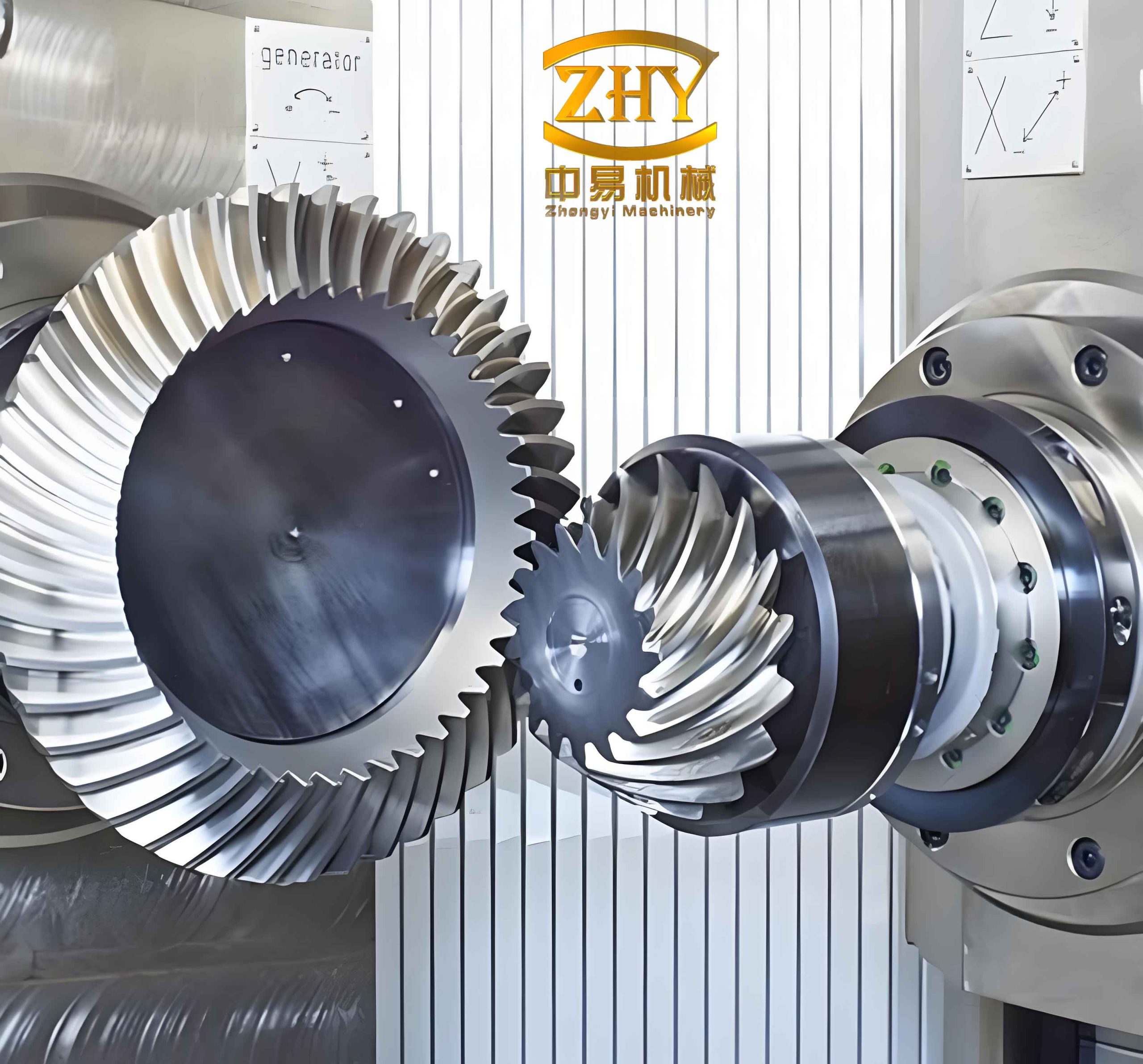
The theoretical foundation for hyperboloid gear design relies on coordinate transformations and surface equations. For a pinion generated by duplex cutting, the tooth surface can be represented using position vectors and normal vectors based on machining parameters. Let’s denote the cutting parameters as $\zeta$, which includes machine settings and cutter parameters. The position vector $\mathbf{r}_L$ and normal vector $\mathbf{n}_L$ for the theoretical pinion tooth surface are given by:
$$\mathbf{r}_L(\zeta, u, \beta, \phi_1) = \mathbf{M}_{1t} \mathbf{r}_t(u)$$
$$\mathbf{n}_L(\zeta, u, \beta, \phi_1) = \frac{\partial \mathbf{r}_L}{\partial u} \times \frac{\partial \mathbf{r}_L}{\partial \beta} \left/ \left\| \frac{\partial \mathbf{r}_L}{\partial u} \times \frac{\partial \mathbf{r}_L}{\partial \beta} \right\| \right.$$
Here, $\mathbf{M}_{1t}$ is the transformation matrix from the cutter coordinate system to the pinion coordinate system, $u$ is the cutter parameter, $\beta$ is the cutter rotation angle, and $\phi_1$ is the pinion rotation angle. The matrix $\mathbf{M}_{1t}$ depends on parameters such as tool inclination angle $i$, tool rotation angle $j$, initial machine angle $\theta_c$, and others. This formulation is essential for modeling hyperboloid gears in manufacturing processes.
To achieve active design, we first generate a conjugate pinion tooth surface from the gear theoretical tooth surface. The gear tooth surface, whether generated or formed, is represented similarly. For a gear made by forming, the surface is:
$$\mathbf{r}_2(u, \beta) = \mathbf{M}_{2t}(\beta) \mathbf{r}_t(u)$$
The conjugate pinion surface $\mathbf{r}_g$ is derived by simulating the meshing between the gear and pinion, incorporating the kinematic relationship $\phi_2 = (z_1/z_2)(\phi_1 – \phi_1^{(0)})$, where $z_1$ and $z_2$ are tooth numbers, and $\phi_1^{(0)}$ and $\phi_2^{(0)}$ are initial angles. The meshing equation is:
$$f_g(u, \beta, \phi_g) = \mathbf{n}_g \cdot \mathbf{v}_g^{(2g)} = 0$$
where $\mathbf{v}_g^{(2g)}$ is the relative velocity. This conjugate surface serves as a baseline for further modifications to meet preset conditions in hyperboloid gear design.
Next, we preset the meshing performance for the hyperboloid gear pair. The transmission error curve is defined as a parabolic function to absorb linear errors from misalignments. For a pinion rotation angle $\phi_1$, the transmission error $\Delta \phi_2(\phi_1)$ is:
$$\Delta \phi_2(\phi_1) = -\delta_{TE} \frac{z_1^2}{\pi^2} (\phi_1 – \phi_1^{(0)})^2$$
where $\delta_{TE}$ is the transmission error at the pitch point. The contact pattern is designed as a straight line on the gear tooth surface projection, with a direction angle $\eta$ and an instantaneous contact ellipse semi-major axis length $a$. This ensures low sensitivity to installation errors. The following table summarizes typical preset parameters for hyperboloid gears:
| Parameter | Drive Side | Coast Side |
|---|---|---|
| Transmission Error $\delta_{TE}$ (arcsec) | 18 | 20 |
| Contact Path Angle $\eta$ (degrees) | 140 | 40 |
| Contact Ellipse Semi-major Axis $a$ (mm) | 4 | 4 |
| Modification Parameter $a’$ | 0 | 0.1 |
To obtain the target pinion tooth surface, we modify the conjugate surface along the contact path and contact line directions. First, we adjust the kinematic relationship to include the preset transmission error: $\phi_2 = \phi_2^{(0)} + (z_1/z_2)(\phi_1 – \phi_1^{(0)}) + \Delta \phi_2(\phi_1)$. This yields a surface $\mathbf{r}_t$ that is line-contact with the gear and satisfies $\Delta \phi_2(\phi_1)$. Then, we apply parabolic modifications along the contact line to control the contact area. The modification curve is divided into two regions: within the contact area and outside it. The normal modification amount $\delta_y$ is defined as:
$$\delta_y = \begin{cases}
-\frac{\delta}{a^2} x^2, & -\frac{l}{2} \leq x \leq \frac{l}{2} \\
-\left( \frac{\delta}{a^2} + a’ \right) x^2 + Y, & x < -\frac{l}{2} \text{ or } x > \frac{l}{2}
\end{cases}$$
where $l = 2a$ is the contact length, $\delta$ is the elastic deformation (typically 0.00635 mm), and $Y = a’ l^2 / 4$. This modification ensures point contact between the hyperboloid gear pair, improving tolerance to misalignments. The target pinion surface $\mathbf{r}_1$ at discrete grid points is:
$$\mathbf{r}_1(k) = \mathbf{r}_t(k) + \delta_y(k) \mathbf{n}_t(k)$$
$$\mathbf{n}_1(k) = \frac{\partial \mathbf{r}_1(k)}{\partial u} \times \frac{\partial \mathbf{r}_1(k)}{\partial \beta} \left/ \left\| \frac{\partial \mathbf{r}_1(k)}{\partial u} \times \frac{\partial \mathbf{r}_1(k)}{\partial \beta} \right\| \right.$$
where $k = 1, 2, \dots, q$ represents grid points on the tooth surface. The normal deviation between the theoretical pinion surface and the target surface is computed as $\delta_{1L}(k) = [\mathbf{r}_1(k) – \mathbf{r}_L(k)] \cdot \mathbf{n}_L(k)$.
The core of the active design for hyperboloid gears involves optimizing the pinion machining parameters to minimize these deviations. Since duplex cutting affects both sides of the hyperboloid gear, we consider adjustments for both the drive and coast sides. The machining parameters include tool geometry and machine settings, such as cutter radius, tool pressure angle, and machine angles. To account for higher-order transmission error, we introduce a third-order polynomial for the generating motion:
$$\phi_{c2}(\phi_1) = \frac{1}{R_a} \phi_1 + C_1 \phi_1^2 + C_2 \phi_1^3$$
where $R_a$ is the gear ratio, and $C_1$ and $C_2$ are coefficients. The optimization model aims to minimize the sum of squared normal deviations for both sides, weighted by a factor $w$ to balance performance. Let $\Delta \zeta$ be the adjustments to machining parameters, with bounds $\chi_1$ and $\chi_2$. The objective function is:
$$\min f(\Delta \zeta) = w f_X + (1-w) f_V$$
$$f_X = \sum_{k=1}^q \delta_{Xk}^2(\mu_X, \beta_X, \phi_X, \Delta \zeta)$$
$$f_V = \sum_{k=1}^q \delta_{Vk}^2(\mu_V, \beta_V, \phi_V, \Delta \zeta)$$
subject to $\Delta \zeta \in [\chi_1, \chi_2]$ and $w \in [0,1]$. Here, $X$ denotes the convex side (drive side) and $V$ denotes the concave side (coast side) of the hyperboloid gear. The weight $w$ can be adjusted based on operational requirements, such as the duration of forward and reverse rotation in applications like vehicle axles. We solve this nonlinear optimization problem using the sequence quadratic programming (SQP) algorithm, which efficiently handles constraints and convergence.
To validate the method, consider a high-speed axle hyperboloid gear pair with the following basic parameters:
| Parameter | Gear (Convex) | Pinion (Concave) |
|---|---|---|
| Shaft Angle (degrees) | 90 | 90 |
| Offset Distance (mm) | 22 | 22 |
| Normal Module at Reference Point (mm) | 3.251 | 3.251 |
| Number of Teeth | 39 | 9 |
| Face Width (mm) | 31 | 31 |
| Pitch Angle (degrees) | 72.026 | 17.325 |
| Spiral Angle at Reference Point (degrees) | 49.997 | 34.046 |
| Pitch Radius at Reference Point (mm) | 76.5 | 22.756 |
The initial machining parameters for the pinion are derived from standard settings, but through active design, we adjust them to approach the target surface. After optimization with $w=0.5$, the adjustments to pinion machining parameters are as follows:
| Parameter | Concave Side Adjustment | Convex Side Adjustment |
|---|---|---|
| Cutter Radius (mm) | 0.0448 | 0.0482 |
| Tool Pressure Angle (arcmin) | 0.0547 | 0.0534 |
| Tool Direction Angle (arcmin) | — | — |
| Edge Radius (mm) | -0.0004 | -0.0001 |
| Tool Inclination Angle (arcmin) | -0.0194 | -0.0194 |
| Tool Rotation Angle (arcmin) | -0.004 | -0.004 |
| Tool Position (mm) | -0.0798 | -0.0798 |
| Initial Machine Angle (arcmin) | 0.0232 | 0.0232 |
| Vertical Wheel Position (mm) | 0.0781 | 0.0781 |
| Wheel Position Correction (mm) | 0.0113 | 0.0113 |
| Bed Position Correction (mm) | 0.0041 | 0.0041 |
| Machine Root Angle (arcmin) | -0.0303 | -0.0303 |
| Gear Ratio Coefficient $C_1$ | 0.0005 | 0.0005 |
| Gear Ratio Coefficient $C_2$ | 0.0003 | 0.0003 |
After applying these adjustments, the normal deviations between the pinion tooth surface and the target surface are minimized. For $w=0.5$, the maximum normal deviations are -4.7 μm for the convex side and -4.67 μm for the concave side, with a sum of squared deviations of 2440.11 μm². This indicates a close match to the target design for the hyperboloid gear. The meshing performance is evaluated through tooth contact analysis (TCA). The results show that the transmission error at the pitch point is 19.2 arcsec for the drive side and 20.8 arcsec for the coast side, deviating by 6.67% and 4% from the preset values, respectively. The contact path deviations are within 0.275 mm for the convex side and 0.177 mm for the concave side, and the contact patterns are located in the desired regions (36% to 66.3% of face width for convex side, 34.9% to 72.1% for concave side). These outcomes confirm that the active design method effectively achieves the preset conditions for hyperboloid gears.
The active design approach offers several advantages for hyperboloid gear manufacturing. By pre-controlling transmission error and contact pattern, it reduces noise and improves durability. The use of optimization allows for precise adjustments in duplex cutting, which is critical for mass production. Moreover, the method can be extended to other gear types, such as spiral bevel gears, by adapting the surface equations. Future work may focus on incorporating higher-order transmission error curves or dynamic load considerations. In summary, this methodology provides a robust framework for designing hyperboloid gears with enhanced performance, leveraging mathematical modeling and advanced optimization techniques.
In conclusion, I have detailed an active tooth surface design process for cycloid hyperboloid gears using duplex cutting. The process involves preset meshing performance, generation of conjugate surfaces, bidirectional modification, and parameter optimization. The hyperboloid gear pair designed through this method exhibits improved transmission error and contact patterns, validating the approach. This work underscores the importance of active design in advancing hyperboloid gear technology for applications in automotive and industrial machinery. Further research could explore real-time adaptive manufacturing or integration with digital twins for hyperboloid gear systems.