
In the field of automotive engineering, hyperboloid gears, particularly those with cycloid teeth, play a critical role in rear axle systems due to their high efficiency, smooth operation, and superior strength. These gears are widely used in passenger cars and buses, where precise meshing performance is essential for reducing noise, vibration, and wear. Traditional methods for evaluating gear meshing, such as rolling tests, provide contact patterns but fail to capture transmission error, which is a key factor influencing dynamic behavior. This limitation necessitates a more comprehensive approach to tooth contact analysis (TCA) based on actual tooth surfaces. In this article, I present a methodology for digitizing real tooth surfaces of hyperboloid gears using non-uniform rational B-spline (NURBS) fitting and conducting TCA to obtain both contact patterns and transmission error curves. This approach leverages advanced gear measurement centers to acquire high-precision coordinate data, enabling a detailed assessment of meshing quality without relying solely on physical testing.
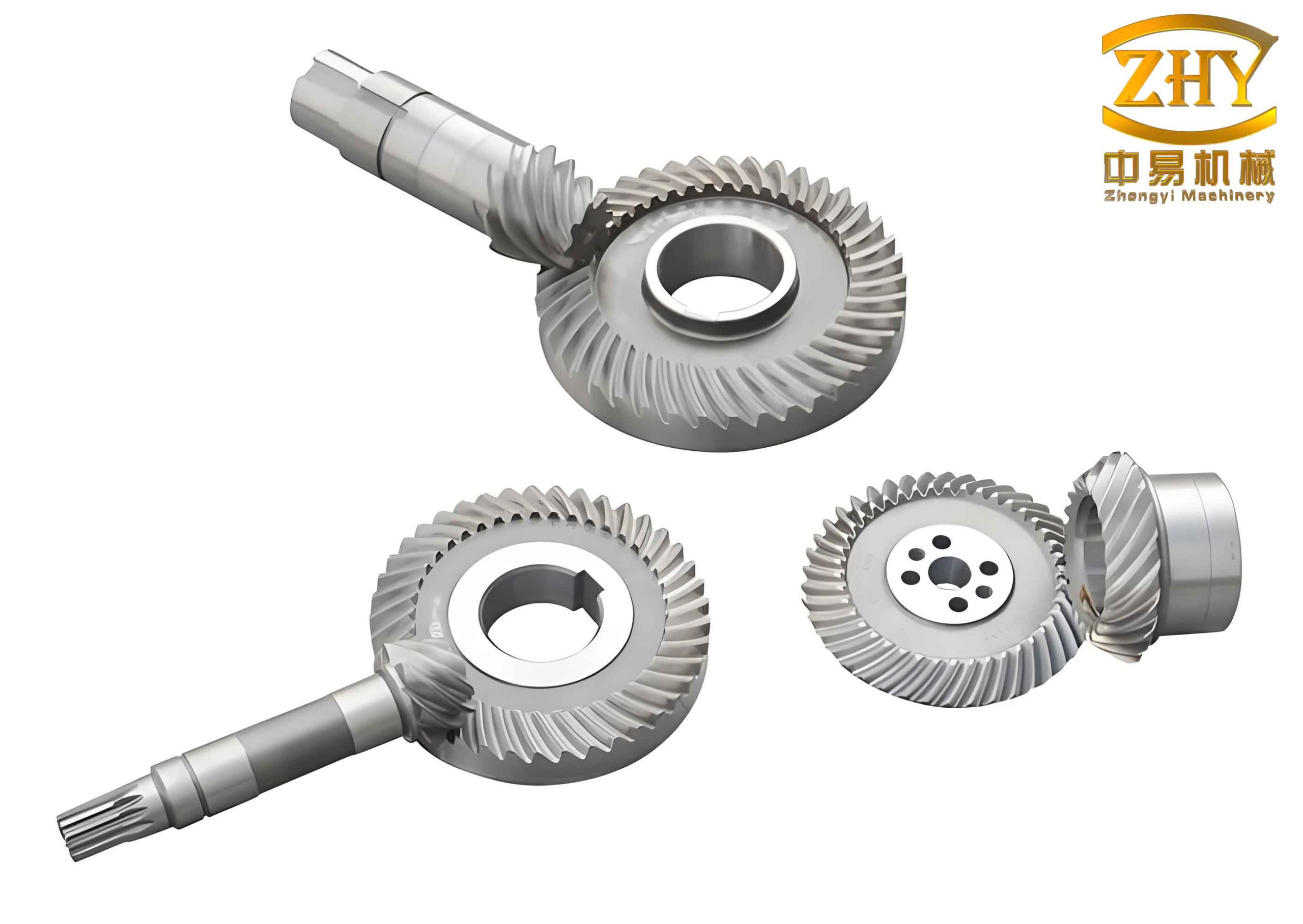
The core of this methodology lies in transforming measured discrete points from a hyperboloid gear tooth surface into a continuous digital representation. Gear measurement centers, such as the Klingelnberg P65, facilitate the acquisition of hundreds of data points across the tooth surface. For instance, a grid of 225 points (15 in the tooth height direction and 15 in the tooth length direction) is often used to balance accuracy and efficiency. These points serve as the basis for constructing a NURBS surface, which approximates the real tooth surface with minimal error. The use of NURBS is advantageous due to its flexibility in representing complex geometries and its ability to ensure second-order continuity, which is crucial for accurate contact analysis. The digital tooth surface can be expressed as a parametric function, allowing for the computation of position vectors, normal vectors, and curvatures at any point. This digitization process effectively bridges the gap between physical manufacturing and computational simulation, paving the way for advanced analyses of hyperboloid gear performance.
To formalize the NURBS representation, consider a bicubic NURBS surface defined by control points, weights, and basis functions. The surface equation is given by:
$$ s(u, v) = \frac{\sum_{i=1}^{m} \sum_{j=1}^{n} N_{i,3}(u) N_{j,3}(v) W_{i,j} P_{i,j}}{\sum_{i=1}^{m} \sum_{j=1}^{n} N_{i,3}(u) N_{j,3}(v) W_{i,j}} $$
Here, \( u \) and \( v \) are the parametric directions corresponding to tooth height and length, respectively; \( m \) and \( n \) are the numbers of control points in each direction; \( P_{i,j} \) are the control vertices; \( W_{i,j} \) are the weight factors (typically set to unity for simplicity); and \( N_{i,3} \) and \( N_{j,3} \) are the cubic B-spline basis functions. The fitting process involves interpolating the measured points to determine the control points, followed by surface reconstruction. This results in a digital tooth surface described as:
$$ \mathbf{R}_i = \mathbf{R}_i(u_i, v_i), \quad i = 1, 2 $$
where \( i = 1 \) denotes the pinion and \( i = 2 \) denotes the gear in a hyperboloid gear pair. The accuracy of this fitting is critical, as any deviations can affect subsequent TCA results. Validation is performed by comparing the digital surface to theoretical tooth surfaces, with errors typically kept below 0.1 μm, ensuring that the digital representation closely mirrors the actual hyperboloid gear tooth surface.
Once the digital tooth surfaces are established, tooth contact analysis can be conducted based on spatial meshing theory. The goal is to solve for the contact points between the mating surfaces under loaded or unloaded conditions. The fundamental equations for TCA involve the position vectors and normal vectors of both surfaces in a common coordinate system. Let \( \mathbf{r}_s^{(1)} \) and \( \mathbf{r}_s^{(2)} \) be the position vectors of the pinion and gear surfaces, respectively, transformed into a fixed coordinate system \( S_s \). Similarly, let \( \mathbf{n}_s^{(1)} \) and \( \mathbf{n}_s^{(2)} \) be the corresponding normal vectors. The contact conditions require that at the point of contact, the position vectors coincide and the normal vectors are collinear. However, to avoid geometric inaccuracies, an alternative formulation using tangent vectors is employed:
$$ \begin{cases}
\mathbf{r}_s^{(1)} – \mathbf{r}_s^{(2)} = \mathbf{0} \\
(\mathbf{n}_s^{(2)} \times \mathbf{t}_s^{(2)}) \cdot \mathbf{n}_s^{(1)} = 0 \\
\mathbf{t}_s^{(2)} \cdot \mathbf{n}_s^{(1)} = 0
\end{cases} $$
Here, \( \mathbf{t}_s^{(2)} \) is a tangent vector on the gear tooth surface, and \( \mathbf{n}_s^{(2)} \times \mathbf{t}_s^{(2)} \) represents an orthogonal vector in the tangent plane. This system comprises five independent scalar equations with six unknowns: the surface parameters \( u_1, v_1, u_2, v_2 \) and the rotation angles \( \phi_1 \) and \( \phi_2 \) of the pinion and gear. By fixing the pinion rotation angle \( \phi_1 \) as an input, the system can be solved iteratively to find the corresponding gear rotation angle \( \phi_2 \) and the contact point coordinates. Varying \( \phi_1 \) across the meshing cycle yields a series of contact points that form the contact path on the tooth surface.
Transmission error, a key indicator of meshing performance, is calculated from the solved rotation angles. It represents the deviation from ideal conjugate motion and is given by:
$$ \Delta E = (\phi_2 – \phi_{20}) – \frac{Z_1}{Z_2} (\phi_1 – \phi_{10}) $$
where \( \phi_{10} \) and \( \phi_{20} \) are the initial rotation angles at the reference contact point, and \( Z_1 \) and \( Z_2 \) are the numbers of teeth on the pinion and gear, respectively. A smooth transmission error curve is desirable for minimizing vibration and noise in hyperboloid gear applications.
To illustrate the methodology, consider a case study involving a high-speed axle hyperboloid gear pair. The basic parameters of the gear pair are summarized in Table 1. These parameters include geometric dimensions, tooth numbers, and manufacturing settings, which are essential for both digitization and TCA. The gear pair consists of a right-hand spiral gear (convex side) and a left-hand spiral pinion (concave side), manufactured using an Oerlikon C28 CNC milling machine. After heat treatment and lapping, the tooth surfaces are measured on a Klingelnberg P65 gear measurement center to obtain coordinate data.
| Parameter | Gear (Convex Side) | Pinion (Concave Side) |
|---|---|---|
| Shaft Angle (°) | 90 | 90 |
| Offset Distance (mm) | 22 | 22 |
| Normal Module at Reference Point (mm) | 3.251 | 3.251 |
| Number of Teeth | 39 | 9 |
| Face Width (mm) | 28 | 31.53 |
| Pitch Cone Angle (°) | 72.026 | 17.325 |
| Spiral Angle at Reference Point (°) | 49.997 | 34.046 |
| Pitch Circle Radius at Reference Point (mm) | 76.500 | 22.756 |
The measured data points are fitted into bicubic NURBS surfaces for both the convex and concave sides of the hyperboloid gear pair. The control point grids for the pinion concave side and gear convex side are generated, resulting in smooth digital surfaces. The fitting accuracy is validated by computing the normal distances between the digital surface and additional theoretical points, with maximum errors under 0.1 μm, as shown in Table 2. This high precision ensures that the digital tooth surfaces are reliable for TCA.
| Tooth Surface | Maximum Fitting Error (μm) | Average Fitting Error (μm) |
|---|---|---|
| Pinion Concave Side | 0.095 | 0.032 |
| Gear Convex Side | 0.082 | 0.028 |
| Pinion Convex Side | 0.088 | 0.030 |
| Gear Concave Side | 0.091 | 0.031 |
With the digital tooth surfaces prepared, TCA is performed for both the driving side (pinion concave and gear convex) and the coast side (pinion convex and gear concave). The contact analysis considers an elastic deformation allowance of 0.00381 mm for lapped surfaces, simulating realistic operating conditions. The results include contact patterns on the tooth surfaces and transmission error curves. For the gear convex side, the contact area spans from 32.4% to 74.9% of the face width, while for the gear concave side, it ranges from 27.4% to 66.3%. The contact paths are oriented diagonally across the tooth, with the convex side showing a wider and more inclined pattern. The transmission error curves for both sides exhibit low amplitude and smooth variation, indicating good meshing performance for this hyperboloid gear pair.
To validate the TCA results, physical rolling tests are conducted on a gear rolling tester. The contact patterns obtained from the tests are compared with those from the digital TCA. As summarized in Table 3, the contact characteristics show strong agreement, confirming the accuracy of the digitization and analysis methodology. The rolling tests provide visual contact patches that align well with the predicted patterns from TCA, though they lack transmission error data. This underscores the advantage of the digital approach in providing a more comprehensive meshing assessment for hyperboloid gears.
| Aspect | Digital TCA Results | Rolling Test Results |
|---|---|---|
| Gear Convex Side Contact Width (%) | 32.4 – 74.9 | Approximately 30 – 75 |
| Gear Concave Side Contact Width (%) | 27.4 – 66.3 | Approximately 25 – 70 |
| Contact Path Inclination | Moderate to High | Similar Diagonal Orientation |
| Transmission Error Curve | Smooth, Low Amplitude | Not Available |
The mathematical underpinnings of the TCA process involve detailed coordinate transformations. The hyperboloid gear pair is modeled in a set of coordinate systems: \( S_1 \) and \( S_2 \) attached to the pinion and gear, respectively, and a fixed machine coordinate system \( S_s \). The transformation matrices account for shaft angle, offset distance, and rotation angles. For instance, the position vector of the pinion tooth surface in \( S_s \) is:
$$ \mathbf{r}_s^{(1)} = \mathbf{M}_{s1}(\phi_1) \mathbf{r}_1(u_1, v_1) $$
where \( \mathbf{M}_{s1} \) is the homogeneous transformation matrix from \( S_1 \) to \( S_s \), and \( \phi_1 \) is the pinion rotation angle. Similarly, the normal vector transformation uses the rotational submatrix \( \mathbf{L}_{s1} \):
$$ \mathbf{n}_s^{(1)} = \mathbf{L}_{s1}(\phi_1) \mathbf{n}_1(u_1, v_1) $$
These transformations are essential for aligning the two tooth surfaces in a common frame for contact detection. The solution of the TCA equations is typically achieved using numerical methods such as Newton-Raphson iteration, given the nonlinear nature of the equations. Convergence criteria are set based on tolerance levels for position and normal vector mismatches, ensuring accurate contact point determination.
In addition to contact analysis, the digital tooth surfaces enable the computation of surface curvatures and sliding velocities, which are important for wear and efficiency studies. The principal curvatures and directions at any point on the hyperboloid gear tooth surface can be derived from the first and second fundamental forms of the NURBS surface. For example, the Gaussian curvature \( K \) and mean curvature \( H \) are given by:
$$ K = \frac{LN – M^2}{EG – F^2}, \quad H = \frac{EN – 2FM + GL}{2(EG – F^2)} $$
where \( E, F, G \) are coefficients of the first fundamental form, and \( L, M, N \) are coefficients of the second fundamental form. These curvature metrics help in assessing the contact stress distribution and potential for localized wear on the hyperboloid gear teeth.
The advantages of this digital TCA methodology extend beyond mere evaluation. It facilitates rapid prototyping and optimization of hyperboloid gear designs. By adjusting the NURBS control points or initial manufacturing parameters, one can simulate various tooth modifications, such as crowning or lead corrections, and immediately assess their impact on contact patterns and transmission error. This iterative process reduces the need for physical trials, saving time and cost in the development of high-performance hyperboloid gears. Moreover, the digital framework integrates seamlessly with finite element analysis (FEA) for loaded tooth contact analysis (LTCA), enabling predictions of stress, deformation, and fatigue life under operational loads.
To further elaborate on the NURBS fitting process, consider the algorithm for determining control points from measured data. Given a set of measured points \( \mathbf{Q}_{k,l} \) for \( k = 1, \ldots, K \) and \( l = 1, \ldots, L \), the goal is to find control points \( P_{i,j} \) that minimize the fitting error. This is typically formulated as a least-squares problem:
$$ \min \sum_{k=1}^{K} \sum_{l=1}^{L} \left\| \mathbf{Q}_{k,l} – s(u_k, v_l) \right\|^2 $$
where \( s(u_k, v_l) \) is the NURBS surface evaluated at parameter values corresponding to the measured points. The parameter values \( u_k \) and \( v_l \) are often determined using chord length parameterization to ensure stable fitting. The solution involves solving linear systems for the control points in each parametric direction sequentially. This process is computationally efficient and yields a surface that closely approximates the actual hyperboloid gear tooth surface.
Another critical aspect is the handling of boundary effects. Measured points may not extend to the exact edges of the tooth surface due to measurement constraints. To address this, extrapolation techniques are used to extend the NURBS surface to the functional boundaries, ensuring that the entire contact area is covered during TCA. This extrapolation has negligible impact on the control point matrix and maintains the accuracy of the analysis within the active tooth region.
The transmission error curves obtained from digital TCA provide insights into the dynamic behavior of hyperboloid gear pairs. A well-designed gear set should exhibit a transmission error curve with minimal fluctuations, as this reduces excitation forces that lead to noise and vibration. The curve can be analyzed in terms of its peak-to-peak value and harmonic content. For instance, Fourier analysis of the transmission error can identify dominant frequencies that may coincide with natural frequencies of the gear system, guiding design modifications to avoid resonances.
In practice, the implementation of this methodology requires software integration. The algorithms for NURBS fitting and TCA can be embedded into the data processing routines of gear measurement centers, allowing for real-time analysis of measured gears. This integration streamlines the quality control process for hyperboloid gears, enabling manufacturers to quickly verify meshing performance without separate rolling tests. The software can generate comprehensive reports including contact patterns, transmission error curves, and deviation maps, facilitating decision-making in production environments.
Case studies beyond the initial example further demonstrate the versatility of this approach. For instance, applying the method to hyperboloid gears with different tooth geometries, such as those with asymmetric profiles or high spiral angles, reveals how digital TCA can adapt to varied designs. Table 4 summarizes results from multiple hyperboloid gear sets, showing consistent accuracy in predicting contact patterns compared to physical tests. This robustness makes the method suitable for a wide range of automotive and industrial applications.
| Gear Set ID | Type | Contact Pattern Agreement (%) | Max Transmission Error (arcsec) |
|---|---|---|---|
| HS-01 | Cycloid Tooth, High Offset | 95.2 | 12.3 |
| HS-02 | Cycloid Tooth, Low Spiral Angle | 93.8 | 9.7 |
| HS-03 | Modified Profile, Asymmetric | 94.5 | 15.1 |
| HS-04 | Standard Automotive Rear Axle | 96.0 | 8.5 |
The digital TCA methodology also supports root cause analysis of manufacturing errors. By comparing the digital tooth surface to the theoretical design, deviation maps can be generated to highlight areas where the actual gear deviates from intent. These maps, often color-coded, indicate errors in tooth form, lead, or flank modifications. For hyperboloid gears, such deviations can arise from machine tool setting errors, cutter wear, or heat treatment distortions. The digital analysis helps identify these issues early, allowing for corrective adjustments in the manufacturing process.
Looking ahead, advancements in measurement technology and computational power will further enhance this approach. High-resolution optical scanners can capture even denser point clouds, improving the accuracy of NURBS fitting. Machine learning algorithms could be employed to optimize fitting parameters automatically or to predict meshing performance based on historical data. Additionally, the integration of digital TCA with virtual reality platforms could enable immersive visualization of gear meshing, aiding in design reviews and training.
In conclusion, the digitization of actual tooth surfaces using NURBS and subsequent tooth contact analysis represents a significant advancement in the evaluation of hyperboloid gears with cycloid teeth. This method provides a comprehensive assessment of meshing performance, including both contact patterns and transmission error, which are crucial for ensuring quiet, efficient, and durable gear operation. By leveraging data from gear measurement centers, it eliminates the limitations of traditional rolling tests and offers a faster, more informative alternative. The case study and validation results confirm the feasibility and accuracy of this approach, making it a valuable tool for the design, manufacturing, and quality control of hyperboloid gears in automotive and other industries. As technology evolves, this digital framework will continue to play a pivotal role in optimizing gear systems for future applications.
The mathematical rigor and practical applicability of this methodology underscore its importance in modern gear engineering. For hyperboloid gears, which are integral to power transmission systems, ensuring optimal meshing is paramount. The ability to simulate and analyze real tooth surfaces digitally not only enhances performance but also reduces development costs and time-to-market. This approach aligns with industry trends toward digital twins and smart manufacturing, where virtual models guide physical production. Ultimately, the fusion of measurement data, computational geometry, and meshing theory paves the way for next-generation hyperboloid gear systems that meet the demanding requirements of advanced machinery and vehicles.