
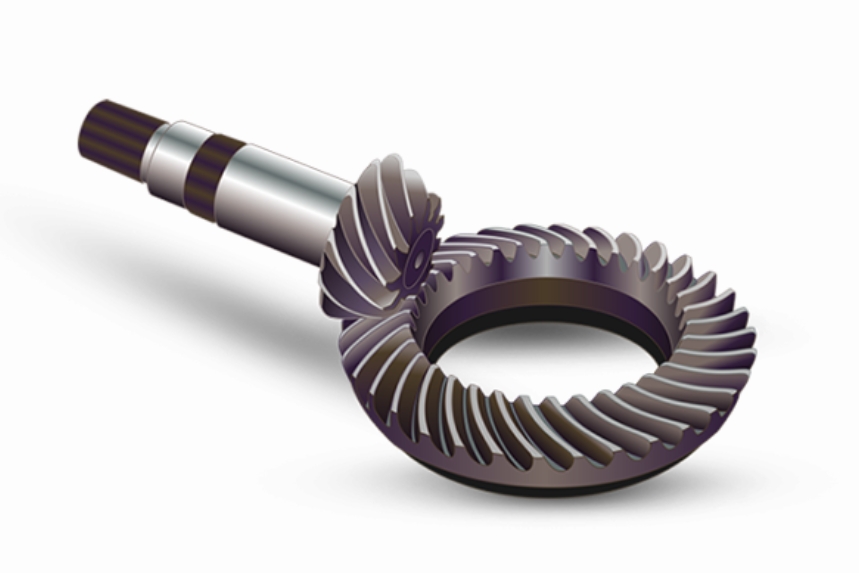
In my extensive experience with mechanical transmission systems, the spiral bevel gear stands out as a critical component due to its smooth operation, high load-bearing capacity, and low noise characteristics. These gears are widely used in automotive, engineering equipment, and agricultural machinery applications. However, the complexity of their meshing principles and the stringent assembly adjustments required in critical applications directly impact transmission stability and service life. Mastering the correct adjustment methods for spiral bevel gears is essential for ensuring quality, reducing noise, and extending longevity in machinery.
The adjustment of the contact pattern, or imprint, on spiral bevel gear teeth is notoriously tedious. For instance, altering the installation distance of the pinion (small spiral bevel gear) often necessitates changes to the ring gear (large spiral bevel gear) installation distance, along with adjustments to bearing preload shims. This process can involve multiple disassembly and reassembly cycles, increasing workload and disrupting production节奏. Through years of practice, I have explored and analyzed the assembly adjustment methods and pattern variation rules for spiral bevel gears, summarizing effective techniques for various models to provide technical support for rapid adjustment in production.
Fundamentals of Spiral Bevel Gear Contact Pattern Adjustment
Spiral bevel gears primarily follow the Gleason system with contracted teeth. They are classified into two types based on axis intersection: the arc tooth bevel gear, where the pinion and ring gear axes intersect, and the hypoid spiral bevel gear, where the axes are offset. The hypoid type allows for greater design flexibility but introduces additional complexity in adjustment.
The contact pattern must be positioned near the toe (small end) of the tooth under no-load conditions. This is because under load, elastic deformations in the gears, bearings, and housing cause the pattern to shift toward the heel (large end) and edges. Design specifications typically mandate that the pattern be located toward the toe to ensure even distribution across the entire tooth surface under operational loads. A qualified pattern is generally elliptical, covering approximately 50% of both tooth height and length, centered slightly toward the toe and mid-height.
The assembly adjustment sequence for a spiral bevel gear pair is methodical: first, determine the shim thickness for the pinion installation distance; second, adjust the preload of the pinion’s tapered bearings; third, adjust the preload of the ring gear’s tapered bearings; fourth, set the backlash between the meshing gears; and finally, adjust the contact pattern. If the pattern is unsatisfactory, it can be corrected by modifying the installation distances of both gears. This sequence is crucial, as each step influences the others.
Mathematical Modeling and Adjustment Principles
To quantitatively understand adjustment effects, we can model the relationship between installation distances and contact pattern movement. Let \( \Delta P \) represent the change in pinion installation distance (positive for moving away from the ring gear), and \( \Delta R \) represent the change in ring gear installation distance. The contact pattern shift on the ring gear tooth surface can be described in terms of longitudinal (along tooth length) and height (along tooth profile) directions.
For a typical spiral bevel gear with spiral angle \( \beta \), the pattern displacement \( \delta_L \) longitudinally and \( \delta_H \) in height can be approximated by:
$$ \delta_L = k_{L,P} \cdot \Delta P + k_{L,R} \cdot \Delta R $$
$$ \delta_H = k_{H,P} \cdot \Delta P + k_{H,R} \cdot \Delta R $$
where \( k_{L,P}, k_{L,R}, k_{H,P}, k_{H,R} \) are influence coefficients dependent on gear geometry, such as spiral angle, pressure angle, and tooth curvature. Empirical studies show that for many spiral bevel gears, changing the pinion installation distance primarily affects the longitudinal position (\( k_{L,P} \) is significant), while changing the ring gear installation distance primarily affects the height position (\( k_{H,R} \) is significant). This aligns with practical observations summarized later.
Backlash \( B \) is also affected by installation distances. The relationship can be expressed as:
$$ B = B_0 + c_P \cdot \Delta P + c_R \cdot \Delta R $$
where \( B_0 \) is the initial backlash, and \( c_P, c_R \) are coefficients typically positive, meaning increasing installation distances increases backlash.
These formulas highlight the interconnected nature of adjustments. When optimizing the contact pattern, one must consider backlash changes and potentially iterate.
Case Studies and Pattern Variation Rules
In one project involving an agricultural gearbox, the ring gear had 63 teeth, module 7.899, right-hand spiral angle 34°51′, and no offset. Initial assembly showed an unacceptable contact pattern: on the convex side of the ring gear tooth, the pattern was near the heel, while on the concave side, it was near the toe. After ruling out part tolerances, multiple adjustments failed. Upon checking the gear pair on a dedicated testing machine calibrated with gauge blocks for pinion distance and height settings for the ring gear, the pattern remained faulty, indicating a fundamental issue in gear cutting or machine calibration. It was deduced that the ring gear installation axis was higher than intended relative to the pinion axis during cutting. This necessitated scrapping and re-cutting the pinion gears to match corrected settings, after which assembly yielded a proper pattern.
Later, during trial assembly of the same product, another pattern issue arose: the pattern was escaping from the toe, with a vague contact area in the middle. By increasing the pinion installation distance by 0.3 mm, the pattern improved, with the vague area disappearing, but it shifted slightly toward the root. Subsequently, adjusting the ring gear installation distance to increase backlash from 0.18 mm to 0.33 mm brought the pattern to specification. From these trials, I derived the following adjustment rules for the convex side contact pattern of the ring gear in a spiral bevel gear pair, summarized in the table below.
| Pattern Observation | Initial Adjustment | Subsequent Adjustment | Expected Pattern Movement |
|---|---|---|---|
| Pattern合格 (elliptical, ~50% coverage, mid-length near toe, mid-height) | No change needed | None | Stable |
| Pattern near root | Increase pinion distance (move pinion away from ring gear) | Adjust backlash (typically increase) | Toward tip |
| Pattern near tip | Decrease pinion distance (move pinion toward ring gear) | Adjust backlash (typically decrease) | Toward root |
| Pattern near toe (small end) | Decrease pinion distance | Adjust backlash | Toward heel (large end) |
| Pattern near heel (large end) | Increase pinion distance | Adjust backlash | Toward toe |
Another case involved a hypoid spiral bevel gear for an automotive rear axle reducer, with ring gear teeth 38, module 10.132, spiral angle 33°47′, and pinion offset downward by 35 mm. Adjustment patterns were similar, reinforcing the above rules. However, spiral bevel gear contact pattern adjustment is complex, as changes in height, length, and backlash are interdependent. Modifying one parameter can slightly alter others, sometimes improving or worsening the overall condition. Therefore, adjustment priorities must be established: contact pattern position takes precedence over backlash; tooth height position takes precedence over tooth length position; the drive side (convex for ring gear in many designs) pattern takes precedence over the coast side; backlash can be slightly larger but not too small; the pattern should be toward the toe (5–10 mm from toe) and not escape the tip (1–3 mm from tip), avoiding edges.
Advanced Considerations and Formula Derivation
To deepen understanding, let’s consider the geometry of a spiral bevel gear. The tooth surface can be represented parametrically. For a Gleason spiral bevel gear, the surface coordinates depend on machine settings during cutting. The contact pattern is essentially the projection of the contact ellipse onto the tooth surface under given assembly misalignments.
The misalignment parameters include changes in shaft angle \( \Delta \Sigma \), offset \( \Delta E \), and installation distances \( \Delta P \) and \( \Delta R \). Using tooth contact analysis (TCA) theory, the contact ellipse center shift can be computed. A simplified linear model for small adjustments is:
$$ \begin{bmatrix} \Delta X \\ \Delta Y \end{bmatrix} = \mathbf{J} \begin{bmatrix} \Delta P \\ \Delta R \\ \Delta \Sigma \\ \Delta E \end{bmatrix} $$
where \( \Delta X \) and \( \Delta Y \) are pattern center coordinates on the tooth surface (longitudinal and height directions), and \( \mathbf{J} \) is a Jacobian matrix derived from gear geometry. For most assembly adjustments, shaft angle and offset are fixed, so we focus on \( \Delta P \) and \( \Delta R \). From TCA simulations, the influence coefficients can be estimated. For example, for a gear with spiral angle \( \beta = 35^\circ \), pressure angle \( \alpha = 20^\circ \), typical values might be:
$$ k_{L,P} \approx 0.8 \, \text{mm/mm}, \quad k_{L,R} \approx 0.2 \, \text{mm/mm} $$
$$ k_{H,P} \approx 0.1 \, \text{mm/mm}, \quad k_{H,R} \approx 0.6 \, \text{mm/mm} $$
These values justify the empirical rules: pinion distance change strongly affects longitudinal movement, while ring gear distance change strongly affects height movement.
Backlash sensitivity can be modeled similarly. The backlash change per unit installation distance change depends on the normal tooth thickness and pressure angle. Approximating:
$$ c_P \approx \frac{2 \tan \alpha_n}{\cos \beta}, \quad c_R \approx \frac{2 \tan \alpha_n}{\cos \beta} $$
where \( \alpha_n \) is the normal pressure angle. For \( \alpha_n = 20^\circ \), \( \beta = 35^\circ \), \( c_P \approx c_R \approx 0.5 \, \text{mm/mm} \).
Implementation Results and Practical Insights
Through repeated testing, measurement, and adjustment, I have accumulated substantial data and mastered pattern variation laws. This provides robust technical support for daily assembly of spiral bevel gear pairs. Two key insights emerged:
- When the contact patterns on the convex and concave sides of a spiral bevel gear are asymmetrical and cannot be corrected by changing installation distance shims, the root cause may be gear quality issues (e.g., cutting errors) or housing machining inaccuracies. This often requires re-cutting or part replacement.
- The adjustment规律 confirms that altering the ring gear installation distance has a negligible effect on the longitudinal pattern position but a significant impact on height position; conversely, altering the pinion installation distance markedly affects the longitudinal position with minimal height effect. This is summarized in the table below, which compares adjustment actions for common pattern defects.
| Defect Observed on Ring Gear Tooth | Primary Adjustment Action | Effect on Pattern Longitudinally | Effect on Pattern in Height | Typical Backlash Change |
|---|---|---|---|---|
| Pattern too close to heel | Increase pinion distance | Shifts toward toe (strong) | Minimal shift toward root | Increases |
| Pattern too close to toe | Decrease pinion distance | Shifts toward heel (strong) | Minimal shift toward tip | Decreases |
| Pattern too close to root | Increase ring gear distance | Minimal shift | Shifts toward tip (strong) | Increases |
| Pattern too close to tip | Decrease ring gear distance | Minimal shift | Shifts toward root (strong) | Decreases |
| Pattern too large (over 60% coverage) | Decrease both distances slightly | Contracts pattern | Contracts pattern | Decreases significantly |
| Pattern too small (under 40% coverage) | Increase both distances slightly | Expands pattern | Expands pattern | Increases significantly |
These insights enable efficient troubleshooting. For instance, if a pattern is both near the heel and near the root, a combined adjustment of increasing pinion distance and increasing ring gear distance might be needed, followed by backlash correction. The process often requires iteration, but following the priorities minimizes trials.
Conclusion and Future Directions
The adjustment of contact patterns in spiral bevel gears is a nuanced task that blends theoretical knowledge with practical skill. By understanding the geometric relationships and employing systematic adjustment rules, assembly quality can be consistently achieved. The mathematical models and tables provided here serve as a guide for engineers working with spiral bevel gears in various industries. Future work could involve developing automated adjustment systems based on real-time pattern analysis, further reducing production time. As machinery demands higher performance, mastering these adjustments for spiral bevel gears remains paramount for ensuring reliability and efficiency.
In summary, the key to successful spiral bevel gear assembly lies in meticulous attention to contact pattern behavior, backed by empirical rules and mathematical insights. Through continuous practice and analysis, I have refined these methods to enhance production outcomes, demonstrating that even complex adjustments can be streamlined with the right approach.