
In the realm of gear transmission systems, spiral bevel gears play a pivotal role due to their ability to transmit power between intersecting shafts with high efficiency and smooth operation. The quality of spiral bevel gear performance is heavily influenced by the contact pattern formed between the mating teeth. As an engineer specializing in gear design and manufacturing, I have observed that improper contact patterns can lead to increased noise, reduced lifespan, and premature failure. Therefore, understanding and adjusting the contact pattern of spiral bevel gears is critical. This article delves into the importance of contact pattern adjustment, explores the correct positioning of the contact area, analyzes the laws governing its changes on rolling testers, and details various correction methods on gear cutting machines. Throughout this discussion, I will emphasize the significance of spiral bevel gears in applications such as automotive drive axles and heavy machinery, where precise contact ensures optimal performance.
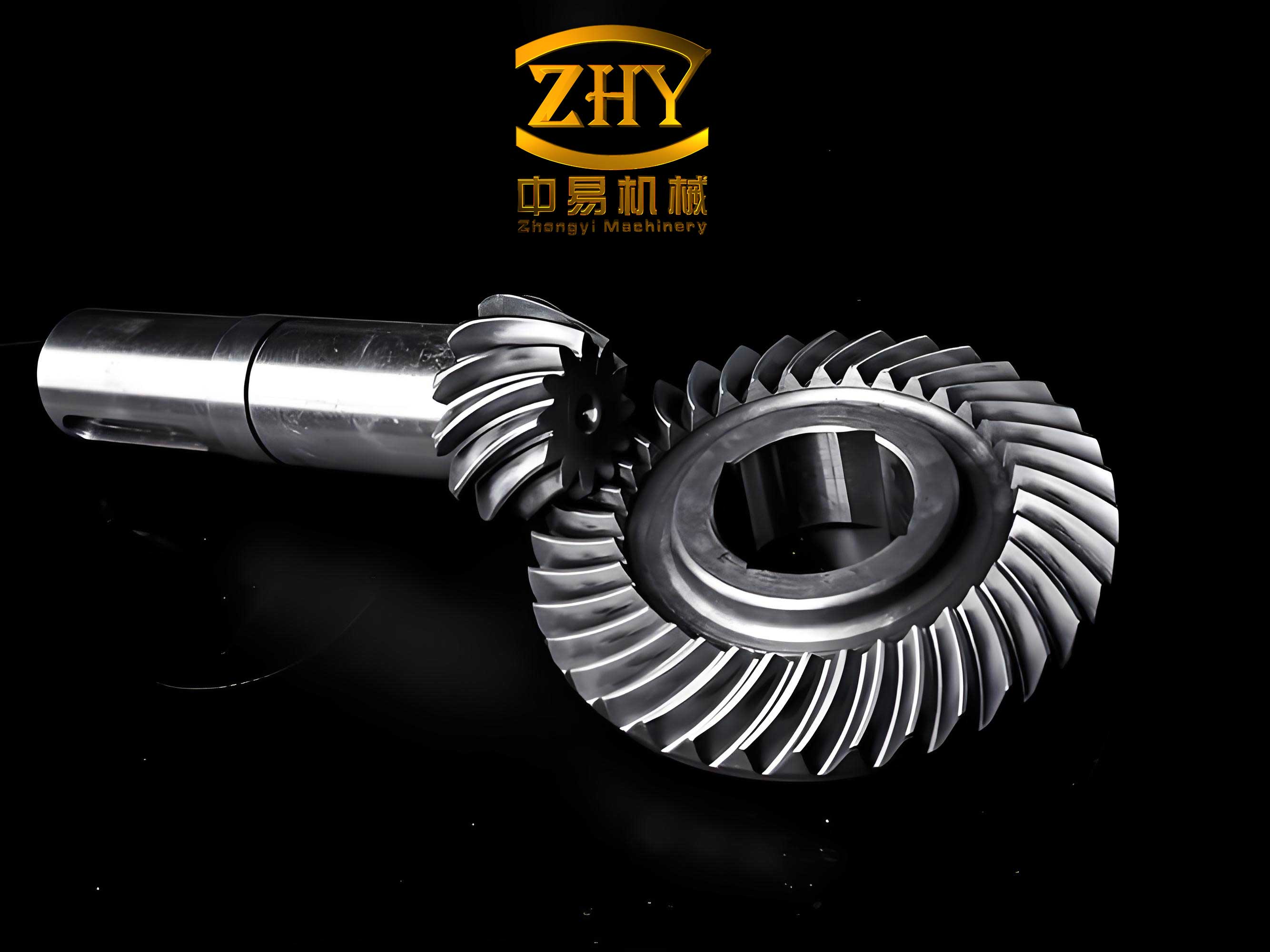
The contact pattern on spiral bevel gears refers to the area where the teeth of the pinion and gear mesh under load. Its position, size, and shape directly affect the operational stability, load-bearing capacity, and acoustic emissions of the gear pair. For spiral bevel gears, which are characterized by curved teeth that engage gradually, the contact pattern must be meticulously controlled to avoid edge loading, which can cause stress concentrations and pitting. In my experience, a well-adjusted contact pattern ensures that multiple teeth share the load, thereby enhancing durability and reducing vibration. This is particularly important for spiral bevel gears used in high-speed and high-torque environments, where any misalignment can lead to catastrophic failures. Thus, the adjustment process is not merely a finishing step but a fundamental aspect of spiral bevel gear manufacturing that demands precision and expertise.
To begin, let’s consider the ideal contact pattern for spiral bevel gears. Under no-load conditions, the contact area should be positioned slightly toward the toe (small end) of the tooth and centered in height, as the pattern will shift toward the heel (large end) and expand slightly under operational loads. For spiral bevel gears, the ideal contact pattern typically covers 40% to 60% of the tooth length and about 60% of the tooth height. This positioning compensates for deflections and thermal expansions during operation, ensuring that the contact remains within the tooth flank under load. For gears like the G-type extended epicycloidal spiral bevel gears, the pattern should be centered toward the toe, while for N-type variants, it should be biased toward the heel and root due to different load-induced shifts. Achieving this ideal pattern requires careful adjustment during cutting and finishing processes, which I will elaborate on later.
The behavior of the contact pattern can be studied on a rolling tester, where the relative positions of the pinion and gear are altered to simulate misalignments. By observing how the pattern changes, engineers can diagnose errors and determine the necessary corrections on the gear cutting machine. For spiral bevel gears, it is common to inspect the contact pattern on the gear teeth, as they provide a clearer view, but adjustments are often made by recutting the pinion due to its fewer teeth and shorter machining time. The following table summarizes the规律 of contact pattern changes for a left-hand spiral bevel gear pinion when the relative positions are modified on the rolling tester. This knowledge is essential for spiral bevel gear adjustment, as it guides the correction process.
| Adjustment Parameter | Effect on Concave Flank (Along Height) | Effect on Concave Flank (Along Length) | Effect on Convex Flank (Along Length) |
|---|---|---|---|
| Increase Mounting Distance (+ΔH) | Shifts from tip to root (significant effect) | Moves toward toe (minor effect) | Moves toward heel (minor effect) |
| Decrease Mounting Distance (-ΔH) | Shifts from root to tip (significant effect) | Moves toward heel (minor effect) | Moves toward toe (minor effect) |
| Positive Offset (+ΔV) | Shifts from tip to root (minor effect) | Moves from heel to toe (significant effect) | Moves from toe to heel (significant effect) |
| Negative Offset (-ΔV) | Shifts from root to tip (minor effect) | Moves from toe to heel (significant effect) | Moves from heel to toe (significant effect) |
Note: For a right-hand spiral bevel gear, the patterns along the length方向 are reversed, while height方向 changes remain the same. These规律 are applicable to both standard spiral bevel gears and extended epicycloidal types. Understanding these shifts is crucial for spiral bevel gear technicians, as it allows them to predict how adjustments will influence the final contact pattern. In practice, I often use these observations to calibrate the gear cutting machine, ensuring that the spiral bevel gear pair meets the required specifications.
Once the contact pattern deviations are identified on the rolling tester, corrections are made on the gear cutting machine, typically by recutting the pinion while keeping the gear unchanged. This approach is efficient because the pinion has fewer teeth, reducing machining time. The adjustment process involves several steps, each targeting specific aspects of the contact pattern: spiral angle (length方向), pressure angle (height方向), tooth flank curvature (pattern length), profile curvature (pattern width), and diagonal contact. Let’s explore each in detail, focusing on spiral bevel gear applications.
First, spiral angle correction adjusts the contact pattern along the tooth length. This is often achieved by changing the cutter position or eccentric angle on the machine. The cutter position, denoted as \(S_o\), can be calculated using the formula:
$$S_o = \sqrt{V^2 + H^2} = \sqrt{L_m^2 + \gamma_o^2 – 2 L_m \gamma_o \sin \beta_m}$$
where \(L_m\) is the mean cone distance, \(\gamma_o\) is the nominal cutter radius, and \(\beta_m\) is the mean spiral angle. For spiral bevel gears, small adjustments in \(S_o\) (e.g., 0.1 mm to 0.7 mm) can significantly shift the pattern. The table below illustrates how changes in cutter position affect the contact pattern for spiral bevel gears.
| Change in Cutter Position or Eccentric Angle | Effect on Concave Flank (Left-Hand Spiral Bevel Gear) | Effect on Convex Flank (Left-Hand Spiral Bevel Gear) |
|---|---|---|
| Increase | Pattern moves from heel to toe | Pattern moves from toe to heel |
| Decrease | Pattern moves from toe to heel | Pattern moves from heel to toe |
Second, pressure angle correction addresses height方向 deviations. This is commonly done by altering the horizontal work offset or the ratio of roll. For spiral bevel gears, pressure angle errors often co-occur with spiral angle errors, so simultaneous adjustments are needed. The horizontal offset change, \(\Delta X\), can be derived from the rolling tester data, and it must be accompanied by a corresponding change in the machine’s sliding base to maintain the cutting depth. In some cases, for single-indexing cutting of spiral bevel gears, cutter tilt angles are modified to correct pressure angles without requiring multiple cutter specifications.
Third, tooth flank curvature correction controls the length of the contact pattern. This is typically achieved by changing the cutter diameter, which alters the curvature of the tooth flank. For spiral bevel gears, the adjustment amount \(\Delta \varepsilon\) can be expressed as:
$$\Delta \varepsilon = \Delta \gamma \times \frac{25 \sin(\delta_f – \beta_m)}{\cos(\varepsilon / 2)}$$
where \(\Delta \gamma\) is the change in cutter radius, \(\delta_f\) is the face angle, and \(\varepsilon\) is the machine setting parameter (e.g., for Y2250-type machines). The relationship is such that if the eccentric angle is greater than \(\beta_m\), increasing the cutter diameter lengthens the contact pattern; if less, it shortens it. This adjustment is vital for ensuring that spiral bevel gears have an adequate contact area under load, preventing premature wear.
Fourth, profile curvature correction adjusts the width of the contact pattern. This involves changing the vertical work offset, which influences the tooth profile curvature. For spiral bevel gears, the effect varies depending on the hand of the spiral and the flank being cut. The table below summarizes how vertical offset adjustments impact the contact pattern width for spiral bevel gears.
| Adjustment Goal | Gear Type and Flank | Vertical Offset Direction | Cutter Position Change | Ratio of Roll Change |
|---|---|---|---|---|
| Widen Pattern (Decrease Curvature) | Left-Hand, Convex | Up | Decrease | Increase |
| Left-Hand, Concave | Down | Increase | Decrease | |
| Narrow Pattern (Increase Curvature) | Left-Hand, Convex | Down | Increase | Decrease |
| Left-Hand, Concave | Up | Decrease | Increase |
Fifth, diagonal contact correction is necessary when the pattern runs diagonally across the tooth flank, which is common in spiral bevel gears due to the平顶齿轮 cutting principle and varying spiral angles along the tooth length. This “inner diagonal” effect can cause uneven loading. For spiral bevel gears, mild diagonal contact may self-correct during run-in, but severe cases require adjustments using the “ratio of roll and horizontal offset” method. This involves changing both parameters simultaneously while adjusting the cutter position and sliding base to maintain depth. The table below outlines the adjustments for correcting diagonal contact in spiral bevel gears.
| Contact Pattern Type | Flank Type | Ratio of Roll Change | Horizontal Offset Change | Cutter Position Change | Sliding Base Change |
|---|---|---|---|---|---|
| Inner Diagonal | Concave | Increase | Decrease | Decrease | Increase |
| Convex | Decrease | Increase | Increase | Decrease | |
| Outer Diagonal | Concave | Decrease | Increase | Increase | Decrease |
| Convex | Increase | Decrease | Decrease | Increase |
Beyond these standard corrections, spiral bevel gears may exhibit other abnormal contact patterns that require specific fixes. For instance, “end contact” occurs when the pattern is concentrated at one end of the tooth, often due to incorrect tooth taper during cutting of the gear with a dual-face cutter. This can be corrected by adjusting the work installation angle on the machine, along with corresponding changes in cutter position and sliding base. Another issue is “limp contact,” where one flank contacts near the tip and the other near the root, typically caused by pressure angle errors in the gear cutting process. For spiral bevel gears, this is resolved by fine-tuning the work installation angle or the cradle angle, especially in semi-completing cuts.
To illustrate the impact of installation angle changes on spiral bevel gear contact patterns, consider the following table:
| Adjustment | Contact Pattern Shift |
|---|---|
| Increase Installation Angle | Pattern moves toward heel |
| Decrease Installation Angle | Pattern moves toward toe |
In all these adjustments, the goal is to achieve a contact pattern that maximizes the effective overlap ratio of spiral bevel gears, thereby enhancing load distribution and minimizing noise. The process often involves iterative testing and refinement, as factors like heat treatment变形 can alter the pattern post-manufacturing. For high-precision spiral bevel gears used in aerospace or automotive applications, computer-aided simulation and advanced metrology tools are employed to predict and correct contact patterns before physical cutting, reducing trial-and-error.
From a practical standpoint, the adjustment of spiral bevel gear contact patterns is not just about machine settings but also involves understanding the gear geometry and operational conditions. The spiral bevel gear design parameters, such as pitch angle, spiral angle, and pressure angle, interplay to define the contact characteristics. For example, the spiral angle \(\beta\) influences the smoothness of engagement, and its correction is tied to the cutter path. The pressure angle \(\alpha\) affects the tooth strength and contact stress, requiring precise control. In many spiral bevel gear systems, the contact pattern is optimized using the following generalized formula for contact stress \(\sigma_c\):
$$\sigma_c = C \sqrt{\frac{F_t}{b d} \cdot \frac{1}{\cos \alpha \cos \beta}}$$
where \(C\) is a material constant, \(F_t\) is the tangential force, \(b\) is the face width, and \(d\) is the pitch diameter. By adjusting the contact pattern to distribute load evenly, \(\sigma_c\) is minimized, extending the life of spiral bevel gears.
Moreover, the role of lubrication in spiral bevel gear contact cannot be overlooked. A well-adjusted pattern ensures proper oil film formation, reducing friction and wear. For spiral bevel gears operating under high loads, such as in wind turbines or industrial gearboxes, the contact pattern adjustment must account for elastohydrodynamic lubrication effects, which can be modeled using equations like the Hamrock-Dowson formula for film thickness \(h\):
$$h = 2.69 R’ U^{0.67} G^{0.53} W^{-0.067}$$
where \(R’\) is the reduced radius of curvature, \(U\) is the speed parameter, \(G\) is the material parameter, and \(W\) is the load parameter. Proper contact pattern alignment in spiral bevel gears promotes optimal lubrication, further enhancing performance.
In conclusion, the adjustment of spiral bevel gear contact patterns is a multifaceted process that demands a deep understanding of gear kinematics, machine tool dynamics, and material science. Through careful correction of spiral angle, pressure angle, curvatures, and diagonal contact, engineers can ensure that spiral bevel gears operate with minimal noise, maximum durability, and high efficiency. The use of rolling testers and advanced cutting machines, coupled with empirical规律 and mathematical models, enables precise control over the contact area. As spiral bevel gears continue to be integral in demanding applications, mastering these adjustment techniques remains essential for achieving reliable and high-performance gear systems. Ultimately, a well-adjusted spiral bevel gear not only meets technical specifications but also contributes to the overall sustainability and safety of mechanical transmissions.
To further elaborate, let’s consider some advanced topics in spiral bevel gear contact pattern adjustment. For instance, the influence of tooth modifications, such as tip relief or crowning, on the contact pattern of spiral bevel gears. These modifications are often applied to compensate for deflections under load, ensuring that the contact remains centered. The amount of crowning \(\Delta_c\) can be calculated based on the expected deflection \(\delta\):
$$\Delta_c = k \delta$$
where \(k\) is a factor dependent on the spiral bevel gear geometry and load conditions. This is particularly relevant for spiral bevel gears in heavy-duty vehicles, where dynamic loads can cause significant tooth bending.
Another aspect is the use of finite element analysis (FEA) to simulate contact patterns in spiral bevel gears before physical prototyping. FEA models can predict stress distributions and contact shifts, allowing for virtual adjustments. For example, the contact pressure \(p\) on a spiral bevel gear tooth can be approximated using Hertzian contact theory:
$$p = \frac{2F}{\pi a b}$$
where \(F\) is the normal force, and \(a\) and \(b\) are the semi-axes of the contact ellipse. By iterating machine settings in FEA, optimal contact patterns for spiral bevel gears can be achieved with reduced material waste.
Additionally, the impact of manufacturing tolerances on spiral bevel gear contact patterns cannot be ignored. Tolerances in cutter diameter, machine alignments, and heat treatment can all deviate the pattern from ideal. Statistical process control (SPC) methods are often employed in spiral bevel gear production to monitor these variations and make real-time adjustments. For instance, control charts for contact pattern size and position can help maintain consistency across batches of spiral bevel gears.
Finally, the future trends in spiral bevel gear technology, such as additive manufacturing and digital twins, promise to revolutionize contact pattern adjustment. With 3D-printed spiral bevel gears, designers can experiment with novel tooth profiles that inherently produce better contact patterns. Digital twins, which are virtual replicas of physical gear systems, can simulate operational conditions and predict contact pattern changes over time, enabling proactive maintenance for spiral bevel gears in critical applications.
In summary, the adjustment of spiral bevel gear contact patterns is a dynamic field that combines traditional craftsmanship with modern engineering tools. By leveraging tables, formulas, and iterative testing, technicians can fine-tune spiral bevel gears to perfection. As I reflect on my experiences, I emphasize that every spiral bevel gear pair is unique, and its contact pattern tells a story of precision and care—a story that ensures smooth and silent power transmission in machines worldwide.