
The strain wave gear, also known as a harmonic drive, represents a paradigm shift in precision gearing technology. Its operation fundamentally relies on the controlled elastic deformation of a flexible spline component, distinguishing it from conventional rigid-body gear systems. This unique mechanism necessitates a comprehensive analysis that integrates tooth profile geometry, accurate deformation modeling, and robust meshing theory. Among various tooth profiles, the double-circular-arc (DCA) profile with a common tangent, known for its superior load distribution and high positional accuracy, offers significant performance advantages. This article delves into a detailed comparative analysis of the DCA profile for strain wave gears, employing both exact and approximate conjugate principles derived from different theoretical foundations. We will explore the implications of these principles on critical performance metrics such as the conjugate existent domain, generated conjugate tooth profiles, relative motion trajectories, and the resulting mesh backlash.
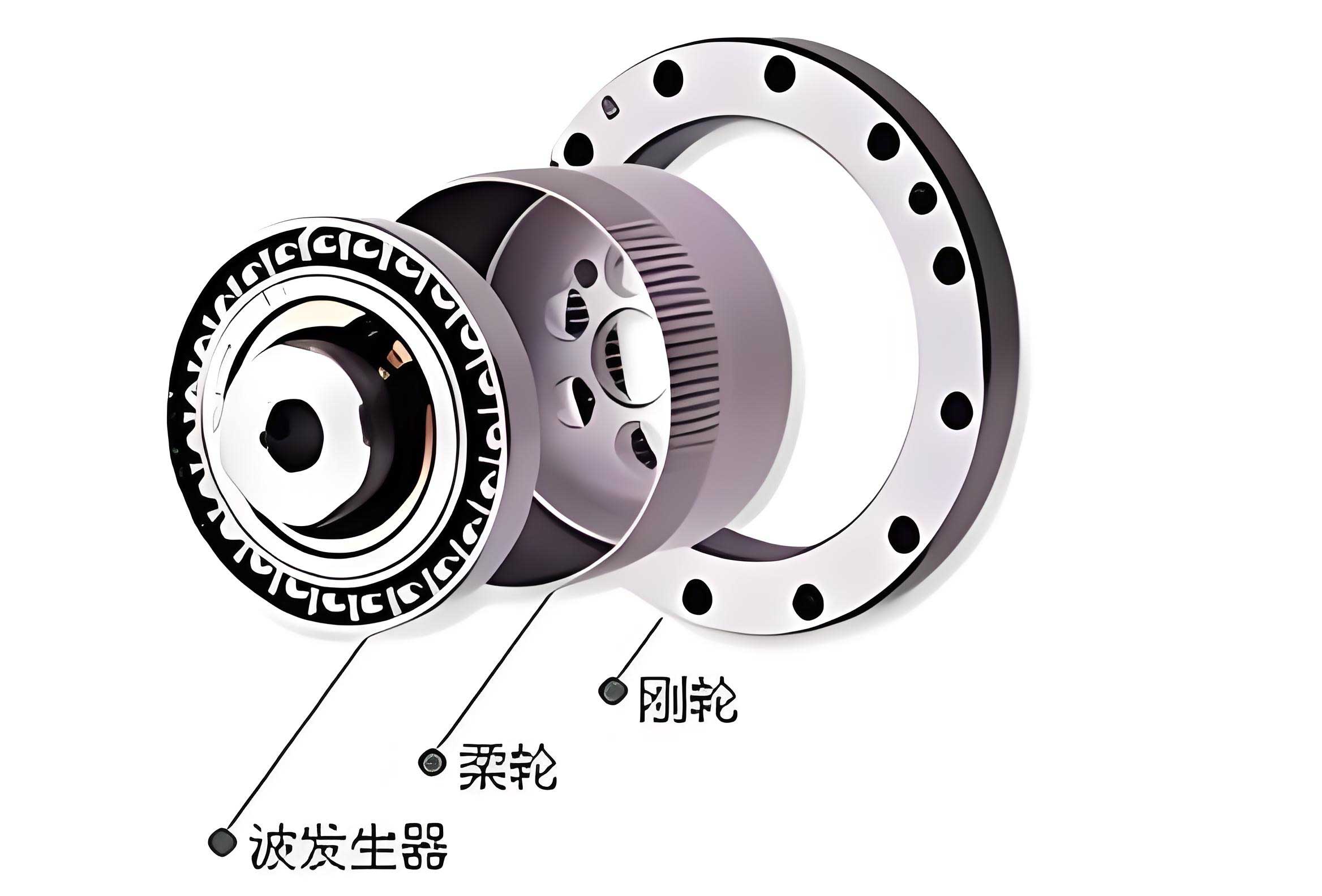
The core of a strain wave gear system consists of three primary elements: a rigid circular spline (CS), a flexible spline (FS), and a wave generator (WG). The WG, typically an elliptical cam or a set of bearings, deforms the FS into a non-circular shape, enabling simultaneous meshing at multiple points across the major axis. For the analysis, we establish coordinate systems: a moving frame \(\\{O_1, X_1, Y_1\\}\) attached to the FS tooth’s symmetry axis, a fixed frame \(\\{O_2, X_2, Y_2\\}\) for the CS, and a moving frame \(\\{O, X, Y\\}\) for the WG with its Y-axis aligned to the WG’s major axis. The kinematic relationship is defined with the WG as input, CS fixed, and FS as output.
The DCA tooth profile of the flexible spline is characterized by several key parameters, as defined in a local coordinate system centered on the tooth’s neutral layer. The profile consists of three distinct segments: a convex arc, a common tangent line, and a concave arc. The parametric equations for the right-side profile segments, defined by the arc length parameter \(s\), are as follows:
Convex Arc Segment (AB):
$$
\mathbf{r}_{AB}(s) = \begin{bmatrix} \rho_a \cos(\alpha_a – s/\rho_a) + x_{oa} \\ \rho_a \sin(\alpha_a – s/\rho_a) + y_{oa} \\ 0 \\ 1 \end{bmatrix}, \quad \mathbf{n}_{AB}(s) = \begin{bmatrix} \cos(\alpha_a – s/\rho_a) \\ \sin(\alpha_a – s/\rho_a) \\ 0 \\ 1 \end{bmatrix}, \quad s \in (0, l_1)
$$
where \(l_1 = \rho_a (\alpha_a – \delta_L)\), \(\alpha_a = \arcsin((h_a + X_a)/\rho_a)\), \(x_{oa} = -l_a\), \(y_{oa} = h – h_a + d_s – X_a\).
Common Tangent Segment (BC):
$$
\mathbf{r}_{BC}(s) = \begin{bmatrix} \rho_a\cos(\delta_L) + x_{oa} + (s – l_1)\sin(\delta_L) \\ \rho_a\sin(\delta_L) + y_{oa} – (s – l_1)\cos(\delta_L) \\ 0 \\ 1 \end{bmatrix}, \quad \mathbf{n}_{BC}(s) = \begin{bmatrix} -\cos(\delta_L) \\ -\sin(\delta_L) \\ 0 \\ 1 \end{bmatrix}, \quad s \in (l_1, l_2)
$$
where \(l_2 = l_1 + (\rho_a + \rho_f)\tan(\delta_L)\).
Concave Arc Segment (CD):
$$
\mathbf{r}_{CD}(s) = \begin{bmatrix} x_{of} – \rho_f \cos(\delta_L + (s – l_2)/\rho_f) \\ y_{of} – \rho_f \sin(\delta_L + (s – l_2)/\rho_f) \\ 0 \\ 1 \end{bmatrix}, \quad \mathbf{n}_{CD}(s) = \begin{bmatrix} -\cos(\delta_L + (s – l_2)/\rho_f) \\ -\sin(\delta_L + (s – l_2)/\rho_f) \\ 0 \\ 1 \end{bmatrix}, \quad s \in (l_2, l_3)
$$
where \(l_3 = l_2 + \rho_f (\arcsin((X_f + h_f)/\rho_f) – \delta_L)\), \(x_{of} = \pi m/2 + l_f\), \(y_{of} = h – h_a + d_s + X_f\).
In these equations, \(\rho_a\) and \(\rho_f\) are the radii of the convex and concave arcs, \(h_a\) is the addendum, \(h\) is the whole depth, \(\delta_L\) is the pressure/process angle, and \(X_a, l_a, X_f, l_f\) are profile modification parameters. The unit normal vector \(\mathbf{n}\) is crucial for subsequent meshing analysis.
Precise Calculation of Flexible Spline Deformation
Accurate modeling of the flexible spline’s deformation under the wave generator’s influence is paramount for conjugate analysis. The deformation is characterized by radial displacement \(\omega(\phi)\), tangential displacement \(\nu(\phi)\), and the angular rotation \(\mu(\phi)\) of the neutral layer’s normal. The relationship between the angular coordinate on the deformed neutral curve \(\phi_1\) and the coordinate on the undeformed circle \(\phi\) is governed by the condition of inextensibility of the neutral layer.
Approximate Method: A common simplification assumes small derivatives and approximates the deformed radius with the undeformed radius \(r_m\). This yields:
$$
\mu \approx \frac{\omega'(\phi)}{r_m}, \quad \Delta\phi = \phi_1 – \phi_H \approx \frac{z_2 – z_1}{z_2} \phi + \frac{\nu(\phi)}{r_m}
$$
where \(\phi_H\) is the WG rotation angle, and \(z_1, z_2\) are the number of teeth on the FS and CS, respectively.
Exact Method: The exact relationship, without the simplifying assumptions, is given by:
$$
\phi = \int_{0}^{\phi_1} \sqrt{ \left(1 + \frac{\omega(\phi_1)}{r_m}\right)^2 + \left(\frac{\omega'(\phi_1)}{r_m}\right)^2 } \, d\phi_1 = F(\phi_1)
$$
Consequently, the angular difference is:
$$
\Delta\phi = \phi_1 – \phi_H = \phi_1 – \frac{z_1}{z_2} F(\phi_1)
$$
This exact formulation, while more computationally intensive, forms the basis for the precise conjugate principles. The derivative is:
$$
\frac{d\phi}{d\phi_1} = \sqrt{ \left(1 + \frac{\omega(\phi_1)}{r_m}\right)^2 + \left(\frac{\omega'(\phi_1)}{r_m}\right)^2 }
$$
Conjugate Principles for Strain Wave Gear Meshing
Two primary theoretical frameworks are used to derive the conditions for conjugate action in strain wave gears: the envelope theory and the modified kinematic method.
1. Exact Conjugate Principle (Based on Envelope Theory):
The fundamental meshing condition from envelope theory requires the mixed product (Jacobian) of the family of surfaces to vanish. Using the exact deformation model with \(\phi_1\) as the independent variable, the condition becomes:
$$
\frac{\partial x_2(s, \phi_1)}{\partial s} \frac{\partial y_2(s, \phi_1)}{\partial \phi_1} / \frac{d\phi}{d\phi_1} – \frac{\partial x_2(s, \phi_1)}{\partial \phi_1} \frac{\partial y_2(s, \phi_1)}{\partial s} / \frac{d\phi}{d\phi_1} = 0
$$
where \((x_2, y_2)\) are the coordinates of the FS tooth profile transformed into the CS coordinate system.
2. Exact Conjugate Principle (Based on Modified Kinematic Method):
This method leverages relative velocity vectors. The meshing equation states that the relative velocity at the contact point must be orthogonal to the common surface normal.
$$
\left( \mathbf{n}^{(1)} \right)^T \left( \mathbf{W}_{21}^* \right)^T \frac{d\mathbf{M}_{21}}{dt} \mathbf{r}^{(1)} = 0
$$
Here, \(\mathbf{n}^{(1)}\) is the FS tooth normal, \(\mathbf{M}_{21}\) is the coordinate transformation matrix from FS to CS, and \(\mathbf{W}_{21}^*\) is a related matrix. Substituting the exact deformation model yields:
$$
\left( \mathbf{n}^{(1)} \right)^T \left( \mathbf{W}_{21}^* \right)^T \frac{d \mathbf{M}_{21}}{d\phi_1} / \sqrt{ \left(1 + \frac{\omega(\phi_1)}{r_m}\right)^2 + \left(\frac{\omega'(\phi_1)}{r_m}\right)^2 } \, \mathbf{r}^{(1)} = 0
$$
The matrix \(\mathbf{B} = \left( \mathbf{W}_{21}^* \right)^T \frac{d\mathbf{M}_{21}}{dt}\) has the form:
$$
\mathbf{B} = \begin{bmatrix}
0 & -\beta(\phi_1)’ & 0 & -\omega(\phi_1)’\sin(\mu(\phi_1)) – \rho(\phi_1)\Delta\phi(\phi_1)’\cos(\mu(\phi_1)) \\
\beta(\phi_1)’ & 0 & 0 & \omega(\phi_1)’\cos(\mu(\phi_1)) – \rho(\phi_1)\Delta\phi(\phi_1)’\sin(\mu(\phi_1)) \\
0 & 0 & 0 & 0 \\
0 & 0 & 0 & 0
\end{bmatrix}
$$
Approximate Conjugate Principles: These are derived by substituting the approximate deformation relationships for \(\mu\) and \(\Delta\phi\) into the respective meshing equations of the two theories above.
For a given arc length \(s\) on the FS tooth profile, solving either exact equation yields the conjugate angle \(\phi_1\). The set of all \((\phi_1, s)\) pairs that satisfy the equation defines the Conjugate Existent Domain (CED). Transforming the FS profile coordinates at these conjugate angles generates the corresponding Conjugate Tooth Profile (CTP) for the CS.
Comparative Analysis of Conjugate Principles
To perform a concrete analysis, a strain wave gear with the following specifications is considered: module \(m = 0.3175\), FS teeth \(z_1 = 160\), CS teeth \(z_2 = 162\), radial deformation coefficient of 1.0, elliptical wave generator, and a gear ratio of 80. The DCA profile parameters for the FS are listed in the table below.
| Parameter | Value (mm) | Parameter | Value (mm) | Parameter | Value (mm) |
|---|---|---|---|---|---|
| Addendum, \(h_a\) | 0.1900 | Concave Shift, \(X_f\) | 0.1100 | Convex Radius, \(\rho_a\) | 0.60 |
| Whole Depth, \(h\) | 0.4850 | Concave Offset, \(l_f\) | 0.3214 | Concave Radius, \(\rho_f\) | 0.65 |
| Convex Shift, \(X_a\) | 0.1009 | Pressure Angle, \(\delta_L\) | 12° | Tooth Thickness Ratio, \(k\) | 1.7751 |
| Convex Offset, \(l_a\) | 0.4129 | Root Distance, \(d_s\) | 0.4150 | Tangent Length, \(h_l\) | 0.05 |
Conjugate Existent Domain (CED)
A key finding from solving the exact meshing equations for the DCA profile is the existence of two distinct conjugate existent domains, labeled CED-1 and CED-2. This leads to a “dual-conjugation” phenomenon: for a given point on the FS tooth (a specific \(s\)), there are two possible WG positions (\(\phi_1\)) where conjugate contact can occur. Conversely, for a given WG position, two different points on the FS profile can potentially be in conjugate contact.
Each CED comprises three segments corresponding to the convex arc, common tangent, and concave arc of the FS profile. Comparative analysis reveals that:
- The CEDs calculated using the exact envelope theory and the exact modified kinematic method are identical.
- The CEDs calculated using the two corresponding approximate methods are also identical.
- However, comparing exact vs. approximate CEDs shows significant differences. For CED-1, the approximate method slightly increases the conjugate angle and domain range. For the larger CED-2, the approximate method causes a noticeable reduction in both the conjugate angle range and the domain span. The segment corresponding to the common tangent shows the most pronounced change.
Conjugate Tooth Profile (CTP)
The conjugate tooth profiles generated for the circular spline from the two CEDs were analyzed. A notable observation is that the concave arc profile from CED-1 and the convex arc profile from CED-2 are nearly coincident. Therefore, the effective conjugate profile for the CS is synthesized from the unique convex profile of CED-1, the unique concave profile of CED-2, and the overlapping profile.
Key findings regarding the CTP are:
- For CED-1, the CTPs from both exact principles coincide perfectly. The CTPs from the approximate principles show negligible deviation (< 0.0001 mm) from the exact ones, and from each other.
- For CED-2, the CTPs from the two exact principles coincide, as do those from the two approximate principles. However, the approximate CTP for CED-2 is offset from the exact CTP by approximately 0.002 mm and exhibits a slight reduction in arc length (by ~0.011-0.0155 mm).
Given the identical results from the two foundational theories, we hereafter refer to the Exact Conjugate Principle (encompassing both methods) and the Approximate Conjugate Principle.
Motion Trajectory and Mesh Analysis
Using the exact conjugate principle, the effective CTP for the CS was determined and fitted with circular arcs using a least-squares method. The same was done using the approximate principle. The resulting CS profile parameters are compared below.
| Principle | Convex Arc Profile | Concave Arc Profile | ||
|---|---|---|---|---|
| Center (mm) | Radius (mm) | Center (mm) | Radius (mm) | |
| Exact | {0.6747, 25.7926} | 0.4990 | {-0.4367, 25.6047} | 0.6273 |
| Approximate | {0.6834, 25.7988} | 0.5087 | {-0.4316, 25.6067} | 0.6219 |
The approximate principle has a more substantial effect on the CS convex arc parameters than on the concave arc parameters.
Analyzing the relative motion trajectory of an FS tooth within the CS tooth space over a 90° WG rotation reveals critical behavior:
- Exact Principle Trajectory: The FS tooth follows a smooth, inwardly concave path. Contact is continuous, with the meshing point shifting progressively along the profile (e.g., from point A to B to C). This behavior promotes even load distribution, reduced localized wear, and enhanced transmission accuracy.
- Approximate Principle Trajectory: The trajectory in the later stages of mesh (near the major axis) is similar to the exact case. However, in the initial engagement phase, significant deviations occur, leading to a substantial increase in the clearance between the FS and CS profiles.
Mesh Backlash Distribution
A quantitative analysis of mesh backlash across multiple teeth provides further insight. Defining the FS tooth aligned with the WG major axis as tooth #1, the flank clearance for successive teeth was calculated.
The backlash distribution demonstrates that:
- All backlash values are positive, confirming the absence of tooth interference under both principles.
- For teeth near the WG major axis (e.g., the first 6 teeth), the backlash values calculated by the exact and approximate principles are nearly identical.
- For teeth farther from the major axis, the backlash from the exact principle remains relatively constant. In stark contrast, the backlash calculated by the approximate principle increases dramatically as the tooth position moves away from the engagement zone.
This highlights a critical shortcoming of the approximate method: it fails to accurately predict the mesh conditions for teeth not in the immediate vicinity of the major axis, which is essential for understanding the full multi-tooth engagement behavior of the strain wave gear.
Conclusion
This comprehensive analysis of the double-circular-arc tooth profile for strain wave gears, comparing exact and approximate conjugate principles, yields several significant conclusions:
- The DCA profile in strain wave gears exhibits a dual-conjugation characteristic, manifesting as two separate conjugate existent domains (CED-1 and CED-2). This unique property implies multiple potential contact scenarios for a given tooth profile point or wave generator position.
- The foundational meshing theory—whether envelope theory or modified kinematics—has a negligible impact on the calculated CED and CTP when the exact deformation model is employed. The core mathematical formulations, though derived differently, converge to the same physical solution.
- The use of an approximate deformation model, however, introduces significant inaccuracies. It substantially alters the predicted conjugate existent domains, especially the larger CED-2 and the segments associated with the common tangent profile. While its effect on the final conjugate tooth profile geometry is relatively minor, its implications for system dynamics are severe.
- The approximate principle fails to accurately capture the relative motion trajectory during the initial mesh engagement phase and grossly overestimates the mesh backlash for teeth positioned away from the wave generator’s major axis. This can lead to incorrect assessments of positional error, torsional stiffness, and multi-tooth load sharing in the strain wave gear assembly.
Therefore, for the high-fidelity design and analysis of precision strain wave gear systems utilizing advanced profiles like the DCA, employing an exact conjugate principle based on a precise model of flexible spline deformation is not merely beneficial but essential. It ensures accurate prediction of conjugation zones, correct generation of mating gear profiles, and a true understanding of the engagement kinematics and resulting clearance, all of which are critical for achieving the high performance, reliability, and precision expected from modern strain wave gear applications.