
The manufacturing of high-modulus spur gears (where the module m ≥ 3) is a cornerstone of power transmission in heavy industries. With the rapid development of sectors like heavy-duty vehicles, the demand for these critical components continues to rise. The pursuit of efficient, reliable, and precise manufacturing methods is therefore paramount. While gear production is a continuous process, precision forging must balance production efficiency with die reliability. The advancement of cold extrusion technology has made it a prominent near-net-shape manufacturing method for spur gears. Gears formed by cold extrusion exhibit excellent surface finish, continuous metal flow lines, and high load-bearing capacity. Subsequent cold sizing can further enhance forming accuracy. Consequently, the integrated “cold extrusion-cold sizing” process is increasingly becoming a primary method for spur gear machining.
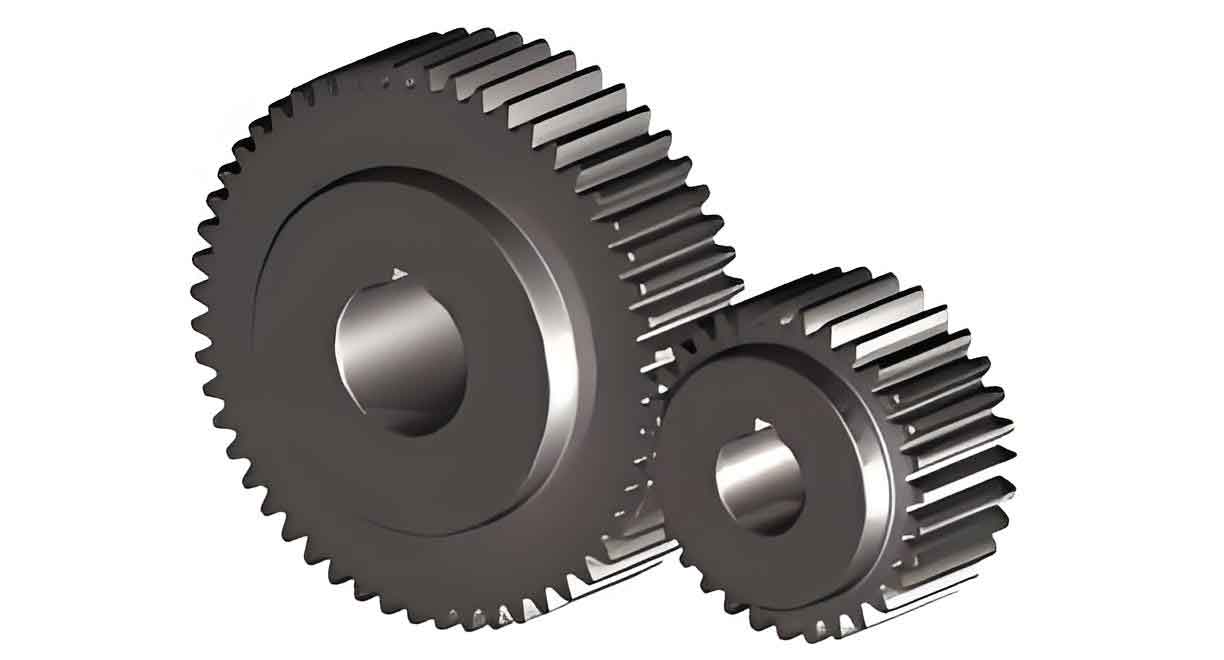
However, challenges persist when applying this sequence to heavy-duty truck spur gears. Traditional methods involving cold extrusion followed by a separate cold sizing operation often fail to consistently achieve Grade 8 precision according to international standards (e.g., GB/T 10095). Furthermore, issues with forming quality, such as significant塌角 (collapse) at the tooth ends and large machining allowances on the gear faces, lead to material waste and increased post-processing. This article addresses these limitations by proposing and validating a novel “cold extrusion-cold sizing” compound forming process, where extrusion and sizing occur in a single, continuous stroke within a compound die.
Limitations of the Conventional Two-Stage Process
The target component is a spur gear with a module m=4, number of teeth Z=16, pressure angle α=20°, and a profile shift coefficient x=0.45, made from 20CrMnTi steel. The conventional process flow is: hot forging (for preform) → spheroidizing annealing → shot blasting → turning (final preform) → lubrication → cold extrusion → cold sizing. The cold sizing operation only refines the tooth flanks with a unilateral sizing allowance of 0.15 mm, while the root and tip areas are relieved in the die design.
Gears produced via this method exhibit several defects. The upper tooth face shows underfilling of 1.5-2.5 mm in length and an end-face indentation of about 2.5 mm, often accompanied by longitudinal burrs. The lower tooth face shows more severe underfilling (3.5-5.0 mm) and end-face protrusion (~1.5 mm). The addendum塌角 is more pronounced at the lower end. These defects necessitate large machining allowances on both end faces. The primary causes are twofold: 1) Friction and the extrusion die’s entrance angle hinder axial metal flow, causing the outer layer to lag behind the inner layer (leading to lower-end protrusion). The velocity difference creates a “pulling” effect, causing tip collapse. 2) In continuous extrusion, insufficient back-pressure from the previously formed part leads to weak radial filling at both ends of the gear, resulting in “collapse” or underfilling at the tooth tips.
Precision measurement of five randomly selected gears from this process revealed an average tooth profile total deviation (Fα) of 14.3 μm (approximately Grade 7) and an average helix total deviation (Fβ) of 35.2 μm (approximately Grade 9). The target of stable Grade 8 accuracy was not achieved.
Proposal of the Integrated Compound Forming Process
To overcome the instability in precision and poor forming quality, a new compound forming process is proposed. The key innovation is the integration of the extrusion and sizing dies into a single tooling setup, as schematically represented below. The workpiece is extruded through the extrusion die and immediately enters the sizing die cavity in a continuous motion. This configuration offers critical advantages:
- Enhanced Back-Pressure: The presence of the sizing die provides substantial and controlled back-pressure during the final stage of extrusion. This promotes better radial filling of the tooth cavities, especially at the lower end, thereby reducing addendum collapse.
- Improved Accuracy: The gear preform, upon exiting the extrusion zone, is immediately constrained by the sizing die. This minimizes free elastic recovery and the associated irregular springback that plagues the two-stage process, leading to a more dimensionally stable preform before final sizing.
- Higher Guiding Precision & Efficiency: The compound die ensures excellent alignment between extrusion and sizing stages. Furthermore, combining two operations into one stroke significantly improves production efficiency.
The unilateral sizing allowance (ΔL) is a paramount parameter in this compound process, critically influencing both the final quality and accuracy of the spur gears.
Numerical Simulation and Analysis of Key Parameters
An elastic-plastic finite element model was established to simulate the compound forming process. The billet (20CrMnTi) was modeled as an elastic-plastic body, while the dies were defined as rigid bodies. A constant punch speed of 20 mm/s was applied. The friction factor between the billet and the extrusion die was set to 0.08, and to 0.12 between the workpiece and the sizing die, obeying the shear friction model.
The primary variable studied was the unilateral sizing allowance (ΔL = 0.10 mm, 0.15 mm, 0.20 mm). The results were compared against simulations of the conventional two-stage process.
Effect of Sizing Allowance on Forming Quality (Addendum Collapse)
The addendum collapse at the gear’s lower end was tracked. The subsequent machining step involves turning the outer diameter to φ73.6 mm, so material below this diameter represents waste. The results are summarized in the table and description below.
| Process Type | Sizing Allowance ΔL (mm) | Addendum Collapse Severity | Implied Machining Allowance |
|---|---|---|---|
| Conventional | 0.10 | Moderate, clear塌角 | Large |
| Conventional | 0.15 | Severe, significant塌角 | Very Large |
| Conventional | 0.20 | Most Severe | Largest |
| Compound | 0.10 | Marked Improvement, small塌角 | Reduced |
| Compound | 0.15 | Significant Improvement, minimal塌角 | Smallest |
| Compound | 0.20 | Excellent Filling, virtually no塌角 | Very Small |
In the conventional process, collapse worsens with increasing ΔL. Conversely, in the compound process, the collapse defect is dramatically reduced and improves further as ΔL increases. This is directly attributed to the increased back-pressure (Fback) provided by the sizing die, which can be conceptually related to the material’s flow stress and the contact area:
$$ F_{back} \propto \bar{\sigma} \cdot A_{contact} $$
where $\bar{\sigma}$ is the effective flow stress of the material and $A_{contact}$ is the contact area within the sizing die. A larger ΔL increases $A_{contact}$ earlier in the stroke, thereby raising $F_{back}$ and improving radial filling for the spur gear teeth.
Effect of Sizing Allowance on Forming Accuracy
The simulated tooth profile (Fα) and helix (Fβ) total deviations were extracted via surface node coordinate analysis. The trends are critical for process optimization.
| Accuracy Metric | Trend vs. ΔL (Conventional) | Trend vs. ΔL (Compound) | Optimal ΔL (Compound) |
|---|---|---|---|
| Tooth Profile Fα | Increases slightly with ΔL | Increases slightly with ΔL, but values lower than conventional. | Lower is better (0.10-0.15 mm) |
| Helix Fβ | High, decreases slightly then increases. | Significantly lower. Shows a clear minimum. | 0.15 – 0.175 mm |
The underlying mechanism involves the interplay between plastic deformation and elastic springback. When ΔL is too small (e.g., 0.10 mm), the contact pressure may only induce elastic or minimal plastic deformation in the tooth flanks of the spur gear. Upon exiting the die, elastic recovery ($\epsilon_e$) occurs, negating the sizing effect:
$$ \epsilon_{total} = \epsilon_{p} + \epsilon_{e} $$
If $\epsilon_{p}$ is negligible, $\epsilon_{total} \approx \epsilon_{e}$, leading to springback and poor accuracy correction.
When ΔL is too large (e.g., 0.20 mm), the material undergoes severe plastic deformation, potentially distorting the carefully extruded tooth profile rather than just calibrating it. The optimal range (ΔL ≈ 0.15 mm) ensures sufficient plastic deformation ($\epsilon_{p}$ dominates) to permanently set the tooth geometry while minimizing distortive forces.
The compound process yields superior accuracy across all ΔL values because the initial elastic recovery from extrusion is constrained, providing a more accurate preform to the sizing section. The relationship between final deviation (D), springback (S), and sizing effect (E) can be simplified as:
$$ D_{compound} \approx S_{constrained} – E_{sizing} $$
$$ D_{conventional} \approx S_{free} – E_{sizing} $$
where $S_{constrained} < S_{free}$, explaining the accuracy benefit for compound-formed spur gears.
Analysis of Forming Forces
The forming force curve for the compound process reveals two distinct stages: the initial extrusion stage and the stable compound forming stage. The force in the stable stage, which corresponds to the back-pressure, increases with the sizing allowance ΔL.
$$ F_{0.20} > F_{0.15} > F_{0.10} $$
This corroborates the finding that higher back-pressure (from larger ΔL) improves filling but must be balanced against the risk of excessive distortion during sizing.
Process Experiment and Validation
Based on the simulation results, a sizing allowance of ΔL = 0.15 mm was selected for experimental validation. The compound die was constructed with a tungsten carbide (YG15) insert for both the extrusion and sizing sections. The die set was assembled on a 6.3 MN hydraulic press.
Five finished spur gears were randomly selected and measured on a gear measuring center. The average results were outstanding:
- Average Tooth Profile Total Deviation Fα: 12.2 μm. This corresponds to Grade 6 accuracy.
- Average Helix Total Deviation Fβ: 24.2 μm. This corresponds to Grade 8 accuracy, achieved stably.
The measured accuracy for a sample gear showed a maximum Fα of 12.2 μm (Grade 6) and a maximum Fβ of 26.6 μm (Grade 8), fully meeting the target specification. The forming quality was also excellent. The addendum diameters at the upper and lower ends were φ74.4 mm and φ73.8 mm respectively, both well above the final machining diameter of φ73.6 mm, indicating minimal塌角 and significantly reduced machining allowance. After minimal turning of the end faces and outer diameter, the spur gears exhibited full, well-defined teeth.
Conclusion
1. A novel “cold extrusion-cold sizing” compound forming process was proposed to solve the problems of unstable precision (below Grade 8) and large machining allowances in heavy-duty truck spur gears manufactured by the sequential two-stage process.
2. Numerical simulation revealed the sizing allowance (ΔL) as a critical parameter. An allowance that is too small (0.10 mm) fails to adequately improve accuracy due to dominant elastic recovery. An allowance that is too large (0.20 mm) risks distorting the tooth profile despite excellent filling. An optimal allowance of 0.15 mm was identified, providing a balance that yields minimal addendum collapse and high forming accuracy for the spur gears.
3. Experimental validation with the compound die confirmed the simulation findings. The produced spur gears consistently achieved a tooth profile accuracy of Grade 6 and a helix accuracy of Grade 8. The addendum collapse was drastically reduced, leading to minimal machining allowances on the end faces and a significant improvement in material utilization. This compound process presents a highly effective solution for the precision manufacturing of high-modulus spur gears.