
The pursuit of higher power density, efficiency, and quieter operation in modern mechanical transmissions places immense demands on gear design. Among various gear types, helical gears are extensively favored for their smooth engagement, high load capacity, and reduced noise compared to spur gears. However, under high-speed and heavy-load conditions, elastic deformations of the teeth, shafts, and bearings, combined with manufacturing and assembly errors, can lead to uneven load distribution, edge loading, and transmission error (TE), ultimately causing increased vibration, noise, and reduced service life. Therefore, accurately analyzing the contact behavior and implementing targeted tooth modifications are critical for optimizing the performance of helical gears. Traditional modification methods often rely heavily on empirical formulas, which may not be optimal for specific, complex operational conditions. This study presents a comprehensive methodology integrating precise finite element contact analysis with systematic multi-objective optimization to determine the optimal modification parameters for a pair of helical gears.
The foundation of any accurate mechanical analysis is a precise geometric model. For helical gears, the tooth surface is a complex three-dimensional involute helicoid. The first step involves establishing the mathematical model based on gear meshing theory. The key geometric parameters for the gear pair under investigation are summarized in Table 1.
| Parameter | Pinion | Gear |
|---|---|---|
| Number of Teeth, \(z\) | 20 | 63 |
| Normal Module, \(m_n\) (mm) | 2 | |
| Normal Pressure Angle, \(\alpha_n\) (°) | 20 | |
| Face Width, \(b\) (mm) | 35 | |
| Helix Angle, \(\beta\) (°) | 12 (Right-hand) | |
| Normal Profile Shift Coefficient, \(x_n\) | +0.40 | -0.33 |
| Total Contact Ratio, \(\epsilon_{\gamma}\) | 2.687 | |
| Center Distance, \(a\) (mm) | 85 | |
| Transmitted Power, \(P\) (kW) | 7.5 | |
| Pinion Speed, \(n_1\) (rpm) | 1088 | |
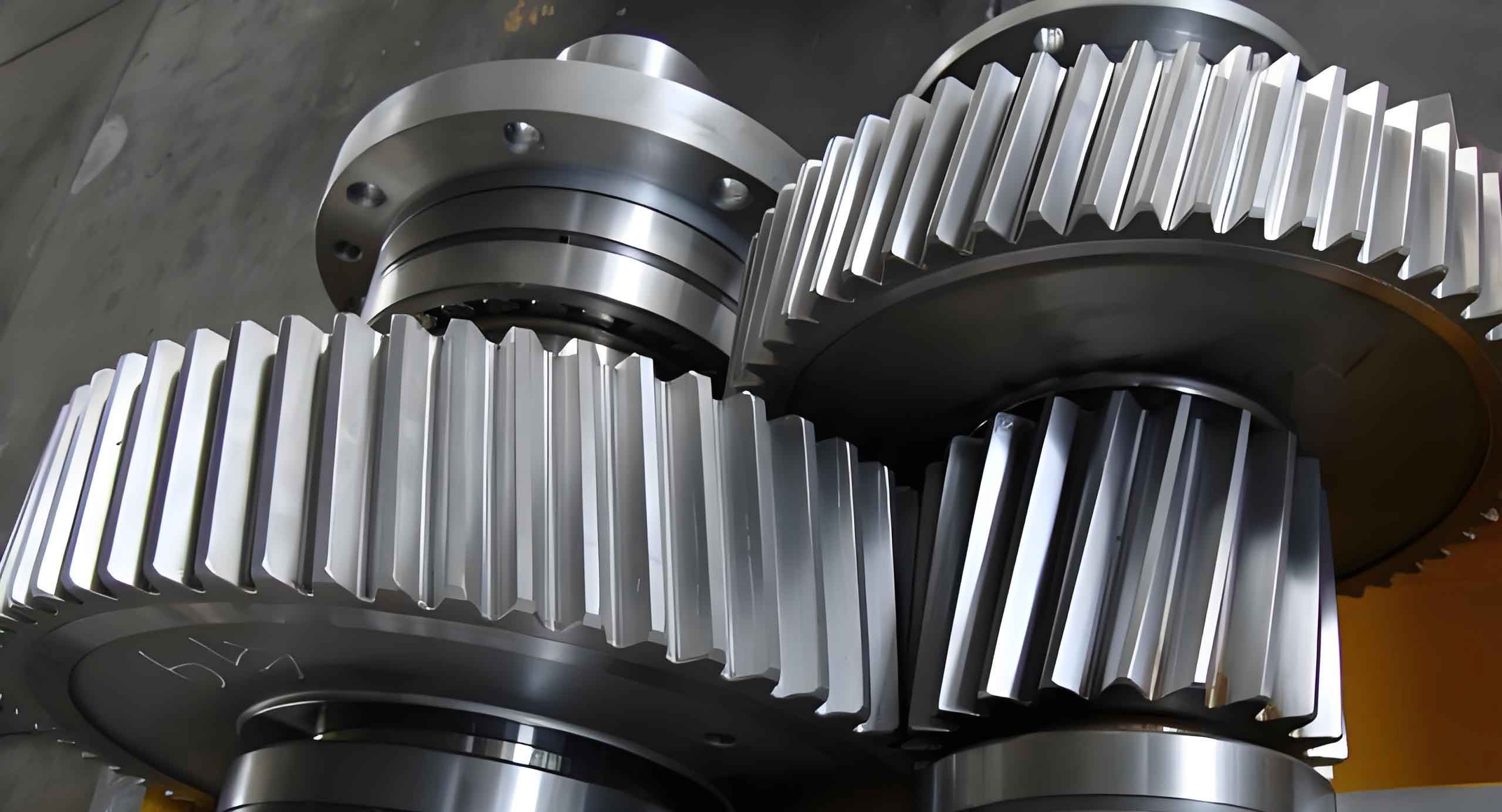
Using these parameters, the equations for the involute profile, root fillet, and helix are derived. A robust 3D parametric model of the pinion and gear is then created in CAD software, ensuring high accuracy for subsequent analysis. The assembled model clearly shows the staggered contact pattern characteristic of helical gears.
Performing a full-gear finite element analysis (FEA) is computationally prohibitive. A simplified yet representative model must be constructed. Given the total contact ratio of 2.687, at least two to three tooth pairs are in contact simultaneously. To capture interaction effects and ensure result accuracy, a model encompassing five tooth pairs is extracted. The boundaries are set far enough from the contact zone to avoid influencing the stress field. The model is then partitioned into structured blocks to enable high-quality hexahedral meshing. The most critical aspect is meshing the contact region. According to Hertzian contact theory, the semi-width of the contact band, \(a\), must be calculated to guide mesh sizing.
The contact between two gear teeth can be approximated as the contact of two elastic cylinders with radii equivalent to the radii of curvature at the contact point. The contact semi-width \(a\) is given by:
$$ a = \sqrt{ \frac{4 F_n}{\pi L} \cdot \frac{\frac{1-\nu_1^2}{E_1} + \frac{1-\nu_2^2}{E_2}}{\frac{1}{R_{\Sigma}}} } $$
where \(F_n\) is the normal load, \(L\) is the total length of contact lines, \(\nu\) and \(E\) are Poisson’s ratio and Young’s modulus, and \(R_{\Sigma}\) is the equivalent radius of curvature. For helical gears, these are calculated as:
$$ \frac{1}{R_{\Sigma}} = \frac{2 \cos \beta_b}{d_1 \sin \alpha_t} \left( \frac{u + 1}{u} \right) $$
$$ L = \frac{b \cdot \epsilon_{\alpha}}{\cos \beta_b} $$
$$ F_n = \frac{2 T_1}{d_1 \cos \alpha_t \cos \beta_b} $$
Here, \(\beta_b\) is the base circle helix angle, \(\alpha_t\) is the transverse pressure angle, \(\epsilon_{\alpha}\) is the transverse contact ratio, \(T_1\) is the pinion torque, \(d_1\) is the pinion pitch diameter, and \(u\) is the gear ratio.
Substituting the parameters for our helical gears (material: steel, \(E = 206\) GPa, \(\nu = 0.3\)), the contact semi-width is calculated to be \(a \approx 0.064\) mm. Consequently, the mesh size in the contact region is refined to 0.03 mm, which is finer than the theoretical contact width to accurately resolve the stress gradient. The final finite element model contains several hundred thousand elements, with dense, structured hexahedral elements in the contact zones of the central tooth pairs.
The analysis is set up as a static structural problem with nonlinear contact. The contact pairs are defined using a surface-to-surface formulation with an Augmented Lagrange algorithm. A coefficient of friction of 0.1 is applied. The pinion is constrained in all degrees of freedom at its inner bore, except for rotation about its axis. A specified rotational displacement (corresponding to the transmitted torque) is applied to the gear, while its axial and radial movements are constrained, simulating a typical mounting condition. The solved model reveals the contact pressure (von Mises stress) distribution and deformation. The maximum contact stress from FEA is approximately 916 MPa, while the theoretical Hertzian stress calculates to about 902 MPa. The difference of 1.6% validates the accuracy of the finite element model. The analysis also provides the maximum deformation values for the pinion and gear teeth at the points of engagement and disengagement, which are crucial inputs for determining modification magnitudes.
The finite element results confirm the gear pair’s safety under the given load but also indicate the potential for optimization. Unmodified ideal tooth surfaces, when subjected to load-induced deflections, experience edge loading and abrupt changes in load sharing between tooth pairs, leading to increased transmission error (TE) and stress concentrations. Tooth modification is the deliberate, minute alteration of the ideal tooth profile and/or lead to compensate for these deflections and errors, ensuring a more uniform pressure distribution and smoother transmission under load. For helical gears, common modifications include profile crowning (tip and root relief) and lead crowning (barreling). The modification parameters are illustrated in the schematic below and include:
- Tip Relief Amount, \(C_{\alpha a}\): Removal of material near the tooth tip.
- Root Relief Amount, \(C_{\alpha f}\): Removal of material near the tooth root.
- Profile Crowning Amount, \(C_a\): A slight bulge in the profile direction.
- Relief Lengths, \(L_{ca}\) and \(L_{cf}\): The axial extent over which relief is applied.
- Relief Curve Factor, \(t_a\), \(t_f\): Defines the shape (parabolic, etc.) of the relief.
Instead of using fixed empirical formulas, the deformation results from the FEA are used to inform reasonable starting bounds for the modification amounts. For instance, the tip relief amount should be on the same order as the tooth deflection at the point of engagement to prevent edge contact. The length of modification can be estimated based on the theoretical line of action and contact ratio. The ranges for the modification parameters for both the pinion and gear are established as shown in Table 2.
| Modification Parameter | Pinion Range | Gear Range |
|---|---|---|
| Tip Relief Amount, \(C_{\alpha a}\) (\(\mu m\)) | 4 – 13 | 4 – 13 |
| Root Relief Amount, \(C_{\alpha f}\) (\(\mu m\)) | 10 – 18 | 10 – 18 |
| Tip Relief Length, \(L_{ca}\) (mm) | 0.8 – 3.6 | 0.8 – 3.6 |
| Root Relief Length, \(L_{cf}\) (mm) | 0.8 – 3.6 | 0.8 – 3.6 |
| Profile Crowning Amount, \(C_a\) (\(\mu m\)) | 0 – 5 | 0 – 5 |
With these parameter ranges defined, a multi-objective optimization is performed using specialized gear design software (KISSsoft). The software employs numerical algorithms to iteratively evaluate different modification combinations within the specified bounds. The primary optimization targets are:
- Minimization of the maximum contact pressure.
- Minimization of the peak-to-peak transmission error (TE).
- Maximization of safety factors for contact stress, bending stress, and scoring resistance.
The software simulates the loaded tooth contact for each design variant, calculating the stress distribution, load sharing, and TE. After the optimization loop, a set of optimal modification parameters is identified, as presented in Table 3.
| Optimal Modification Parameter | Pinion Value | Gear Value |
|---|---|---|
| Tip Relief Amount, \(C_{\alpha a}\) (\(\mu m\)) | 7.38 | 10.00 |
| Root Relief Amount, \(C_{\alpha f}\) (\(\mu m\)) | 14.70 | 17.10 |
| Tip Relief Length, \(L_{ca}\) (mm) | 3.00 | 3.00 |
| Root Relief Length, \(L_{cf}\) (mm) | 1.00 | 1.00 |
| Profile Crowning Amount, \(C_a\) (\(\mu m\)) | 3.33 | 2.10 |
The effectiveness of the optimized modifications is strikingly evident in the software’s simulation results. The load distribution plot shifts from a concentrated, uneven pattern for the unmodified gears to a uniform, well-distributed pattern covering a broader area of the tooth flank for the modified helical gears. Most importantly, the peak-to-peak transmission error is significantly reduced, indicating a smoother kinematic excitation and the potential for lower vibration and noise. A comparative summary of key performance indicators before and after optimization is shown in Table 4.
| Performance Indicator | Unmodified Gears | Optimally Modified Gears |
|---|---|---|
| Maximum Contact Stress (Software) | 873 MPa | 721 MPa |
| Peak-to-Peak Transmission Error | 3.26 \(\mu m\) | 1.75 \(\mu m\) |
| Safety Factor for Contact Stress (Pinion) | 1.21 | 1.26 |
| Safety Factor for Bending Stress (Gear) | 2.60 | 2.65 |
To provide final, independent validation, the 3D models of the pinion and gear with the optimized modification parameters are exported. A new five-tooth-pair finite element model is built using these modified geometries. The same boundary conditions and load are applied. The resulting contact stress distribution confirms the optimization outcome: the maximum contact stress is significantly reduced to approximately 845 MPa. This final FEA validation step closes the loop, confirming that the optimization process based on software simulation reliably produces a tangible improvement in the physical stress state of the helical gears.
In conclusion, this study demonstrates a highly effective and systematic approach for enhancing the performance of helical gears. By combining high-fidelity finite element contact analysis to understand the baseline behavior and obtain critical deformation data with a subsequent multi-objective optimization routine targeting contact pressure, transmission error, and safety factors, optimal tooth modification parameters can be determined. This method moves beyond traditional experience-based modification, providing a data-driven and optimized solution tailored to the specific gear geometry and operating conditions. The results unequivocally show that properly optimized modifications for helical gears lead to a more uniform load distribution, reduced maximum contact stress, minimized transmission error fluctuation, and improved overall safety factors, thereby enhancing load capacity, reliability, and acoustic performance. This integrated methodology provides a robust framework for the advanced design and development of high-performance helical gear transmissions.