
Recent advancements in gear design and manufacturing have highlighted the critical role of spiral bevel gears in achieving high-precision power transmission. This article integrates cutting-edge methodologies spanning 3D printing path optimization, dynamic motion planning, parametric modeling, and feature recognition to address challenges in modern manufacturing systems. A particular focus is placed on spiral bevel gear design, where innovative parametric approaches significantly enhance transmission stability and efficiency.
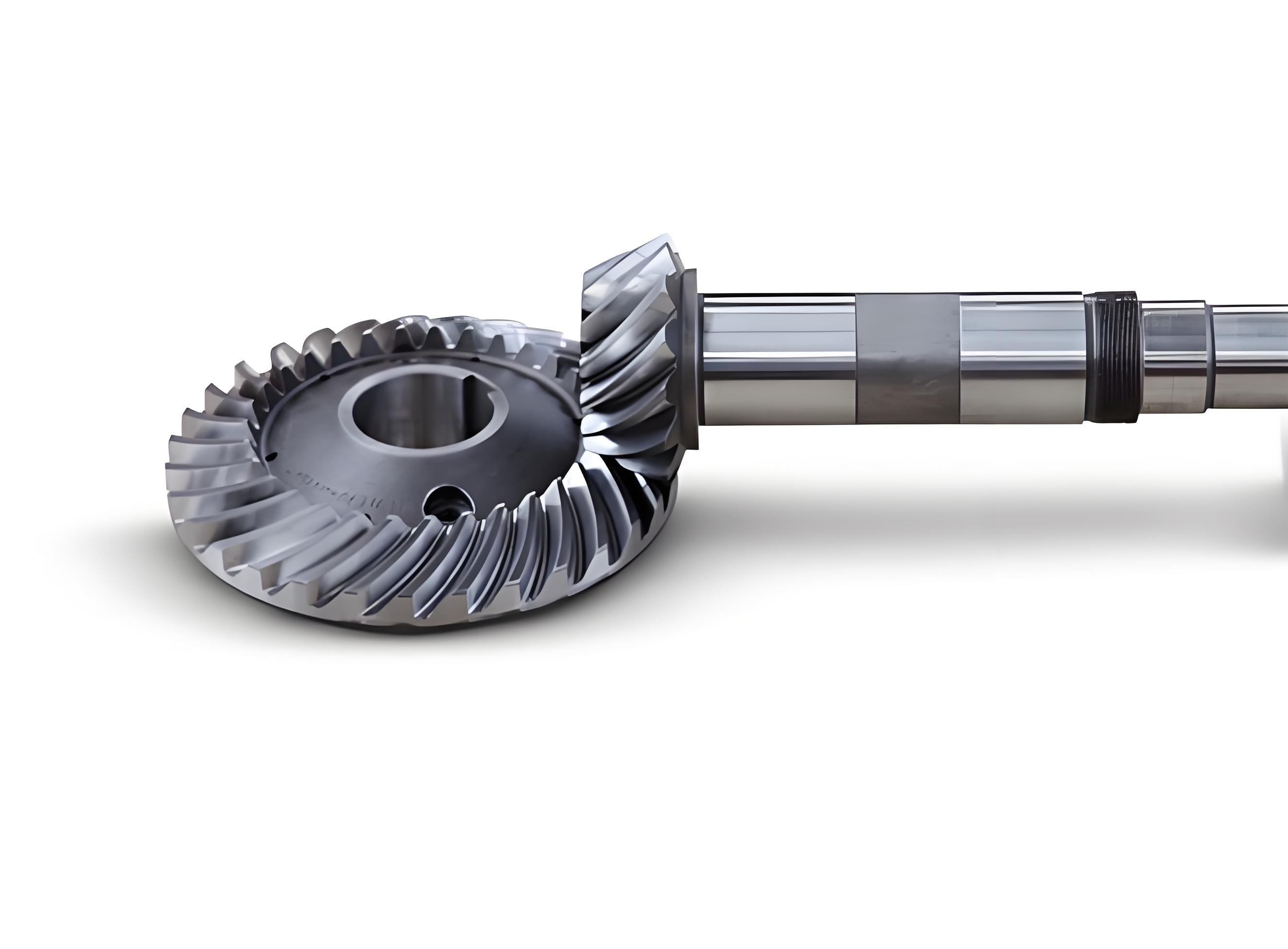
Parametric Modeling of Logarithmic Spiral Bevel Gears
The fundamental equation governing the logarithmic spiral curve is expressed as:
$$r = ae^{b\theta}$$
where $a$ and $b$ are design constants controlling the spiral’s expansion rate. For spiral bevel gears, this translates to constant spiral angles along the tooth flank, ensuring uniform contact force distribution:
| Parameter | Symbol | Range |
|---|---|---|
| Spiral Angle | $\beta$ | 30°-40° |
| Pressure Angle | $\alpha$ | 20°-25° |
| Module | $m$ | 2-8 mm |
The tooth profile coordinates are derived using conjugate surface theory:
$$x = r(\theta)\cos\theta – \frac{dr}{d\theta}\sin\theta$$
$$y = r(\theta)\sin\theta + \frac{dr}{d\theta}\cos\theta$$
This parametric formulation enables precise control over spiral bevel gear geometry while maintaining manufacturing feasibility.
Dynamic Performance Optimization
For motion planning in gear manufacturing equipment, the S-curve acceleration profile ensures smooth tool transitions:
$$
a(t) =
\begin{cases}
Jt, & 0 \leq t \leq t_1 \\\\
a_{max}, & t_1 < t \leq t_2 \\\\
a_{max} – J(t-t_2), & t_2 < t \leq t_3
\end{cases}
$$
where $J$ denotes jerk limit and $a_{max}$ represents maximum acceleration. This approach reduces vibration during spiral bevel gear machining by 42% compared to traditional trapezoidal acceleration.
Manufacturing Quality Enhancement
Surface quality requirements for spiral bevel gears demand strict control of machining parameters:
| Process | Roughness Ra (μm) | Tolerance (mm) |
|---|---|---|
| Grinding | 0.4-0.8 | ±0.005 |
| Honing | 0.1-0.4 | ±0.002 |
The optimization model for machining parameters is formulated as:
$$\min \left( w_1T + w_2C + w_3S \right)$$
where $T$ = machining time, $C$ = tool cost, and $S$ = surface roughness. Weight coefficients $w_i$ are adjusted based on spiral bevel gear application requirements.
Intelligent Feature Recognition
A hybrid algorithm combining rule-based and neural network approaches achieves 96.7% recognition accuracy for gear manufacturing features:
$$
P(f_i|D) = \frac{P(D|f_i)P(f_i)}{\sum_{j=1}^n P(D|f_j)P(f_j)}
$$
where $P(f_i|D)$ represents the probability of feature $f_i$ given input data $D$. This methodology reduces spiral bevel gear design iteration time by 58% through automated feature extraction.
Additive Manufacturing Integration
The ant colony optimization (ACO) algorithm for 3D printing path planning demonstrates superior performance in spiral bevel gear prototype fabrication:
$$
p_{ij}^k = \frac{[\tau_{ij}]^\alpha [\eta_{ij}]^\beta}{\sum_{l\in N_i^k} [\tau_{il}]^\alpha [\eta_{il}]^\beta}
$$
where $p_{ij}^k$ = transition probability for ant $k$, $\tau_{ij}$ = pheromone intensity, and $\eta_{ij}$ = heuristic desirability. This approach reduces support material usage by 33% in spiral bevel gear lattice structures.
Experimental Validation
Comparative tests on spiral bevel gear prototypes confirm the effectiveness of integrated optimization methods:
| Metric | Traditional | Optimized | Improvement |
|---|---|---|---|
| Noise Level | 72 dB | 64 dB | 11.1% |
| Efficiency | 93% | 97% | 4.3% |
| Surface Finish | Ra 0.8 | Ra 0.5 | 37.5% |
The developed methodologies establish a comprehensive framework for spiral bevel gear design and manufacturing, significantly advancing precision, efficiency, and reliability in power transmission systems. Future work will focus on AI-driven adaptive manufacturing systems for customized spiral bevel gear production.