
In the realm of precision manufacturing, gear hobbing stands as a pivotal process for producing high-quality gears essential in heavy machinery, wind turbines, and naval applications. The accuracy of gear hobbing directly influences the performance, noise, and longevity of transmission systems. My research focuses on large-sized gear hobbing machines, which face unique challenges due to their massive workpieces and complex kinematic chains. Geometric errors, stemming from manufacturing and assembly imperfections, significantly degrade machining precision. In this study, I propose a novel methodology to identify key geometric errors by integrating a tooth surface posture-geometric error model with the Sobol global sensitivity analysis method. This approach not only enhances error compensation efficiency but also guides precision design improvements for gear hobbing machines.
The core of my work lies in developing a robust error model that captures the intricate relationship between machine tool geometric errors and the resulting tooth surface deviations. Traditional error models often simplify the tool as a point, neglecting the complex interaction between the hob and workpiece during gear hobbing. However, gear hobbing is a generating process where the hob’s cutting edges envelop the gear blank to form the tooth profile. Therefore, I have constructed a comprehensive model that accounts for this enveloping action, ensuring accurate error propagation from the machine structure to the final gear tooth surface.
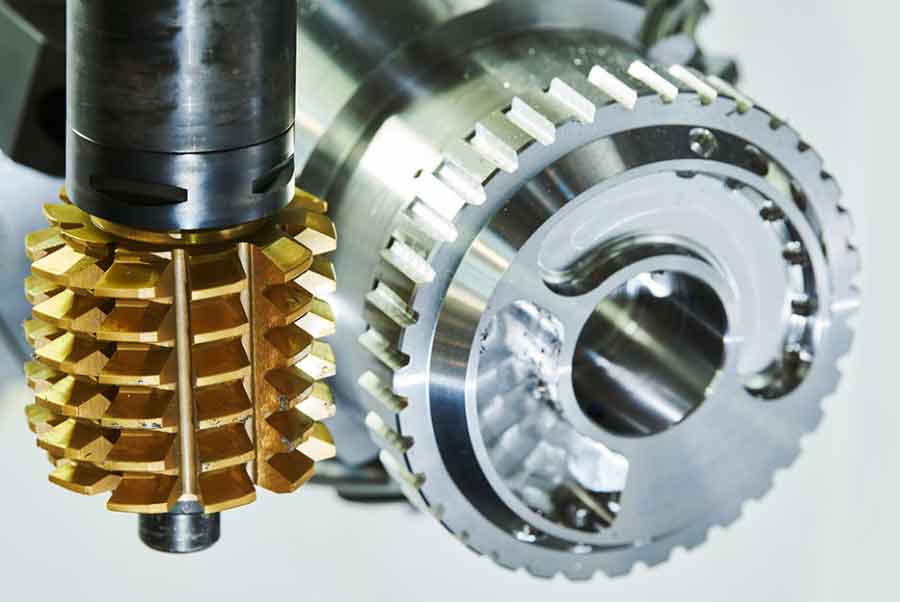
To begin, I analyzed the geometric error elements of a large-sized CNC gear hobbing machine with three linear axes (X, Y, Z) and three rotational axes (A, B, C). These errors are categorized into position-dependent geometric errors (PDGEs) and position-independent geometric errors (PIGEs). PDGEs, such as linear displacement errors and angular errors, vary with the axis position, while PIGEs, like perpendicularity errors, remain constant. In total, 51 geometric error terms were considered, as summarized in Table 1. Each axis contributes six PDGEs, and additional PIGEs account for misalignments between axes. Understanding these errors is crucial for modeling their impact on the gear hobbing process.
| Axis | PDGEs | PIGEs | Error Numbers |
|---|---|---|---|
| X | δ_X(x), δ_Y(x), δ_Z(x), ε_X(x), ε_Y(x), ε_Z(x) | — | 1–6 |
| Y | δ_X(y), δ_Y(y), δ_Z(y), ε_X(y), ε_Y(y), ε_Z(y) | S_YX, S_YZ | 7–14 |
| Z | δ_X(z), δ_Y(z), δ_Z(z), ε_X(z), ε_Y(z), ε_Z(z) | S_ZX | 15–21 |
| A | δ_X(α), δ_Y(α), δ_Z(α), ε_X(α), ε_Y(α), ε_Z(α) | δ_AY, δ_AZ, ε_AY, ε_AZ | 22–31 |
| C | δ_X(γ), δ_Y(γ), δ_Z(γ), ε_X(γ), ε_Y(γ), ε_Z(γ) | δ_CX, δ_CY, ε_CX, ε_CY | 32–41 |
| B | δ_X(β), δ_Y(β), δ_Z(β), ε_X(β), ε_Y(β), ε_Z(β) | δ_BX, δ_BZ, ε_BX, ε_BZ | 42–51 |
Based on multi-body system theory and homogeneous coordinate transformation (HCT), I established the tool posture-geometric error model. The ideal transformation matrix from the hob coordinate system to the workpiece coordinate system is given by:
$$ {}^{i}T_{2,8} = (T_{1,2} T_{0,1})^{-1} T_{0,3} T_{3,4} T_{4,5} T_{5,6} T_{6,7} T_{7,8} $$
where \( T_{i,j} \) represents the ideal transformation between adjacent bodies. When geometric errors are present, the actual transformation matrix becomes:
$$ {}^{e}T_{i,j} = T_{PI_{i,j}} T_{i,j} T_{PD_{i,j}} $$
Here, \( T_{PI_{i,j}} \) and \( T_{PD_{i,j}} \) denote the position-independent and position-dependent error matrices, respectively. The actual transformation from hob to workpiece is:
$$ {}^{e}T_{2,8} = ({}^{e}T_{1,2} {}^{e}T_{0,1})^{-1} {}^{e}T_{0,3} {}^{e}T_{3,4} {}^{e}T_{4,5} {}^{e}T_{5,6} {}^{e}T_{6,7} {}^{e}T_{7,8} $$
The tool posture errors, including position error \( \delta_t \) and orientation error \( \epsilon_t \), are then calculated as:
$$ \delta_t = (\delta_X, \delta_Y, \delta_Z, 1)^T = ({}^{e}T_{2,8} – {}^{i}T_{2,8}) (a, b, c, 1)^T $$
$$ \epsilon_t = (\epsilon_X, \epsilon_Y, \epsilon_Z, 0)^T = ({}^{e}T_{2,8} – {}^{i}T_{2,8}) (i, j, k, 0)^T $$
However, this tool-based model is insufficient for gear hobbing because it does not consider the enveloping generation of the tooth surface. Therefore, I developed a tooth surface posture-geometric error model. The hob tooth surface, represented as an involute helicoid, is parameterized by:
$$ \mathbf{r}_h(\phi_h, \theta_h) = \mathbf{M}_{hp} \mathbf{r}_p(\phi_h) $$
where \( \phi_h \) is the involute roll angle, \( \theta_h \) is the rotation parameter, and \( \mathbf{M}_{hp} \) is the helical motion matrix. The hob surface normal vector is \( \mathbf{n}_h(\phi_h, \theta_h) \). Using the transformation matrices, the ideal and actual tooth surfaces in the workpiece coordinate system are:
$$ {}^{i}\mathbf{r}_g(\phi_h, \theta_h) = {}^{i}T_{2,8} \mathbf{r}_h(\phi_h, \theta_h) $$
$$ {}^{i}\mathbf{n}_g(\phi_h, \theta_h) = {}^{i}T_{2,8} \mathbf{n}_h(\phi_h, \theta_h) $$
$$ {}^{e}\mathbf{r}_g(\phi_h, \theta_h) = {}^{e}T_{2,8} \mathbf{r}_h(\phi_h, \theta_h) $$
$$ {}^{e}\mathbf{n}_g(\phi_h, \theta_h) = {}^{e}T_{2,8} \mathbf{n}_h(\phi_h, \theta_h) $$
According to the two-parameter envelope theory, the contact points on the generated gear tooth surface satisfy the following equations:
$$ \mathbf{n}_g \cdot \frac{\partial \mathbf{r}_g}{\partial \beta} = 0 $$
$$ \mathbf{n}_g \cdot \frac{\partial \mathbf{r}_g}{\partial z} = 0 $$
By solving these equations for both ideal and error-affected cases, I obtained the coordinates of contact trace points, denoted as \( {}^{i}\mathbf{R}_g \), \( {}^{i}\mathbf{N}_g \) (ideal) and \( {}^{e}\mathbf{R}_g \), \( {}^{e}\mathbf{N}_g \) (actual). The tooth surface posture error is then defined as:
$$ \mathbf{E} = (\delta_g; \epsilon_g) = (\delta_X, \delta_Y, \delta_Z, \epsilon_X, \epsilon_Y, \epsilon_Z)^T $$
where \( \delta_g = {}^{e}\mathbf{R}_g – {}^{i}\mathbf{R}_g \) and \( \epsilon_g = {}^{e}\mathbf{N}_g – {}^{i}\mathbf{N}_g \). This model comprehensively captures the position and orientation deviations of the tooth surface due to geometric errors in gear hobbing.
To identify the key geometric errors from the 51 error terms, I employed the Sobol global sensitivity analysis method. This method is based on variance decomposition and quantifies the contribution of each input error to the output variance of the tooth surface posture error. The tooth surface error model can be expressed as a function of the geometric error vector \( \mathbf{G} = (x_1, x_2, \dots, x_{51})^T \):
$$ E_k = f_k(\mathbf{G}), \quad k = 1, \dots, 6 $$
where \( E_k \) represents the six components of \( \mathbf{E} \). For each output component, the Sobol method decomposes the function into summands of increasing dimensionality:
$$ f(\mathbf{x}) = f_0 + \sum_{i=1}^{n} f_i(x_i) + \sum_{i=1}^{n} \sum_{j>i}^{n} f_{ij}(x_i, x_j) + \dots + f_{12\dots n}(x_1, x_2, \dots, x_n) $$
The total variance \( V \) and partial variances \( V_{i_1,\dots,i_s} \) are computed, leading to sensitivity indices. The first-order sensitivity index \( S_i \) measures the individual effect of error \( x_i \), while the total-effect index \( S_{Ti} \) accounts for both individual and interactive effects with other errors:
$$ S_i = \frac{V_i}{V}, \quad S_{Ti} = \frac{V_{Ti}}{V} $$
where \( V_i \) is the variance due to \( x_i \), and \( V_{Ti} \) is the total variance including interactions. To estimate these indices, I used Quasi-Monte Carlo sampling with Sobol sequences, generating \( m = 100 \) samples for each error term. The sampling range was based on measured error data from a large-sized gear hobbing machine, with position errors in [0, 40] µm and angular errors in [0, 0.00053] rad. The model was evaluated at multiple positions along the Z-axis (810–890 mm) to account for spatial variations in gear hobbing, and sensitivity indices were averaged over these positions.
The sensitivity analysis results for each tooth surface posture error component are presented in Table 2, which summarizes the key geometric errors identified based on first-order and total-effect indices greater than 0.03. The threshold of 0.03 is chosen as 1.5 times the uniform sensitivity value (1/51 ≈ 0.02), highlighting errors with significant impact.
| Error Component | Key Geometric Error Terms | Strongly Coupled Errors | Sensitive Axes |
|---|---|---|---|
| δ_X | δ_X(x), ε_Y(x), δ_X(y), δ_X(z), S_ZX, δ_X(α), δ_X(γ), ε_Y(γ), δ_CX, ε_CY, δ_X(β), δ_BX | ε_Y(x), ε_CY | C, X |
| δ_Y | ε_Z(x), S_YX, ε_Z(z), ε_Z(α), ε_AZ, ε_Z(γ), ε_Z(β), ε_BZ | S_YX | C |
| δ_Z | ε_Y(x), ε_Y(z), ε_Y(γ), ε_CY, ε_Y(β) | — | C |
| ε_X | ε_Z(x), ε_Z(y), S_YX, ε_Z(z), ε_Z(α), ε_AZ, ε_Z(γ), ε_Z(β), ε_BZ | ε_Z(y), S_YX, ε_Z(z), ε_Z(α), ε_BZ | Y, A |
| ε_Y | ε_Z(x), ε_Z(y), S_YX, ε_Z(z), ε_Z(α), ε_AZ, ε_Z(γ), ε_Z(β), ε_BZ | ε_Z(y), S_YX, ε_Z(z), ε_Z(α), ε_BZ | Y, A |
| ε_Z | ε_X(x), ε_Y(x), ε_X(y), S_YZ, ε_X(z), ε_X(α), ε_Y(α), ε_X(γ), ε_CX, ε_X(β), ε_BX | ε_X(y), S_YZ, ε_X(z), ε_X(α), ε_X(β) | C, A |
From the results, it is evident that geometric errors of the C-axis (workpiece rotation) have a dominant influence on all tooth surface error components, underscoring its critical role in gear hobbing accuracy. Angular errors, particularly roll, pitch, and yaw errors, exhibit higher sensitivity compared to linear displacement errors. The sensitive axes identified—C, X, Y, and A—should be prioritized in error compensation and precision design for gear hobbing machines. Additionally, the analysis reveals significant coupling among errors, as indicated by differences between first-order and total-effect indices. For instance, errors like ε_Y(x) and ε_CY show strong interactive effects, complicating error compensation strategies.
To validate the identification results, I performed virtual simulation corrections. For each tooth surface error component, the key geometric errors were set to zero while other errors retained their sampled values. The reduction rate in error magnitude after correction was computed, defined as the error reduction ratio. As shown in Table 3, the primary error reduction ratios exceed 60%, with some reaching up to 98.39%, confirming that the identified key errors account for the majority of the tooth surface deviation. This demonstrates the effectiveness of the Sobol-based sensitivity analysis in pinpointing critical errors in gear hobbing.
| Corrected Component | δ_X Reduction (%) | δ_Y Reduction (%) | δ_Z Reduction (%) | ε_X Reduction (%) | ε_Y Reduction (%) | ε_Z Reduction (%) |
|---|---|---|---|---|---|---|
| δ_X | 83.76 | 1.30 | 83.02 | 0.34 | 4.22 | 1.15 |
| δ_Y | -0.24 | 68.63 | 0.01 | 67.39 | 70.58 | 4.29 |
| δ_Z | -26.42 | -0.01 | 82.51 | 21.01 | 0.26 | 16.43 |
| ε_X | -2.90 | 62.13 | 0.96 | 98.39 | 94.48 | -4.66 |
| ε_Y | -2.90 | 62.13 | 0.96 | 98.39 | 94.48 | -4.66 |
| ε_Z | -28.14 | -5.90 | 38.80 | -0.05 | -11.01 | 78.63 |
Note that correcting key errors for one component may inadvertently increase errors in other components due to coupling effects, as seen with δ_Z correction affecting δ_X negatively. This highlights the complexity of error interactions in gear hobbing and emphasizes the need for holistic compensation approaches.
I further compared the Sobol method with other sensitivity analysis techniques, such as the matrix differential method and Morris method, to evaluate its superiority. For the δ_X component, the matrix differential method identified only four key errors, while the Sobol and Morris methods yielded similar sets. However, the Sobol method provides quantitative sensitivity indices, whereas Morris is primarily qualitative. Moreover, I contrasted the tooth surface posture error model with a conventional tool posture error model. The tooth surface model identified additional key errors for δ_Y and δ_Z, leading to higher error reduction ratios (68.63% vs. 36.71% for δ_Y), proving its enhanced accuracy in capturing gear hobbing specifics.
The implications of this research extend to practical applications in gear hobbing. By focusing on key geometric errors like C-axis angular errors and X-axis linear errors, manufacturers can implement targeted error compensation through CNC systems, reducing setup time and improving gear quality. Additionally, machine tool designers can use the sensitivity results to allocate tolerances more effectively, enhancing the cost-performance ratio of large-sized gear hobbing machines. Future work could integrate thermal and force-induced errors into the model, further refining accuracy predictions.
In conclusion, my study presents a comprehensive framework for key error identification in gear hobbing machines. The tooth surface posture-geometric error model, combined with Sobol global sensitivity analysis, effectively quantifies the impact of geometric errors on gear accuracy. The identified key errors, predominantly angular errors of sensitive axes, provide a roadmap for precision enhancement. This methodology not only advances the understanding of error propagation in gear hobbing but also offers a practical tool for industry to achieve higher-quality gear production. As gear hobbing continues to evolve for larger and more precise applications, such analytical approaches will be indispensable for maintaining competitiveness in manufacturing.