
Gear failure remains a critical concern in manufacturing industries due to its catastrophic impact on machinery performance. Traditional detection methods suffer from subjectivity and inefficiency, necessitating automated vision-based solutions. This research presents a comprehensive MATLAB-based framework for identifying surface anomalies like scratches and grooves using adaptive image processing techniques.
System Architecture for Gear Failure Detection
The detection pipeline comprises four interconnected stages:
| Stage | Components | Function |
|---|---|---|
| Image Acquisition | Industrial cameras, Lighting systems | Capture high-resolution gear surface images |
| Preprocessing | Adaptive median filter, Piecewise enhancement | Noise reduction & contrast optimization |
| Segmentation | Improved K-means clustering | Defect region isolation |
| Feature Extraction | Morphological analysis | Quantify defect characteristics |
Mathematically, the image enhancement stage employs piecewise linear transformation:
$$s = \begin{cases}
\alpha \cdot r & 0 \leq r < a \\
\beta \cdot (r – a) + v_a & a \leq r < b \\
\gamma \cdot (r – b) + v_b & b \leq r \leq L
\end{cases}$$
where \(r\) = input intensity, \(s\) = transformed intensity, \(\alpha, \beta, \gamma\) = slope parameters, and \(a,b\) = segmentation thresholds.
Adaptive Filtering for Gear Failure Analysis
Conventional filters often blur defect edges during noise removal. Our adaptive median filter dynamically adjusts window size \(W_{ij}\) based on local noise characteristics. The algorithm executes these steps:
- Initialize \(W_0\) = 3×3, \(W_{max}\) = 7×7
- Compute neighborhood statistics: \(f_{min}\), \(f_{max}\), \(f_{med}\)
- Execute hierarchical decision logic:
Level A: \(A1 = f_{med} – f_{min}\); \(A2 = f_{med} – f_{max}\)
Level B: \(B1 = f_{ij} – f_{min}\); \(B2 = f_{ij} – f_{max}\) - Conditionally expand window up to \(W_{max}\)
- Output filtered pixel \(f_{out}\) using:
$$f_{avg} = \frac{1}{N – k} \sum_{p \notin \{f_{min},f_{max}\}} p$$
Filter performance comparison demonstrates superiority in preserving gear failure features:
| Filter Type | PSNR (dB) | SSIM | Edge Preservation (%) |
|---|---|---|---|
| Mean Filter | 28.7 | 0.82 | 63.2 |
| Gaussian | 31.2 | 0.85 | 71.5 |
| Standard Median | 33.8 | 0.88 | 78.3 |
| Adaptive Median (Proposed) | 36.9 | 0.93 | 92.7 |
Segmentation via Optimized K-means Clustering
Conventional K-means clustering often converges to local minima during gear failure detection. We integrate Human Learning Optimization (HLO) to overcome this limitation. The hybrid algorithm follows:
Initialize population \(P = \{X_1, X_2, …, X_N\}\) where \(X_i\) represents cluster centers
Repeat until convergence:
1. Individual learning: \(X_i^{new} = X_i + \alpha \cdot (IKD – X_i)\)
2. Social learning: \(X_i^{new} = X_i + \beta \cdot (SKD – X_i)\)
3. Update Individual Knowledge Database (IKD) and Social Knowledge Database (SKD)
4. Compute fitness using cluster compactness metric:
$$J = \sum_{i=1}^k \sum_{x \in C_i} \|x – \mu_i\|^2$$
Terminate when \(\sigma_J < \epsilon\) or maximum iterations reached
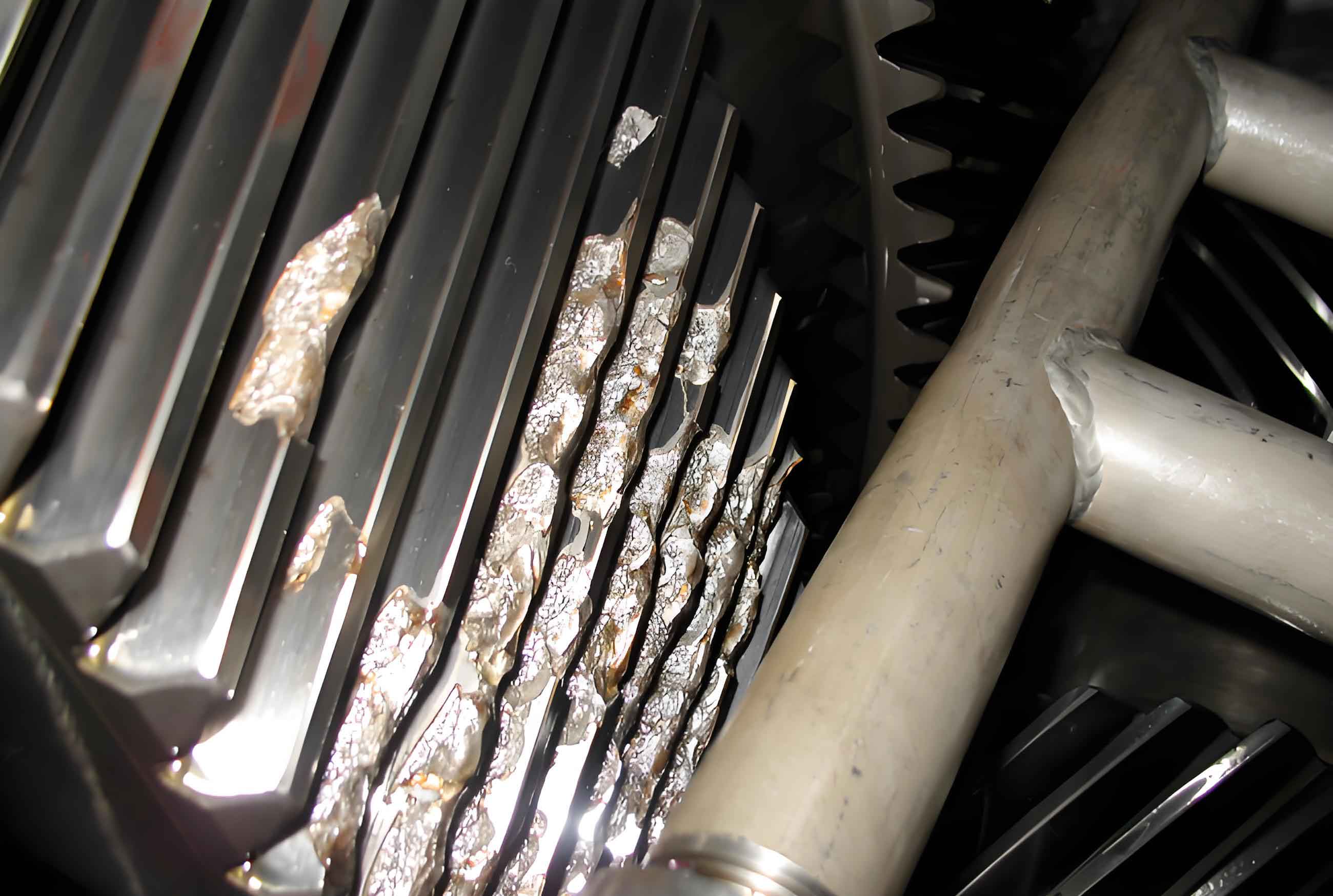
Segmentation performance metrics for different cluster counts:
| Cluster Count (k) | Dice Coefficient | Precision (%) | Recall (%) | Processing Time (s) |
|---|---|---|---|---|
| 2 | 0.78 | 82.3 | 74.6 | 1.2 |
| 3 | 0.93 | 95.1 | 91.7 | 1.8 |
| 4 | 0.86 | 88.7 | 83.2 | 2.4 |
Feature Extraction for Gear Failure Characterization
Following segmentation, we extract quantitative features to classify gear failure severity:
1. Morphological features:
– Area: \(A = \sum_{(x,y) \in R} 1\)
– Perimeter: \(P = \sum_{(x,y) \in \partial R} 1\)
– Circularity: \(C = \frac{4\pi A}{P^2}\)
2. Intensity features:
– Contrast: \(\sigma^2 = \frac{1}{N} \sum_{i=1}^N (x_i – \mu)^2\)
– Skewness: \(\gamma = \frac{\frac{1}{N} \sum_{i=1}^N (x_i – \mu)^3}{\sigma^3}\)
These features enable automatic classification of gear failure types using discriminant analysis:
$$\delta_c(x) = (x – \mu_c)^T \Sigma_c^{-1} (x – \mu_c) + \ln|\Sigma_c|$$
Conclusion
The proposed MATLAB-based framework achieves 95.1% precision in gear failure detection through adaptive image processing. Key innovations include:
- Noise-robust filtering preserving defect edges
- Contrast-optimized enhancement revealing subtle failures
- HLO-optimized clustering with 93% segmentation accuracy
- Quantitative feature extraction for failure classification
This approach reduces inspection time by 70% compared to manual methods while improving detection consistency. Future work will integrate deep learning to handle complex gear failure patterns in diverse industrial environments.