
Gear transmission performance—including load capacity, operational smoothness, and service life—is fundamentally determined by the contact conditions between meshing tooth surfaces under actual working conditions. The micro-geometric topography of tooth surfaces significantly influences vibration, noise, and durability. Precision machining of hardened gears enhances load-bearing capacity, reduces noise and vibration, and extends service life across critical power transmission systems. Common precision machining methods for hardened gears include grinding, skiving, lapping, high-speed dry cutting, and gear honing. While grinding remains the most mature and widely adopted process, it presents limitations such as high costs and unfavorable surface micro-geometry for noise reduction. Gear honing, conversely, generates unique surface patterns that effectively suppress transmission noise, driving its sustained development, particularly in automotive gear manufacturing.
Modern gear honing technology has evolved substantially with the integration of CNC systems, direct drives, and advanced control algorithms. This evolution enables gear honing to transition from a mere finishing operation to a standalone precision machining solution. The development path encompasses three key phases:
1. Conventional Soft Gear Honing: Utilizes flexible honing wheels made of synthetic resin or rubber. The free meshing action primarily polishes surfaces with minimal material removal (< 0.01 mm) and limited error correction capability. Gear accuracy depends heavily on pre-machining and heat treatment quality. The material removal rate \( MRR \) is governed by:
$$ MRR = k \cdot v_s \cdot P_n $$
where \( k \) is the honing coefficient, \( v_s \) is the sliding velocity, and \( P_n \) is the normal pressure.
2. CBN Wheel Hard Gear Honing: Emerged in the 1980s, employing steel-based honing wheels electroplated with CBN abrasives. This increases rigidity and material removal capacity (0.02–0.05 mm), enabling correction of profile, pitch, and helix deviations. Surface roughness improves to \( Ra \leq 0.4 \mu m \).
3. Power Gear Honing: Features electronically synchronized, forced meshing between a rigid honing wheel and the workpiece. This achieves significant error correction, elevating accuracy to DIN class 5 and surface roughness to \( Ra < 0.2 \mu m \). Material removal reaches 0.1 mm, rivaling grinding efficiency for specific applications.
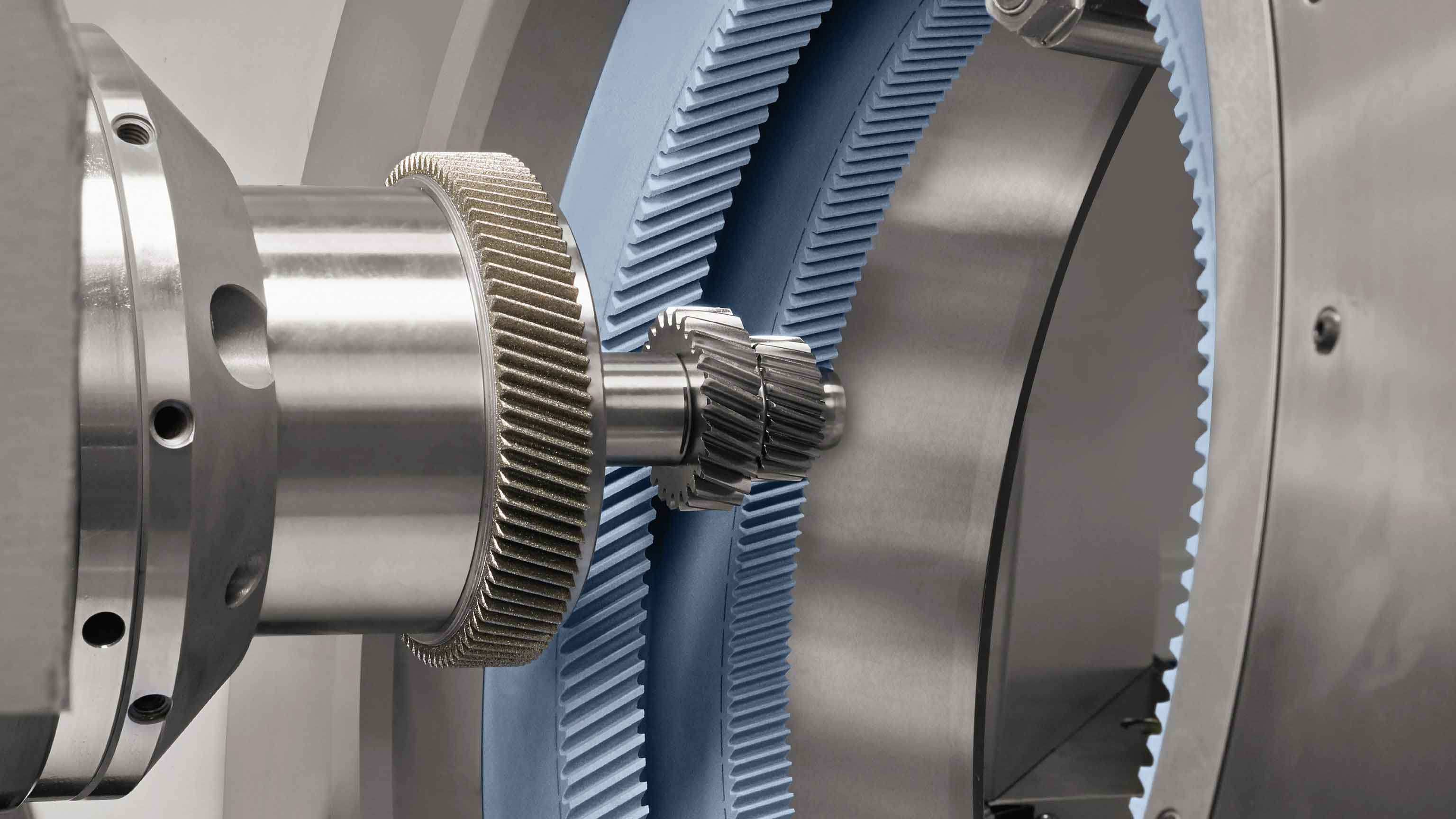
Advantages of Power Gear Honing
Power gear honing offers distinct benefits over grinding and other processes:
| Parameter | Power Gear Honing | Grinding | Improvement |
|---|---|---|---|
| Surface Texture | Cross-helical arc patterns | Linear/parallel grooves | Noise reduction up to 8 dB |
| Surface Stress | Compressive residual stress (≥ -400 MPa) | Tensile stress risk | +30% fatigue life |
| Thermal Damage | Negligible (cutting speed < 3 m/s) | Burn/micro-crack risk | Zero thermal distortion |
| Surface Roughness | \( Ra < 0.2 \mu m \) (mirror-finish achievable) | \( Ra = 0.4–0.8 \mu m \) | 50% lower \( Ra \) |
| Geometric Flexibility | Machines gears with shoulders/no undercuts | Requires overrun | No auxiliary machining |
| Tooling Cost | Honing wheel: $800–$1,200 | Grinding wheel: $2,500–$4,000 | 60–70% lower |
The unique arc pattern generated by crossed-axis meshing (Figure 5b) disrupts resonant frequencies, while low heat input ensures metallurgical integrity. The process efficiency \( \eta \) is quantified as:
$$ \eta = \frac{\text{Volume removed}}{\text{Energy consumed}} = \frac{V_m}{P \cdot t} $$
where \( V_m \) is material volume, \( P \) is power, and \( t \) is time.
Global Advancements in Power Gear Honing Systems
Leading manufacturers have developed specialized CNC power gear honing machines:
| Manufacturer | Model | Key Innovations | Capabilities |
|---|---|---|---|
| Gleason (USA) | 150SPH | Spherical honing for flexible crowning | Ø150 mm max, \( m = 0.5–4 \), 550 mm length |
| Prawema (Germany) | Synchrofine 205 HS | Dual-spindle, marble bed, in-process measurement | Ø250 mm max, \( m = 1–6 \), 600 mm length |
| Fässler (Switzerland) | HMX-400 | Internal meshing architecture | Ø50–350 mm, \( m = 0.5–6 \), 500 mm length |
| Kanzaki (Japan) | GFC-α300-NC6 | Synchronous encoder control | Ø50–300 mm, \( m = 1–4 \), 350 mm length |
These systems incorporate electronic gearboxes (EGB), linear motors, and AI-driven adaptive control. The EGB synchronization error \( \delta \) is minimized to under 1 arcsecond:
$$ \delta = \frac{\Delta \theta_m}{i} + \Delta \theta_w $$
where \( \Delta \theta_m \) and \( \Delta \theta_w \) are angular errors of the honing wheel and workpiece, and \( i \) is the transmission ratio.
Critical Technologies in Power Gear Honing
Three core technologies enable high-precision gear honing:
1. Machine Stiffness Optimization: Static, dynamic, and thermal stiffness ensure stability during forced meshing. Natural frequency \( f_n \) must exceed excitation frequencies:
$$ f_n = \frac{1}{2\pi} \sqrt{\frac{k}{m}} > 2 \times f_{\text{meshing}} $$
where \( k \) is stiffness and \( m \) is system mass.
2. Honing Wheel Dressing: Precision dressing using diamond-coated gears remains costly ($15,000–$20,000 per tool). Research focuses on CNC-form dressing to enable flexible profile modifications without dedicated tools. The wear rate \( W_r \) follows:
$$ W_r = C \cdot v^{1.2} \cdot F_n^{0.8} $$
where \( C \) is abrasive constant, \( v \) is speed, and \( F_n \) is normal force.
3. Profile Modification Control: Electronic path compensation adjusts tooth flank geometry. Contact trajectory \( T_c \) is modeled as:
$$ T_c = f(\Sigma, \alpha, \beta, \Delta x, \Delta y) $$
where \( \Sigma \) is shaft angle, \( \alpha \) and \( \beta \) are helix angles, and \( \Delta x \), \( \Delta y \) are axis offsets.
Future Development Trends
Power gear honing technology will evolve in these directions:
- Intelligent Process Control: IoT-enabled real-time monitoring of acoustic emissions, force, and temperature to auto-optimize parameters.
- Ultra-Precision Honing: Combining ELID (Electrolytic In-Process Dressing) with CBN wheels to achieve \( Ra < 0.1 \mu m \).
- Hybrid Machining: Integrating gear honing with laser hardening or PVD coating in single setups.
- Sustainable Solutions: Minimum Quantity Lubrication (MQL) systems reducing coolant usage by 95%.
The global gear honing market is projected to grow at 6.8% CAGR through 2030, driven by EV transmission demands. Power gear honing will complement grinding in high-volume precision manufacturing, particularly where noise, surface integrity, and cost are critical.