
In modern industries such as automotive and aerospace, the demand for high-precision gears with superior surface quality and performance is ever-increasing. Gear grinding, particularly gear profile grinding, plays a critical role in achieving these requirements by enabling precise tooth surface modifications. These modifications, including crowning and lead corrections, are essential for reducing noise, vibration, and improving load capacity. However, traditional methods often rely on simplified constraints, such as drum shape parameters, leading to discrepancies between design and manufacturing. To address this, we propose a novel continuous generation grinding method that integrates electronic gearbox (EGB) principles with high-order polynomial interpolation. This approach allows for flexible and accurate tooth surface modifications by superimposing additional multi-axis motions, optimizing the grinding process to minimize deviations from the ideal tooth geometry.
Gear grinding is a sophisticated process that involves the removal of material from gear teeth using abrasive tools like worm wheels. One common challenge in gear grinding is the occurrence of grinding cracks, which can compromise the integrity and lifespan of gears. These cracks often result from excessive thermal stress or improper grinding parameters. Therefore, developing methods that enhance control over the grinding process is crucial. Our method focuses on gear profile grinding, where the worm wheel engages with the gear in a continuous generating motion, ensuring high efficiency and accuracy. By incorporating high-order polynomial motions into the EGB framework, we achieve precise control over the grinding path, reducing the risk of defects like grinding cracks and improving overall gear quality.
The foundation of our approach lies in accurate modeling of the gear tooth surface and the worm wheel geometry. For a standard helical gear, the involute tooth surface can be represented using parametric equations. Let \( r_b \) be the base radius, \( \delta \) the half-angle of the tooth space, \( \phi \) the roll angle, and \( \beta_b \) the base helix angle. The position vector \( \mathbf{r}_g(\phi, \varphi) \) for the gear tooth surface is given by:
$$ \mathbf{r}_g(\phi, \varphi) = \begin{bmatrix} r_b \left[ \cos(\delta + \phi + \varphi) + \phi \sin(\delta + \phi + \varphi) \right] \\ r_b \left[ \sin(\delta + \phi + \varphi) – \phi \cos(\delta + \phi + \varphi) \right] \\ r_b \varphi / \tan \beta_b \end{bmatrix} $$
where \( \varphi \) is the spiral angle. The normal vector \( \mathbf{n}_g(\phi, \varphi) \) is derived by taking partial derivatives with respect to \( \phi \) and \( \varphi \). For modification, we introduce a parabolic lead crowning, where \( \Delta \varphi = G / r_b \) and \( G \) is the crowning function. The modified surface becomes:
$$ \mathbf{r}_g^{\text{mod}}(\phi, \varphi) = \begin{bmatrix} r_b \left[ \cos(\delta + \phi + \varphi – \Delta \varphi) + \phi \sin(\delta + \phi + \varphi – \Delta \varphi) \right] \\ r_b \left[ \sin(\delta + \phi + \varphi – \Delta \varphi) – \phi \cos(\delta + \phi + \varphi – \Delta \varphi) \right] \\ r_b \varphi / \tan \beta_b \end{bmatrix} $$
Next, we model the worm wheel surface by transforming the gear coordinates to the worm wheel system. Using transformation matrices, the worm wheel surface \( \mathbf{R}_{w1}(\phi, \varphi, \theta_g, \lambda_w) \) and its normal vector \( \mathbf{n}_{w1} \) are obtained. The engagement between the worm wheel and gear is governed by the equation of meshing, which ensures continuous contact during grinding. The worm wheel surface is further parameterized as:
$$ \mathbf{R}_{w2}(\xi, \tau) = \begin{bmatrix} r_w \left[ \cos(\xi + \tau) + \xi \sin(\xi + \tau) \right] \\ r_w \left[ \sin(\xi + \tau) – \xi \cos(\xi + \tau) \right] \\ p_w \tau + \Delta z_w \\ 1 \end{bmatrix} $$
where \( r_w \) is the base radius of the worm wheel, \( p_w \) is the spiral parameter, and \( \xi \), \( \tau \) are independent parameters. This dual-parameter representation allows for precise calculation of the grinding contact points.
The continuous generation grinding process is based on the EGB principle, where the motions of the worm wheel and gear are synchronized. The relationship between the worm wheel rotation \( \phi_{B1} \), gear rotation \( \phi_{C1} \), and feed axes positions \( F_{Y1} \) and \( F_{Z1} \) is given by:
$$ \phi_{C1} = \frac{N_w}{N_g} \phi_{B1} + \frac{1}{p_g} F_{Z1} + \frac{N_w}{N_g p_w} F_{Y1} $$
where \( N_w \) and \( N_g \) are the number of teeth on the worm wheel and gear, respectively, and \( p_g \) is the gear spiral parameter. The ground tooth surface \( \mathbf{R}_p \) in the workpiece coordinate system is derived through coordinate transformations and the meshing conditions:
$$ \mathbf{R}_p = \mathbf{M}_{pw2} \mathbf{R}_{w2}(\xi, \tau) $$
The normal vector \( \mathbf{n}_p \) is similarly transformed. The meshing conditions are expressed as a set of equations that must be satisfied simultaneously:
$$ \begin{aligned} f_1(\xi, \tau, \phi_{B1}, F_{Y1}, F_{Z1}, t) &= \mathbf{n}_p \cdot \frac{\partial \mathbf{R}_p}{\partial \phi_{B1}} = 0 \\ f_2(\xi, \tau, \phi_{B1}, F_{Y1}, F_{Z1}, t) &= \mathbf{n}_p \cdot \frac{\partial \mathbf{R}_p}{\partial F_{Y1}} = 0 \\ f_3(\xi, \tau, \phi_{B1}, F_{Y1}, F_{Z1}, t) &= \mathbf{n}_p \cdot \frac{\partial \mathbf{R}_p}{\partial F_{Z1}} = 0 \end{aligned} $$
These equations are solved numerically to obtain the cloud of contact points, which are then discretized into grid points for analysis. The grid points are distributed along the profile and lead directions, allowing for detailed evaluation of tooth surface deviations.
To achieve tooth surface modifications, we superimpose high-order polynomial motions on the feed axes of the worm wheel. The standard feed motions \( F_{X1} \), \( F_{Y1} \), and \( F_{Z1} \) are augmented with 6th-order polynomials:
$$ \begin{aligned} F’_{X1}(z_b) &= F_{X1} + \lambda_1 z_b + \lambda_2 z_b^2 + \lambda_3 z_b^3 + \lambda_4 z_b^4 + \lambda_5 z_b^5 + \lambda_6 z_b^6 \\ F’_{Y1}(z_b) &= F_{Y1} + \lambda_7 z_b + \lambda_8 z_b^2 + \lambda_9 z_b^3 + \lambda_{10} z_b^4 + \lambda_{11} z_b^5 + \lambda_{12} z_b^6 \\ F’_{Z1}(z_b) &= F_{Z1} + \lambda_{13} z_b + \lambda_{14} z_b^2 + \lambda_{15} z_b^3 + \lambda_{16} z_b^4 + \lambda_{17} z_b^5 + \lambda_{18} z_b^6 \end{aligned} $$
where \( z_b = F_{Z1} / b_g \) is the normalized position along the gear width \( b_g \), and \( \lambda_1 \) to \( \lambda_{18} \) are the polynomial coefficients to be optimized. The goal is to minimize the normal deviation between the actual ground surface and the target modified surface. For each grid point \( j \), the deviation \( \varepsilon_j \) is calculated as:
$$ \varepsilon_j = (\mathbf{P}_{jA} – \mathbf{P}_{jT}) \cdot \mathbf{n}_{jP} $$
where \( \mathbf{P}_{jA} \) is the actual position, \( \mathbf{P}_{jT} \) is the target position, and \( \mathbf{n}_{jP} \) is the normal vector at the grid point.
We employ the Levenberg-Marquardt (LM) algorithm to optimize the polynomial coefficients. The sensitivity matrix \( \mathbf{M}_s \) is constructed from the partial derivatives of the tooth surface with respect to the coefficients:
$$ \mathbf{M}_s = \begin{bmatrix} \frac{\partial \mathbf{R}_p(1) \cdot \mathbf{n}(1)}{\partial \lambda_1} & \cdots & \frac{\partial \mathbf{R}_p(1) \cdot \mathbf{n}(1)}{\partial \lambda_{18}} \\ \vdots & \ddots & \vdots \\ \frac{\partial \mathbf{R}_p(2N \times M) \cdot \mathbf{n}(2N \times M)}{\partial \lambda_1} & \cdots & \frac{\partial \mathbf{R}_p(2N \times M) \cdot \mathbf{n}(2N \times M)}{\partial \lambda_{18}} \end{bmatrix} $$
where \( N \) and \( M \) are the number of grid points along the profile and lead directions, respectively. The LM update step for the coefficients is:
$$ \{\delta \lambda_i\} = \left( \mathbf{M}_s^T \mathbf{M}_s + \mu \mathbf{I} \right)^{-1} \mathbf{M}_s^T \{\delta \varepsilon_j\} $$
Here, \( \mu \) is a damping factor, and \( \mathbf{I} \) is the identity matrix. The algorithm iteratively adjusts the coefficients until the deviations are minimized below a threshold. This optimization process ensures that the grinding process accurately produces the desired tooth modifications, reducing errors and preventing issues like grinding cracks.
For practical implementation, we utilize the polynomial interpolation capability of the Siemens 840Dsl CNC system. The high-order polynomials are converted into machine-executable code using the POLY function. The POLY command defines the axis motions as:
$$ \begin{aligned} X1 &= \text{PO}(x_e, a_2, a_3, a_4, a_5) \\ Y1 &= \text{PO}(y_e, b_2, b_3, b_4, b_5) \\ Z1 &= \text{PO}(z_e, c_2, c_3, c_4, c_5) \\ \text{PL} &= n_p \end{aligned} $$
where \( x_e, y_e, z_e \) are the end positions, \( a_2 \) to \( a_5 \), \( b_2 \) to \( b_5 \), and \( c_2 \) to \( c_5 \) are the coefficients for the polynomial interpolation, and \( \text{PL} \) is the parameter interval. The polynomial form is:
$$ f(p) = a_0 + a_1 p + a_2 p^2 + a_3 p^3 + a_4 p^4 + a_5 p^5 $$
with \( a_0 \) as the current axis position and \( a_1 \) calculated based on the end position and additional terms. To convert the theoretical polynomial functions into machine polynomials, we segment the motion based on sample points from the grid. The number of segments \( k_a \) is determined by:
$$ k_a = \frac{s – 1}{n – 1} $$
where \( s \) is the total number of grid points and \( n \) is the number of sample points per segment. The parameter \( p \) for each sample point is scaled relative to the total time \( T \):
$$ p_I = p_l \frac{\Delta t_I}{T} $$
where \( \Delta t_I \) is the time interval from the segment start. For each segment, a system of equations is solved using least-squares to find the machine polynomial coefficients. This conversion ensures that the high-order motions are accurately executed by the CNC system, enabling flexible and precise gear profile grinding.
We conducted numerical simulations and experimental tests to validate the proposed method. The gear parameters used in the study are summarized in the table below:
| Parameter | Symbol | Value |
|---|---|---|
| Number of teeth | \( N_g \) | 48 |
| Normal module (mm) | \( m_n \) | 4.0 |
| Normal pressure angle (°) | \( \alpha_n \) | 20.0 |
| Helix angle (°) | \( \beta \) | 30.0 |
| Addendum diameter (mm) | \( d_a \) | 229.703 |
| Dedendum diameter (mm) | \( d_f \) | 211.703 |
| Face width (mm) | \( b_g \) | 40 |
The worm wheel parameters and machine settings are as follows:
| Parameter | Symbol | Value |
|---|---|---|
| Number of starts | \( N_w \) | 3 |
| Outer diameter (mm) | \( d_w \) | 291.910 |
| Lead angle (°) | \( \gamma_w \) | 2.569 |
| Center distance (mm) | \( E \) | 250.851 |
| Installation angle (°) | \( \gamma \) | 27.431 |
In the numerical example, we targeted a lead crowning modification with a parabolic profile. The normal deviations between the target and actual surfaces were minimized using the LM algorithm. The optimization process converged within a few iterations, demonstrating the efficiency of the method. The resulting deviations at the grid points had an average magnitude of 3.7 μm, indicating high accuracy. The table below shows a subset of the deviations before and after optimization:
| Grid Point Index | Target Deviation (μm) | Actual Deviation (μm) |
|---|---|---|
| 1 | -5.2 | -4.8 |
| 2 | -3.1 | -2.9 |
| 3 | -1.5 | -1.4 |
| 4 | 0.0 | 0.1 |
| 5 | 1.5 | 1.6 |
| 6 | 3.1 | 3.0 |
| 7 | 5.2 | 4.9 |
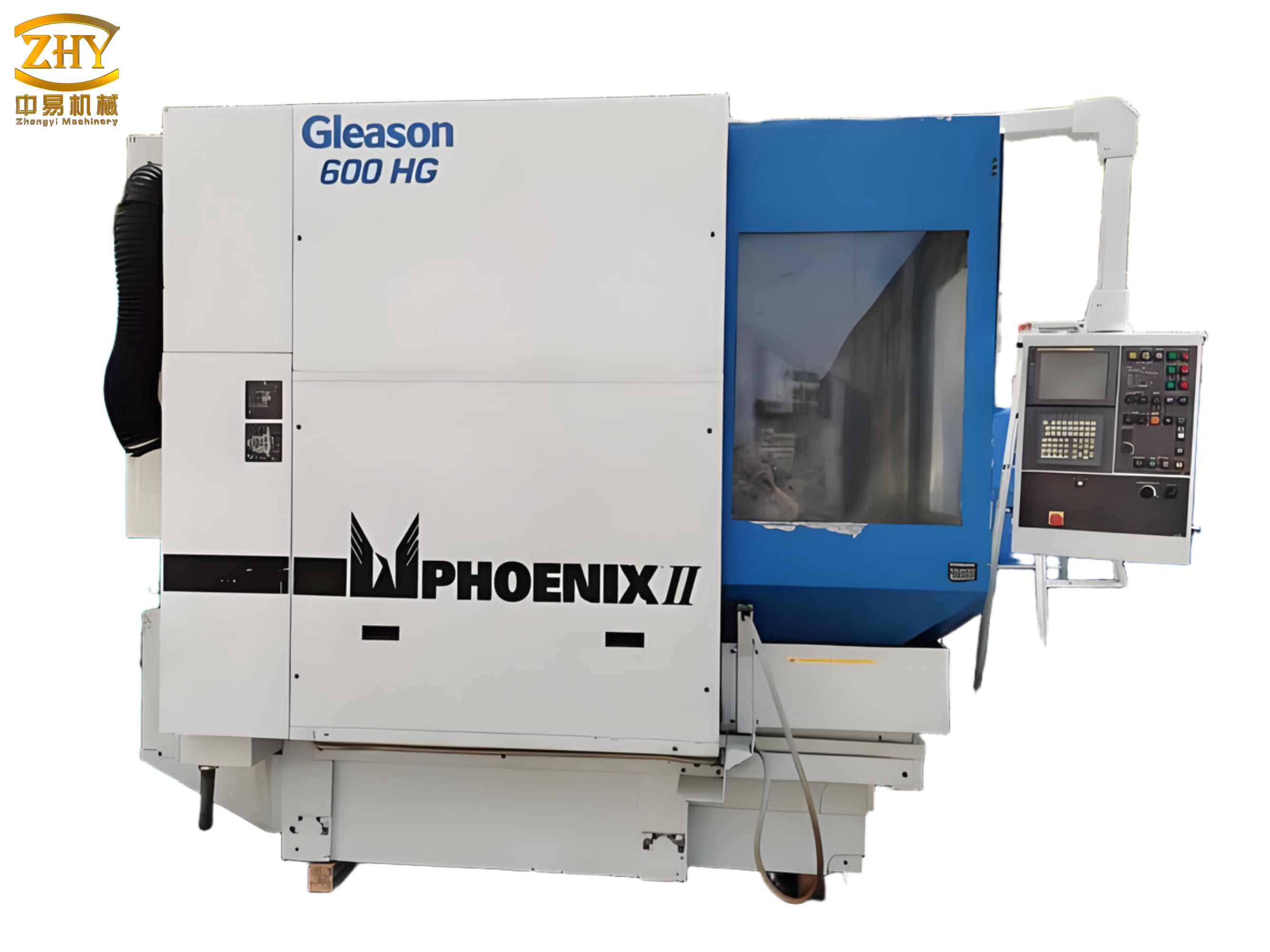
The experimental setup involved a YW7232 CNC gear grinding machine equipped with a Siemens 840Dsl system. The machine polynomials were generated from the optimized theoretical functions and executed via POLY commands. Data collected from the machine axes confirmed that the actual motions closely followed the desired polynomials, with similarities between theoretical and machine polynomials measured below \( 1 \times 10^{-5} \) for all axes. This validates the effectiveness of the polynomial conversion and the feasibility of implementing high-order motions in real-world gear grinding applications.
Furthermore, we analyzed the impact of the method on grinding cracks. By providing precise control over the grinding path and reducing excessive localized stress, the proposed approach minimizes the risk of grinding cracks. In gear profile grinding, such control is essential for maintaining surface integrity. The integration of EGB with high-order motions ensures that the grinding process remains stable and accurate, even under demanding conditions.
In conclusion, our method of continuous generation grinding with electronic gearbox and high-order motion superposition offers a robust solution for tooth surface modifications. The key advantages include:
- Enhanced accuracy in achieving target tooth geometries, reducing deviations to micrometer levels.
- Flexibility in implementing various modification profiles through polynomial optimization.
- Practical feasibility on industrial CNC systems like Siemens 840Dsl, enabling real-time control.
- Reduction in defects such as grinding cracks by optimizing grinding parameters.
The numerical and experimental results demonstrate that this approach bridges the gap between design and manufacturing, providing a reliable method for high-precision gear profile grinding. Future work could explore extensions to other gear types or the integration of real-time monitoring for adaptive control.