
The pursuit of precision, durability, and efficiency in power transmission systems places stringent demands on critical components such as spiral bevel gears. These gears, essential for transmitting torque between non-parallel, intersecting shafts, are subject to complex loading conditions requiring exceptional surface hardness, core toughness, and dimensional stability. My focus here is to synthesize and expand upon key metallurgical and manufacturing strategies, particularly isothermal annealing and liquid die forging, that collectively enhance the performance and manufacturability of high-performance spiral bevel gears.
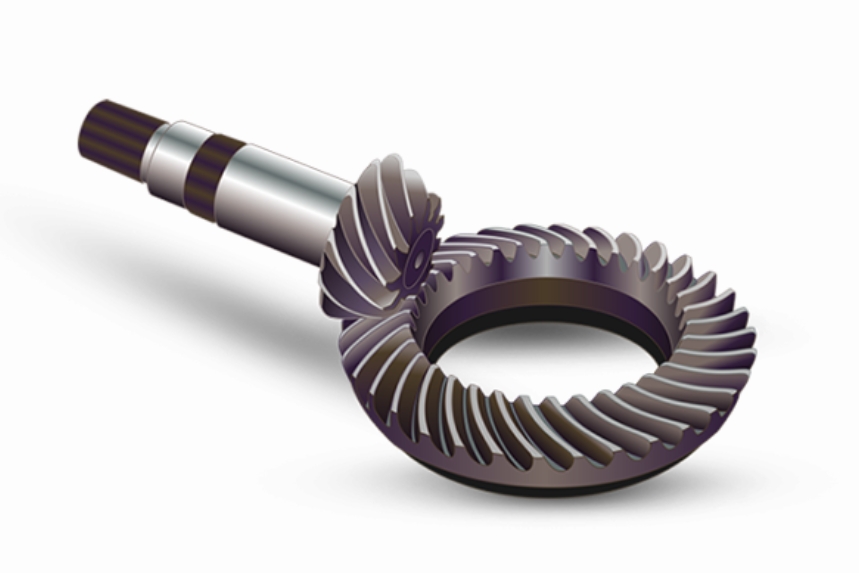
The manufacturing journey of spiral bevel gears begins with the forging of gear blanks. The conventional process chain often involves free forging followed by separate normalizing and machining operations. While functional, this route has inherent drawbacks: significant material waste, extended lead times, and potential microstructural inhomogeneities that can propagate through subsequent steps, ultimately affecting the gear’s performance. A pivotal advancement lies in rethinking the initial heat treatment of the forged blank. For case-hardening steels like 20CrMnTi, commonly used for spiral bevel gears, the standard normalizing process can result in mixed, non-uniform ferrite-pearlite structures with variable hardness, leading to poor and inconsistent machinability.
The isothermal annealing or isothermal normalizing process presents a superior alternative. Instead of allowing the austenitized steel to cool continuously in air, it is rapidly cooled to a temperature just below the Ar1 (the temperature at which austenite begins to transform to ferrite) and held isothermally until the transformation to ferrite and pearlite is complete. This controlled transformation yields a uniformly fine, equiaxed ferrite-pearlite (P+F) microstructure. The kinetics of this diffusional transformation can be described by the Johnson-Mehl-Avrami-Kolmogorov (JMAK) equation:
$$ f = 1 – \exp(-k t^n) $$
where \( f \) is the transformed fraction, \( k \) is a rate constant dependent on temperature and composition, \( t \) is the isothermal holding time, and \( n \) is the Avrami exponent. For the formation of ferrite-pearlite in 20CrMnTi, holding at 600-650°C ensures \( k \) and \( n \) values that promote a rapid and complete transformation to the desired fine structure.
The benefits for spiral bevel gear blanks are profound. The resultant uniform microstructure translates to a consistent and optimal hardness range, typically HB 165-187, across the entire cross-section. This homogeneity is critical for subsequent machining of the complex tooth geometry of spiral bevel gears, as it ensures predictable tool wear, excellent surface finish, and, most importantly, a consistent starting condition for the final carburizing heat treatment. The relationship between initial blank hardness (Hblank) and achievable machining surface finish (Ra) can be empirically modeled for a given tool material:
$$ R_a = C \cdot \left( \frac{H_{\text{blank}}}{H_{\text{ref}}} \right)^m $$
where \( C \) and \( m \) are constants, and \( H_{\text{ref}} \) is a reference hardness. A uniform Hblank minimizes variance in Ra.
The impact extends to the final carburized gear. A uniform pre-hardened microstructure responds more predictably to carburizing, leading to a more uniform case depth and carbon concentration profile. This dramatically reduces the magnitude and scatter of heat treatment distortion, a major challenge in producing precision spiral bevel gears. The distortion (\(\Delta D\)) can be conceptually related to the microstructural homogeneity index (\(I_\mu\)) of the pre-treated blank:
$$ \Delta D \propto \frac{1}{I_\mu} $$
where a higher \(I_\mu\), representing greater uniformity from isothermal annealing, results in lower and more predictable distortion.
| Process Parameter | Conventional Normalizing | Isothermal Annealing | Impact on Spiral Bevel Gears |
|---|---|---|---|
| Austenitizing Temperature | 880-940°C | 880-940°C | Dissolves carbides, homogenizes austenite. |
| Cooling Method | Continuous air cooling | Rapid cool to isothermal hold temperature | Prevents pro-eutectoid ferrite networks. |
| Isothermal Hold Temperature | N/A | 580-660°C (e.g., ~620°C for 20CrMnTi) | Determines final F+P grain size and hardness. |
| Hold Time | N/A | 1-4 hours (depends on section size) | Ensures complete transformation. |
| Resultant Microstructure | Mixed, possibly coarse F+P | Fine, equiaxed, uniform F+P | Core of final gear has uniform toughness. |
| Hardness (HB) | Wide scatter (e.g., 150-210) | Tight range (e.g., 165-187) | Predictable machinability and post-machining distortion. |
| Energy Consumption | Baseline | ~15% higher (for separate furnace process) | Offset by superior quality and reduced scrap. |
A logical and economically significant progression from this separate isothermal annealing process is its integration with the forging operation itself: forge-isothermal annealing. The concept is to utilize the residual heat from the forging process. By controlling the final forging temperature to a specific range slightly above the austenitizing temperature, the blank can be directly transferred to an isothermal holding furnace. This eliminates the need for a separate re-austenitizing cycle, saving substantial energy (potentially 30-50% compared to the two separate processes) and reducing the total production cycle time for spiral bevel gear blanks. The key process control variables become:
- Final Forging Temperature (Tff): Must be high enough to ensure complete austenitization but low enough to prevent excessive grain growth. For 20CrMnTi: \( T_{ff} \approx 950 – 1000°C \).
- Transfer Time (Δt): Must be minimized to avoid undesirable non-isothermal transformation products like Widmanstätten ferrite. \( \Delta t_{max} \approx 30-60 \) seconds.
- Isothermal Hold Parameters: As defined in the table above.
Shifting focus from the gear blank to the tooling used to produce it, another transformative manufacturing approach is liquid die forging (also known as squeeze casting or extrusion casting). This process is particularly relevant for producing complex, high-strength tooling components like the forging dies used to create spiral bevel gear blanks. A traditional forging die for a spiral bevel gear, as shown in the referenced figure, is typically machined from a large, free-forged block of hot-work tool steel like 5CrNiMo. This method is material- and time-intensive.
Liquid die forging of 5CrNiMo steel offers a near-net-shape alternative. The process involves pouring molten alloy into a precision die cavity and applying a high pressure (50-100 MPa) via a punch during solidification and cooling. This yields a denser product with superior as-cast mechanical properties, often approaching those of a forged component. The governing equation for the applied pressure’s role in suppressing shrinkage porosity is derived from the Darcy’s law model for interdendritic feeding:
$$ P_a \geq \frac{64 \mu L^2 \dot{T}_s \beta}{d_c^2 (1-\beta)} $$
where \( P_a \) is the applied pressure, \( \mu \) is the dynamic viscosity of the interdendritic liquid, \( L \) is the characteristic dendrite arm spacing, \( \dot{T}_s \) is the solidification rate, \( \beta \) is the solidification shrinkage factor, and \( d_c \) is the capillary diameter. For 5CrNiMo, the applied pressure in liquid die forging ensures \( P_a \) satisfies this condition, eliminating internal defects.
The key process parameters for liquid die forging a 5CrNiMo die are summarized below:
| Parameter Category | Specific Parameter & Value/Range | Rationale & Effect |
|---|---|---|
| Alloy & Melting | Material: 5CrNiMo (from scrap dies). Deoxidation: 0.1-0.15% Al. | Ensures chemistry control, reduces gas porosity. |
| Temperature | Pouring Temperature: 1530-1570°C | Low superheat reduces thermal shock to dies and shrinkage tendency. |
| Die Design | Combination die with pre-stressed sleeve; Punch-Die clearance: 0.2 mm; Draft: 1-2°. | Manages thermal stress, ensures part ejection, controls flash. |
| Pressure | Intensification Pressure: 70-90 MPa | Suppresses gas evolution and compensates for solidification shrinkage. |
| Thermal Management | Die Pre-heat: 200-300°C (flame); Cooling: Controlled air cool. | Prevents premature freezing, manages solidification gradient. |
The resultant liquid die forged 5CrNiMo component exhibits a fine, dendritic-as-cast structure that, after appropriate heat treatment (quenching and tempering), achieves the required service properties: tensile strength (σb) of 1200-1350 MPa, hardness of HB 387-444, and impact toughness (ak) of 20-25 J/cm². This process dramatically reduces machining time and material waste for producing forging dies, and perhaps most significantly, offers a direct route for recycling and remanufacturing worn or failed spiral bevel gear forging dies, closing the manufacturing loop.
The synergy between these advanced processes creates a highly optimized manufacturing chain for spiral bevel gears:
1. Die Production: A liquid die forged 5CrNiMo forging die is produced near-net-shape, offering excellent service life and recyclability.
2. Gear Blank Forming: A steel billet (e.g., 20CrMnTi) is forged into a gear blank using the above die.
3. Integrated Heat Treatment: The hot blank is immediately subjected to forge-isothermal annealing, creating a uniform, fine-grained pre-machining microstructure.
4. Machining: The blank is machined to create the precise tooth geometry of the spiral bevel gear, benefiting from consistent hardness and tool wear.
5. Final Carburizing & Hardening: The gear is carburized. The uniform pre-condition leads to predictable case depth and minimal, controllable distortion during quenching.
The final performance of the spiral bevel gear can be modeled by considering the integrated effect of these processes. The core toughness (KIC-core) is primarily a function of the isothermally annealed microstructure, while the surface fatigue resistance (e.g., pitting resistance) is governed by the carburized case properties. The overall gear bending fatigue strength (σFL) can be approximated by a combined core-case model:
$$ \sigma_{FL} \approx \sqrt{ \left( \frac{S_{\text{case}} \cdot \sigma_{\text{case}}}{\beta_{\text{case}}} \right)^2 + \left( \frac{S_{\text{core}} \cdot \sigma_{\text{core}}}{\beta_{\text{core}}} \right)^2 } $$
where \( \sigma_{\text{case}} \) and \( \sigma_{\text{core}} \) are the fatigue strengths of case and core materials, \( S_{\text{case}} \) and \( S_{\text{core}} \) are size factors, and \( \beta_{\text{case}} \) and \( \beta_{\text{core}} \) are stress concentration factors. The processes described directly optimize \( \sigma_{\text{core}} \) (via isothermal annealing) and the uniformity of \( \sigma_{\text{case}} \) (via resultant predictable carburizing).
In conclusion, the advancement in manufacturing high-performance spiral bevel gears lies not in a single silver bullet but in the systemic integration of advanced metallurgical processes. The adoption of isothermal annealing, especially when synergistically combined with forging as forge-isothermal annealing, fundamentally improves the microstructural homogeneity of the gear blank, setting the stage for superior machinability and predictable, minimal heat treatment distortion. Complementing this, the use of liquid die forging for producing the necessary tooling embodies principles of near-net-shape manufacturing and material sustainability. Together, these approaches form a cohesive strategy for enhancing the quality, consistency, and economic production of the critical and complex components that are spiral bevel gears, driving forward the reliability and efficiency of modern mechanical systems. Future research will undoubtedly refine the integration of these thermal and mechanical cycles, further pushing the boundaries of performance for these essential power transmission elements.