
In modern mechanical transmission systems, the gear shaft plays a critical role in ensuring efficient power transfer, stability, and durability. Among various gear types, the herringbone gear shaft stands out due to its unique design, which combines high precision, substantial load-bearing capacity, and reduced noise levels. This makes it ideal for applications in engineering machinery, forging equipment, marine propulsion, and wind power generation. However, the complex geometry of the herringbone gear shaft, characterized by its helical teeth arranged in a V-shape, presents significant manufacturing challenges. These include the need for specialized equipment, custom tools, and refined processes to achieve the required accuracy, typically up to GB-7 grade. This article delves into a comprehensive manufacturing process for large module single herringbone gear shafts, focusing on structural analysis, equipment selection, tooling design, and process optimization. By separating rough and finishing operations, we ensure that the final product meets stringent standards while maintaining cost-effectiveness and production efficiency.
The advantages of herringbone gear shafts are multifaceted, contributing to their widespread adoption in high-performance systems. Firstly, herringbone gear shafts exhibit exceptional transmission efficiency, often ranking among the highest in cylindrical gear systems. This is attributed to the increased number of teeth and larger contact area, which enhance torque transmission capabilities. The efficiency can be modeled using the formula for gear transmission efficiency: $$ \eta = \frac{P_{\text{output}}}{P_{\text{input}}} \times 100\% $$ where \( P_{\text{output}} \) is the output power and \( P_{\text{input}} \) is the input power. For herringbone gear shafts, this efficiency typically exceeds 95% due to reduced sliding friction and optimized tooth engagement. Secondly, herringbone gear shafts demonstrate superior wear resistance. The bilateral contact啮合 ensures even load distribution, minimizing localized stress and extending service life. The wear rate can be expressed as: $$ W = k \cdot P \cdot v $$ where \( W \) is the wear rate, \( k \) is a material constant, \( P \) is the contact pressure, and \( v \) is the sliding velocity. In herringbone gear shafts, the symmetrical tooth design reduces \( P \) and \( v \), leading to lower wear. Lastly, noise reduction is a key benefit; the uniform contact and balanced forces during operation result in smoother meshing, with noise levels often 10-15 dB lower than spur gears. This is quantified by the sound pressure level formula: $$ L_p = 20 \log_{10} \left( \frac{p}{p_0} \right) $$ where \( L_p \) is the sound pressure level in decibels, \( p \) is the measured sound pressure, and \( p_0 \) is the reference pressure. The herringbone gear shaft’s design inherently dampens vibrations, contributing to quieter operation.
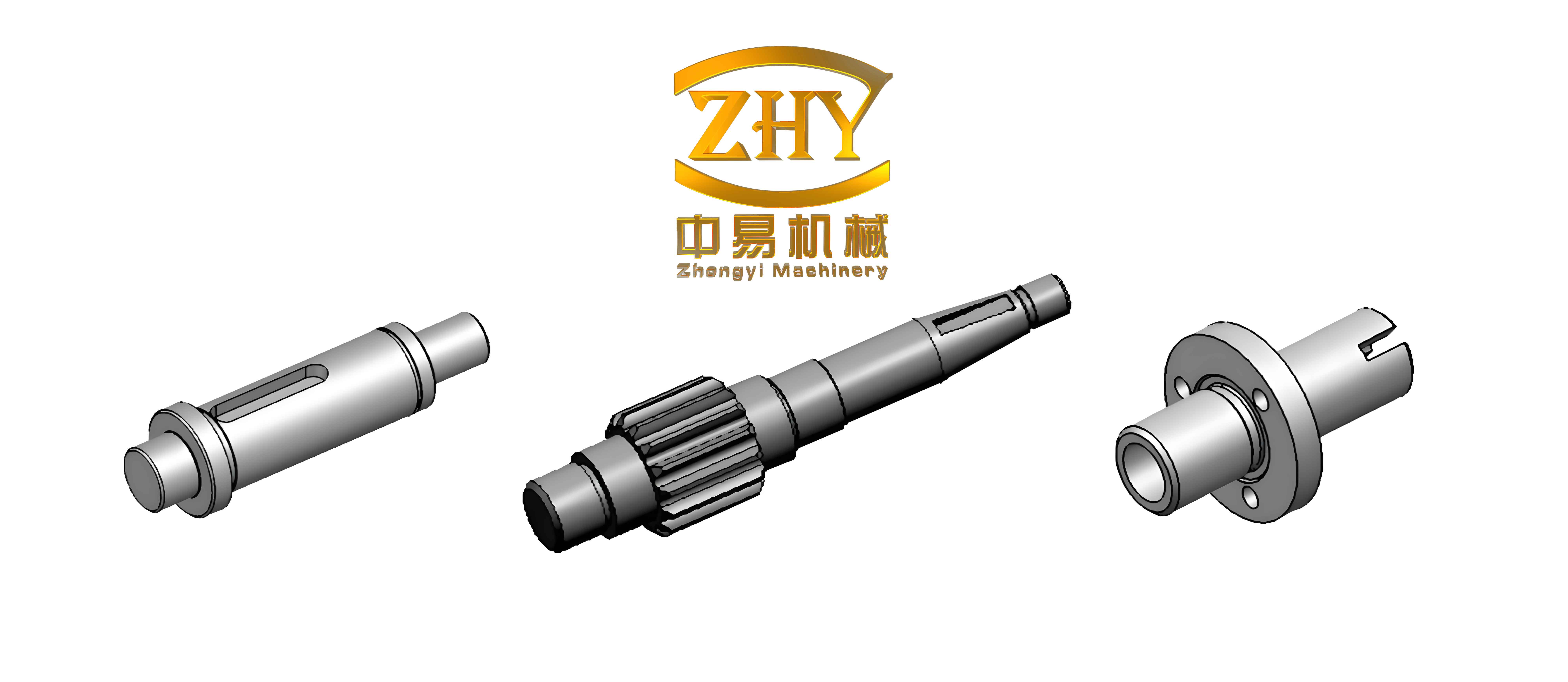
When analyzing the structure and manufacturing process of herringbone gear shafts, it is essential to categorize them based on their construction and退刀槽 (tool relief groove) dimensions. Broadly, herringbone gear shafts can be divided into assembled and integral types. The assembled herringbone gear shaft consists of a central shaft and separate herringbone gear sleeves that are joined using keys or similar fasteners. This modular approach simplifies manufacturing but may compromise on torque capacity and precision. In contrast, the integral herringbone gear shaft, where the gear teeth are machined directly onto the shaft, offers higher strength and accuracy, making it suitable for demanding applications. However, the integral type requires sophisticated machining strategies, particularly concerning the退刀槽. Based on the width of this groove, integral herringbone gear shafts are further classified into three subtypes, each dictating specific manufacturing techniques.
For large退刀槽 herringbone gear shafts, where the groove width is substantial, processes like hobbing, quenching, and grinding can be employed. This allows for high precision, potentially achieving GB-6 grade. The relationship between module size and required退刀槽 width can be summarized in the following table, which outlines typical parameters for large module gear shafts:
| Module (mm) | Minimum退刀槽 Width (mm) | Recommended Process | Achievable Accuracy Grade |
|---|---|---|---|
| 14-20 | 50-80 | Hobbing + Grinding | GB-6 |
| 21-30 | 80-120 | Hobbing + Grinding | GB-6 |
| >30 | >120 | Custom Hobbing | GB-7 |
The machining process for large退刀槽 gear shafts involves calculating the tooth profile using the basic gear equation: $$ d = m \cdot z $$ where \( d \) is the pitch diameter, \( m \) is the module, and \( z \) is the number of teeth. After hobbing, heat treatment like quenching is applied to enhance hardness, followed by grinding to achieve fine tolerances. For small退刀槽 herringbone gear shafts, with groove widths between 20-100 mm, planning or slotting methods are preferred. These processes are less efficient but necessary due to space constraints. The accuracy generally reaches GB-7 grade, and the cutting parameters must be optimized to avoid tool interference. The cutting speed \( v_c \) in planning can be derived from: $$ v_c = \frac{\pi \cdot d \cdot n}{1000} $$ where \( d \) is the tool diameter and \( n \) is the spindle speed. Lastly, for no退刀槽 herringbone gear shafts, milling-based copying is used, though it is complex and less common due to alignment challenges and equipment limitations.
Determining the appropriate manufacturing scheme for a large module single herringbone gear shaft involves selecting between horizontal and vertical machining approaches based on part geometry, equipment capabilities, and precision requirements. In horizontal machining, the gear shaft is mounted horizontally, typically on a planer or slotting machine. This method is suitable for gear shafts with high length-to-diameter ratios, as it facilitates easy tool access and alignment. The process begins with rough tooth cutting using a finger-type milling cutter on a horizontal milling machine, followed by fine planning on a planer. The planning operation involves cutting from both sides towards the center, ensuring symmetry and accuracy. Key considerations include the design of specialized fixtures to hold the gear shaft securely and minimize vibrations. The cutting force \( F_c \) during planning can be estimated as: $$ F_c = k_c \cdot a_p \cdot f $$ where \( k_c \) is the specific cutting force, \( a_p \) is the depth of cut, and \( f \) is the feed rate. A comparison of horizontal machining parameters is provided below:
| Process Step | Tool Type | Cutting Speed (m/min) | Feed Rate (mm/rev) | Depth of Cut (mm) |
|---|---|---|---|---|
| Rough Cutting | Finger Milling Cutter | 30-50 | 0.1-0.3 | 2-5 |
| Fine Planning | Planer Tool | 20-40 | 0.05-0.15 | 0.5-1 |
In cases where horizontal machines cannot accommodate the gear shaft dimensions due to size limitations, vertical machining becomes necessary. This involves using vertical milling machines or gear slotting machines for rough cutting, and slotting machines for finishing. The vertical setup requires custom fixtures, such as hollow mandrels or clamping chucks, to position the gear shaft axially and radially. For instance, a dedicated fixture might include a clamping chuck at the bottom to rotate with the machine table, and a collar at the top to stabilize the shaft. The alignment precision is critical, with tolerances for fixture gaps kept within 0.1 mm to prevent deviations. During rough cutting on a vertical milling machine, the material removal rate \( Q \) can be calculated as: $$ Q = a_p \cdot f \cdot v_c $$ where \( a_p \) is the depth of cut, \( f \) is the feed rate, and \( v_c \) is the cutting speed. After roughing, the finishing stage on a slotting machine focuses on achieving GB-7 accuracy. This involves using custom slotting tools designed to operate within the narrow退刀槽, and implementing anti-rotation measures like flattening sections of the shaft for secure clamping. The table below summarizes vertical machining stages:
| Machining Stage | Equipment | Key Parameters | Accuracy Control |
|---|---|---|---|
| Rough Tooth Cutting | Vertical Milling Machine | Speed: 40-60 m/min, Feed: 0.2-0.4 mm/rev | ±0.2 mm |
| Finishing | Slotting Machine | Speed: 10-30 m/min, Feed: 0.05-0.1 mm/rev | GB-7 Grade |
Tooling design is paramount in both horizontal and vertical machining of herringbone gear shafts. For rough cutting, high-strength tools like finger mills are used, while finishing requires precision tools such as custom planer or slotter blades. The tool life \( T \) can be predicted using Taylor’s tool life equation: $$ T = \frac{C}{v_c^n} $$ where \( C \) and \( n \) are constants dependent on tool material, and \( v_c \) is the cutting speed. Additionally, process optimization involves minimizing thermal deformation and residual stresses through controlled cooling and multi-pass strategies. For example, in rough cutting, multiple passes with decreasing depths of cut help distribute heat evenly, reducing the risk of distortion in the gear shaft.
In summary, the manufacturing of large module single herringbone gear shafts demands a holistic approach that integrates structural analysis, equipment selection, and process refinement. By adopting separated rough and finishing operations, and leveraging custom tooling and fixtures, it is possible to achieve GB-7 grade accuracy consistently. This gear shaft process not only enhances transmission performance but also extends service life in critical applications. Future advancements may involve digital twin simulations and AI-driven optimization to further reduce production time and costs while maintaining high standards for this essential gear shaft component.