
The dynamic analysis of gear transmission systems is fundamental to understanding and mitigating vibration, shock, and noise during power and motion transfer. As critical components within mechanical drivetrains, the dynamic characteristics of helical gears directly influence the operational stability and acoustic performance of the entire system. Compared to their spur counterparts, helical gears offer superior performance due to their gradual engagement, which results in smoother operation and higher load capacity. However, this advantage introduces greater modeling complexity, primarily due to the three-dimensional nature of the mesh forces and the consequential axial vibration component. Accurately capturing the dynamic behavior of helical gears hinges on two pivotal aspects: the precise calculation of the nonlinear, time-varying mesh stiffness and the formulation of a rigorous dynamic model that correctly couples the torsional, lateral, and axial vibrations. This article delves into these challenges, presenting a refined methodology for stiffness calculation and critically examining prevalent modeling approaches to establish a more accurate framework for the dynamic analysis of helical gear systems.
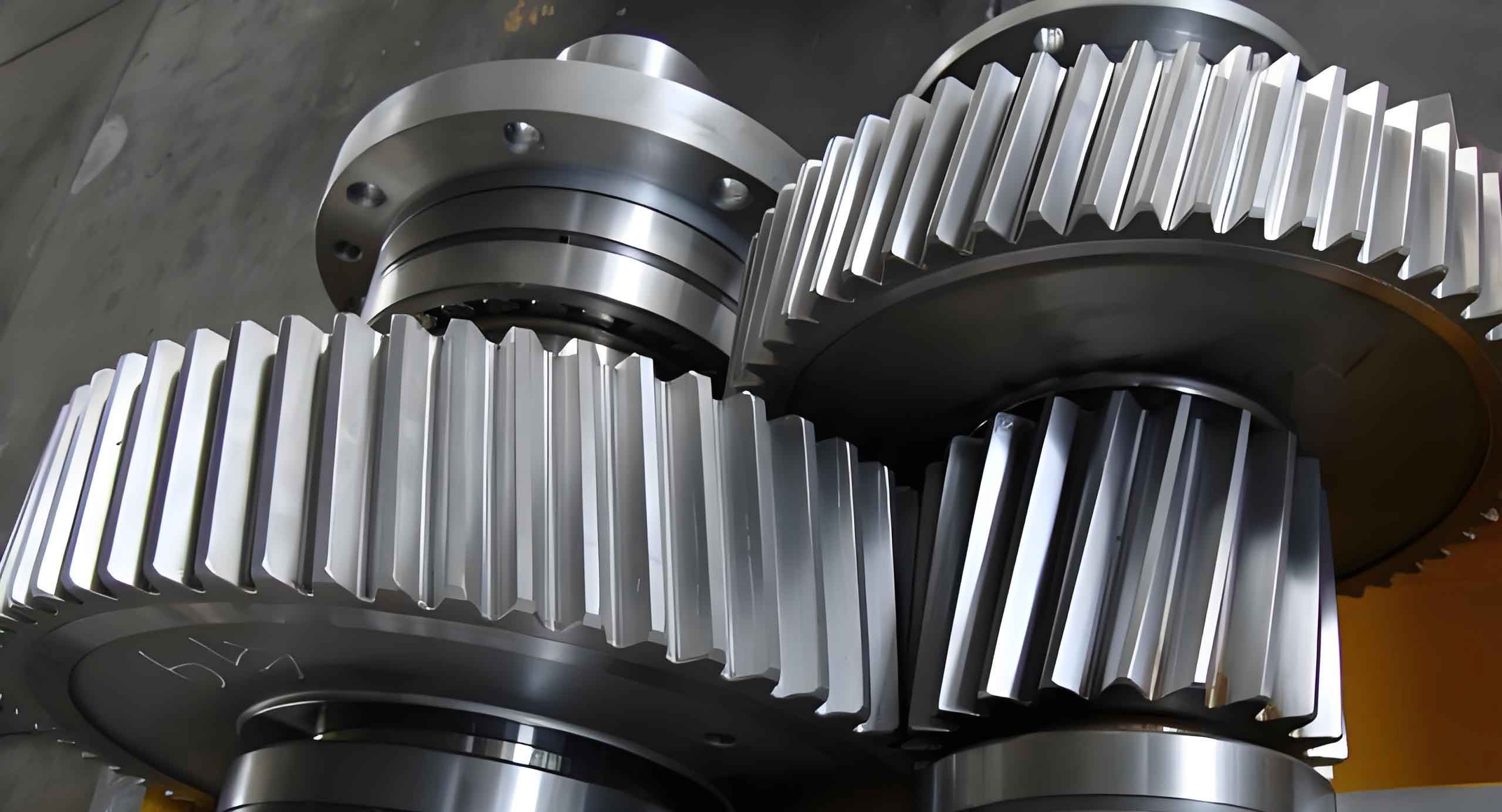
The foundation of any dynamic model for helical gears is the accurate representation of the mesh stiffness, denoted as $k_m(t)$. This parameter is inherently periodic and nonlinear, fluctuating as the number of tooth pairs in contact changes along the line of action. Traditional methods, such as the Weber energy method, approximate the tooth as a non-uniform cantilever beam to calculate stiffness based on bending, shear, foundation, and Hertzian contact deformations. While instructive, these methods often overlook system-level influences. A more comprehensive approach is proposed here, integrating Loaded Tooth Contact Analysis (LTCA) with considerations for shaft torsional compliance.
This enhanced LTCA method begins with a detailed discretization of the gear teeth into surface grids. The core innovation lies in augmenting the classical tooth surface compliance matrix with an additional compliance matrix derived from the torsional deflection of the supporting shafts. When a unit load is applied at a specific nodal point on the tooth surface, it induces not only local contact deformation but also a twisting of the gear shaft. This torsional effect alters the relative angular position along the gear’s axis, effectively changing the engagement condition for all other nodal points. The torsional compliance coefficient at a node $j$ due to a unit load at node $i$ is calculated as:
$$\gamma_{ij}^{torsion} = \phi_{ij} \cdot r_b$$
where $\phi_{ij}$ is the relative twist angle at node $j$ and $r_b$ is the base circle radius. This torsional compliance matrix is superimposed onto the native contact compliance matrix of the tooth surfaces.
Subsequently, the force equilibrium, deformation compatibility, and non-embedding conditions are solved iteratively for the loaded gear pair under a specified torque. From the resulting total normal deformation of the contacting surfaces $\delta_{total}$, the effective time-varying mesh stiffness for a given angular position can be determined. This method inherently accounts for manufacturing errors (e.g., profile deviations), assembly misalignments, intentional tooth modifications (tip and lead relief), and crucially, the elastic coupling introduced by the shaft dynamics. A comparative analysis demonstrates its efficacy. Consider the parameters for a single-stage helical gear set used in marine applications:
| Parameter | Pinion (Driving) | Gear (Driven) |
|---|---|---|
| Normal Module (mm) | 6 | 6 |
| Transverse Pressure Angle (°) | 20 | 20 |
| Helix Angle, $\beta$ (°) | 24.43 (Left Hand) | 24.43 (Right Hand) |
| Number of Teeth, $z$ | 17 | 44 |
| Face Width (mm) | 90 | 90 |
| Applied Torque (N·m) | 500 (Input) | – |
The mesh stiffness over one mesh cycle calculated via the enhanced LTCA method is plotted against results from the classical Weber method and a detailed quasi-static Abaqus finite element analysis (FEA). The comparison reveals that the Weber method typically yields the highest stiffness values as it neglects shaft torsion. The FEA results, though accurate, are computationally expensive and can be slightly lower due to dynamic inertia effects in quasi-static simulation. The proposed LTCA-based stiffness values lie between them, with a maximum deviation under 8%, confirming its accuracy and practicality for dynamic modeling of helical gears.
With a reliable stiffness function $k_m(t)$ established, the next critical step is formulating the equations of motion. A 6-degree-of-freedom (DOF) lumped-parameter model is standard for a pair of helical gears, accounting for the transverse ($y$), axial ($z$), and torsional ($\theta$) vibrations of both the pinion (subscript $p$) and the gear (subscript $g$). The generalized displacement vector is:
$$\{\delta\} = \{ y_p, z_p, \theta_p, y_g, z_g, \theta_g \}^T$$
Here, the $y$-direction is aligned with the transverse component of the mesh force (along the line of action in the transverse plane), and the $z$-direction is the axial direction. The model includes bearing support stiffness and damping in both directions, time-varying mesh stiffness, damping, static transmission error excitation, and possible corner mesh impacts. The dynamic mesh force is the primary source of coupling.
A common approach found in the literature for modeling helical gears is to decompose the normal mesh stiffness vectorially into transverse and axial components. According to this paradigm, the components are:
$$k_{my} = k_m \cos \beta, \quad k_{mz} = k_m \sin \beta$$
and similarly for mesh damping $c_m$. The resulting dynamic mesh forces in the transverse ($F_y$) and axial ($F_z$) directions are then expressed as:
$$F_y = c_{my}(\dot{y}_p – \dot{y}_g + R_p\dot{\theta}_p – R_g\dot{\theta}_g) + k_{my}(y_p – y_g + R_p\theta_p – R_g\theta_g)$$
$$F_z = c_{mz}[\dot{z}_p – \dot{z}_g + (\dot{y}_p – \dot{y}_g + R_p\dot{\theta}_p – R_g\dot{\theta}_g)\tan\beta] + k_{mz}[z_p – z_g + (y_p – y_g + R_p\theta_p – R_g\theta_g)\tan\beta]$$
These forces are then used in Newton’s second law to derive the equations of motion for the pinion and gear.
However, a critical examination reveals a fundamental inconsistency in this “stiffness decomposition” method. The physical excitation stems from the relative displacement between the gears projected onto the tooth normal direction. Let the normal static transmission error be $e_n(t)$. The correct sequence is to first calculate the normal dynamic force $F_n$ due to the total normal relative displacement (which includes $e_n$ and dynamic motions), and then resolve $F_n$ into transverse and axial components. The normal relative displacement $\delta_n$ is a projection of the transverse ($\delta_y$) and axial ($\delta_z$) relative displacements:
$$\delta_n = \delta_y \cos\beta + \delta_z \sin\beta = [ (y_p – y_g + R_p\theta_p – R_g\theta_g) \cos\beta + (z_p – z_g) \sin\beta ]$$
Therefore, the normal force is:
$$F_n = c_m \dot{\delta}_n + k_m \delta_n$$
Resolving $F_n$ gives the correct dynamic mesh forces:
$$F’_y = F_n \cos\beta = \cos\beta [ c_m \dot{\delta}_n + k_m \delta_n ]$$
$$F’_z = F_n \sin\beta = \sin\beta [ c_m \dot{\delta}_n + k_m \delta_n ]$$
Substituting $\delta_n$ yields expressions distinctly different from those derived via stiffness decomposition. The stiffness decomposition method erroneously applies the projection operation to the stiffness parameter itself before multiplying by displacement, which is not mechanically justified. This leads to an incorrect weighting of the displacement components in the final force equations.
To quantify the impact of this methodological difference, a dynamic simulation is performed on the example helical gear pair. The system parameters for dynamic analysis are as follows:
| Parameter | Pinion | Gear |
|---|---|---|
| Mass (kg) | 7.70 | 34.90 |
| Left Bearing Stiffness (N/m) | 9.93e8 | 1.32e9 |
| Right Bearing Stiffness (N/m) | 6.27e8 | 1.21e9 |
| Damping Ratio (Support & Mesh) | 0.1 | |
| Pinion Speed (rpm) | 2000 | |
The equations of motion, formulated using both the disputed stiffness decomposition method and the proposed force/displacement resolution method, are integrated numerically using a variable-step Runge-Kutta solver. The dynamic responses are compared. While the time history waveforms show similar periodic patterns, the amplitudes differ significantly. For instance, the root-mean-square (RMS) value of the relative vibration acceleration along the line of action is 9.47 m/s² using the force resolution method, compared to 10.86 m/s² using the stiffness decomposition method—a difference of nearly 15%. The discrepancy is even more pronounced in the axial dynamics. The axial vibration acceleration RMS of the pinion is 0.63 m/s² vs. 0.40 m/s², a deviation of over 36%.
The most telling comparison lies in the axial dynamic load on the pinion. The static axial force component, derived from the transmitted torque $T_p$, helix angle $\beta$, and base radius $R_p$, is:
$$F_{z,static} = \frac{T_p}{R_p} \tan \beta$$
For the given parameters, this calculates to approximately -157.8 N (negative indicating direction). The dynamic simulation using the force resolution method shows the axial load fluctuating around this static value, which aligns with physical expectations where dynamic variations superimpose on the static load. In stark contrast, the simulation based on stiffness decomposition produces an axial dynamic load oscillating around -260 N, a substantial and physically implausible deviation from the theoretical static load. This clear anomaly underscores the theoretical flaw in the decomposition of mesh stiffness for helical gears.
In conclusion, the accurate dynamic modeling of helical gear systems requires meticulous attention to both the excitation formulation and the model structure. The proposed LTCA-based method for calculating time-varying mesh stiffness offers a robust and accurate alternative to classical methods by incorporating vital system compliance effects, particularly shaft torsion. More importantly, this analysis highlights a significant pitfall in a common modeling practice for helical gears. The decomposition of the normal mesh stiffness vector into transverse and axial components prior to force calculation is mechanically inconsistent. The correct methodology, as demonstrated, is to first compute the total normal mesh force based on the projection of all relative displacements onto the tooth normal direction, and subsequently resolve this force into its spatial components. This force/displacement resolution approach yields dynamic responses, particularly for axial loads and vibrations, that are in agreement with theoretical expectations, whereas the stiffness decomposition method can lead to substantial and erroneous deviations. Therefore, for future research and analysis involving the complex dynamics of helical gears, it is strongly recommended to adopt modeling frameworks that adhere to this fundamental principle of mechanics.