
This article delves into the methodology and application of profile and lead modification design for herringbone gears, leveraging modern computational tools to achieve superior performance. Herringbone gears, characterized by their opposing helical sections, are pivotal components in high-power, high-reliability transmission systems such as naval propulsion, helicopter main drives, and aero-engine gearboxes. Their design offers significant advantages, including high load capacity, inherent axial force cancellation, and smooth operation. However, achieving these benefits in real-world applications necessitates addressing inherent challenges posed by manufacturing inaccuracies, assembly misalignments, and elastic deformations under load. These factors can lead to detrimental edge contact, stress concentration, elevated vibration and noise, and ultimately, premature gear failure. Strategic tooth modification, encompassing both profile (transverse) and lead (longitudinal) corrections, is the established engineering practice to mitigate these issues, ensuring the contact pattern is centralized and the load distribution is optimized across the tooth flank.
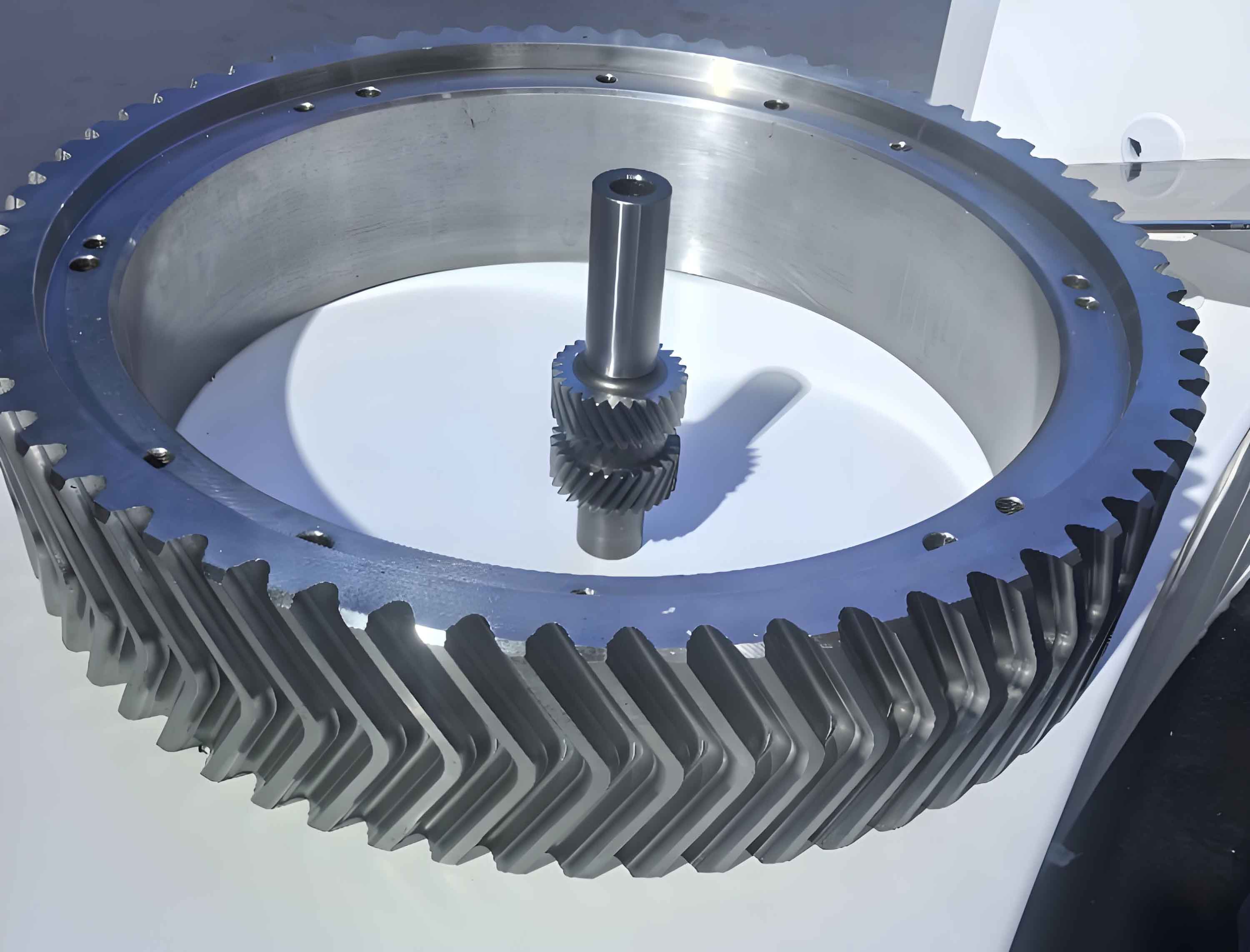
Fundamentals of Gear Modification
The primary goal of modification in herringbone gears, as with other gear types, is to compensate for static and dynamic displacements to ensure smooth, low-vibration meshing with a favorable load distribution. The two principal types of modification are applied in orthogonal directions relative to the tooth surface.
Profile Modification (Tip/Flank Relief): This involves the deliberate removal of a small amount of material from the standard involute profile near the tip and/or root of the tooth. Its core function is to ease the engagement and disengagement of mating teeth. Without modification, perfect rigid-body meshing would cause a sudden application and release of load at the start and end of contact, generating impact and excitation. Profile relief creates a slight clearance, allowing a gradual take-up of load, thereby reducing transmission error (TE) fluctuations and the associated dynamic loads and noise. The amount of relief, its starting point on the active profile, and the form of the relief curve (linear, parabolic, etc.) are critical design parameters.
Lead Modification (Crowning/End Relief): This modification is applied along the tooth face width. Its objective is to counteract the effects of misalignments (e.g., shaft parallelism errors, wind-up) and bending deflections that would otherwise cause the load to concentrate at one or both ends of the tooth. By introducing a slight barrel shape (crowning) or tapering the ends (end relief), the contact is encouraged to remain in the central region of the tooth face under a range of operating conditions. For herringbone gears, lead modification is often applied independently to each helical half to account for potential independent deflections or mounting errors of the two helical sections relative to each other.
Traditional vs. Software-Based Modification Design
Historically, the design of modifications for herringbone gears followed an iterative, empirically driven process heavily reliant on physical testing.
The Traditional Iterative Method
The conventional workflow begins with an initial estimate of modification parameters derived from empirical formulas found in design handbooks and standards. Gears are then manufactured with these initial parameters. The critical validation step involves physical testing, such as rolling tests (roll testing) on a checking fixture to visualize the contact pattern, and dynamic tests to measure vibration, noise, and transmission error on a test rig. Based on the observed contact pattern (e.g., edge contact, too narrow/wide) and the measured performance metrics, engineers qualitatively assess the outcome. If the performance is unsatisfactory, the modification parameters are adjusted based on experience, new prototypes are made, and the test cycle is repeated. This process is inherently time-consuming, costly, and lacks precise predictive capability, often requiring multiple iterations to converge on an acceptable, though not necessarily optimal, solution.
The Modern Computational Approach Using KISSsoft
The advent of powerful gear design and analysis software like KISSsoft has revolutionized this process. This methodology shifts the iterative optimization loop from the physical realm to the virtual, digital environment. The workflow is as follows:
- Parameter Input: The basic geometric parameters of the herringbone gear pair are entered. For analysis, the herringbone gear is typically treated as two independent helical gears with opposite hands.
- Initial Modification Calculation: The software can automatically propose initial modification values (profile relief, crowning) based on international standards (e.g., ISO 6336), which consider factors like module, face width, and material.
- Comprehensive Loaded Tooth Contact Analysis (LTCA): This is the core of the software approach. The KISSsoft software performs a sophisticated LTCA that simulates the meshing of the gears under specified loads, including the effects of tooth bending and contact deformations, shaft deflections, and precisely defined misalignments.
- Performance Evaluation: The software outputs a suite of quantitative performance indicators, which serve as the objective basis for evaluating the modification design.
- Virtual Optimization: Based on the analysis results, the modification parameters are adjusted virtually within the software. The LTCA is rerun instantaneously. This cycle is repeated until the performance indicators meet the design targets. This process eliminates the need for multiple physical prototypes.
The quantitative metrics provided by the software offer a far superior evaluation basis compared to the qualitative assessment of contact patterns. Key performance indicators include:
- Transmission Error (TE): The primary excitation source for gear noise and vibration. An optimal modification minimizes the peak-to-peak amplitude and smooths the curve.
- Load Distribution: Visual and quantitative representation of contact pressure across the tooth flank. The goal is a uniform, centered pattern without edge loading.
- Tooth Root Bending Stress & Safety Factor ($S_F$): Calculated according to standards (e.g., ISO 6336). Target minimum values are typically $S_{Fmin} \geq 1.25$ for general reliability and $S_{Fmin} \geq 1.6$ for higher reliability.
- Contact (Hertzian) Stress & Safety Factor ($S_H$): Also calculated per standards. Target minima are $S_{Hmin} \geq 1.00$ (general) and $S_{Hmin} \geq 1.25$ (higher reliability).
- Load Distribution Factor ($K_{H\beta}$): A numerical factor that quantifies the unevenness of load distribution across the face width. An ideal, perfectly even distribution corresponds to $K_{H\beta} = 1.0$. The modification aims to bring this factor as close to 1.0 as possible.
- Tooth Normal Load per Unit Length: The distribution of the normal force along the path of contact and across the face width. A smooth, low-magnitude distribution is desirable.
Accounting for Installation Errors: The Case of Axis Misalignment
A critical aspect of realistic design is the incorporation of anticipated installation errors, primarily axis misalignment. For parallel axis gears, this is defined by two components in orthogonal planes, as per ISO standards:
- Axis Deviation in the Parallel Plane ($f_{\Sigma\beta}$): Misalignment in the plane containing the axes.
- Axis Deviation in the Vertical Plane ($f_{\Sigma\delta}$): Misalignment in the plane perpendicular to the common plane containing the axes and the line of shortest distance between them. Standards often recommend $f_{\Sigma\delta} = 2 \cdot f_{\Sigma\beta}$.
The maximum permissible values are typically calculated based on gear accuracy grade and geometry. For a face width $b$ and bearing span $L$, the deviation in the parallel plane can be estimated as:
$$f_{\Sigma\beta} = 0.5 \cdot \left( \frac{L}{b} \right) \cdot F_{\beta}$$
where $F_{\beta}$ is the helix slope deviation for the corresponding accuracy grade.
When modeling a herringbone gear as two separate helical gears in software, the total axis misalignment for the herringbone pair must be apportioned to each helical half. If $b_s$ is the single-helix face width and $c$ is the gap width, the effective deviation for one helix can be approximated as:
$$f’_{\Sigma\beta} = \frac{b_s}{2b_s + c} \cdot f_{\Sigma\beta}$$
$$f’_{\Sigma\delta} = \frac{b_s}{2b_s + c} \cdot f_{\Sigma\delta}$$
These calculated values for $f’_{\Sigma\beta}$ and $f’_{\Sigma\delta}$ are then input into the software’s misalignment settings for the analysis of each helical half, ensuring the simulation reflects a realistic operating environment.
Case Study: Optimization of an Industrial Herringbone Gear Pair
To demonstrate the practical application and benefits of the software-based approach, we consider an industrial high-power gearbox stage. The target herringbone gears (Pinion z3 and Gear z4) had existing modification parameters derived from traditional methods. Our objective was to use KISSsoft to analyze and optimize these parameters to improve performance.
Initial Conditions and Problem Definition
The basic geometric parameters for the gear pair are summarized in Table 1. The original modification design is listed in Table 2 (Original Scheme). The analysis was set up with a specified input torque, material properties (18CrNiMo7-6), lubrication (ISO VG100), and the calculated axis misalignments based on a 5th accuracy grade and the given bearing span, as shown in Table 4.
| Parameter | Pinion (z3) | Gear (z4) |
|---|---|---|
| Normal Module, $m_n$ [mm] | 3.5 | 3.5 |
| Number of Teeth, $z$ | 25 | 110 |
| Normal Pressure Angle, $\alpha_n$ [°] | 22.5 | 22.5 |
| Helix Angle, $\beta$ [°] | 30 | 30 |
| Hand | Left-Right | Right-Left |
| Profile Shift Coefficient, $x_n$ | 0.05 | -0.05 |
| Single Helix Face Width, $b_s$ [mm] | 47 | 47 |
| Gap Width, $c$ [mm] | 20 | 20 |
| Component | Profile Modification | Lead Modification | |
|---|---|---|---|
| Amount [μm] | Crowning [μm] | End Relief [μm] | |
| Original Scheme | |||
| z3 (Left & Right Halves) | 18 | 27.4 | 0 |
| z4 (Left & Right Halves) | 18 | 27.4 | 0 |
| KISSsoft Optimized Scheme | |||
| z3 (Left & Right Halves) | 15 | 20 | 10 |
| z4 (Left & Right Halves) | 15 | 0 | 0 |
| Parameter | Value [μm] |
|---|---|
| Effective Deviation in Parallel Plane per helix, $f’_{\Sigma\beta}$ | 5.8 |
| Effective Deviation in Vertical Plane per helix, $f’_{\Sigma\delta}$ | 11.6 |
Analysis of Original Design and Optimization Process
The LTCA for the original modification scheme revealed several performance shortcomings typical of a non-optimized design:
- Transmission Error (TE): The peak-to-peak TE was relatively high (~1.49 μm), indicating a steeper meshing excitation.
- Load Distribution Factor ($K_{H\beta}$): The calculated $K_{H\beta}$ was 1.64, signifying a 64% increase in contact stress due to uneven load distribution across the face width.
- Tooth Normal Load: The maximum normal load per unit length exceeded 480 N/mm, showing high localized loading.
- Contact Pattern: The simulated contact pressure was concentrated in the central region of the tooth flank without spreading favorably under load.
Guided by these metrics, an optimization loop was performed within KISSsoft. The adjustments focused on reducing profile relief to avoid excessive loss of contact ratio, reducing the crowning amount on the pinion, and introducing a small end relief specifically on the pinion to better compensate for the combined effects of deflection and misalignment. The gear’s lead modification was removed as the analysis showed it was unnecessary for this specific case. The optimized parameters are listed in Table 2 (KISSsoft Optimized Scheme).
Results and Comparative Performance
The performance of the optimized design was compared directly with the original. The core safety factors ($S_F$, $S_H$) remained virtually unchanged and well above the required minima, confirming that the optimization did not compromise basic strength. The critical improvement was observed in the dynamic and load distribution metrics.
| Performance Metric | Original Scheme | Optimized Scheme | Improvement |
|---|---|---|---|
| Load Distribution Factor, $K_{H\beta}$ | 1.641 | 1.237 | -24.6% |
| Peak-to-Peak Transmission Error [μm] | ~1.49 | ~0.80 | ~-46% |
| Max. Normal Load per Unit Length [N/mm] | ~482 | ~328 | -32.0% |
| Tooth Root Safety Factor, $S_F$ | >3.55 | >3.54 | Negligible change |
| Contact Safety Factor, $S_H$ | >2.10 | >2.10 | Negligible change |
The results are decisive:
- Load Distribution ($K_{H\beta}$): Reduced by 24.6%, indicating a significantly more uniform distribution of contact stress across the face width of the herringbone gears.
- Transmission Error: The peak-to-peak amplitude was nearly halved (46% reduction). This translates directly to a lower excitation source for vibration and noise, a critical factor for high-performance applications.
- Tooth Normal Load: The maximum value dropped by 32%, reducing the risk of localized plastic deformation or excessive wear.
- Contact Pattern: The optimized modification resulted in a broader, more evenly distributed contact area under load, effectively utilizing more of the available tooth flank and moving away from a potentially damaging concentrated contact.
The optimization process, conducted entirely in the digital domain, successfully identified a set of modification parameters that dramatically improved the predicted functional performance of the herringbone gear pair without the need for a single physical prototype iteration.
Conclusion
The design of profile and lead modifications is essential for unlocking the full performance potential of herringbone gears in demanding applications. The transition from traditional, trial-and-error methods based on physical testing to a modern, simulation-driven approach represents a significant advancement in gear engineering. As demonstrated through the detailed case study, software tools like KISSsoft enable a comprehensive Loaded Tooth Contact Analysis that accurately models the complex interaction of geometry, load, deflection, and misalignment.
This computational methodology allows engineers to define clear, quantitative performance targets—such as minimizing transmission error, optimizing the load distribution factor ($K_{H\beta}$), and ensuring even contact pressure—and to systematically adjust modification parameters to meet these targets. The result is a fully virtual optimization loop that yields a superior, performance-validated design before manufacturing commences. For herringbone gears, this approach is particularly valuable due to their complexity and the high cost associated with prototyping and testing. It ensures robust, quiet, and reliable gear operation, reduces development time and cost, and provides deep insight into the meshing behavior that is difficult or impossible to obtain through physical means alone. The demonstrated improvements in key metrics underscore the effectiveness of this software-based strategy for the advanced design of high-performance herringbone gear transmissions.