
The relentless pursuit of higher power density in aerospace and other advanced mechanical transmission systems places immense demands on critical components. Among these, the spiral bevel gear stands out for its ability to efficiently transmit power between intersecting shafts. To meet the dual challenges of increased load capacity and stringent weight reduction, a paradigm shift from traditional, often conservative, design methods is required. This article delves into a sophisticated multi-parameter optimization technology for spiral bevel gear blanks, leveraging the power of genetic algorithms and a comprehensive strength evaluation framework. The goal is to systematically determine the optimal combination of fundamental gear blank parameters—namely tooth numbers, module, and face width—to achieve a minimal volume design that satisfies all operational, installation, and rigorous strength constraints.
The traditional design sequence for spiral bevel gears often follows an iterative, trial-and-error approach. Starting with a transmission ratio, designers select tooth numbers, estimate a module based on experience or size constraints, and choose a face width according to empirical rules (e.g., not exceeding one-third of the outer cone distance). This initial set is then subjected to strength calculations. If the safety factors are insufficient, parameters are manually adjusted—increasing module or face width—and the process repeats. This method, while functional, is time-consuming, heavily reliant on designer expertise, and crucially, it does not guarantee a globally optimal solution. It often yields designs that are over-engineered, carrying unnecessary weight, or it may struggle to find a feasible solution under extreme design constraints where material limits and spatial envelopes are tightly bounded.
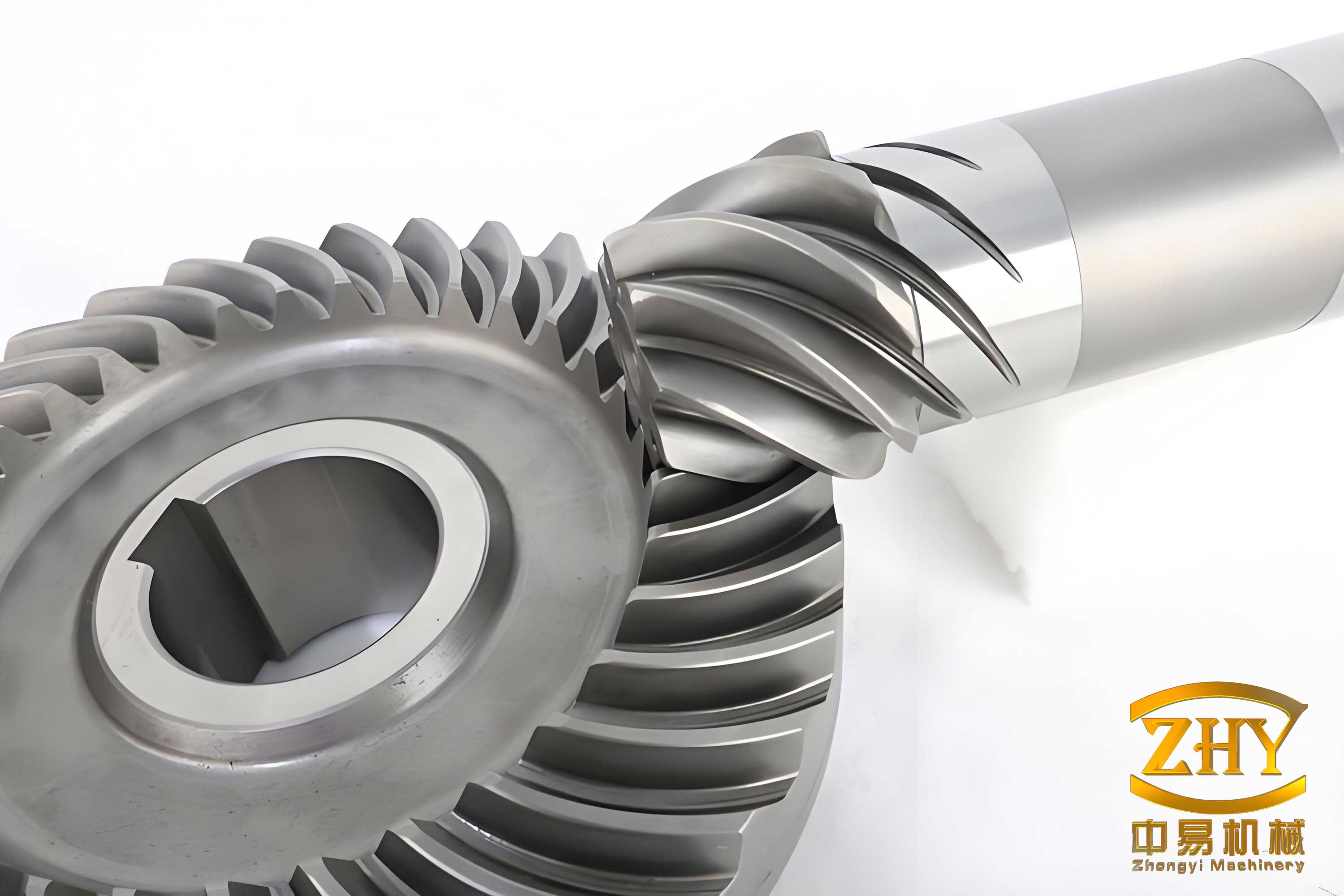
To overcome these limitations, we turn to evolutionary computation, specifically Genetic Algorithms (GAs). GAs are inspired by the principles of natural selection and genetics. They work with a population of potential solutions (individuals), each encoded as a string of parameters (chromosomes). Through iterative cycles of selection (favoring better solutions), crossover (combining parts of two solutions), and mutation (introducing random changes), the population evolves toward increasingly optimal regions of the design space. This stochastic, population-based approach gives GAs a significant advantage: a high probability of finding a global optimum, even for problems with discrete variables, non-linear constraints, and complex, non-convex design landscapes—precisely the characteristics of spiral bevel gear blank design.
Comprehensive Strength Evaluation Benchmarks
A robust optimization must be founded on reliable constraint evaluation. For spiral bevel gears, especially in aerospace, multiple standards exist to calculate contact (pitting) and bending (root) fatigue strength. Relying on a single standard might lead to an overly conservative or, conversely, an non-conservative design. Our methodology integrates two prominent standards: the Chinese Aviation Industry Standard (HB) and the International Organization for Standardization (ISO) standard. While sharing a common theoretical foundation based on Hertzian contact and cantilever beam stress models, they differ in the detail and formulation of their influence factors (correction coefficients).
The core stress calculation formulas for the two standards are summarized below. The contact stress \(\sigma_h\) and bending stress \(\sigma_f\) are calculated and compared against their respective permissible stresses \(\sigma_{hp}\) and \(\sigma_{fp}\). The design is considered safe when the calculated safety factors \(S_h = \sigma_{hp}/\sigma_h\) and \(S_f = \sigma_{fp}/\sigma_f\) exceed the required minimum values \(S_{hmin}\) and \(S_{fmin}\).
| Standard | Fatigue Type | Core Calculation Formulas |
|---|---|---|
| HB Standard | Contact | $$\sigma_h = \sigma_{h0}\sqrt{K_A K_V K_{H\beta}}$$, $$\sigma_{h0} = Z_H Z_E Z_{\epsilon} Z_I Z_{\rho} Z_C \sqrt{ \frac{F_{mt}}{d_{v1} b} \cdot \frac{u_v + 1}{u_v} }$$, $$\sigma_{hp} = Z_N Z_{\theta} \frac{\sigma_{Hlim}}{S_{hmin}}$$ |
| Bending | $$\sigma_f = \sigma_{f0} K_A K_V K_{F\beta}$$, $$\sigma_{f0} = Y_{Fa} Y_{Sa} Y_{\epsilon} Y_{\gamma} Y_I Y_{LC} \frac{F_{mt}}{b m_{mn}} Y_b$$, $$\sigma_{fp} = Y_{\theta} Y_X Y_{ST} \frac{\sigma_{Flim}}{S_{fmin}}$$ | |
| ISO 10300 Standard | Contact | $$\sigma_h = \sigma_{h0}\sqrt{K_A K_V K_{H\beta}K_{H\alpha}}$$, $$\sigma_{h0} = \sqrt{ \frac{F_n}{l_{bm} \rho_{rel}} } Z_{MB} Z_{LS} Z_E Z_K$$, $$\sigma_{hp} = \sigma_{Hlim} Z_{NT} Z_X Z_L Z_V Z_R Z_W Z_{HYP}$$ |
| Bending | $$\sigma_f = \sigma_{f0} K_A K_V K_{F\beta}K_{F\alpha}$$, $$\sigma_{f0} = Y_{Fa} Y_{Sa} Y_{\epsilon} Y_{BS} Y_{LS} \frac{F_{mt}}{b m_{mn}}$$, $$\sigma_{fp} = \sigma_{Flim} Y_{ST} Y_{NT} Y_{\delta relT} Y_{R relT} Y_X$$ |
The key difference lies in the application factors. The ISO standard generally incorporates a more extensive set of detailed factors accounting for load sharing (\(Z_{LS}, Y_{LS}\)), mesh alignment (\(Z_{MB}\)), lubrication condition (\(Z_L\)), velocity (\(Z_V\)), surface roughness (\(Z_R\)), and work hardening (\(Z_W\)). This often results in a more comprehensive, and in many cases, a slightly more conservative (lower calculated safety factor) assessment compared to the HB standard for the same gear geometry and loading. By enforcing constraints from both standards simultaneously in our optimization (\(S_h^{HB} \geq 1.12, S_f^{HB} \geq 1.25\) and \(S_h^{ISO} \geq 1.0, S_f^{ISO} \geq 1.3\)), we ensure a highly reliable design that is not biased by the assumptions of a single calculation method. This multi-benchmark approach is a cornerstone of our proposed technology for spiral bevel gear optimization.
Formulation of the Multi-Parameter Optimization Model
The optimization model is constructed to systematically navigate the design space of the spiral bevel gear blank. The primary objective is lightweight design, directly translating to minimizing the material volume of the gear pair, which is a dominant contributor to overall system weight and inertia.
Objective Function:
The objective is to minimize the combined approximate volume \(V_{total}\) of the pinion and gear.
$$ \text{Minimize: } f(\mathbf{x}) = V_{total} \approx \frac{0.78539}{\cos(0.5\beta_m)} \left( \frac{R_m}{R} \right)^2 (d_{a1}^2 + d_{a2}^2) b $$
where \(R\) is the outer cone distance, \(R_m\) is the mean cone distance, \(d_{a1}, d_{a2}\) are the tip diameters, \(b\) is the face width, and \(\beta_m\) is the mean spiral angle (often set to 35°).
Design Variables:
The core geometrical parameters subject to optimization form the design variable vector \(\mathbf{x}\).
$$ \mathbf{x} = [Z_1, Z_2, m_{et}, b]^T = [x_1, x_2, x_3, x_4]^T $$
Here, \(Z_1\) and \(Z_2\) are the pinion and gear tooth numbers (discrete integers), \(m_{et}\) is the outer transverse module (treated as a continuous variable but often discretized post-optimization), and \(b\) is the face width (continuous). Other parameters like pressure angle (20°) and shaft angle (90°) are typically fixed.
Constraints:
The design must satisfy a set of boundary and performance constraints:
- Boundary Constraints: Practical limits on design variables.
$$ Z_{1}^{min} \leq x_1 \leq Z_{1}^{max}, \quad Z_{2}^{min} \leq x_2 \leq Z_{2}^{max} $$
$$ m_{et}^{min} \leq x_3 \leq m_{et}^{max}, \quad b^{min} \leq x_4 \leq b^{max} $$
The limits for \(m_{et}\) are often derived from pitch diameter limits, and for \(b\) from rules like \(b \leq R/3\) or specific installation envelopes. - Geometric/Assembly Constraints:
- Pitch diameter limit: \(x_1 \cdot x_3 \leq d_{1}^{constraint}\).
- Transmission ratio tolerance: \( \frac{n_{input}}{n_{output} + \Delta n} \leq \frac{x_2}{x_1} \leq \frac{n_{input}}{n_{output} – \Delta n} \).
- Common divisor restriction: \(\gcd(x_1, x_2) \leq n_{gcd}\) (e.g., 1 or 2).
- Strength Constraints (The Core of Feasibility):
- HB Contact Safety: \( S_h^{HB}(\mathbf{x}) = \frac{Z_N Z_{\theta} \sigma_{Hlim}}{\sigma_h^{HB}(\mathbf{x})} \geq 1.12 \).
- HB Bending Safety: \( S_f^{HB}(\mathbf{x}) = \frac{Y_N Y_{\theta} \sigma_{Flim}}{\sigma_f^{HB}(\mathbf{x})} \geq 1.25 \).
- ISO Contact Safety: \( S_h^{ISO}(\mathbf{x}) = \frac{\sigma_{hp}^{ISO}(\mathbf{x})}{\sigma_h^{ISO}(\mathbf{x})} \geq 1.00 \).
- ISO Bending Safety: \( S_f^{ISO}(\mathbf{x}) = \frac{\sigma_{fp}^{ISO}(\mathbf{x})}{\sigma_f^{ISO}(\mathbf{x})} \geq 1.30 \).
The functions \(\sigma_h(\mathbf{x}), \sigma_f(\mathbf{x}), \sigma_{hp}(\mathbf{x}), \sigma_{fp}(\mathbf{x})\) are complex, non-linear functions evaluating all the correction coefficients based on the current design vector \(\mathbf{x}\).
The Genetic Algorithm is tasked with solving this constrained minimization problem. An individual’s “fitness” is a combination of its objective function value and a penalty for violating any of the above constraints. Through selection, crossover, and mutation, the population evolves towards designs that are both lightweight and fully compliant with all requirements. The parallelism inherent in evaluating a population of designs and the algorithm’s ability to escape local minima make it exceptionally well-suited for this spiral bevel gear optimization problem.
Demonstration and Validation via Case Studies
The effectiveness of the proposed spiral bevel gear optimization technology is demonstrated through two case studies with significantly different power levels.
Case 1: 0.75 MW Power Transmission (Feasible within Constraints)
Design Requirements: Power \(P \geq 0.75\) MW, input speed \(n_1 = 20,000\) rpm, output speed \(n_2 = 15,000 \pm 100\) rpm, gear pitch diameter \(\leq 210\) mm, face width \(\leq 26\) mm. Material limits: \(\sigma_{Hlim} = 1600\) MPa, \(\sigma_{Flim} = 874\) MPa.
The GA-based optimization was executed, successfully finding an optimal parameter set that satisfies all constraints, including both HB and ISO strength benchmarks.
| Optimal Design Variable | Symbol | Optimized Value |
|---|---|---|
| Pinion Teeth | \(Z_1\) | 38 |
| Gear Teeth | \(Z_2\) | 51 |
| Outer Module | \(m_{et}\) | 2.839 mm |
| Face Width | \(b\) | 21 mm |
The resulting key performance metrics were:
- Gear Pitch Diameter: \(d_2 = Z_2 \cdot m_{et} = 144.84\) mm (31% redundancy against the 210 mm limit).
- Face Width: 21 mm (19.23% redundancy against the 26 mm limit).
- Safety Factors: \(S_h^{HB}=1.20, S_f^{HB}=2.12, S_h^{ISO}=1.02, S_f^{ISO}=1.30\). All meet or exceed minimums.
- Volume: \(0.8476 \times 10^6\) mm³ (minimized for the feasible set).
This result validates the technology’s ability to find a compact, feasible design with a clear and quantifiable design margin. A manual comparison with other candidate parameter sets confirmed that this solution indeed offered the lowest volume while satisfying all strength constraints, proving the GA’s global search capability for the spiral bevel gear system.
Case 2: 5 MW Power Transmission (Infeasible under Initial Constraints)
Design Requirements: Power \(P \geq 5\) MW, \(n_1 = 8,500\) rpm, \(n_2 = 6,260 \pm 100\) rpm, pinion pitch diameter \(\leq 215\) mm, face width \(\leq 62\) mm. Material limits: \(\sigma_{Hlim} = 1550\) MPa, \(\sigma_{Flim} = 600\) MPa.
Initial optimization runs confirmed that no parameter combination within the given size and material limits could satisfy the strength constraints for this high-power case. This highlights a critical real-world scenario. The technology then guides the designer through strategic alternatives:
Alternative 1: Material Upgrade.
The optimization model was adapted to treat material strength limits (\(\sigma_{Hlim}, \sigma_{Flim}\)) as additional variables to be minimized, subject to the original size constraints. The algorithm converged on a solution requiring significantly enhanced material: \(\sigma_{Hlim} \approx 1880\) MPa and \(\sigma_{Flim} \approx 890\) MPa. This provides a clear, quantifiable target for material selection, demonstrating that merely increasing gear size within the allowed envelope is insufficient; the material itself must be improved.
Alternative 2: Size Increase.
Relaxing the strict size constraints (keeping them as goals rather than hard limits), the optimization sought the minimum volume design that meets strength. This resulted in a larger spiral bevel gear, for example with a module over 10.8 mm and a face width over 108 mm. This solution defines the minimum physical envelope required if the original material must be used.
Alternative 3: Combined Optimization (Practical Compromise).
A practical approach is a trade-off. By allowing moderate relaxations in both material and size, the optimization finds a balanced solution. For instance, one optimal compromise found was:
$$ \mathbf{x} = [27, 37, 8.337\text{ mm}, 63.645\text{ mm}]^T $$
with required material properties \(\sigma_{Hlim} \approx 1766\) MPa and \(\sigma_{Flim} \approx 824\) MPa.
- This design has a pinion diameter of ~225.1 mm (4.69% over the initial 215 mm limit).
- A face width of ~63.65 mm (2.65% over the initial 62 mm limit).
- Safety factors comfortably exceed all minima.
- The required material upgrade is less severe than in Alternative 1, and the size increase is smaller than in Alternative 2.
This balanced solution, generated automatically by the optimization framework, provides the designer with a clear, optimal trade-off path forward, moving from an infeasible initial specification to a viable, optimized spiral bevel gear design.
Conclusion
The proposed multi-parameter optimization technology, integrating Genetic Algorithms with a dual strength benchmark (HB and ISO), presents a powerful and systematic design tool for high-performance spiral bevel gears. It successfully automates and optimizes the traditionally manual and suboptimal process of gear blank parameter selection. Key advantages include:
- Global Optimality: The GA’s stochastic search effectively navigates the discrete, non-linear design space, finding globally optimal or near-optimal solutions with high reliability, overcoming the limitations of traditional methods.
- Comprehensive Constraint Handling: By enforcing constraints from multiple international strength standards, the resulting spiral bevel gear design is robust and reliable, with a well-understood safety margin.
- Design Guidance under Extreme Conditions: When initial specifications are infeasible, the technology does not simply fail. It systematically explores and quantifies alternative pathways—material upgrade, size increase, or a balanced compromise—providing clear engineering guidance.
- Explicit Design Margins: The optimization results, as shown in the case studies, naturally incorporate quantifiable redundancies (e.g., 31% diameter margin in Case 1) or pinpoint the minimal necessary exceedance (e.g., 4.69% in Case 3), offering valuable insight for system integration and reliability assessment.
This foundational optimization of the spiral bevel gear blank is a critical first step that sets the stage for subsequent advanced tooth surface modifications, contact pattern optimization, and system-level dynamics analysis. The methodology is directly applicable to the design of high-power-density transmissions in aerospace, marine, and energy sectors, contributing significantly to the goals of enhanced performance, reduced weight, and increased operational life.