
In modern high-power gear transmission systems, the application of wide helical gears has become increasingly widespread. While existing standards provide basic strength calculation methods for helical gears, these approaches often fall short in delivering detailed insights into stress distribution, load sharing, and other intricate meshing behaviors. Finite element contact analysis emerges as a powerful tool to investigate the meshing state of helical gears. However, establishing an accurate finite element contact analysis model for helical gears presents challenges such as efficient data management, automated mesh generation for helical gears, and refined meshing in the contact zones. Numerous studies have explored finite element modeling techniques for helical gears, but many rely on complex self-programmed routines for data storage and mesh generation, often employing full-tooth-surface mesh refinement. This leads to cumbersome data structures and a massive number of nodes, severely hampering computational efficiency. In this work, I propose a novel parameterized modeling method that integrates SQL Server database management with finite element analysis to streamline the process for helical gears. By importing three-dimensional finite element model data into a SQL Server database, we leverage its robust data processing capabilities for rapid and precise management of finite element information. Crucially, I introduce a localized mesh refinement strategy for the contact zone, replacing the conventional full-tooth-surface refinement. This allows for the use of smaller element sizes without a significant increase in the total number of elements and nodes, effectively reducing the scale of the finite element model and enhancing computational efficiency. The entire methodology is implemented programmatically and parameterized using VB programming language. Upon inputting the basic parameters of the helical gears, the system can automatically generate data files for three-dimensional finite element contact analysis models, facilitating numerical simulation of the meshing state for helical gears.
The core of this approach lies in a well-defined information structure for the parameterized model, encompassing both geometric and finite element analysis data. A complete parameterized model for a gearbox should include information on geometric structure and finite element analysis, as outlined below.
| Category | Information Components | Description |
|---|---|---|
| Geometric Information | Gear Parameters | Module, number of teeth, pressure angle, helix angle, center distance, etc. |
| Transmission Type | Fixed-axis transmission, planetary transmission | |
| Shaft Segment Parameters | Position, length, radius | |
| Bearing Parameters | Type, position | |
| Other Components | Coupler position, etc. | |
| Finite Element Information | Contact Line Refinement Count | Number of subdivisions along the contact line |
| Contact Zone Extension Layers | Number of element layers extended around the contact zone | |
| Retained Teeth Count | Number of teeth retained in the model based on contact ratio | |
| Transmitted Torque | Load condition for analysis | |
| Mesh Parameters | Element type, size, etc. |
Based on this information structure, data tables are established within the SQL Server database, defining corresponding data fields and establishing relationships between tables. The modeling process for helical gears follows a systematic workflow, which I will detail in the following sections.
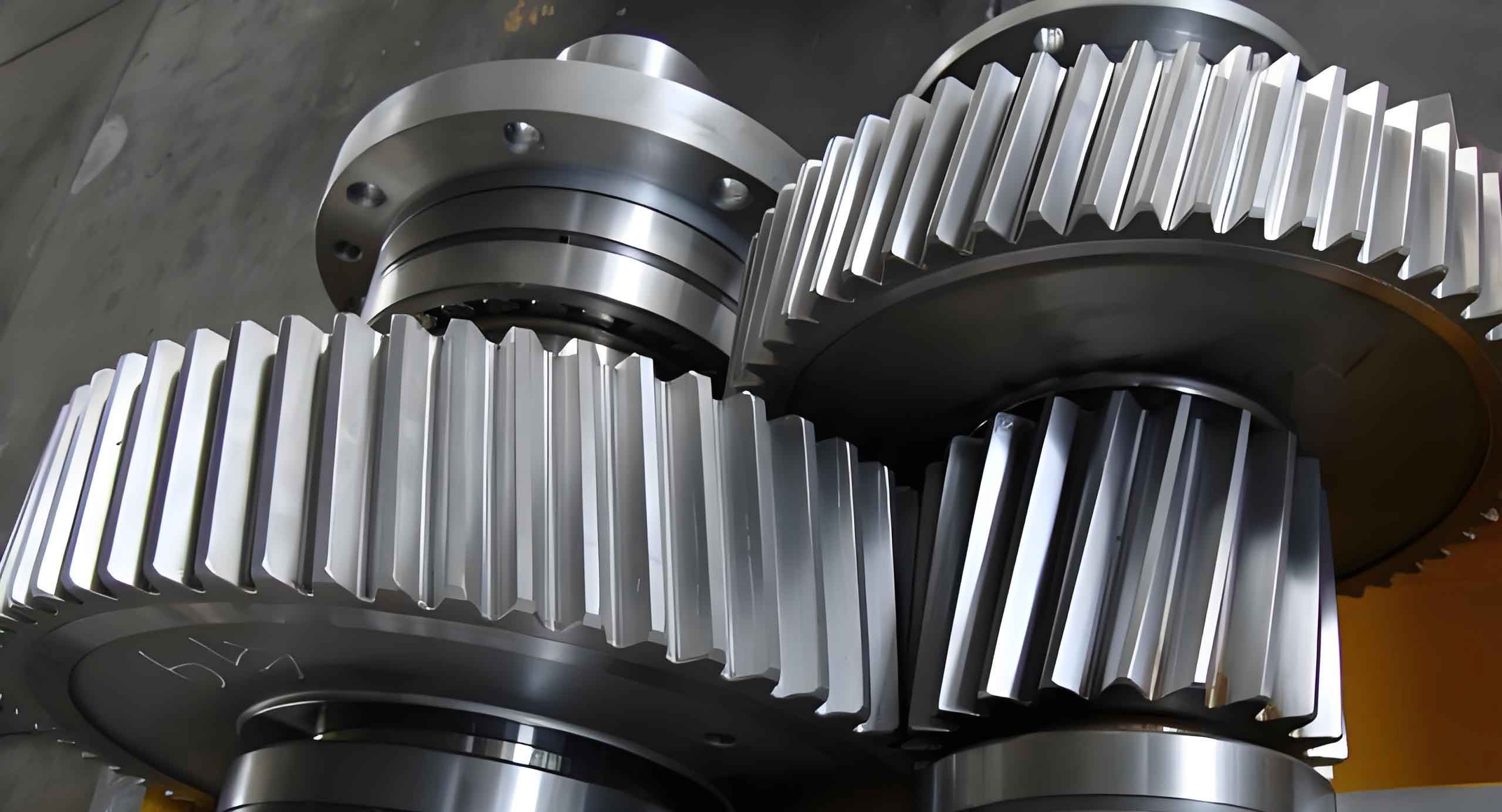
The first step involves generating a finite element mesh for a primitive spur gear. This serves as the foundation for creating the helical gear model. The basic steps are as follows. First, the transverse tooth profile is generated using APDL commands. The involute curve is defined mathematically. For a standard involute, the parametric equations in the transverse plane are given by:
$$ x = r_b (\cos(\theta) + \theta \sin(\theta)) $$
$$ y = r_b (\sin(\theta) – \theta \cos(\theta)) $$
where \( r_b \) is the base radius and \( \theta \) is the roll angle. The root fillet is generated according to the specified gear geometry, and arcs are drawn for the tip and root circles to complete a single transverse tooth profile. To account for shaft deformation in later stages for helical gears with lead modifications, circumferential lines for all shaft diameters are also created at this stage. Furthermore, to facilitate subsequent contact zone refinement, the tooth is partitioned into contact-side and non-contact-side segments.
Second, to minimize the finite element model size, the number of teeth retained in the model is determined based on the contact ratio of the helical gears. Typically, for helical gears, the total contact ratio \( \varepsilon_{\gamma} \) is the sum of the transverse contact ratio \( \varepsilon_{\alpha} \) and the overlap ratio \( \varepsilon_{\beta} \):
$$ \varepsilon_{\gamma} = \varepsilon_{\alpha} + \varepsilon_{\beta} $$
where \( \varepsilon_{\alpha} = \frac{\sqrt{r_{a1}^2 – r_{b1}^2} + \sqrt{r_{a2}^2 – r_{b2}^2} – a \sin\alpha_t}{p_{bt}} \) and \( \varepsilon_{\beta} = \frac{b \sin\beta}{\pi m_n} \). Here, \( r_a \) is tip radius, \( r_b \) is base radius, \( a \) is center distance, \( \alpha_t \) is transverse pressure angle, \( p_{bt} \) is base pitch, \( b \) is face width, \( \beta \) is helix angle, and \( m_n \) is normal module. The maximum number of teeth simultaneously in contact is the ceiling of \( \varepsilon_{\gamma} \). Thus, only the necessary number of teeth is retained and replicated via rotational copy commands to form the complete transverse tooth profile.
Third, mesh densities are assigned to various contour lines. A free quadrilateral meshing scheme is applied, and the mesh is extruded along the axial direction to generate the gear body mesh and shaft segment meshes. This method predominantly produces hexahedral elements with only a few degenerate elements, reducing overall node and element count while improving computational accuracy and efficiency. The regular arrangement of nodes and elements also simplifies subsequent contact zone refinement and post-processing.
Once the primitive spur gear mesh is established, the next phase involves transforming it into a helical gear finite element model. Because the spur gear mesh is generated entirely by extrusion, all nodes form regular “layers” along the axial direction. Each layer in the gear portion corresponds to a transverse section. Therefore, all nodes are stratified, and their coordinates are rotated around the gear axis by an angle proportional to their axial position. The rotation angle \( \Delta \phi \) for a node at axial position \( z \) is given by:
$$ \Delta \phi = \frac{z \tan \beta}{r_p} $$
where \( \beta \) is the helix angle and \( r_p \) is the pitch radius. This transformation is performed efficiently in the SQL Server database through batch processing of node coordinates. The modified coordinates are then imported into ANSYS, and the finite element mesh is reconstructed based on the original element-node connectivity, yielding the standard helical gear finite element mesh.
For modified helical gears, which are essential for compensating manufacturing errors and improving meshing performance in applications like wind turbine gearboxes, the method extends seamlessly. Modification surfaces, such as tip relief, root relief, and lead crowning, are defined by mathematical equations. For instance, a linear lead modification profile can be expressed as:
$$ \delta(z) = \delta_{max} \left(1 – \frac{|z – z_{mid}|}{L/2}\right) $$
for \( |z – z_{mid}| \leq L/2 \), where \( \delta_{max} \) is the maximum modification amount, \( z_{mid} is the midpoint of the face width, and \( L \) is the modification length. These modification values are applied to the node coordinates in the SQL Server database through batch updates before reconstruction in ANSYS. This enables simulation of contact pattern shifts, transmission error, and stress distribution for modified helical gears.
A critical aspect of accurate contact analysis for helical gears is mesh refinement in the contact zone. The contact width is typically narrow, around 1–2 mm, requiring fine mesh density to resolve stress gradients. The element width should be approximately one-tenth of the Hertzian contact width \( b_h \), given by:
$$ b_h = 2 \sqrt{\frac{2 F \rho}{\pi E’}} $$
where \( F \) is the load per unit length, \( \rho \) is the equivalent radius of curvature, and \( E’ \) is the equivalent Young’s modulus. Refining the entire tooth surface is inefficient. Instead, I propose a hierarchical subdivision method for localized refinement of hexahedral elements in the contact zone. The principle is illustrated through a 3×3 subdivision of a hexahedral element face oriented toward the contact zone. First, a set of “core” elements is established along one edge of the original hexahedron. These core elements are connected to the original element via virtual diagonal planes, and subsequent refined elements are aligned with these diagonals. This ensures that refined elements remain hexahedral and maintain node compatibility with surrounding elements. The subdivision can be generalized to n×n partitions. The process significantly reduces node count compared to full-tooth refinement, enhancing computational efficiency and precision for helical gears contact analysis.
| Refinement Step | Action | Outcome |
|---|---|---|
| 1 | Identify elements in potential contact zone based on gear geometry and loading. | Target elements for refinement. |
| 2 | Apply hierarchical subdivision algorithm to target hexahedral elements. | Creation of “core” elements and virtual diagonal planes. |
| 3 | Generate new nodes and elements according to subdivision scheme. | Locally refined mesh with compatible nodes. |
| 4 | Update element-node connectivity in database. | Integrated refined model ready for analysis. |
To demonstrate the efficacy of this parameterized modeling method for helical gears, I present an application example involving a wind turbine gearbox output stage external helical gear pair. The gear transmission parameters are summarized in the following table.
| Parameter | Pinion | Gear | Unit |
|---|---|---|---|
| Number of teeth, \( z \) | 27 | 102 | – |
| Helix angle, \( \beta \) | 25.2 | ° | |
| Normal module, \( m_n \) | 5.5 | mm | |
| Normal pressure angle, \( \alpha_n \) | 20 | ° | |
| Face width, \( b \) | 120 | mm | |
| Center distance, \( a \) | 397 | mm | |
| Tip/root relief amount | 0.02 | mm | |
| Lead crowning amount | 0.02 | mm | |
| Lead modification length | 30 | mm | |
| Helix angle modification | 28 | arcsec | |
The total contact ratio for this helical gear pair is calculated as 4.44, indicating alternating regions of 4-tooth and 5-tooth contact. Analysis is performed at a position just entering the 5-tooth contact region. In theory, the first tooth pair experiences point contact with zero contact line length. Finite element contact analysis models are generated for both unmodified and modified helical gears using the described parameterized method. For the unmodified helical gears, edge contact is observed at the tooth tips and ends, leading to high stress concentrations. The maximum von Mises stress occurs on the pinion’s fifth tooth, indicating load bias toward the torque input end. In contrast, for the modified helical gears, the load is primarily shared by the middle three tooth pairs, with the contact pattern exhibiting a more ideal elliptical distribution. Edge contact is eliminated, and the maximum stress is significantly reduced. The Hertzian contact stress theoretical value is computed as 703.5 MPa, while the finite element result in the central contact zone is approximately 675 MPa, showing good agreement and validating the modeling approach for helical gears.
The parameterized modeling method for helical gears offers several advantages in finite element contact analysis. By integrating SQL Server database management, the process achieves efficient data handling and batch coordinate transformations. The localized mesh refinement strategy for the contact zone reduces model size while maintaining accuracy. The entire workflow is automated, allowing rapid generation of finite element models for both standard and modified helical gears upon input of basic parameters. This facilitates detailed studies on meshing behavior, stress distribution, and the effects of modifications for helical gears in complex applications like wind turbine gearboxes. Future work may extend this method to incorporate dynamic effects, thermal analysis, and multi-body system simulations for helical gears, further enhancing its utility in industrial design and optimization.
In conclusion, the proposed parameterized finite element modeling approach for helical gears, combining database technology with advanced meshing techniques, provides a robust framework for efficient and accurate contact analysis. It addresses key challenges in model generation, refinement, and data management, making it a valuable tool for engineers and researchers working with helical gears in high-power transmission systems. The ability to simulate modified helical gears and assess their performance underscores the method’s practical relevance in modern gear design, where vibration, noise, and reliability are critical concerns for helical gears operating under demanding conditions.