
In the realm of precision manufacturing, the production of high-quality spur and pinion gears remains a critical challenge due to the demanding requirements for strength, wear resistance, and dimensional accuracy. As an engineer specializing in metal forming technologies, I have extensively explored cold forging as a viable method for fabricating these gears, given its ability to enhance mechanical properties and minimize material waste. However, traditional cold forging of spur and pinion gears often encounters prohibitively high forming loads, which lead to increased tool wear and limited process applicability. In this article, I delve into a novel two-step cold forging approach that combines whole loading for pre-forging with local loading for finish forging, leveraging finite element simulation to optimize the process. Through detailed analysis using DEFORM-3D software, I demonstrate how this method significantly reduces forming pressures while ensuring complete tooth profile filling, paving the way for more efficient manufacturing of spur and pinion gears. The insights gained here are not only applicable to spur gears but also extend to various pinion gear designs, underscoring the versatility of local loading techniques in gear fabrication.
The fundamental geometry of spur and pinion gears is defined by parameters such as module, number of teeth, pressure angle, and width. For instance, in my simulation, I consider a spur gear with a module of 2 mm, 18 teeth, a pressure angle of 20°, and a width of 10 mm, featuring a 1.5 mm high boss with a diameter of 28 mm. Using Unigraphics NX, I developed three-dimensional models of the forging, dies, and billet, ensuring accuracy through parametric curve functions. The initial billet dimensions are derived from volume conservation principles, typically set close to the root circle diameter to facilitate material flow. The design considerations for spur and pinion gears often involve mathematical relationships; for example, the tooth profile of an involute gear can be expressed using parametric equations:
$$ x = r_b (\cos(\theta) + \theta \sin(\theta)) $$
$$ y = r_b (\sin(\theta) – \theta \cos(\theta)) $$
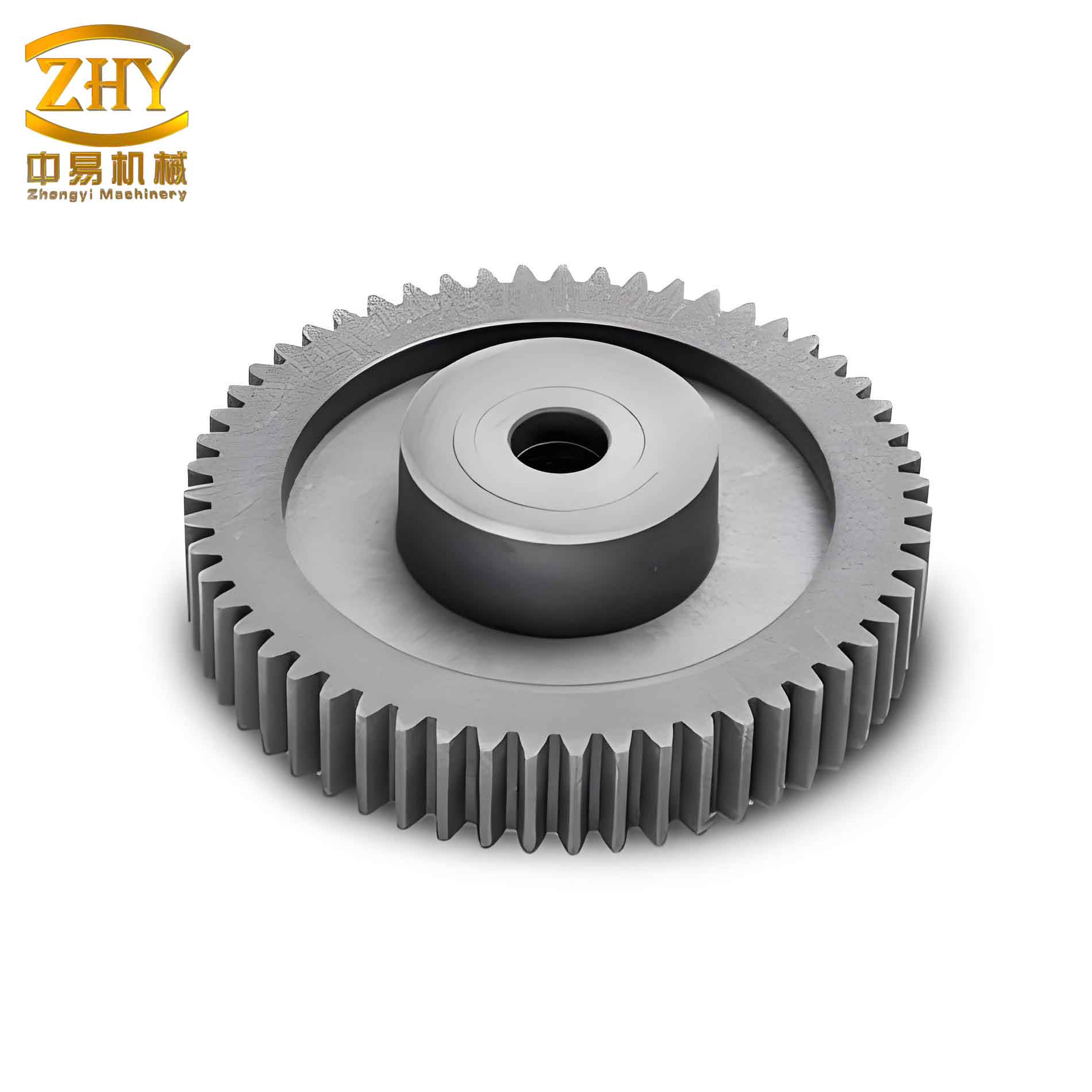
where $r_b$ is the base circle radius and $\theta$ is the involute angle. Such formulas are crucial for accurate CAD modeling, enabling precise simulation of tooth engagement in spur and pinion gear systems. To visualize the typical geometry involved, refer to the following image that illustrates a spur and pinion gear assembly:
In my simulation setup, I utilize DEFORM-3D, a finite element analysis software specifically designed for metal forming processes. The material models are configured to reflect cold forging conditions: the dies are defined as rigid bodies, while the workpiece material is AISI-1010 (cold), modeled as a plastic body with a yield strength of 205 MPa. The flow stress, which governs plastic deformation, is a function of strain, strain rate, and temperature, often described by constitutive equations such as the Johnson-Cook model:
$$ \sigma = (A + B \epsilon^n) \left(1 + C \ln \frac{\dot{\epsilon}}{\dot{\epsilon}_0}\right) \left(1 – \left(\frac{T – T_{\text{room}}}{T_{\text{melt}} – T_{\text{room}}}\right)^m\right) $$
where $\sigma$ is the flow stress, $\epsilon$ is the equivalent plastic strain, $\dot{\epsilon}$ is the strain rate, and $T$ is the temperature. For cold forging, temperature effects are minimal, so the focus lies on strain and strain-rate dependencies. Friction at the die-workpiece interface is modeled using shear friction, with a coefficient of 0.12, and the forming temperature is set to 20°C. The motion of the upper punch and floating die is controlled at a speed of 5 mm/s to simulate realistic press conditions. To manage mesh distortion during the complex three-dimensional deformation of spur and pinion gears, I employ tetrahedral remeshing techniques with criteria based on strain, contact penetration, volume ratio, and direct checks. The initial mesh has a maximum edge length of 0.4 mm, with local refinement in the tooth regions to 0.2 mm, ensuring computational accuracy while minimizing simulation time. Table 1 summarizes the key parameters used in the finite element model for spur and pinion gear forging.
| Parameter | Value | Description |
|---|---|---|
| Gear Module | 2 mm | Defines tooth size for spur and pinion gear |
| Number of Teeth | 18 | Total teeth in the spur gear |
| Pressure Angle | 20° | Angle of tooth face in spur and pinion gear |
| Billet Diameter | 30 mm | Initial billet dimension |
| Billet Height | 19.4 mm | Initial billet dimension |
| Material | AISI-1010 | Workpiece material for spur and pinion gear |
| Yield Strength | 205 MPa | Material property |
| Friction Coefficient | 0.12 | Shear friction model |
| Forming Temperature | 20°C | Cold forging condition |
| Punch Speed | 5 mm/s | Velocity of upper and floating dies |
| Mesh Size (Global) | 0.4 mm | Maximum edge length |
| Mesh Size (Local) | 0.2 mm | Refined in tooth region |
The simulation process involves two distinct stages: pre-forging using whole loading and finish forging via local loading. In the pre-forging stage, I apply a whole load of 150 kN to the billet, resulting in a unit pressure of approximately 1364 MPa. This step aims to accumulate material in the tooth cavities, creating a preformed blank that facilitates subsequent local loading. The pre-forged geometry shows significant material redistribution, with bulging in the tooth areas, which is essential for reducing loads in the final stage. After pre-forging, the workpiece undergoes stress relief annealing to soften the material, enhancing formability for the finish forging of spur and pinion gears. The finish forging employs a local loading strategy, where only the tooth regions are subjected to deformation force through a ring-shaped punch. This approach drastically reduces the contact area compared to whole loading, leading to lower forming pressures. During local loading, the material flows radially to fill the tooth cavities, with the ring punch allowing upward flow into the boss region, acting as a pressure relief mechanism. The simulation captures this behavior incrementally, revealing the evolution of strain, stress, and velocity fields.
Analyzing the equivalent strain distribution provides insights into the deformation mechanics of spur and pinion gears. Initially, at incremental step 90, strain concentrates in the upper tooth regions as material begins to fill the cavities. As deformation progresses to step 100, strain spreads to the lower tooth corners and boss transition zones. By the final step 111, the maximum equivalent strain reaches 1.60 in the lower tooth corners and boss transition areas, indicating these as critical filling regions. The strain evolution can be quantified using the effective strain formula:
$$ \bar{\epsilon} = \sqrt{\frac{2}{3} \epsilon_{ij} \epsilon_{ij}} $$
where $\epsilon_{ij}$ are the components of the strain tensor. This helps in identifying areas prone to defects in spur and pinion gear forging. Similarly, the equivalent stress distribution mirrors the strain pattern, with stresses gradually shifting from upper to lower tooth corners. The maximum stress observed is below 666 MPa, significantly lower than in whole loading scenarios. The stress state is critical for predicting tool life, as high stresses can lead to die failure in spur and pinion gear manufacturing. Table 2 summarizes the key results from the simulation for both pre-forging and finish forging stages.
| Stage | Load (kN) | Unit Pressure (MPa) | Max Equivalent Strain | Max Equivalent Stress (MPa) | Key Observations |
|---|---|---|---|---|---|
| Pre-forging (Whole Loading) | 150 | 1364 | 0.85 | 540 | Material accumulation in tooth cavities |
| Finish Forging (Local Loading) | 45 | 409 | 1.60 | 666 | Complete tooth filling with reduced load |
| Finish Forging (After Annealing) | 40 | 364 | 1.55 | 630 | Further load reduction due to material softening |
The velocity field analysis reveals the material flow dynamics during local loading of spur and pinion gears. At incremental step 90, the fastest flow occurs in the upper tooth areas, with simultaneous movement toward the lower corners and boss. By step 100, as the upper corners fill, velocity increases in the boss and lower regions. At step 111, the boss region exhibits the highest velocity, indicating that tooth filling is not the final stage, thereby avoiding sudden load spikes common in whole loading. This flow behavior is governed by the principle of volume constancy and can be described using the continuity equation for incompressible flow:
$$ \nabla \cdot \mathbf{v} = 0 $$
where $\mathbf{v}$ is the velocity vector. The load-stroke curves extracted from the simulation clearly demonstrate the advantages of local loading for spur and pinion gears. Compared to whole loading, local loading reduces the forming load by approximately 70%, from around 400 kN to 120 kN in the final stages. After annealing, the load drops further to about 100 kN, highlighting the benefits of intermediate heat treatment. This reduction is attributed to the smaller contact area and the pressure relief effect of the ring punch, which diverts material flow into the boss, reducing resistance in tooth cavities. The mathematical relationship between load and contact area can be expressed as:
$$ F = P \times A $$
where $F$ is the forming force, $P$ is the pressure, and $A$ is the contact area. By localizing the load to the tooth regions, $A$ decreases, leading to lower $F$ for the same $P$, making the process more efficient for spur and pinion gear production.
Further discussion on the local loading mechanism emphasizes its potential for broader applications in gear manufacturing. The success of this method for spur gears suggests that similar approaches could be adapted for pinion gears, which often involve smaller sizes and higher precision requirements. The finite element simulation allows for parametric studies to optimize die design and process parameters. For instance, varying the ring punch geometry or friction conditions can yield insights into minimizing forming loads while ensuring dimensional accuracy of spur and pinion gears. Additionally, the simulation results can be validated through experimental trials, though that falls outside the scope of this article. The use of advanced software like DEFORM-3D enables visualization of complex deformation patterns, facilitating better understanding of tooth filling in spur and pinion gears. Future work could explore multi-stage local loading or hybrid processes combining forging with machining for net-shape gear fabrication.
In conclusion, the two-step cold forging process integrating whole loading pre-forging and local loading finish forging offers a promising solution for manufacturing high-quality spur and pinion gears. Through detailed finite element simulation, I have shown that this approach significantly lowers forming pressures by up to 70%, ensures complete tooth profile filling, and reduces tool wear. The analysis of strain, stress, velocity, and load-stroke curves provides comprehensive insights into the deformation mechanics, underscoring the efficiency of local loading. As the demand for precision gears grows, such innovative forming techniques will play a crucial role in advancing manufacturing capabilities for spur and pinion gears across various industries, from automotive to aerospace. The integration of simulation tools with practical process design continues to drive improvements in gear production, making cold forging a more viable option for complex components like spur and pinion gears.