
The pursuit of compact, high-ratio, and high-torque transmission systems has long been a central theme in mechanical engineering. Among the various solutions, the harmonic drive gear has established itself as a premier technology, renowned for its exceptional precision, high reduction ratios within a single stage, and compact coaxial design. The conventional harmonic drive gear relies on the elastic deformation of a flexible spline, a feature that, while enabling its unique advantages, also imposes a fundamental constraint: the inherent trade-off between the degree of deformation and the component’s ultimate load-bearing capacity. This limitation becomes particularly pronounced in applications demanding high power transmission, such as in mining, heavy machinery, and metallurgical industries.
To transcend this limitation, a novel transmission concept was developed: the Oscillating Tooth End Face Harmonic Drive Gear. This innovative design synthesizes the principles of traditional harmonic drives with those of oscillating tooth (or “live tooth”) transmissions. The core innovation lies in replacing the continuously deforming flexible spline with a set of discrete, radially movable oscillating teeth. This fundamental shift in architecture decouples the motion generation mechanism from the load-bearing structure, thereby potentially overcoming the capacity ceiling of traditional designs while preserving their valuable kinematic benefits, including a high, constant instantaneous speed ratio and a compact form factor.
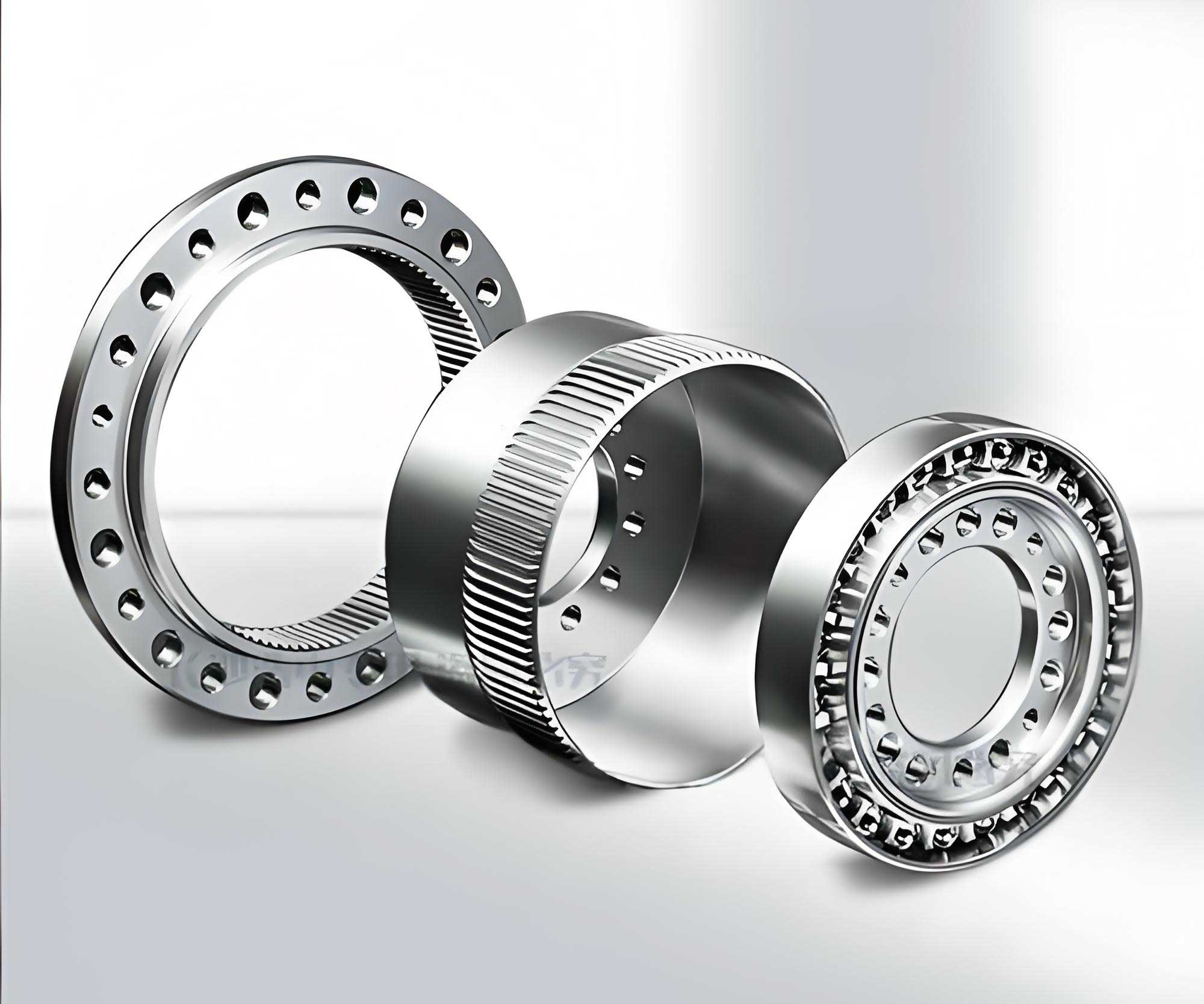
The operation of this novel harmonic drive gear centers around two critical engagement pairs within its kinematic chain. The first pair (Pair A) is between a non-circular wave generator and the rear end (or base) of the oscillating teeth. The second pair (Pair B) is between the front end (or tip) of the oscillating teeth and a fixed end-face gear. The oscillating teeth themselves are constrained within radial guide slots of a central carrier, often called the槽轮 (sprocket wheel), allowing only radial translation. A simplified circumferential development of this engagement is highly instructive for understanding the motion sequence.
When the wave generator rotates with a constant input angular velocity $$ω_w$$, its lobed profile acts upon the oscillating teeth. Specifically, the rising flank (or “ascending segment”) of the wave generator’s lobe pushes an oscillating tooth radially outward. As the tooth moves outward, its front-end profile engages with the working flank of a tooth on the fixed end-face gear. This engagement forces the oscillating tooth to move along the end-face gear’s profile from the dedendum (root) towards the addendum (tip). Due to the radial constraint imposed by the carrier’s guide slot, this radial motion is converted into a tangential force, causing the carrier to rotate. This phase constitutes the power stroke or working travel of the cycle.
Upon the wave generator’s lobe reaching its crest (maximum radius), the oscillating tooth reaches its outermost radial position, typically in contact with the root of the end-face gear tooth. As the wave generator continues to rotate, the descending flank (or “returning segment”) of its lobe comes into play. During this phase, the reactive force from the non-working flank of the end-face gear’s tooth pushes the oscillating tooth radially inward, back to its starting position, guided by the wave generator’s return profile. This is the return stroke, which ideally should transmit no net driving torque. All oscillating teeth undergo this sequential, phase-shifted engagement, providing smooth and continuous motion transmission to the carrier.
A critical observation from this analysis is the asymmetry in the functional roles of the wave generator’s profile segments. Only the ascending segment performs positive work by driving the load; the descending segment merely facilitates the return of the tooth under little to no load. In a conventional symmetric tooth design for both the wave generator and the end-face gear, the angular spans allocated to the working and return flanks are equal. This represents a potential inefficiency. By strategically adopting an asymmetric tooth profile, we can extend the angular span of the working flank while proportionally shortening the return flank. This design philosophy achieves a “slow-in, fast-out” motion characteristic for the oscillating teeth, effectively increasing the number of teeth simultaneously engaged in the power-transmitting phase. Theoretically, in a frictionless idealization, an appropriately designed asymmetric profile could engage nearly all teeth in load sharing. In practice, the selection of pressure angles is limited by friction angles to prevent self-locking. Nonetheless, a well-designed asymmetric profile for this harmonic drive gear can significantly enhance its torque density and power transmission capability.
Structural Forms of Asymmetric Oscillating Teeth
The kinematic relationship in an Oscillating Tooth End Face Harmonic Drive Gear is defined by the tooth counts. Let $$Z_E$$ be the number of teeth on the fixed End-face gear and $$Z_O$$ be the number of Oscillating teeth. The transmission ratio is fundamentally linked to the difference $$(Z_E – Z_O)$$. Crucially, the relative magnitude of $$Z_E$$ and $$Z_O$$ determines on which side of the oscillating tooth the engagements with the wave generator and end-face gear occur. This, in turn, dictates the viable forms of asymmetric teeth.
Case 1: $$Z_E > Z_O$$
In this configuration, the engagement regions with the end-face gear and the wave generator lie on opposite sides of the oscillating tooth’s central axis. By elongating the working flank or shortening the return flank, four conceptual asymmetric tooth forms can be derived, as summarized in Table 1. The bolded sectors indicate the active engagement surfaces.
| Form | Description | Modification Strategy | Active Surfaces (Power Stroke) |
|---|---|---|---|
| Form I | Elongated working flank on wave generator side. | Extend the ascending segment profile. | Rear flank (Wave Gen.) & Opposite-side front flank (End Gear). |
| Form II | Elongated working flank on end-face gear side. | Extend the working flank on the front end. | Opposite-side rear flank (Wave Gen.) & Front flank (End Gear). |
| Form III | Shortened return flank on wave generator side. | Reduce the descending segment profile. | Rear flank (Wave Gen.) & Opposite-side front flank (End Gear). |
| Form IV | Shortened return flank on end-face gear side. | Reduce the non-working flank on the front end. | Opposite-side rear flank (Wave Gen.) & Front flank (End Gear). |
While all four forms are kinematically conceivable, Forms III and IV present a critical structural challenge. Shortening the return flank while maintaining a constant overall tooth height inevitably reduces the tooth’s thickness at its base or mid-section. Since the oscillating tooth’s profile and the end-face gear’s profile are conjugate, the corresponding space in the end-face gear also narrows. However, the physical body of the adjacent oscillating tooth, residing in its guide slot, remains unchanged. This can lead to geometric interference between the bodies of adjacent oscillating teeth during assembly or operation, especially when they are at different radial positions. One could eliminate this interference by removing (“skipping”) every other tooth, but this directly reduces the number of potentially load-sharing teeth, counteracting the primary benefit of the asymmetric design. Therefore, for $$Z_E > Z_O$$, Forms I and II, which achieve asymmetry by elongating the working flanks, are structurally preferable.
Case 2: $$Z_E < Z_O$$
Here, the engagement regions with the end-face gear and the wave generator lie on the same side of the oscillating tooth’s central axis. A similar set of four asymmetric forms can be conceptualized, as detailed in Table 2.
| Form | Description | Modification Strategy | Active Surfaces (Power Stroke) |
|---|---|---|---|
| Form V | Elongated working flank on the common engagement side. | Extend both relevant profiles on the same side. | Rear flank (Wave Gen.) & Front flank (End Gear) on the same side. |
| Form VI | Elongated working flank on the opposite side. | Extend profiles on the side not directly engaged during power stroke. | Flanks opposite to the primary engagement side. |
| Form VII | Shortened return flank on the common engagement side. | Reduce return profiles on the same side. | Rear flank (Wave Gen.) & Front flank (End Gear) on the same side. |
| Form VIII | Shortened return flank on the opposite side. | Reduce return profiles on the opposite side. | Flanks opposite to the primary engagement side. |
Analogous to the previous case, Forms VII and VIII suffer from the same structural interference issue due to the thinning of the tooth body when the return flank is shortened. Consequently, for $$Z_E < Z_O$$, Forms V and VI are the viable asymmetric configurations. The choice between elongating the working flank on the engagement side (Form V) or the opposite side (Form VI) depends on detailed stress analysis and manufacturing considerations.
Geometric Foundation and Meshing Condition for Asymmetric Profiles
To establish a rigorous design framework for the asymmetric harmonic drive gear, we must define its geometry mathematically. Consider an imaginary cylindrical surface of radius $$r$$ concentric with the transmission axis. Unwrapping the engagement on this cylinder provides a clear linear representation of the angular relationships.
Let the wave generator have $$U$$ lobes (typically $$U=2$$ for a standard elliptical wave generator). On the reference cylinder of radius $$r$$:
- The arc length corresponding to one complete lobe (one wave) is:
$$ S_W = \frac{2\pi r}{U} $$ - For an asymmetric wave generator, let $$λ_W$$ be its asymmetry coefficient, defined as the fraction of one lobe’s arc dedicated to the ascending (working) flank. Thus, the arc length of the working flank per lobe is:
$$ S_{W1} = λ_W \cdot S_W = \frac{2π r λ_W}{U} $$
Conversely, the return flank occupies $$ (1-λ_W) \cdot S_W $$. - The circular pitch (arc length per tooth) of the end-face gear on the same cylinder is:
$$ S_E = \frac{2\pi r}{Z_E} $$ - Similarly, for an asymmetric end-face gear, define $$λ_E$$ as its asymmetry coefficient, representing the fraction of a tooth’s pitch occupied by the working flank. The arc length of the working flank per end-face gear tooth is:
$$ S_{E1} = λ_E \cdot S_E = \frac{2π r λ_E}{Z_E} $$
The non-working flank occupies $$ (1-λ_E) \cdot S_E $$.
The condition for correct meshing throughout the cycle can be derived from the kinematic consistency requirement. During the power stroke, as the wave generator rotates through the angular span corresponding to its working flank arc $$S_{W1}$$, a reference oscillating tooth must move radially such that its engagement point with the end-face gear traverses exactly the working flank arc $$S_{E1}$$ of one end-face gear tooth. The ratio of these angular motions must be constant and equal to the overall speed ratio. This leads to the fundamental meshing condition:
The kinematic relationship requires that the proportion of the wave generator’s rotation spent on the working flank equals the proportion of the end-face gear’s relative motion spent on its working flank. Mathematically, this is expressed by equating the ratios:
$$ \frac{S_{W1}}{S_W} = \frac{S_{E1}}{S_E} $$
Substituting the expressions from above:
$$ \frac{ \frac{2π r λ_W}{U} }{ \frac{2π r}{U} } = \frac{ \frac{2π r λ_E}{Z_E} }{ \frac{2π r}{Z_E} } $$
This simplifies directly to the essential structural condition for correct engagement with asymmetric teeth:
$$ λ_W = λ_E $$
This elegant result states that for the Oscillating Tooth End Face Harmonic Drive Gear to function correctly with asymmetric profiles, the asymmetry coefficient of the wave generator must be identical to the asymmetry coefficient of the end-face gear. This condition ensures that the timing of the engagement and disengagement phases between the two critical contact pairs (A and B) is perfectly synchronized throughout the transmission cycle.
Analysis of Transmission Ratio Consistency
A paramount requirement for any precision gear transmission, including this advanced harmonic drive gear, is the constancy of the instantaneous speed ratio. Fluctuations in the speed ratio lead to vibration, noise, and reduced positioning accuracy. It must be proven that the adoption of asymmetric teeth, under the condition $$λ_W = λ_E$$, does not compromise this critical characteristic.
The analysis employs the well-established Willis (planetary gear train) analogy method. The oscillating tooth transmission is conceptually transformed into an equivalent planetary system. The detailed derivation accounts for the geometry of the engagement. Let $$α$$ be the semi-tooth-angle of the working flank of the oscillating tooth/end-face gear pair on the reference cylinder, and $$θ$$ be the pressure angle or effective lead angle of the wave generator’s working flank on the same cylinder. These are related to the basic design parameters:
$$ \tan α = \frac{S_{E1}/2}{h} = \frac{π r λ_E}{Z_E h} $$
$$ \tan θ = \frac{h}{S_{W1}/2} = \frac{h U}{2π r λ_W} $$
where $$h$$ is the theoretical radial lift of the wave generator, equivalent to the working depth of the end-face gear tooth.
Through kinematic analysis of the equivalent mechanism, the relationship between the overall transmission ratio $$i_{WH}^{(E)}$$ (carrier output relative to wave generator input, with end-face gear fixed) and the instantaneous velocity ratio $$i_{wh}^{(e)}$$ can be established. The general expressions depend on the tooth count relationship:
For the case $$Z_E > Z_O$$:
$$ i_{wh}^{(e)} = \frac{λ_W U + λ_W Z_O – λ_E U}{λ_E Z_O} \cdot i_{WE}^{(H)} $$
For the case $$Z_E < Z_O$$:
$$ i_{wh}^{(e)} = \frac{λ_E U + λ_W Z_O – λ_W U}{λ_E Z_O} \cdot i_{WE}^{(H)} $$
Now, applying the fundamental meshing condition $$λ_W = λ_E = λ$$, we substitute into both equations:
For $$Z_E > Z_O$$:
$$ i_{wh}^{(e)} = \frac{λ U + λ Z_O – λ U}{λ Z_O} \cdot i_{WE}^{(H)} = \frac{λ Z_O}{λ Z_O} \cdot i_{WE}^{(H)} = i_{WE}^{(H)} $$
For $$Z_E < Z_O$$:
$$ i_{wh}^{(e)} = \frac{λ U + λ Z_O – λ U}{λ Z_O} \cdot i_{WE}^{(H)} = \frac{λ Z_O}{λ Z_O} \cdot i_{WE}^{(H)} = i_{WE}^{(H)} $$
This result is significant: $$ i_{wh}^{(e)} = i_{WE}^{(H)} $$. It demonstrates that under the condition $$λ_W = λ_E$$, the instantaneous velocity ratio is constant and equal to the overall, kinematically determined transmission ratio. This validates that the properly designed asymmetric profile does not introduce velocity fluctuation. The transmission maintains the smooth, constant-ratio performance expected of a high-quality harmonic drive gear, while simultaneously gaining the benefit of increased concurrent tooth engagement.
Design Considerations and Parameter Selection
The implementation of asymmetric teeth in an Oscillating Tooth End Face Harmonic Drive Gear requires careful consideration of several interrelated parameters. Table 3 summarizes the key design variables and their influences.
| Parameter | Symbol | Typical Range / Consideration | Influence on Performance |
|---|---|---|---|
| Asymmetry Coefficient | $$λ$$ ($$=λ_W=λ_E$$) | 0.5 < λ < 0.8 (subject to friction limit) | Higher λ increases simultaneous contact ratio and torque capacity but reduces return speed and must avoid undercutting. |
| Wave Generator Lobes | $$U$$ | Usually 2 (elliptical), can be 3 for higher ratios. | Determines number of working cycles per revolution. U=2 is most common for balance. |
| End-Face Gear Teeth | $$Z_E$$ | Positive integer, differs from $$Z_O$$ by a multiple of U. | Together with $$Z_O$$, defines the reduction ratio: $$i ≈ (Z_E – Z_O) / Z_O$$ or vice versa. |
| Oscillating Teeth Count | $$Z_O$$ | Positive integer, often 1-3 teeth less/more than $$Z_E$$. | Affects load distribution, size of teeth, and manufacturing complexity. |
| Reference Radius | $$r$$ | Determined by required center distance and size constraints. | Scales all linear dimensions and influences bending strength of teeth. |
| Theoretical Lift | $$h$$ | Function of module/pitch and asymmetry. | Directly related to tooth depth and the magnitude of oscillating motion. |
| Pressure Angle (Working) | $$α$$ | 20°-30°, must exceed arctan(μ) to prevent self-locking. | Affects radial forces, bending stress, and contact stress. Higher angle reduces radial load but may weaken tooth root. |
| Wave Generator Lead Angle | $$θ$$ | Derived from $$h$$, $$U$$, $$r$$, and $$λ$$. | Affects efficiency and axial thrust in the tooth-wave generator contact. |
The selection of the asymmetry coefficient $$λ$$ is the most distinctive aspect of this design. While a value of $$λ=0.5$$ corresponds to a symmetric tooth, increasing $$λ$$ directly extends the angular duration of the power stroke. This allows more teeth to be in the load-bearing zone at any given instant, thereby increasing the transmission overlap ratio. The theoretical upper limit for $$λ$$ is less than 1.0, and the practical maximum is constrained by:
- Friction and Self-Locking: The pressure angle on the return flank (which becomes very steep as $$λ$$ increases) must remain greater than the friction angle to ensure reliable return of the oscillating tooth during the idle stroke. This requires:
$$ \text{Return flank effective angle} > \arctan(\mu) $$
where $$μ$$ is the coefficient of friction. - Tooth Strength and Undercutting: Elongating the working flank may lead to a narrowed tooth root or undercutting of the conjugate profile if not properly designed, potentially weakening the tooth.
- Manufacturing Constraints: Highly asymmetric profiles may be more challenging to manufacture with high precision compared to symmetric ones.
The benefits of this asymmetric design for the harmonic drive gear are substantial:
- Increased Torque Capacity: The primary advantage. A higher number of teeth share the load, reducing stress on individual teeth and the wave generator.
- Improved Load Distribution: Smoother transition of load from one tooth to the next, potentially reducing vibration and noise.
- Maintained High Precision: The constant instantaneous speed ratio is preserved, ensuring the positional accuracy inherent to harmonic drive technology.
- Scalability: The design principle allows for larger module sizes since the load is distributed, making it suitable for high-power applications where traditional harmonic drives might be limited by flexspline stress.
Conclusion
The Oscillating Tooth End Face Harmonic Drive Gear represents a significant evolution in the field of high-ratio precision gearing. By replacing the monolithic flexible spline with discrete, radially oscillating teeth, it fundamentally addresses the load-capacity limitation associated with elastic deformation in traditional harmonic drives. The introduction of asymmetric tooth profiles for the engagement pairs is a logical and powerful optimization of this architecture. Through detailed kinematic and geometric analysis, we have established that viable asymmetric forms exist for both major tooth-count relationships ($$Z_E > Z_O$$ and $$Z_E < Z_O$$), with a strong preference for forms achieved by elongating the working flank rather than shortening the return flank to avoid structural interference.
The cornerstone of the design is the derived meshing condition $$λ_W = λ_E$$. This requirement ensures the synchronized motion of the two engagement pairs throughout the operating cycle. Furthermore, it has been rigorously proven that adherence to this condition guarantees a constant instantaneous speed ratio, preserving one of the most valued characteristics of the harmonic drive gear family.
The practical implementation of this asymmetric harmonic drive gear opens new avenues for high-torque, compact reduction systems. Its potential application spans demanding industries such as robotics, aerospace, heavy machinery, and renewable energy systems, where the combination of high reduction ratio, precision, robustness, and increased power density is paramount. Future work may focus on detailed stress analysis of the asymmetric tooth forms, optimization of the asymmetry coefficient for specific load spectra, development of advanced manufacturing techniques, and experimental validation of the predicted performance gains in prototype systems.