
In modern industrial applications, screw gear reducers, commonly known as worm gear reducers, play a pivotal role in transmitting power and motion across various machinery. As an essential component in industries such as petroleum, chemical, textile, and renewable energy, screw gear reducers offer advantages like smooth transmission, high reduction ratios, and adaptability. However, maintaining their operational efficiency is critical, and temperature monitoring of oil and shaft temperatures is a key factor in preventing failures. In this paper, I present a comprehensive temperature detection system designed for screw gear reducers, leveraging STM32 microcontrollers to enhance accuracy and reliability. The system addresses the inefficiencies of manual inspections and provides real-time monitoring, ensuring optimal performance of screw gear mechanisms.
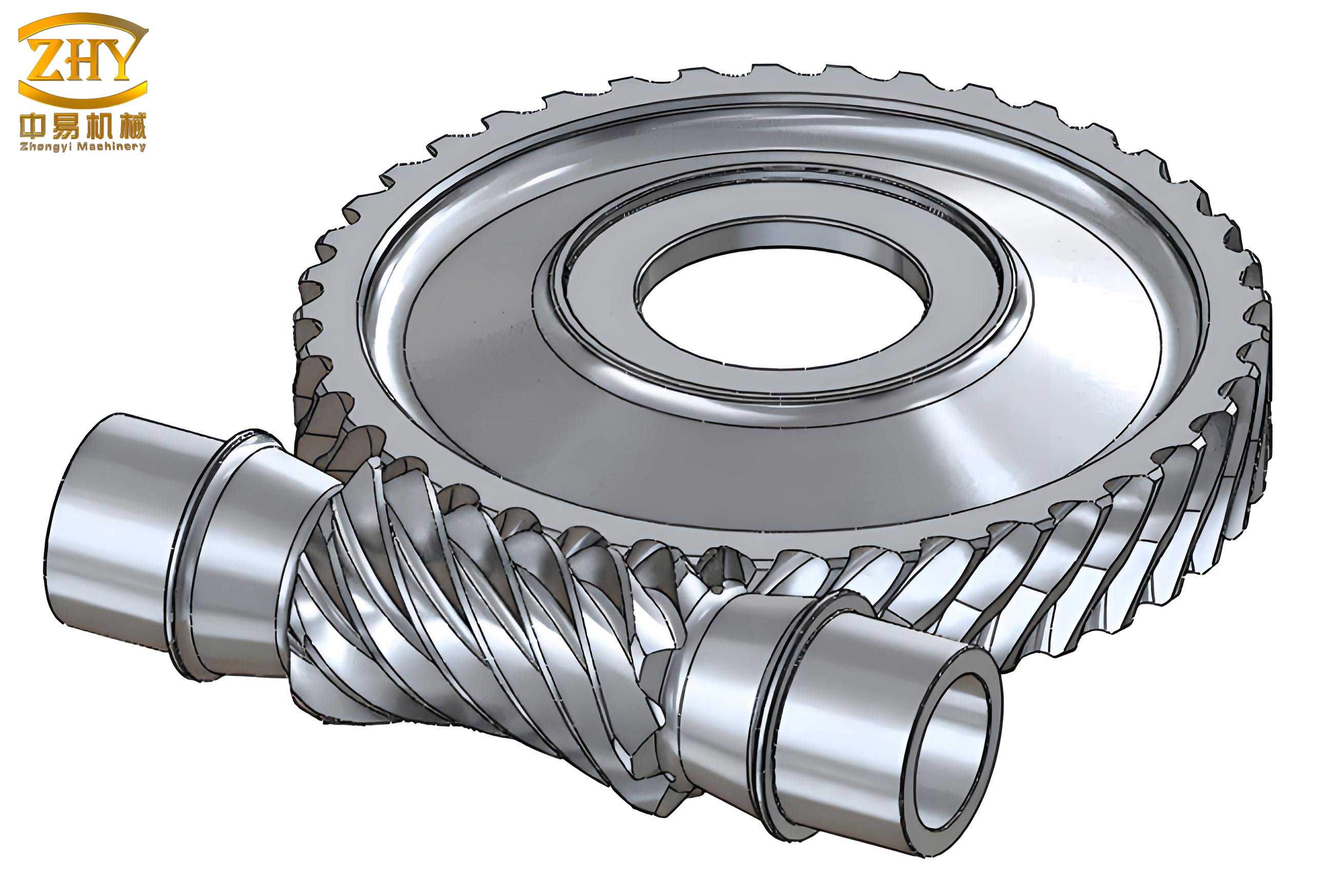
The screw gear reducer operates by converting high-speed motor rotations into lower speeds with higher torque, using a worm and wheel mechanism. This process generates friction between components, leading to heat accumulation that can degrade lubricants and damage parts if unchecked. Temperature rise in screw gear systems often indicates issues like misalignment, wear, or inadequate lubrication, making continuous monitoring vital. Traditional methods rely on periodic manual checks, which are prone to errors and delays. My system automates this process through embedded sensors and microcontrollers, enabling proactive maintenance for screw gear reducers in diverse environments.
To design an effective temperature detection system for screw gear reducers, I focused on several core objectives: accurate measurement of oil and shaft temperatures, real-time data display, alarm triggering for threshold exceedances, data storage, and Ethernet communication for remote monitoring. The system integrates multiple hardware modules, including temperature sensors, a central processing unit, and peripheral interfaces, all tailored for screw gear applications. The choice of components ensures compatibility with the harsh conditions often faced by screw gear reducers, such as vibrations and temperature fluctuations.
The overall architecture of the system is centered around an STM32F407ZGT6 microcontroller, chosen for its computational power and peripheral support. As illustrated in the block diagram, the system comprises data acquisition units for oil and shaft temperatures, signal processing circuits, a display module, an alarm system, and communication interfaces. For oil temperature measurement, I selected the DS18B20 digital temperature sensor due to its direct contact capability and simplicity. For shaft temperature measurement, which requires non-contact sensing, I employed the MLX90614 infrared sensor, which can measure both target and ambient temperatures simultaneously. This dual-sensor approach ensures comprehensive monitoring of screw gear reducer conditions.
In screw gear reducers, the oil temperature reflects the lubrication efficiency and overall thermal state, while shaft temperatures indicate mechanical friction and alignment issues. By monitoring both parameters, the system provides a holistic view of reducer health. The data acquisition process involves converting analog signals from the MLX90614 and digital signals from the DS18B20 into readable temperature values. The STM32 microcontroller processes these signals, applying calibration formulas to enhance accuracy. For instance, the MLX90614 outputs digital values that are converted using the following equations:
$$T_o = 0.02 B_o – 273.15$$
$$T_a = 0.02 B_a – 273.15$$
where \(T_o\) is the target temperature in degrees Celsius, \(T_a\) is the ambient temperature in degrees Celsius, \(B_o\) is the digital value for the target, and \(B_a\) is the digital value for the ambient. These formulas account for the sensor’s resolution and offset, ensuring precise measurements for screw gear components.
The hardware design is critical for reliable operation in industrial settings. Below is a summary of key components used in the system, tailored for screw gear reducer applications:
| Component | Model | Function | Application in Screw Gear System |
|---|---|---|---|
| Microcontroller | STM32F407ZGT6 | Data processing and control | Coordinates sensor inputs and outputs for screw gear temperature monitoring |
| Oil Temperature Sensor | DS18B20 | Contact-based digital temperature sensing | Measures lubricant temperature in screw gear reducer oil sump |
| Shaft Temperature Sensor | MLX90614 | Non-contact infrared temperature sensing | Monitors active and passive shaft temperatures in screw gear assembly |
| Display Module | LCD1602 | Real-time temperature display | Shows oil and shaft temperatures for screw gear operator feedback |
| Communication Module | W5500 Ethernet | Data transmission via TCP/IP | Enables remote monitoring of screw gear reducer status |
| Alarm System | Buzzer and LEDs | Audible and visual alerts | Warns of overheating in screw gear reducers |
The power supply circuit is designed to convert 220V AC to 5V DC, with further regulation to 3.3V using an LM1117 voltage regulator. This ensures stable operation for all components, including the screw gear sensor interfaces. Protection features like resettable fuses and reverse-polarity diodes are incorporated to safeguard against electrical faults common in industrial environments where screw gear reducers operate.
For the oil temperature sensor installation in screw gear reducers, I modified a standard oil plug to integrate the DS18B20 sensor. The screw gear reducer’s oil outlet, typically sized at M16×1.5, was fitted with a threaded sensor probe that extends into the lubricant. This design ensures direct contact with the oil while maintaining密封 integrity to prevent leaks in screw gear systems. The mechanical setup involves adding washers to adjust the probe depth, accommodating variations in screw gear reducer models.
The shaft temperature sensors are mounted on adjustable universal stands, allowing precise alignment with the screw gear reducer’s shaft end-covers. The MLX90614 sensors are positioned approximately 2 cm from the shaft surfaces, enabling non-contact measurement without interfering with screw gear operation. This arrangement facilitates easy installation and maintenance for screw gear reducers in confined spaces.
Software development for the system involves a main program that orchestrates data acquisition, processing, and communication. The flowchart outlines initialization steps, where the system checks hardware and configures sensors for screw gear temperature monitoring. The DS18B20 sensor communicates via a one-wire protocol, while the MLX90614 uses an I²C interface simulated by the STM32. Data from these sensors are processed to compute temperatures, which are then displayed on the LCD and stored in memory. If temperatures exceed preset thresholds—for example, 80°C for oil or 70°C for shafts in screw gear reducers—the alarm system activates with buzzer sounds and LED flashes.
The Ethernet communication module, based on the W5500 chip, enables high-speed data transfer to a host computer. This allows remote monitoring of screw gear reducer temperatures, supporting predictive maintenance strategies. The system implements a lightweight TCP/IP stack, with data packets formatted to include temperature readings and timestamps. This feature is particularly useful for screw gear reducers in automated production lines, where continuous oversight is essential.
To validate the system’s accuracy, I conducted calibration experiments using a FLUKE constant-temperature oil bath. The DS18B20 sensor was immersed in silicon oil at controlled temperatures, while the MLX90614 sensors were positioned above the oil surface. Results demonstrated high precision, with errors within acceptable limits for screw gear applications. The table below summarizes calibration data for oil temperature measurements:
| Test Point (°C) | DS18B20 Reading (°C) | Error (°C) | MLX90614 Sensor 1 Reading (°C) | Error (°C) | MLX90614 Sensor 2 Reading (°C) | Error (°C) |
|---|---|---|---|---|---|---|
| 10 | 9.93 | 0.07 | 10.09 | -0.09 | 10.07 | -0.07 |
| 20 | 19.93 | 0.07 | 20.08 | -0.08 | 20.09 | -0.09 |
| 30 | 29.87 | 0.13 | 30.12 | -0.12 | 30.09 | -0.09 |
| 40 | 39.81 | 0.19 | 40.09 | -0.09 | 40.11 | -0.11 |
| 50 | 49.81 | 0.19 | 50.15 | -0.15 | 50.12 | -0.12 |
| 60 | 59.75 | 0.25 | 60.14 | -0.14 | 60.16 | -0.16 |
| 70 | 69.87 | 0.13 | 70.06 | -0.06 | 70.11 | -0.11 |
| 80 | 80.06 | -0.06 | 79.97 | 0.03 | 80.04 | -0.04 |
| 90 | 90.18 | -0.18 | 89.91 | 0.09 | 89.94 | 0.06 |
From the data, the maximum error for oil temperature measurement with the DS18B20 is 0.25°C, while for shaft temperature measurements with the MLX90614, errors are 0.15°C and 0.16°C, respectively. These values are within industrial tolerances for screw gear reducers, ensuring reliable detection of overheating incidents. The system’s performance can be further analyzed using error propagation formulas. For instance, the total error \(E_t\) in temperature readings can be expressed as:
$$E_t = \sqrt{E_s^2 + E_c^2 + E_a^2}$$
where \(E_s\) is the sensor error, \(E_c\) is the calibration error, and \(E_a\) is the environmental error. In screw gear applications, factors like vibration and dust may introduce additional errors, but the system’s design mitigates these through robust housing and filtering algorithms.
The alarm threshold settings are configurable based on screw gear reducer specifications. Typically, for screw gear systems, oil temperatures should not exceed 90°C, and shaft temperatures should remain below 80°C to prevent lubricant breakdown and mechanical wear. The system allows users to adjust these thresholds via software, accommodating different screw gear models and operating conditions. When a threshold is exceeded, the alarm triggers immediately, prompting maintenance actions to protect the screw gear reducer from damage.
Data storage is implemented using the STM32’s internal memory, with temperatures logged at regular intervals. This historical data can be retrieved via Ethernet for trend analysis, helping identify gradual degradation in screw gear performance. For example, rising baseline temperatures over time might indicate lubricant aging or increased friction in screw gear components. The system supports data export in CSV format, compatible with common analysis tools used in industrial maintenance for screw gear reducers.
In terms of scalability, the system can be extended to monitor multiple screw gear reducers in a network. By daisy-chaining sensors or using additional communication modules, it can cover entire production lines. This scalability is crucial for large-scale industries where screw gear reducers are deployed in critical machinery. The modular design also allows for upgrades, such as integrating wireless communication for screw gear reducers in remote locations.
The economic benefits of this system are significant for screw gear reducer applications. Manual temperature checks often require downtime and labor costs, whereas this automated system operates continuously without interruption. By preventing failures, it reduces repair expenses and extends the lifespan of screw gear reducers, contributing to overall cost savings. Moreover, the use of off-the-shelf components like the STM32 and DS18B20 keeps production costs low, making it accessible for small to medium enterprises using screw gear technology.
Future enhancements could include machine learning algorithms to predict screw gear failures based on temperature trends. By analyzing historical data, the system could forecast overheating events before they occur, enabling proactive maintenance. Additionally, integration with IoT platforms could provide real-time alerts via mobile devices, further improving responsiveness for screw gear reducer management.
In conclusion, the temperature detection system presented here offers a reliable and efficient solution for monitoring screw gear reducers. By combining advanced sensors with a powerful microcontroller, it addresses the limitations of traditional methods and supports the growing demand for automation in industrial maintenance. The system’s accuracy, ease of installation, and communication capabilities make it suitable for diverse screw gear applications, from manufacturing to energy production. As industries continue to rely on screw gear reducers for motion control, such innovative monitoring systems will play a vital role in ensuring operational safety and efficiency.
The development of this system underscores the importance of temperature management in screw gear reducers, highlighting how embedded technology can transform maintenance practices. I hope this work inspires further research into smart monitoring solutions for screw gear and other mechanical systems, driving advancements in industrial automation and reliability.