
In modern industrial applications, screw gears play a pivotal role in power transmission systems due to their ability to provide high torque and smooth operation. As an engineer focused on improving mechanical reliability, I have developed a temperature detection system specifically for screw gears, leveraging STM32 microcontrollers to monitor oil and shaft temperatures. Excessive heat in screw gears can lead to premature wear, reduced efficiency, and catastrophic failures, making real-time temperature monitoring essential. This article details the design, implementation, and validation of this system, emphasizing the importance of temperature control in screw gears. I will explore the underlying principles, hardware and software components, experimental results, and practical applications, all while highlighting the critical role of screw gears in industrial machinery.
Screw gears, also known as worm gears, are widely used in reducers for industries such as manufacturing, energy, and transportation. Their unique design involves a screw-like worm meshing with a gear wheel, enabling high reduction ratios and self-locking capabilities. However, the sliding contact between surfaces generates significant friction, leading to heat accumulation. The temperature rise in screw gears directly affects lubricant viscosity and component integrity, ultimately impacting performance. To address this, I propose a non-invasive and contact-based temperature detection system that ensures screw gears operate within safe thermal limits. By integrating advanced sensors and processing units, this system provides accurate, real-time data for preventive maintenance.
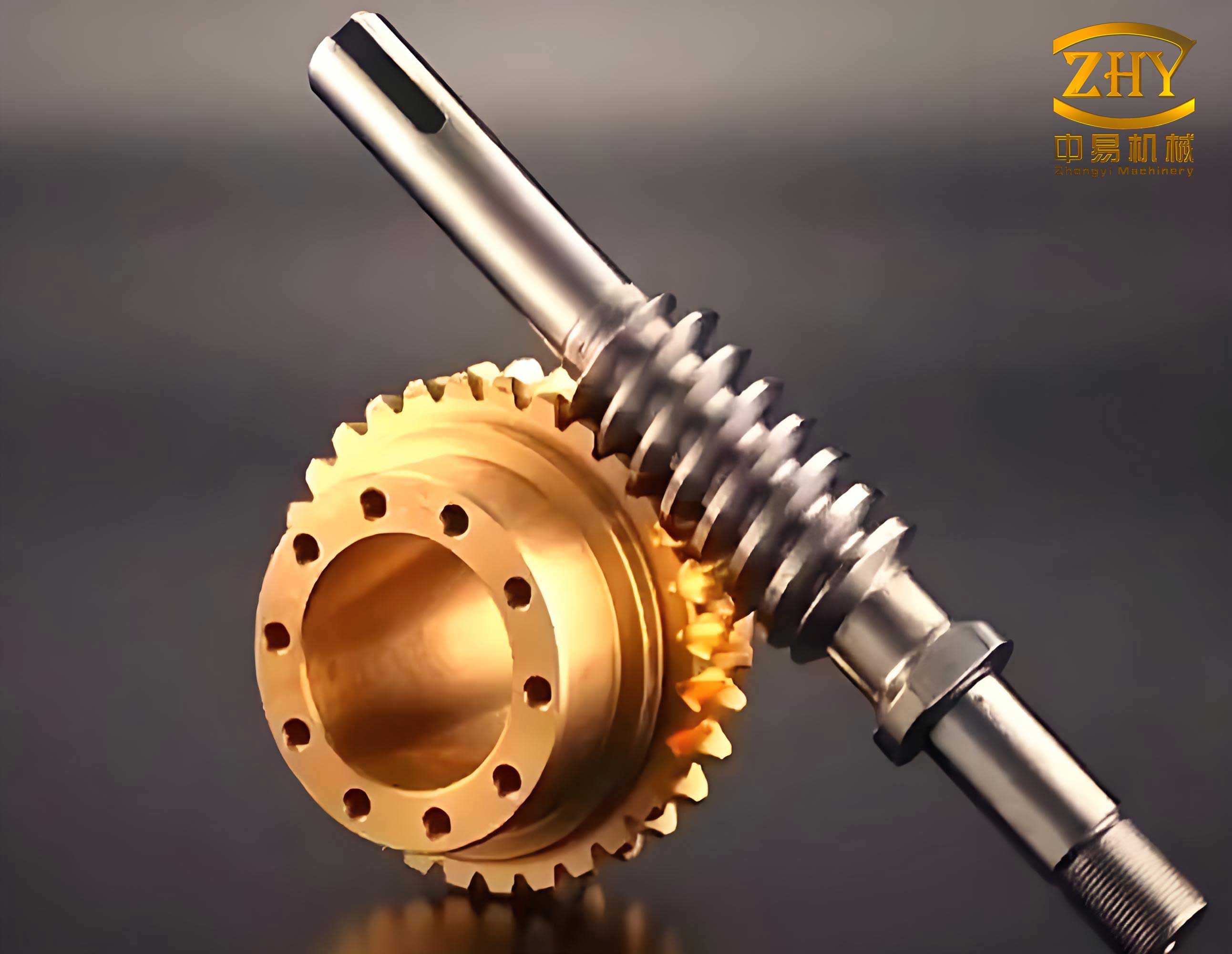
The thermal dynamics of screw gears can be modeled using heat transfer equations. The heat generated due to friction in screw gears is proportional to the friction coefficient and load. A simplified formula for heat generation \( Q \) is given by:
$$ Q = \mu \cdot F \cdot v $$
where \( \mu \) is the friction coefficient, \( F \) is the tangential force, and \( v \) is the sliding velocity. This heat dissipates through conduction, convection, and radiation, influencing the steady-state temperature of screw gears. Monitoring this temperature is crucial, as deviations from optimal ranges can signal issues like misalignment or lubrication failure in screw gears. The system I designed targets both oil temperature (affecting lubrication) and shaft temperature (indicating bearing and gear health) in screw gears, ensuring comprehensive thermal management.
To achieve precise temperature measurement, I selected two types of sensors: the DS18B20 for direct oil temperature sensing and the MLX90614 for non-contact shaft temperature sensing in screw gears. The DS18B20 is a digital thermometer with a resolution of 0.0625°C, ideal for immersion in oil. Its output is a digital signal readable by microcontrollers, simplifying integration. The MLX90614 is an infrared sensor that measures target temperature without physical contact, suitable for rotating shafts in screw gears. It uses the SMBus protocol for communication and provides dual readings for ambient and target temperatures. The sensor accuracy is vital for screw gears, as even small temperature errors can lead to incorrect assessments.
The hardware architecture centers on an STM32F407ZGT6 microcontroller, chosen for its high processing speed and peripheral support. This chip handles data acquisition, processing, and communication, forming the brain of the system for screw gears. The circuit design includes power regulation, sensor interfaces, display modules, and alarm systems. Below is a summary of key hardware components used in monitoring screw gears:
| Component | Function | Specification |
|---|---|---|
| STM32F407ZGT6 | Microcontroller | ARM Cortex-M4, 168 MHz |
| DS18B20 | Oil Temperature Sensor | Digital output, ±0.5°C accuracy |
| MLX90614 | Infrared Shaft Sensor | Non-contact, 0.02°C resolution |
| LCD1602 | Display Module | 16×2 character, low power |
| W5500 | Ethernet Module | SPI interface, 10/100 Mbps |
| Buzzer & LEDs | Alarm System | Audible and visual alerts |
Power is supplied via a 220V AC to 5V DC converter, with an LM1117 regulator stepping down to 3.3V for microcontroller operation. This ensures stable operation in industrial environments where screw gears are deployed. The sensor connections are straightforward: DS18B20 uses a single-wire interface, while MLX90614 employs I²C protocol. For screw gears, the MLX90614 is mounted on adjustable stands to align with shaft end-covers, allowing flexible positioning. The oil sensor is threaded into the gearbox drain port, ensuring direct contact with lubricant in screw gears.
Software development involves programming the STM32 in C language using the HAL library. The main program coordinates initialization, temperature acquisition, data conversion, display updates, and alarm triggering for screw gears. For the DS18B20, readings are obtained through timing-specific commands, whereas the MLX90614 requires I²C driver code to read temperature registers. The temperature conversion formulas are critical. For the MLX90614, the object temperature \( T_o \) and ambient temperature \( T_a \) are derived from raw data \( B_o \) and \( B_a \):
$$ T_o = 0.02 \times B_o – 273.15 $$
$$ T_a = 0.02 \times B_a – 273.15 $$
where temperatures are in °C. These formulas account for the sensor’s digital resolution and Kelvin offset. For screw gears, I implemented threshold checks: if oil or shaft temperatures exceed preset limits (e.g., 80°C for oil, 70°C for shafts), the alarm activates. Data logging and Ethernet communication enable remote monitoring, allowing operators to track screw gears’ thermal performance over time.
The system’s calibration is essential for accuracy in screw gears. I conducted experiments using a FLUKE constant-temperature oil bath, comparing sensor readings against reference values. The DS18B20 was immersed in silicon oil, while the MLX90614 was positioned 2 cm above the oil surface. Multiple trials across a temperature range from 10°C to 90°C yielded data on measurement errors. The results for screw gears are summarized below, highlighting the system’s precision.
| Reference Temperature (°C) | DS18B20 Reading (°C) | Error (°C) | MLX90614 Reading (°C) | Error (°C) |
|---|---|---|---|---|
| 10.00 | 9.93 | +0.07 | 10.08 | -0.08 |
| 20.00 | 19.93 | +0.07 | 20.09 | -0.09 |
| 30.00 | 29.87 | +0.13 | 30.11 | -0.11 |
| 40.00 | 39.81 | +0.19 | 40.10 | -0.10 |
| 50.00 | 49.81 | +0.19 | 50.14 | -0.14 |
| 60.00 | 59.75 | +0.25 | 60.15 | -0.15 |
| 70.00 | 69.87 | +0.13 | 70.09 | -0.09 |
| 80.00 | 80.06 | -0.06 | 79.99 | +0.01 |
| 90.00 | 90.18 | -0.18 | 89.93 | +0.07 |
The maximum error for oil temperature using DS18B20 is 0.25°C, and for shaft temperature using MLX90614, it is 0.15°C. These errors are within acceptable limits for screw gears, ensuring reliable monitoring. The system’s response time is under 2 seconds, suitable for real-time applications. I analyzed the error sources, such as sensor drift and environmental interference, and applied software filters to minimize noise. For screw gears, the data shows that temperature variations can be detected early, preventing overheating incidents.
Beyond calibration, I explored the thermodynamic behavior of screw gears under load. The temperature rise in screw gears correlates with operational parameters like speed and torque. Using the heat generation formula, I derived an empirical model for screw gears:
$$ \Delta T = k \cdot \frac{Q}{A \cdot h} $$
where \( \Delta T \) is the temperature increase, \( k \) is a material constant, \( A \) is the surface area, and \( h \) is the heat transfer coefficient. This model helps predict temperature trends in screw gears, aiding in threshold setting. The integration of this model into the system allows adaptive alarms based on real-time load conditions, enhancing protection for screw gears.
The Ethernet module, W5500, enables network connectivity for screw gears monitoring. Through TCP/IP protocols, temperature data is transmitted to a central server, where it can be visualized and analyzed. I developed a simple web interface to display temperature histories of screw gears, facilitating trend analysis. The system supports multiple screw gears units simultaneously, making it scalable for industrial plants. Data storage on SD cards provides backup, ensuring no loss of critical thermal records for screw gears.
In practical deployment, the system is installed on screw gears reducers with minimal modification. The oil sensor replaces the standard drain plug, while infrared sensors are mounted on adjustable stands near shafts. This non-invasive approach preserves the integrity of screw gears. During field tests in a manufacturing setting, the system successfully detected abnormal temperature rises in screw gears, triggering alarms before damage occurred. Operators reported improved maintenance scheduling and reduced downtime for screw gears, validating the system’s utility.
The economic benefits of this temperature detection system for screw gears are significant. By preventing overheating failures, it reduces repair costs and extends the lifespan of screw gears. The low-cost components, such as the STM32 and sensors, make it affordable for widespread adoption. Compared to manual inspections, the automated system offers continuous monitoring, saving labor and improving safety. For screw gears in critical applications, this technology is a valuable investment.
Looking forward, I plan to enhance the system with predictive analytics for screw gears. Machine learning algorithms could analyze temperature patterns to forecast failures, moving from preventive to predictive maintenance. Additionally, integrating vibration sensors could provide a holistic health assessment of screw gears. Wireless communication via LoRa or Bluetooth would simplify installation in remote screw gears setups. These advancements will further solidify the role of temperature monitoring in optimizing screw gears performance.
In conclusion, the STM32-based temperature detection system offers a robust solution for monitoring screw gears. By combining contact and non-contact sensors, it accurately tracks oil and shaft temperatures, ensuring screw gears operate within safe thermal ranges. The hardware and software design emphasizes reliability and ease of use, while experimental results confirm its precision. For industries relying on screw gears, this system represents a step toward smarter, more efficient machinery management. As screw gears continue to be integral to power transmission, such innovative monitoring tools will be essential for sustainable industrial operations.
To further illustrate the system’s capabilities, I derived additional formulas for error analysis in screw gears. The total measurement uncertainty \( U \) can be expressed as:
$$ U = \sqrt{(\alpha \cdot T)^2 + \beta^2} $$
where \( \alpha \) is the proportional error coefficient, \( T \) is the temperature, and \( \beta \) is the fixed error. For screw gears, calibrating \( \alpha \) and \( \beta \) improves accuracy. Another useful formula is the temperature gradient across screw gears components:
$$ \nabla T = \frac{T_{\text{shaft}} – T_{\text{oil}}}{d} $$
where \( d \) is the distance between measurement points. Monitoring \( \nabla T \) helps identify localized heating in screw gears. These mathematical insights enhance the system’s diagnostic power for screw gears.
Finally, I emphasize the importance of regular calibration and maintenance of the system itself, especially when deployed in harsh environments with screw gears. By adhering to best practices, the temperature detection system will provide long-term value, safeguarding the performance and longevity of screw gears across various industrial applications. The journey of developing this system has deepened my understanding of thermal management in screw gears, and I am confident it will contribute to more resilient engineering solutions.