
In my extensive experience with high-speed and heavy-duty gear applications, I have observed that the relentless demand for increased power transmission, torque, and operational speeds in modern machinery poses significant challenges. These challenges are primarily centered around material performance and heat treatment processes, where defects can severely compromise gear integrity. The evolution from soft gear surfaces to hardened ones, such as through carburizing or nitriding, has been pivotal, but it is not without its pitfalls. Heat treatment defects, including distortion, residual stresses, reduced hardness at elevated temperatures, and inadequate fatigue resistance, remain persistent issues that must be addressed through innovative approaches. This article delves into the current state and future trends, emphasizing how advancements in materials and duplex surface engineering can mitigate these heat treatment defects, ensuring gears meet the stringent requirements of high-performance applications.
The foundation of high-speed and heavy-duty gear manufacturing lies in the selection of appropriate materials and heat treatment techniques. Traditionally, carburizing of low-alloy steels and nitriding of medium-alloy steels have been the go-to methods. Carburizing involves diffusing carbon into the surface of low-carbon steels, typically with carbon content between 0.1% and 0.25%, to enhance surface hardness while maintaining a tough core. Common steels include 12Cr2Ni4, 20Cr2Ni4, and 17CrNiMo6, which incorporate elements like chromium, nickel, and molybdenum to refine microstructure and improve mechanical properties. After carburizing and quenching, these steels achieve core strengths of $\sigma_b = 1100-1300 \, \text{MN/m}^2$ and impact toughness of $a_k = 80-100 \, \text{J/cm}^2$. However, carburizing is prone to heat treatment defects such as dimensional distortion due to high processing temperatures (often around $900-950^\circ\text{C}$), necessitating costly grinding operations to restore precision. Additionally, the formation of undesirable microstructures, like excessive retained austenite or coarse carbides, can lead to reduced wear resistance and premature failure.
On the other hand, nitriding, which involves diffusing nitrogen into the surface at lower temperatures (typically $500-600^\circ\text{C}$), minimizes distortion but introduces its own set of heat treatment defects. Steels like 38CrMoAl, 25Cr2MoV, and AISI 4340 are commonly used, with post-treatment tensile strengths reaching $\sigma_b = 900-1300 \, \text{MN/m}^2$. Nitrided layers, while hard, are often shallow, limiting load-bearing capacity and making gears susceptible to spalling and contact fatigue under heavy loads. The table below summarizes key materials and their associated heat treatment defects:
| Material Type | Typical Steels | Heat Treatment | Common Heat Treatment Defects | Core Strength (MN/m²) |
|---|---|---|---|---|
| Low-Alloy Carburizing Steels | 12Cr2Ni4, 20CrNi2Mo, 18Cr2Ni4W | Carburizing + Quenching | Distortion, retained austenite, oxidation, cracking | 1100-1300 |
| Medium-Alloy Nitriding Steels | 38CrMoAl, 25Cr2MoV, 31CrMoV9 | Nitriding (Ion or Gas) | Shallow case depth, brittleness, porosity, reduced fatigue strength | 900-1300 |
These heat treatment defects are not merely academic concerns; they have real-world implications. For instance, in high-speed gearboxes, where tooth temperatures can exceed $200^\circ\text{C}$, traditional carburized gears experience thermal softening due to the tempering of martensite, leading to accelerated wear and pitting. This is a classic example of a heat treatment defect where the material’s response to operational temperatures is inadequate. The relationship between surface hardness and temperature can be modeled using an Arrhenius-type equation: $$ H(T) = H_0 \cdot e^{-E_a / (RT)} $$ where $H(T)$ is the hardness at temperature $T$, $H_0$ is the initial hardness, $E_a$ is the activation energy for softening, and $R$ is the gas constant. For carburized steels, $E_a$ is relatively low, causing significant hardness drop at elevated temperatures, which exacerbates heat treatment defects like micropitting and scuffing.
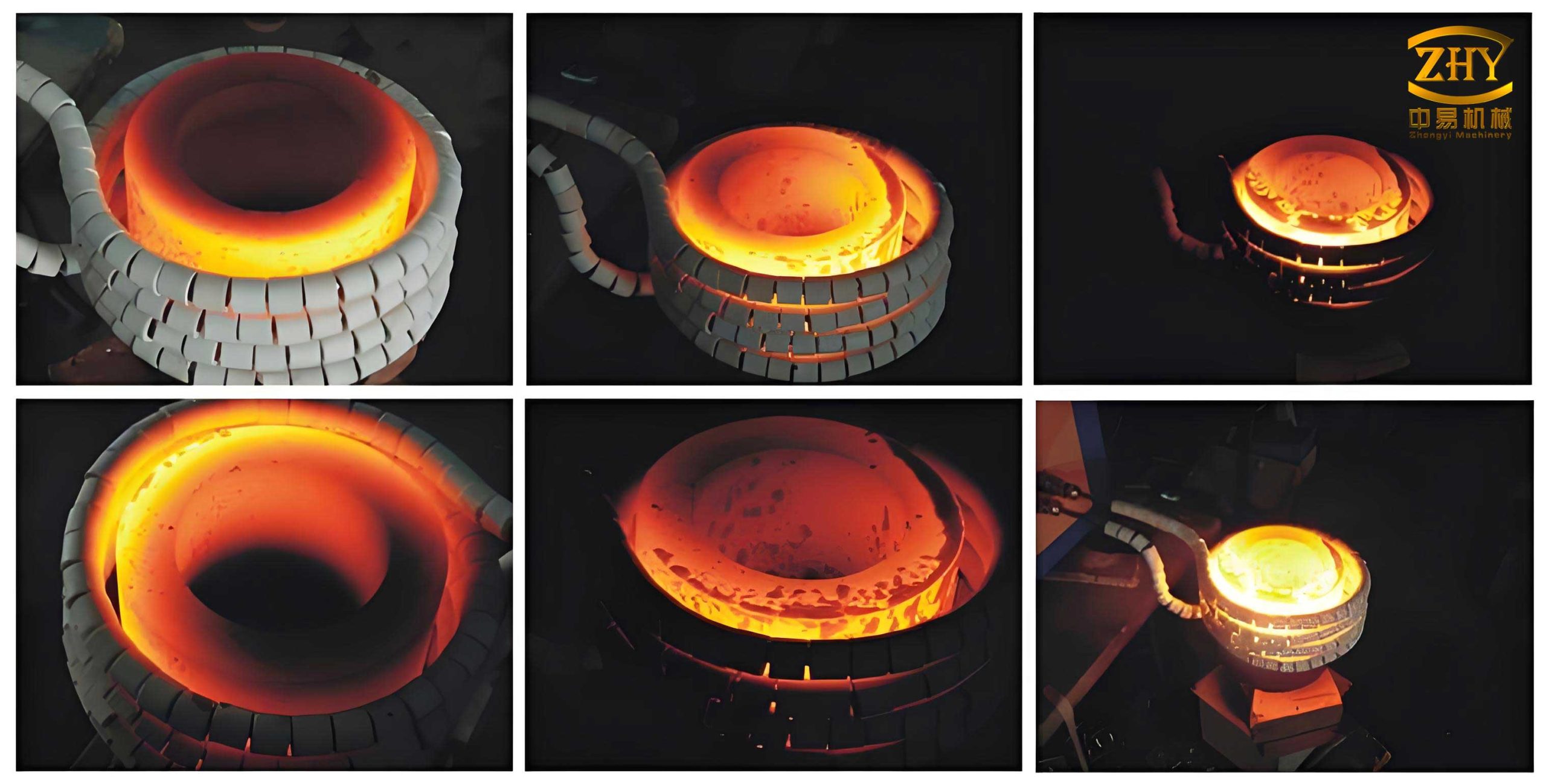
To combat these issues, the industry has shifted towards deeper case hardening and advanced nitriding techniques. Deep nitriding, with effective case depths exceeding $0.5 \, \text{mm}$, has shown promise in matching the contact and bending fatigue performance of carburized gears while offering superior anti-pitting and anti-galling properties. However, achieving such depths without introducing heat treatment defects like excessive white layer formation or residual tensile stresses requires precise control of process parameters. For example, ion nitriding of steels like 32Cr2MoV, with optimized time and temperature cycles, can produce case depths of $0.72 \, \text{mm}$ in 40 hours, accompanied by surface compressive stresses that enhance fatigue resistance. The fatigue life $N_f$ under cyclic loading can be expressed as: $$ N_f = C \cdot (\Delta \sigma)^{-m} $$ where $\Delta \sigma$ is the stress range, and $C$ and $m$ are material constants. By increasing case depth and compressive stresses, $\Delta \sigma$ is reduced, thereby extending $N_f$ and mitigating heat treatment defects related to fatigue failure.
Nevertheless, even with these improvements, conventional treatments often fall short in extreme conditions. This has spurred research into duplex surface engineering, which combines multiple processes to synergistically enhance properties. A prime example is the carburizing + nitriding approach on high-alloy steels like M50NiL, a low-carbon, high-chromium, high-molybdenum, and high-nickel steel. This steel undergoes secondary hardening through precipitation of alloy carbides during multiple tempering cycles, providing high bulk strength and hot hardness. When subjected to carburizing followed by low-temperature nitriding, it achieves a surface layer with exceptional hardness and a core with fracture toughness over $100 \, \text{MPa} \cdot \text{m}^{1/2}$. This duplex treatment addresses multiple heat treatment defects simultaneously: carburizing provides deep hardening, while nitriding adds wear resistance and thermal stability, reducing the risk of softening at high operational temperatures. The Hertzian stress distribution in such gears, critical for contact fatigue analysis, can be calculated using: $$ \sigma_H = \sqrt{ \frac{F}{\pi b} \cdot \frac{1}{\rho} } $$ where $F$ is the load per unit width, $b$ is the contact half-width, and $\rho$ is the effective radius of curvature. For duplex-treated gears, $\sigma_H$ is lower due to improved surface properties, minimizing heat treatment defects like pitting and spalling.
The pursuit of minimizing heat treatment defects has also led to the exploration of novel materials and surface modifications. For instance, phosphorus-based coatings prior to carburizing can form thin zinc phosphate layers ($5-20 \, \mu\text{m}$), which reduce oxide inclusions at grain boundaries and inhibit bainite formation, thereby enhancing surface hardness and fatigue resistance. This is particularly effective in preventing heat treatment defects associated with non-uniform microstructures. Additionally, rare earth carbonitriding has emerged as a method to lower carburizing temperatures, reducing distortion and energy consumption. The diffusion kinetics in such processes can be described by Fick’s second law with an enhanced diffusion coefficient $D$ due to rare earth elements: $$ \frac{\partial C}{\partial t} = D \frac{\partial^2 C}{\partial x^2} $$ where $C$ is the concentration of carbon or nitrogen, $t$ is time, and $x$ is depth. By increasing $D$, deeper case depths are achieved at lower temperatures, alleviating heat treatment defects like warping and cracking.
In high-speed applications, where gears are subjected to rapid load fluctuations, bending fatigue becomes a critical failure mode. Heat treatment defects such as insufficient case depth or improper tempering can lead to catastrophic tooth breakage. The bending stress at the tooth root $\sigma_b$ can be approximated using the Lewis formula modified for dynamic effects: $$ \sigma_b = \frac{F_t}{b m} \cdot Y \cdot K_v $$ where $F_t$ is the tangential load, $b$ is face width, $m$ is module, $Y$ is the form factor, and $K_v$ is the dynamic factor. To ensure reliability, materials must exhibit high fracture toughness, often quantified by the stress intensity factor $K_{IC}$. For advanced steels like M50NiL, $K_{IC}$ values exceed $100 \, \text{MPa} \cdot \text{m}^{1/2}$, providing a buffer against heat treatment defects that might initiate cracks. The table below compares various surface treatments and their effectiveness in mitigating heat treatment defects:
| Surface Treatment | Typical Case Depth (mm) | Surface Hardness (HV) | Key Advantages | Common Heat Treatment Defects Addressed |
|---|---|---|---|---|
| Conventional Carburizing | 0.8-1.5 | 700-900 | Deep hardening, high fatigue strength | Distortion, oxidation, retained austenite |
| Ion Nitriding | 0.3-0.7 | 600-800 | Low distortion, good wear resistance | Shallow case, porosity, brittleness |
| Deep Nitriding | >0.5 | 700-900 | Improved contact fatigue, thermal stability | White layer formation, residual stresses |
| Duplex Carburizing + Nitriding | 1.0-2.0 (combined) | 900-1100 | Synergistic properties, high hot hardness | Softening at high temperatures, pitting, scuffing |
| Rare Earth Carbonitriding | 0.5-1.2 | 750-950 | Reduced processing temperature, less distortion | Microstructural inhomogeneity, cracking |
Furthermore, the integration of surface engineering techniques, such as laser hardening or physical vapor deposition (PVD) coatings, offers additional avenues to combat heat treatment defects. Laser surface melting can refine grain structures and eliminate defects like porosity, while PVD coatings of titanium nitride (TiN) or diamond-like carbon (DLC) provide low friction and high wear resistance, reducing the likelihood of adhesive wear and scoring. These methods are particularly useful for correcting localized heat treatment defects without affecting the bulk material. The wear rate $W$ in gears can be modeled using Archard’s equation: $$ W = k \frac{F_n L}{H} $$ where $k$ is a wear coefficient, $F_n$ is the normal load, $L$ is the sliding distance, and $H$ is the hardness. By enhancing surface hardness through duplex treatments or coatings, $W$ is minimized, addressing heat treatment defects related to excessive wear.
Looking ahead, the trend towards higher power densities and operational speeds will necessitate even more robust solutions. One promising direction is the development of ultra-high-strength steels with optimized alloying elements like vanadium and tungsten, which form stable carbides that resist coarsening at high temperatures. These steels can be processed using low-temperature thermochemical treatments to achieve deep case depths with minimal distortion. For example, plasma-assisted processes allow for precise control of nitrogen and carbon diffusion, reducing heat treatment defects such as incomplete hardening or excessive compound layer formation. The economic impact of heat treatment defects cannot be overstated; they lead to increased scrap rates, rework costs, and downtime. Therefore, adopting predictive modeling tools, such as finite element analysis (FEA) for distortion simulation or computational thermodynamics for phase prediction, is crucial. These tools help optimize process parameters, reducing the incidence of heat treatment defects before they occur in production.
In conclusion, the evolution of gear materials and heat treatment is intrinsically linked to the mitigation of heat treatment defects. From traditional carburizing and nitriding to advanced duplex surface engineering, each step forward addresses specific weaknesses like distortion, shallow case depth, and thermal softening. By leveraging new materials like M50NiL, incorporating rare earth elements, and employing composite treatments, engineers can design gears that withstand extreme loads and speeds with enhanced reliability. Continuous innovation in process control and surface modification will be key to minimizing heat treatment defects, ensuring that high-speed and heavy-duty gears meet the ever-increasing demands of modern machinery. As I reflect on these advancements, it is clear that a holistic approach—combining material science, thermodynamics, and mechanical design—is essential for overcoming the persistent challenge of heat treatment defects in gear manufacturing.