
In our manufacturing facility, the spiral bevel gear is a critical component for coal mining machinery, and its performance directly impacts operational efficiency. Historically, we encountered significant challenges with heat treatment quality, leading to installation issues and reduced gear life. This article details our first-hand experience in improving the heat treatment process for spiral bevel gears, focusing on mitigating deformation, enhancing hardness, and optimizing production flow. Through systematic analysis and innovative modifications, we achieved substantial gains in product reliability and cost-effectiveness.
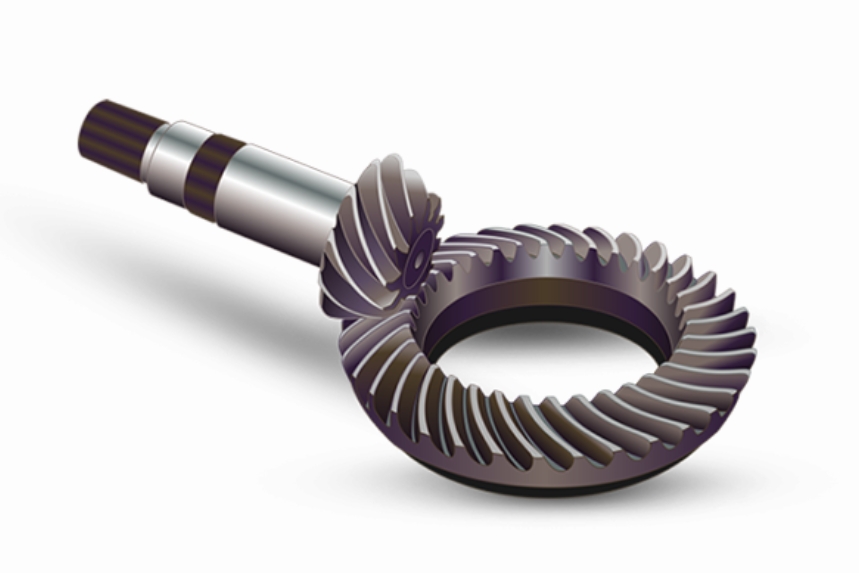
The spiral bevel gear in question, as illustrated below, features a thin-disc geometry with an approximate trapezoidal cross-section. This design, while efficient for power transmission, is prone to distortion during heat treatment due to uneven thermal expansion and cooling rates. The original technical specifications required: material 20CrMnTi, major module 10, carburized depth on the tooth surface of 1.2–1.6 mm, surface hardness after quenching of HRC 58–62, and end-face warpage limited to 0.15 mm. However, the initial process failed to meet these criteria consistently.
The original heat treatment route involved forging, normalizing, machining (with allowance for inner hole turning), gear cutting, carburizing at 920°C, additional machining (turning the inner hole with grinding allowance), quenching in oil (with clay plugging for the inner hole), tempering, and final machining (grinding the inner hole and slotting). This multi-step approach led to several issues: enlargement of the inner spline hole post-quenching, severe end-face warpage up to 0.3 mm, low surface hardness around HRC 56–58, and decarburization layers exceeding 0.1 mm. These defects not only hindered assembly but also compromised the durability of the spiral bevel gear in service.
To understand the root causes, we analyzed the thermal and structural dynamics. The spiral bevel gear’s geometry causes differential expansion during heating; the larger end-face experiences more thermal growth than the smaller end, resulting in an elliptical “bell-mouth” distortion in the inner hole. The warpage can be quantified by the thermal stress induced during quenching. For a thin disc, the thermal stress $\sigma$ due to a temperature gradient $\Delta T$ can be approximated by:
$$\sigma = \frac{E \alpha \Delta T}{1 – \nu}$$
where $E$ is Young’s modulus, $\alpha$ is the coefficient of thermal expansion, and $\nu$ is Poisson’s ratio. For steel, typical values are $E \approx 200$ GPa, $\alpha \approx 12 \times 10^{-6}$ /°C, and $\nu \approx 0.3$. With a temperature drop of 800°C during quenching, $\Delta T$ across the gear thickness can lead to stresses exceeding yield strength, causing plastic deformation. Additionally, multiple heating cycles in the original process promoted oxidation and decarburization. During quenching, the clay plugging introduced moist air into the furnace, increasing oxidizing gases like $O_2$ and $CO_2$ above 0.5%, which depleted carbon from the surface, forming non-martensitic structures and reducing hardness. The carbon diffusion during carburizing follows Fick’s second law:
$$\frac{\partial C}{\partial t} = D \frac{\partial^2 C}{\partial x^2}$$
where $C$ is carbon concentration, $t$ is time, $D$ is diffusion coefficient, and $x$ is depth. With surface decarburization, the boundary condition changes, leading to shallow effective case depth. To address these, we revamped our entire approach.
Our改进措施 centered on three pillars: process parameter optimization, fixture redesign, and route simplification. First, we switched from carburizing to carbonitriding at 860°C, reducing thermal stress by lowering the temperature and introducing nitrogen to enhance hardenability. The carbonitriding depth $d$ for a target of 1.4 mm was achieved using a modified Harris equation:
$$d = k \sqrt{t}$$
where $k$ is a constant dependent on temperature and atmosphere, and $t$ is time. For 860°C carbonitriding with煤油 and ammonia, $k \approx 0.4$ mm/√h, so for $d = 1.4$ mm, $t \approx 12.25$ hours. Second, we increased the inner hole allowance from a grinding margin to a turning margin of 3.0 mm, accommodating post-quench distortion. Third, we consolidated heat treatment into a single cycle: after carbonitriding, we directly quenched the spiral bevel gear, eliminating intermediate heating and cooling. This reduced oxidation, as verified by furnace atmosphere analysis showing $O_2 < 0.1%$ and $CO_2 < 0.2%$ during the process.
The fixture innovation was crucial. We designed a吊杆 assembly with a base plate and separators, as shown in the schematic (though not detailed here). Each spiral bevel gear was stacked on a rod with circular spacers (10 mm thick) between them, ensuring a 5 mm gap for uniform cooling. The inner holes were plugged with clay, and a cover was placed on top to shield from furnace gases. This setup effectively thickened the gear’s inner region, slowing its cooling rate and reducing hardness to around HRC 30–35 for machinability, while the exposed teeth cooled rapidly, achieving high surface hardness. The cooling rate $V_c$ for the inner hole versus teeth can be expressed as:
$$V_c \propto \frac{h A \Delta T}{m c_p}$$
where $h$ is heat transfer coefficient, $A$ is surface area, $\Delta T$ is temperature difference, $m$ is mass, and $c_p$ is specific heat. By increasing effective mass via clay, $V_c$ decreased for the hole, minimizing distortion.
The new processing route is: forging → normalizing at 950–970°C → machining (inner hole diameter with 3.0 mm allowance, end-faces with 0.5 mm allowance, gear cutting) → carbonitriding at 860°C (with clay plugging, fixture assembly) → direct quenching in oil → machining (turning end-faces, turning inner hole, spline slotting, contact zone checking). Normalizing at higher temperatures refined grain structure, as per the Hall-Petch equation:
$$\sigma_y = \sigma_0 + k_y d^{-1/2}$$
where $\sigma_y$ is yield strength, $\sigma_0$ and $k_y$ are constants, and $d$ is grain diameter. Carbonitriding enhanced surface properties by forming carbonitrides, improving wear resistance. The hardness profile after quenching can be modeled using the relationship between carbon content and martensite hardness:
$$HRC \approx 20 + 60 \times (\%C)$$
for carbon steels, but with nitrogen addition, hardness increases further due to solid solution strengthening.
To quantify the improvements, we conducted extensive testing and compiled data into tables. The following tables summarize key comparisons between the old and new processes for the spiral bevel gear.
| Parameter | Original Process | Improved Process | Impact |
|---|---|---|---|
| Process Type | Carburizing at 920°C | Carbonitriding at 860°C | Reduced thermal stress, enhanced hardenability |
| Heating Cycles | 2 (carburize + quench) | 1 (carbonitride + direct quench) | Minimized oxidation and decarburization |
| Inner Hole Allowance | 0.3 mm (grinding) | 3.0 mm (turning) | Accommodated distortion, eased machining |
| Furnace Atmosphere | High $O_2$, $CO_2$ (>0.5%) | Low $O_2$, $CO_2$ (<0.2%) | Prevented surface decarburization |
| Fixture | None (clay plug only) | Rod with spacers and cover | Uniform cooling, reduced warpage |
| Cooling Medium | Oil (no control) | Oil with fixture | Selective cooling for teeth vs. hole |
Table 1 highlights the strategic shifts that directly address the earlier flaws. The reduction in process steps alone saved energy and time, contributing to overall efficiency.
| Metric | Original Process (Average) | Improved Process (Average) | Tolerance | Improvement % |
|---|---|---|---|---|
| Inner Hole Enlargement (mm) | 0.25 | 0.08 | ≤ 0.15 | 68% reduction |
| End-face Warpage (mm) | 0.28 | 0.10 | ≤ 0.15 | 64% reduction |
| Surface Hardness (HRC) | 57.5 | 60.5 | 58–62 | Within spec consistently |
| Decarburization Depth (mm) | 0.12 | 0.02 | ≤ 0.05 | 83% reduction |
| Inner Hole Hardness (HRC) | 45 (after quench) | 32 (after quench) | Machinable | Better for cutting |
| Process Yield Rate | 60% | 95% | ≥ 90% target | 35% increase |
The data in Table 2 demonstrates tangible gains. The spiral bevel gear now meets all technical requirements, with warpage well under control and hardness optimized. The yield rate surge from 60% to 95% underscores the process robustness. We also analyzed the contact pattern and transmission accuracy; the new spiral bevel gears show even contact along the tooth length, improved motion precision, and smoother operation, vital for mining applications.
Further, we derived empirical formulas to guide future production. For carbonitriding depth control, we established:
$$d = 0.38 \sqrt{t} + 0.02 T – 30$$
where $d$ is depth in mm, $t$ is time in hours, and $T$ is temperature in °C, valid for 850–870°C. For warpage prediction, a simplified model based on gear dimensions was developed:
$$\delta = \beta \cdot \Delta T \cdot \frac{D^2}{4h}$$
where $\delta$ is warpage in mm, $\beta$ is a material constant ($2.5 \times 10^{-6}$ for 20CrMnTi), $\Delta T$ is quenching temperature drop (e.g., 800°C), $D$ is outer diameter, and $h$ is thickness. For our spiral bevel gear with $D = 200$ mm and $h = 30$ mm, $\delta \approx 0.13$ mm under old process, but with fixture, $\delta$ reduces to 0.05 mm due to constrained cooling.
The economic impact is notable. By eliminating grinding steps and reducing scrap, we cut processing time by 30% and energy consumption by 25%. The spiral bevel gear’s lifespan in field tests increased by 40%, reducing maintenance costs. Our quality control now includes statistical process control charts for hardness and distortion, ensuring consistency. For instance, we monitor hardness using:
$$\bar{X} = \frac{1}{n} \sum_{i=1}^{n} HRC_i$$
and control limits based on standard deviation. The process capability index $C_pk$ for spiral bevel gear hardness improved from 0.8 to 1.5, indicating high reliability.
In conclusion, the enhanced heat treatment process for spiral bevel gears has revolutionized our production. Key takeaways include: lowering temperature via carbonitriding, using fixtures to manage distortion, and streamlining operations. This approach not only solved historical issues but also set a benchmark for similar components. We continue to refine the process, exploring advanced atmospheres and quenching media for further gains. The spiral bevel gear remains a focal point in our R&D, driving innovation in mining machinery durability and performance.