
The pursuit of manufacturing efficiency, weight reduction, and noise minimization in modern precision instruments, office automation equipment, and household appliances has catalyzed the widespread adoption of polymer-based transmission components. Among these, helical gears stand out due to their superior operational characteristics compared to their spur counterparts. The inherent gradual engagement of helical teeth results in smoother transmission, reduced vibration, and lower acoustic emissions, making them ideal for high-performance applications. Particularly for small module helical gears (module m ≤ 1.0), injection molding becomes the dominant and economically viable manufacturing process for mass production. However, the very geometry that bestows their functional advantages—the helical twist—introduces significant complexities in mold design, cavity fabrication, and part ejection. The development of precision molds for these components is, therefore, not merely a matter of scaling down larger gear molds but involves overcoming a unique set of technological hurdles that directly impact the final gear’s dimensional accuracy, surface integrity, and structural performance.
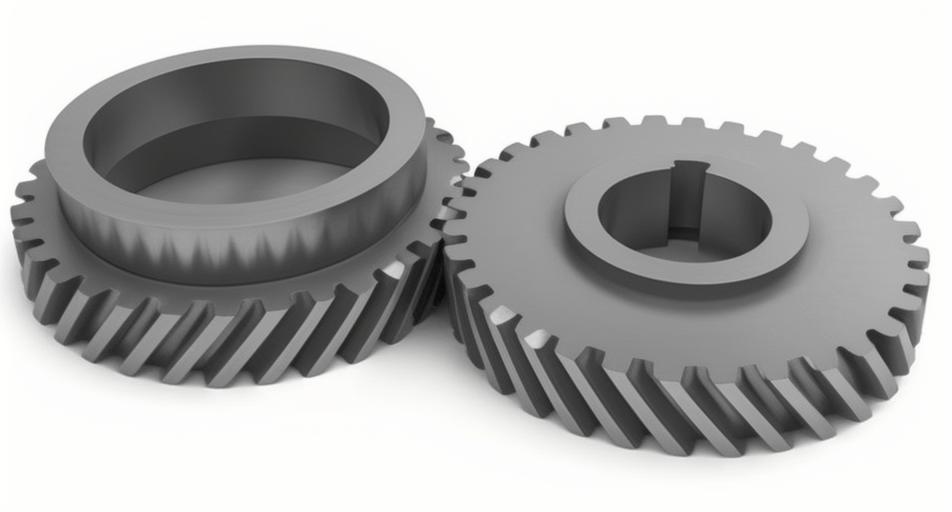
The core challenge in precision molding of small module helical gears stems from the anisotropic and non-uniform shrinkage behavior of thermoplastic polymers during the cooling phase of the injection molding cycle. Unlike simple geometric shapes, a helical gear experiences differential contraction along its radial, circumferential, and axial directions, with the helix angle further complicating the shrinkage vector. This often results in a molded gear whose tooth profile deviates from the theoretical involute form machined into the mold cavity, leading to errors in pressure angle, tooth thickness, and lead. Compensating for this predictable distortion within the mold cavity design is the foremost prerequisite for achieving gears meeting precision classes such as AGMA Class 2 or DIN Class 5. The traditional trial-and-error method of “cut-try-adjust” is prohibitively costly and time-consuming for complex helical gears, necessitating a more scientific, simulation-driven approach.
Theoretical Framework for Shrinkage Prediction and Cavity Compensation
Accurate prediction of final part geometry begins with understanding the interaction between material properties, process parameters, and part design. The volumetric shrinkage \( S_v \) of a plastic is a material property but manifests as linear shrinkage \( S_L \) that is direction-dependent due to molecular and fiber orientation. For a helical gear, we must consider shrinkage in three principal directions relative to the gear geometry: radial (r), tangential (t), and axial (a). A fundamental relationship links the cavity dimension \( D_{cavity} \) to the desired part dimension \( D_{part} \):
$$ D_{cavity} = \frac{D_{part}}{1 – S_{eff}} $$
where \( S_{eff} \) is the effective linear shrinkage rate in the dimension’s direction. For a helical gear, \( S_{eff} \) is not a constant. It varies along the tooth profile. The challenge is to determine the shrinkage vector field \( \vec{S}(x,y,z) \) across the entire gear tooth. Advanced simulation software utilizing the Modified Cross-WLF viscosity model and a dual-domain finite element analysis can predict this. The output is a distorted mesh of the “as-molded” gear. The inverse of this distortion map provides the necessary compensation data for the cavity.
For the critical tooth flank, compensation often involves a non-linear transformation of the standard involute coordinates. A simplified model for pressure angle correction considers the tendency of the tooth to “lean” further due to asymmetric cooling. If the simulated molded gear shows a pressure angle error \( \Delta \alpha \), the cavity pressure angle \( \alpha_{cav} \) may be adjusted:
$$ \alpha_{cav} = \alpha_{nominal} + \Delta \alpha $$
Similarly, the base circle diameter \( d_b \) and consequently the module may require scaling. A more robust method is to generate the cavity profile as a compensated offset curve from the target part profile, where the offset distance is a function of the local shrinkage prediction. The table below summarizes key gear parameters and their typical compensation considerations.
| Gear Parameter | Shrinkage Influence | Compensation Strategy |
|---|---|---|
| Module (m) | Directly scales all tooth dimensions. Affected by radial shrinkage. | Apply a corrected, enlarged module \( m_{cav} = k_m \cdot m \), where \( k_m > 1 \). |
| Pressure Angle (α) | Asymmetric cooling can twist tooth, altering effective angle. | Iterative simulation to determine angular offset \( \Delta \alpha \) for cavity. |
| Helix Angle (β) | Axial shrinkage can slightly alter lead and effective helix angle. | Adjust lead of cavity helix, \( L_{cav} = L_{part} / (1 – S_{axial}) \). |
| Tooth Thickness (s) | Tangential shrinkage is critical; varies from tip to root. | Non-uniform scaling of involute curve or dedicated thickness factor. |
| Root Diameter (d_f) | Subject to radial shrinkage, impacting mesh clearance. | Scale root diameter using radial shrinkage factor \( k_r \). |
Fabrication of Non-Standard Helical Gear Cavities
Once the compensated 3D model of the cavity insert is finalized, the challenge shifts to manufacturing this high-precision, complex geometry. The cavity for a small module helical gear is essentially a non-standard, hardened steel internal helical gear with subtle, non-linear modifications to its tooth flanks. Traditional hobbing or shaping struggles with these compensated profiles and the small internal dimensions. Therefore, the industry relies on a sequence of advanced machining and finishing techniques.
Primary Machining: The rough cavity form is often created using Wire Electrical Discharge Machining (WEDM). A precision brass or coated wire can accurately cut the basic helical form in hardened tool steel. For ultra-precision cavities, Slow-Feed WEDM is employed, which offers better surface finish and minimal recast layer. The formula for calculating the wire offset to achieve the required cavity profile is critical:
$$ Offset = R_{wire} + \Delta_{spark\ gap} + \Delta_{compensation} $$
where \( \Delta_{compensation} \) is the extra offset needed to account for the EDM process’s own thermal effects on the final dimension.
Finishing and Polishing: WEDM leaves a characteristic surface finish with micro-craters, which is unsuitable for the smooth tooth flanks required for efficient gear meshing and easy ejection. The following finishing methods are used:
- Abrasive Flow Machining (AFM): A viscoelastic polymer medium laden with abrasive particles is extruded through the helical cavity. It uniformly deburrs and polishes the complex surfaces, reaching areas inaccessible to tools.
- Precision Grinding: Using a CNC grinding wheel dressed to the inverse of the compensated tooth form. This is highly accurate but requires extremely rigid machine tools and skillful wheel dressing.
- Electrochemical Polishing (ECP): An anodic dissolution process that removes a thin, uniform layer of material, smoothing micro-peaks and producing a mirror-like finish. It does not induce mechanical stresses.
The choice of sequence depends on the required accuracy, surface finish (often Ra < 0.2 µm for precision helical gears), and production economics. A typical process chain is summarized below:
| Process Step | Technology | Key Objective | Tolerance Capability (µm) |
|---|---|---|---|
| 1. Rough Forming | CNC Milling (Soft State) | Create blank, pockets | ±20 |
| 2. Heat Treatment | Vacuum Hardening, Tempering | Achieve hardness (52-58 HRC) | – |
| 3. Semi-Finishing | Slow-Feed WEDM | Machine compensated helical form | ±5 |
| 4. Finishing | Abrasive Flow Machining (AFM) | Deburr, uniform edge rounding | ±3 |
| 5. Super-Finishing | Electrochemical Polishing (ECP) | Achieve mirror finish, remove recast layer | ±1 |
| 6. Quality Assurance | Optical 3D Scanning / Gear Tester | Verify cavity geometry against compensated model | Measurement ±1 |
Innovative Ejection Mechanisms for Complex Helical Gear Forms
The ejection phase is a critical moment where a successfully molded precision helical gear can be damaged. The helical teeth are locked into the corresponding helical grooves of the cavity. A straight pull in the mold opening direction is impossible without causing severe shear stresses and scoring on the tooth flanks. Therefore, the ejection system must provide a combined linear and rotational motion, allowing the gear to “unscrew” itself from the cavity or vice versa. The design of this mechanism is pivotal for automation, cycle time, and part quality.
The two primary design philosophies are Rotating Cavity and Rotating Ejector systems.
1. Rotating Cavity System: In this design, the entire cavity insert (the female helical gear) is mounted on a bearing system (e.g., angular contact ball bearings). During ejection, the ejector plate pushes the gear axially. Because the gear teeth are engaged with the helical cavity, this axial force generates a torque, causing the cavity insert to rotate while the gear itself moves linearly out. The rotation is often guided by a dedicated key or pin. The force balance can be described by:
$$ F_{eject} \cdot \tan(\beta) = T_{friction}/r_{pitch} $$
where \( F_{eject} \) is the ejection force, \( \beta \) is the helix angle, \( T_{friction} \) is the torque required to overcome rotational friction, and \( r_{pitch} \) is the pitch radius. Minimizing friction through high-quality bearings and lubrication grooves is essential.
2. Rotating Ejector System: Here, the cavity is fixed. A special ejector sleeve, which contacts the gear’s face or a dedicated boss, is designed to rotate. This rotation is typically driven by a helical scroll or a rack-and-pinion system activated by the linear motion of the main ejector plate. As the rotating sleeve pushes forward, it imparts the necessary helical unscrewing motion to the gear. The kinematic relationship for a rack-and-pinion system is:
$$ \text{Linear Stroke of Ejector Plate} = \text{Linear Stroke of Gear} + (\theta_{gear} \cdot p_{helix} / 2\pi) $$
where \( \theta_{gear} \) is the rotation angle of the gear and \( p_{helix} \) is the lead of the helix.
The Challenge of Dual Helical Gears: Molding a dual gear (e.g., a two-stage gear with two helical gears on one axis) introduces further complexity. If both helices have the same hand and a different module, they can be molded in a single rotating cavity system, though lead alignment is critical. If the helices are opposite-handed, the unscrewing motions conflict. One innovative solution uses a “split cavity” approach:
– One helical cavity (e.g., for the left-hand gear) is fixed.
– The other helical cavity (for the right-hand gear) is designed to rotate.
– During ejection, the fixed cavity holds one gear set, forcing the part to rotate relative to it, while the rotating cavity unscrews from the other gear set simultaneously. This requires extremely precise timing and alignment to prevent binding.
The evolution of these mechanisms focuses on reducing friction, wear, and complexity while improving reliability. The use of self-lubricating bearing materials, integrated helical cam tracks machined by WEDM, and standardized modular units are key trends.
Integrated Development Pathway and Concluding Perspective
The successful development of a mold for precision small module helical gears is an integrated, iterative process that bridges digital simulation, advanced manufacturing, and mechanical innovation. It cannot be approached as a linear sequence but as a convergent loop where learnings from each stage feed back into the others. The recommended development pathway synthesizes the discussed elements into a coherent workflow.
This pathway begins with the definition of the target gear’s functional specifications, which dictate material selection (e.g., POM, PA66 with lubricants, PEEK for high performance). A preliminary mold design is created, focusing on gating (often a pinpoint gate at the gear center to ensure symmetrical filling), cooling layout (conformal channels for uniform heat extraction), and the initial concept for the ejection mechanism. The core of the development loop is the simulation-driven compensation cycle. A detailed filling, packing, and cooling analysis is performed using the preliminary cavity geometry. The resulting shrinkage and warp prediction are analyzed, focusing on tooth profile distortion, lead deviation, and concentricity errors. Based on this data, the 3D cavity model is algorithmically compensated—scaling, shifting, and warping the surfaces in the opposite direction of the predicted distortion. This compensated model then feeds back into a new simulation to verify the improvement. This loop may run for 2-4 iterations until the predicted molded part meets all geometric tolerances.
Once the digital cavity is finalized, the manufacturing phase commences, employing the hybrid WEDM-AFM-ECP process chain detailed earlier. Crucially, the first articles produced from the finished mold are not merely checked for conformance to the original gear drawing, but to the *simulated, compensated model*. This validates the entire digital-to-physical chain. Any minor deviations at this stage provide empirical data to further refine the simulation material models or compensation algorithms, enriching the knowledge base for future projects.
In conclusion, the frontier of molding precision small module helical gears is being pushed forward by the tight integration of multi-physics simulation, enabling predictive cavity compensation that moves beyond simple scaling factors. This is coupled with the capabilities of hybrid subtractive and abrasive finishing processes that can realize these complex, non-standard cavity geometries with sub-micron accuracy. Finally, the mechanical ingenuity embodied in robust, low-friction unscrewing ejection mechanisms ensures that the precision achieved in the cavity is faithfully translated into the final ejected part without damage. The ongoing research and development in these interconnected areas—material science for lower shrinkage engineering plastics, more accurate simulation algorithms incorporating crystallinity effects, novel micro-machining techniques, and smarter, self-compensating mold designs—will continue to expand the performance envelope and application domains for high-precision injection molded helical gears. Their success is fundamentally rooted in the advanced state of their enabling mold development technology.