
In the realm of power transmission systems for intersecting axes, the spiral bevel gear stands out as a critical component due to its high transmission efficiency, smooth operation, and strong load-bearing capacity. As a core element in applications such as electric tools, the demand for efficient and cost-effective manufacturing methods for spiral bevel gears is ever-growing. Traditional machining techniques, primarily cutting-based methods like the Gleason and Oerlikon systems, involve complex spatial point-contact theories, require paired processing, lack interchangeability, and incur high costs. While alternative forming methods like forging and orbital rolling have been explored, they often suffer from low precision, high equipment investment, limited tool life, and applicability only to larger gears. This article introduces a novel roll forming process for spiral bevel gears, specifically targeting small pinions, which enables net-shape finishing with high surface quality and efficiency. The feasibility of this process is demonstrated through theoretical modeling and experimental validation, focusing on an equal helical angle spherical involute tooth profile tailored for roll forming.
The roll forming process for spiral bevel gears is analogous to cold roll forming of cylindrical gears. It utilizes two tool wheels with a high number of teeth to clamp a gear blank, rotating synchronously in opposite directions while applying a swinging feed motion. During rolling, the tool teeth plastically deform the blank, gradually generating the tooth profile through a gap-free meshing action, with the pinion in a state of relative free rolling. To ensure process versatility, where a single set of tool wheels can form spiral bevel gears of different modules, a specific tooth geometry is required: the equal helical angle spherical involute spiral bevel gear. This design features spherical involute profiles on concentric spherical sections and constant lead spiral lines along the tooth length, making it ideal for roll forming. This article delves into the mathematical foundation of this gear type, blank design calculations, tool wheel design principles, and experimental roll forming outcomes.
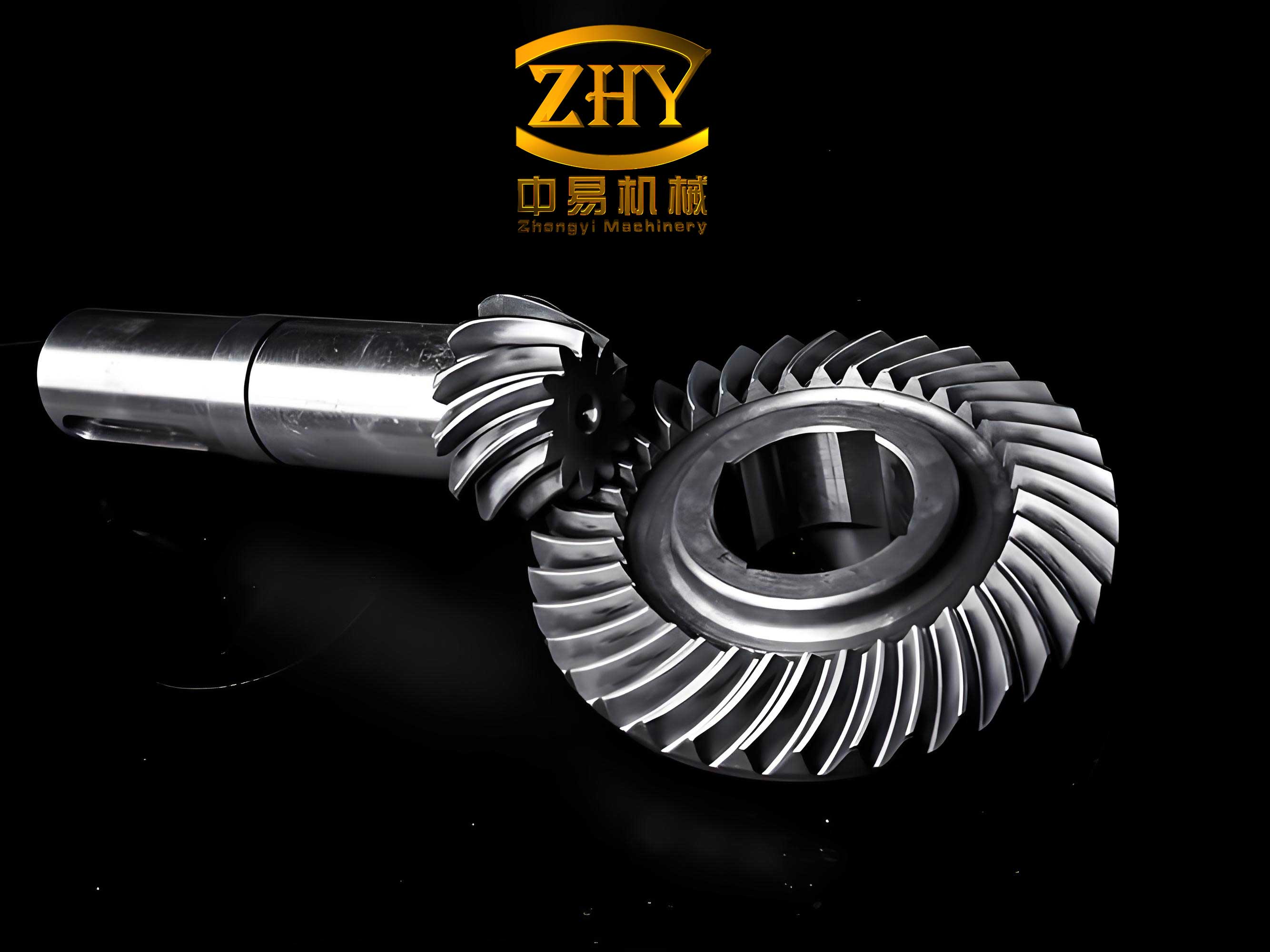
The mathematical model for the equal helical angle spherical involute spiral bevel gear is constructed by considering it as a spherical involute straight bevel gear whose tooth profiles on arbitrary spherical sections are rotated about the axis, following an equiangular spiral on the pitch cone. First, the spherical involute equation is derived. A spherical involute can be generated by a great circle arc (generatrix) rolling without slipping on a base circle on a sphere. Let a coordinate system \( S_{o’} \) be fixed to the rolling plane and \( S_o \) be fixed to the base cone. In \( S_{o’} \), the spherical involute is expressed as:
$$ \mathbf{r’}_i(\phi) = \begin{bmatrix} R \sin \phi \\ 0 \\ R \cos \phi \end{bmatrix} $$
where \( R \) is the spherical radius, \( \phi = -R \sin(\theta_b) \omega / R \), \( \theta_b \) is the base cone half-angle, and \( \omega \) is the rolling angle. Transforming to \( S_o \) via a coordinate transformation matrix \( \mathbf{M}_{O O’} \):
$$ \mathbf{r}_i(\omega) = \mathbf{M}_{O O’} \mathbf{r’}_i(\omega) $$
Next, the rotation angle \( \psi_i \) for any spherical section along the equiangular spiral on the pitch cone is given by the logarithmic spiral formula on a cone:
$$ \psi_i = \frac{\tan \beta_p \left( \ln \frac{R_i}{R_0} \right)}{\sin \theta_p} $$
where \( \beta_p \) is the spiral angle on the pitch cone, \( \theta_p \) is the pitch cone angle, and \( R_i \) is the spherical radius at an arbitrary section. Consequently, the tooth profile equation on any spherical section in \( S_o \) is obtained by rotating the spherical involute by \( \psi_i \) around the axis:
$$ \mathbf{r}_i(\psi_i, \phi) = \mathbf{M}(\psi_i) \mathbf{r}_{op’}(\omega) $$
where \( \mathbf{M}(\psi_i) \) is the rotation matrix. This formulation ensures that the spiral bevel gear has a constant helical angle along the tooth, which is crucial for the roll forming process. The derivation highlights the geometric elegance of the spherical involute spiral bevel gear, providing a foundation for precise manufacturing.
To implement roll forming, the design of the gear blank is paramount. The blank for a spiral bevel gear pinion is essentially a spherical cone, with its large and small end spherical radii matching those of the finished gear. The key parameter is the blank’s half-cone angle \( \theta_{\text{blank}} \), determined by equating the volume of the blank to the volume of the final spiral bevel gear. Given the complexity of calculating the gear volume analytically due to intricate tooth geometry and fillets, we employ CAD software (e.g., SolidWorks) to generate a 3D model and compute the gear volume \( V_{\text{gear}} \). The blank volume \( V_{\text{blank}} \) is derived from the volume formula for a hollow spherical cone:
$$ V_{\text{spherical cone}} = \frac{2\pi}{3} R^3 (1 – \cos \theta) $$
Thus, for a hollow blank with inner radius \( R_1 \) (small end) and outer radius \( R_2 \) (large end):
$$ V_{\text{blank}} = \frac{2\pi}{3} (R_2^3 – R_1^3) (1 – \cos \theta_{\text{blank}}) = V_{\text{hollow sphere}} \frac{1 – \cos \theta_{\text{blank}}}{2} $$
where \( V_{\text{hollow sphere}} = \frac{4\pi}{3} (R_2^3 – R_1^3) \). Setting \( V_{\text{gear}} = V_{\text{blank}} \):
$$ V_{\text{gear}} = V_{\text{hollow sphere}} \frac{1 – \cos \theta_{\text{blank}}}{2} $$
Solving for \( \theta_{\text{blank}} \):
$$ \cos \theta_{\text{blank}} = 1 – \frac{2 V_{\text{gear}}}{V_{\text{hollow sphere}}} $$
This equation allows for accurate blank dimensioning. A summary of key parameters and their relationships is provided in Table 1.
| Parameter | Symbol | Description | Formula or Source |
|---|---|---|---|
| Gear Volume | \( V_{\text{gear}} \) | Volume of finished spiral bevel gear | CAD software computation |
| Blank Half-Cone Angle | \( \theta_{\text{blank}} \) | Half-cone angle of the blank | \( \cos \theta_{\text{blank}} = 1 – \frac{2 V_{\text{gear}}}{V_{\text{hollow sphere}}} \) |
| Hollow Sphere Volume | \( V_{\text{hollow sphere}} \) | Volume between outer and inner spheres | \( \frac{4\pi}{3} (R_2^3 – R_1^3) \) |
| Large End Spherical Radius | \( R_2 \) | Spherical radius at gear large end | Design specification |
| Small End Spherical Radius | \( R_1 \) | Spherical radius at gear small end | Design specification |
The design of roll forming tool wheels is critical for successful spiral bevel gear production. The tool wheels, which act as the generating gears, must have the same helical angle as the pinion and can be conceptualized as the crown gear (or generating gear) in a spiral bevel gear pair. This design enables a single set of tool wheels to form pinions of different modules but identical helical angles, as illustrated in Figure 7 of the original context. To ensure pure rolling at the initial rolling stage, the sine of the blank’s pre-roll cone angle and the sine of the tool wheel’s outer cone angle must maintain a ratio equal to the gear ratio. The tool wheels are manufactured using CNC machining centers to achieve high precision. The design principles are encapsulated in the following relationships for tool wheel geometry, where parameters are selected based on the desired spiral bevel gear specifications.
A comprehensive set of formulas governing tool wheel design is presented below. These equations ensure proper meshing and forming during the roll forming process for spiral bevel gears.
Let \( z_t \) be the number of teeth on the tool wheel, \( z_p \) the number of teeth on the pinion, \( \beta \) the helical angle, \( m_n \) the normal module, and \( \theta_t \) the tool wheel cone angle. The condition for pure rolling is:
$$ \frac{\sin \theta_{\text{blank}}}{\sin \theta_t} = \frac{z_p}{z_t} $$
The tool wheel’s pitch diameter \( d_t \) is related to the normal module and tooth count:
$$ d_t = \frac{z_t m_n}{\cos \beta} $$
Additionally, the tool wheel’s outer diameter \( d_{to} \) is calculated considering clearance and forming depth. Table 2 summarizes the design parameters for roll forming tool wheels tailored for spiral bevel gear production.
| Parameter | Symbol | Equation or Criterion | Notes |
|---|---|---|---|
| Tool Wheel Tooth Count | \( z_t \) | \( z_t \gg z_p \) (typically 3-5 times) | Ensures smooth forming and reduced force |
| Helical Angle | \( \beta \) | \( \beta = \beta_p \) (equal to pinion spiral angle) | Maintained constant across tooth length |
| Normal Module Range | \( m_n \) | Variable, but tool wheel designed for a range | Enables forming of different module gears |
| Tool Wheel Cone Angle | \( \theta_t \) | \( \theta_t = \arcsin\left( \frac{z_t}{z_p} \sin \theta_{\text{blank}} \right) \) | Derived from pure rolling condition |
| Pitch Diameter | \( d_t \) | \( d_t = \frac{z_t m_n}{\cos \beta} \) | Function of module and tooth count |
| Outer Diameter | \( d_{to} \) | \( d_{to} = d_t + 2 \times \text{addendum} \) | Includes addendum for full tooth depth |
Experimental roll forming was conducted to validate the process for spiral bevel gears. A pinion with parameters: tooth number \( z_1 = 11 \), normal module \( m_n = 1 \, \text{mm} \), normal shift coefficient \( x_{n1} = 0.3 \), was targeted. The blank material was 20# steel (low carbon steel). A self-developed roll forming equipment was employed, capable of synchronizing two tool wheels and applying the requisite swing feed motion. The rolling cycle time was approximately 6–7 seconds per piece, demonstrating high efficiency. The formed spiral bevel gear pinion exhibited a surface roughness of about 3.2 μm, indicating net-shape finishing capability. Observations revealed minor depressions at the tooth tips due to plastic flow during rolling, a phenomenon also seen in worm rolling processes, which does not compromise functional performance. Contact pattern tests were performed using a rolling check apparatus, where multiple rolled pinions were meshed with a single master gear (the mating spiral bevel gear). The contact patterns were consistent and regular across pinions, confirming excellent reproducibility and tooth surface uniformity of the roll forming process. The master gear used in testing was machined via CNC, but for mass production, powder metallurgy could be adopted for cost-effective manufacturing of conjugate spiral bevel gears.
The success of the roll forming experiment underscores the viability of cold roll forming as a manufacturing method for small-module spiral bevel gears. However, deeper investigations into the rolling theory, plastic deformation mechanics, and process optimization are warranted to enhance precision and expand applicability. For instance, the stress-strain behavior during rolling of spiral bevel gears can be modeled using finite element analysis (FEA) to predict forming loads and material flow. The yield criterion for the blank material under complex multi-axial stress states during roll forming of spiral bevel gears can be expressed using the von Mises yield condition:
$$ \sigma_{\text{vm}} = \sqrt{\frac{1}{2}\left[ (\sigma_1 – \sigma_2)^2 + (\sigma_2 – \sigma_3)^2 + (\sigma_3 – \sigma_1)^2 \right]} \geq \sigma_y $$
where \( \sigma_1, \sigma_2, \sigma_3 \) are principal stresses and \( \sigma_y \) is the yield strength. The plastic strain increments follow the flow rule associated with the yield function. Understanding these aspects can lead to better blank design and tooling for spiral bevel gear roll forming.
Furthermore, the geometry of the spherical involute spiral bevel gear can be optimized for roll forming. The tooth thickness distribution along the face width affects formability. A parametric study can be conducted by varying design parameters such as spiral angle, pressure angle, and tooth profile modifications. The following equations define key geometric relationships for an equal helical angle spherical involute spiral bevel gear, which can be used in optimization algorithms.
The normal pressure angle \( \alpha_n \) is related to the transverse pressure angle \( \alpha_t \) via the helical angle \( \beta \):
$$ \tan \alpha_t = \frac{\tan \alpha_n}{\cos \beta} $$
The pitch cone distance \( R_p \) is:
$$ R_p = \frac{m_n z}{2 \sin \theta_p} $$
where \( z \) is the tooth number. The tooth trace on the pitch cone is an equiangular spiral, satisfying:
$$ r(\psi) = R_0 e^{\psi \sin \theta_p \cot \beta_p} $$
where \( r \) is the radial distance from the apex, and \( \psi \) is the rotation angle. These equations collectively describe the unique geometry of the spiral bevel gear suitable for roll forming.
To illustrate the computational steps in blank design, consider a numerical example for a spiral bevel gear pinion. Suppose the gear has \( z_1 = 11 \), \( m_n = 1 \, \text{mm} \), \( \beta = 35^\circ \), face width \( F = 10 \, \text{mm} \), pitch cone angle \( \theta_p = 20^\circ \). Using CAD, the gear volume \( V_{\text{gear}} \) is computed as 850 mm³. The spherical radii: \( R_1 = 30 \, \text{mm} \), \( R_2 = 40 \, \text{mm} \). Then, \( V_{\text{hollow sphere}} = \frac{4\pi}{3} (40^3 – 30^3) \approx 148,453 \, \text{mm}^3 \). Applying the formula:
$$ \cos \theta_{\text{blank}} = 1 – \frac{2 \times 850}{148,453} \approx 0.98855 $$
Thus, \( \theta_{\text{blank}} \approx \arccos(0.98855) \approx 8.5^\circ \). This blank half-cone angle ensures volume consistency for the spiral bevel gear.
The roll forming process for spiral bevel gears also presents opportunities for material savings and energy efficiency compared to cutting. Since it is a cold forming process, it can enhance surface hardness and fatigue strength due to work hardening. The mechanical properties of the rolled spiral bevel gear can be assessed through hardness testing and microstructure analysis. A comparison of different manufacturing methods for spiral bevel gears is provided in Table 3, highlighting the advantages of roll forming.
| Method | Process Type | Precision | Interchangeability | Tooling Cost | Efficiency | Suitability for Small Pinions |
|---|---|---|---|---|---|---|
| Gleason Cutting | Subtractive (Cutting) | High | Low (paired) | High | Low | Yes |
| Oerlikon Cutting | Subtractive (Cutting) | High | Low (paired) | High | Low | Yes |
| Forging | Forming (Hot) | Low | High | Medium | High | No (mainly large gears) |
| Orbital Rolling | Forming (Cold/Hot) | Medium | High | High | Medium | No (equipment intensive) |
| Roll Forming (Proposed) | Forming (Cold) | High (Net-shape) | High | Medium (CNC tool wheels) | High (6-7 s/piece) | Yes (ideal for pinions) |
In conclusion, the cold roll forming process for spiral bevel gears, based on the equal helical angle spherical involute tooth profile, offers a promising alternative to traditional methods. The mathematical model provides a solid foundation for design, while volume-based blank calculation and tailored tool wheel design enable practical implementation. Experimental results confirm process feasibility, producing spiral bevel gear pinions with good surface finish and consistent tooth geometry. Future work should focus on refining the roll forming theory for spiral bevel gears, optimizing process parameters, exploring material behavior, and extending the method to larger gears and different tooth profiles. As the demand for efficient power transmission components grows, innovations like roll forming can significantly enhance the manufacturing landscape for spiral bevel gears, contributing to advancements in automotive, aerospace, and industrial applications.
The potential of this roll forming technique extends beyond standard spiral bevel gears. With modifications, it could be adapted for hypoid gears or gears with modified tooth surfaces for reduced noise and vibration. The integration of real-time monitoring and adaptive control during roll forming could further improve quality. Additionally, the use of advanced materials, such as high-strength alloys or composites, in roll forming of spiral bevel gears warrants investigation. The fundamental principles outlined here—spherical involute geometry, constant helical angle, and plastic deformation mechanics—provide a framework for ongoing research and development in gear manufacturing technology.
To encapsulate the core equations governing the design and analysis of spiral bevel gears for roll forming, a consolidated list is presented below. These formulas are essential for engineers and researchers working on advanced gear fabrication methods.
Spherical Involute Coordinates:
In generating coordinate system \( S_{o’} \):
$$ \mathbf{r’}_i(\phi) = \left[ R \sin \phi,\ 0,\ R \cos \phi \right]^T $$
After transformation to base cone system \( S_o \):
$$ \mathbf{r}_i(\omega) = \mathbf{M}_{O O’} \mathbf{r’}_i(\omega) $$
where \( \mathbf{M}_{O O’} \) includes rotations by base cone angle \( \theta_b \).
Equiangular Spiral on Pitch Cone:
Rotation angle at spherical radius \( R_i \):
$$ \psi_i = \frac{\tan \beta_p \ln(R_i / R_0)}{\sin \theta_p} $$
Tooth Profile on Arbitrary Spherical Section:
Combined rotation:
$$ \mathbf{r}_i(\psi_i, \phi) = \mathbf{R}_z(\psi_i) \mathbf{r}_i(\phi) $$
where \( \mathbf{R}_z(\psi_i) \) is a rotation matrix about the z-axis.
Blank Half-Cone Angle:
Volume equivalence:
$$ \cos \theta_{\text{blank}} = 1 – \frac{2 V_{\text{gear}}}{V_{\text{hollow sphere}}} $$
Tool Wheel Pure Rolling Condition:
Cone angle relation:
$$ \frac{\sin \theta_{\text{blank}}}{\sin \theta_t} = \frac{z_p}{z_t} $$
Pitch Diameter of Tool Wheel:
$$ d_t = \frac{z_t m_n}{\cos \beta} $$
These equations, along with the tables and discussions, provide a comprehensive guide to the design and roll forming of equal helical angle spherical involute spiral bevel gears. The iterative nature of process optimization may involve numerical simulations and experimental trials, but the foundational concepts remain rooted in the geometry and mechanics outlined herein. As the technology matures, roll forming could become a standard method for high-volume production of precision spiral bevel gears, driving innovation in various mechanical systems.