
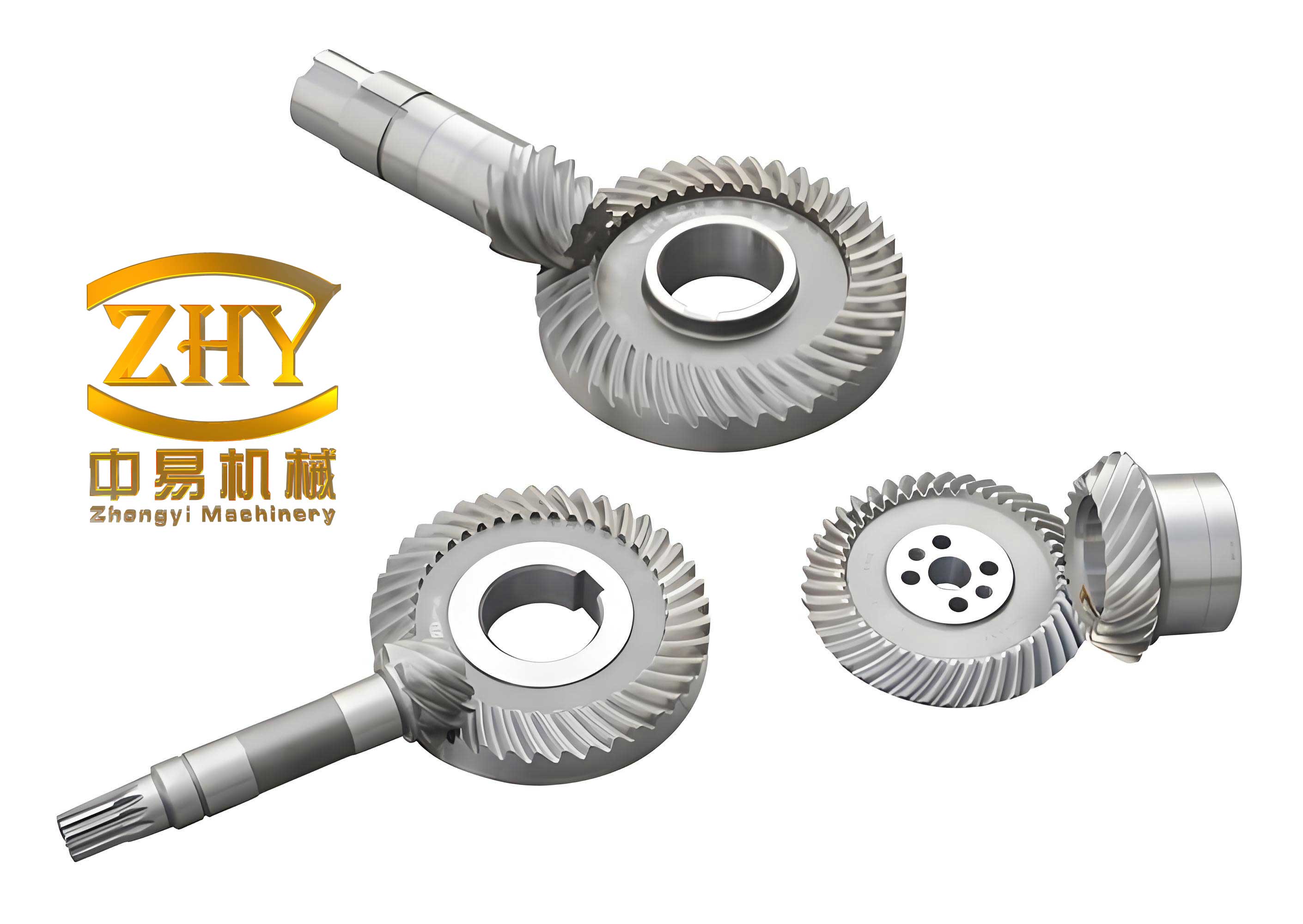
As a key component for power transmission and directional change in spatial drive systems, hypoid gears are indispensable in demanding applications such as aviation, specialized vehicles, and precision robotics. The unique feature of a pinion axial offset, coupled with non-equal spiral angles between the driving and driven members, grants them exceptional advantages in compact design, flexible spatial arrangement, and robust tolerance capabilities. Consequently, the meshing quality of hypoid gear drives fundamentally dictates the overall performance, reliability, and longevity of the host machinery. Despite significant advancements in the theoretical frameworks, generation mechanisms, surface optimization, and manufacturing technologies for this complex spatial gearing, the escalating performance requirements of modern high-end equipment present formidable challenges, necessitating a paradigm shift towards a more proactive and performance-driven design philosophy.
1. Fundamental Geometric Design of Hypoid Gears
The geometric foundation of a hypoid gear pair is established by its pitch cones. The design process involves solving for a pair of cones that satisfy the predefined spatial relationships: shaft angle, offset distance, and the point of tangency. The classical approach is governed by three fundamental geometric relationships derived from vector analysis of the instantaneous contact motion.
The first relationship, concerning the spiral angles, is derived from the scalar product of the pitch cone generatrix vectors:
$$ \vec{\tau_1} \cdot \vec{\tau_2} = |\vec{\tau_1}| |\vec{\tau_2}| \cos \beta_{12} $$
This can be transformed to relate the pitch angles and the mean spiral angle to the shaft angle:
$$ \cos \beta_{12} = \frac{\cos \Sigma – \tan \gamma_{1m} \tan \gamma_{2m}}{\cos \gamma_{1m} \cos \gamma_{2m}} $$
where $\gamma_{1m}$ and $\gamma_{2m}$ are the pinion and gear mean pitch cone angles, $\Sigma$ is the shaft angle, and $\beta_{12}$ is the angle between the generatrices.
The second relationship defines the speed ratio. From the condition of pure rolling at the pitch point, the velocity relationship yields the gear ratio formula:
$$ i_{12} = \frac{\omega_2}{\omega_1} = \frac{r_{1m} \cos \beta_{1m}}{r_{2m} \cos \beta_{2m}} $$
where $r_{1m}$, $r_{2m}$ are the mean cone distances, and $\beta_{1m}$, $\beta_{2m}$ are the mean spiral angles of the pinion and gear, respectively.
The third relationship incorporates the offset. The perpendicular distance between the gear axes, the offset $E$, is given by:
$$ E = \frac{(r_{1m} + r_{2m}) \sin \beta_{12}}{\sin \Sigma} $$
Modern computerized design processes iterate on these fundamental equations, along with parameters like tooth number and module, to converge on a viable set of pitch cone parameters. The design must also navigate critical constraints to avoid tooth surface defects.
Tooth Surface Defect Avoidance: A primary concern in hypoid gear design is the avoidance of undercutting and pointing. Undercutting, a severe form of tooth root interference, is fundamentally linked to the presence of singular points on the generated surface. These singular points, where the meshing equation loses its regular solution, mark the boundary of the envelope. If these points appear within the active tooth flank, they cause severe surface distortion and local root undercut. The longitudinal position of the singular line is highly sensitive to design parameters, particularly the profile shift coefficients. A high positive profile shift tends to pull the singular line towards the root, reducing undercut risk but potentially leading to a pointed tooth tip. Conversely, a negative shift raises the singular line, increasing undercut risk but providing a stronger tip. Therefore, a core aspect of active geometric design is the parametric study and iterative refinement to ensure the singular line lies safely outside the functional tooth area.
The blank design, defining the outer and inner boundaries of the tooth, is another critical step. Hypoid gears can have different tooth taper types, as summarized in the table below.
| Taper Type | Description | Typical Application |
|---|---|---|
| Standard Taper | Addendum and dedendum are proportional to cone distance. Root and face cone axes converge at the pitch apex. | Common for face-milled hypoid gears. |
| Dual Taper | Separate tapers for addendum and dedendum lines, allowing independent control of tooth depth. | Used to balance strength and clearance. |
| Root Angle Taper | Root line is tilted relative to the pitch line to increase root thickness. | Applied for higher bending strength. |
| Uniform Depth | Tooth depth is constant along the face width (face hobbing). | Standard for face-hobbed hypoid gears. |
2. Tooth Surface Generation and Machine-Tool Settings
The generation of hypoid gear tooth surfaces is a complex kinematic process involving the relative motion between a cutting tool and the gear blank. The methodology has evolved from local conjugate principles to modern global synthesis methods empowered by CNC technology.
Generation Methods: Two primary machining methods dominate: Face Milling and Face Hobbing. Face Milling uses an intermittent indexing process where the cutter head, representing a crown gear tooth, reciprocates across the tooth space. The generation roll motion is provided by the rotation of the cradle (or its CNC equivalent) relative to the workpiece. This method produces circular arc tooth traces and is essential for gears that require subsequent grinding for ultra-high precision. Face Hobbing, in contrast, is a continuous indexing process. The cutter head rotates continuously while the workpiece rolls in a timed relationship with it. This method generates an extended epicycloid tooth trace and is known for its high production efficiency and theoretically higher contact ratio. The basic kinematic equations for face hobbing are:
$$ \frac{\omega_{c1} – \omega_p}{z_p} = \frac{\omega_t}{z_0} $$
$$ \frac{\omega_{c2} – \omega_p}{z_p} = \frac{\omega_t}{z} $$
where $\omega_{c1}, \omega_{c2}$ are angular speeds of the two imaginary crown gears (roll mechanisms), $\omega_p$ is the cutter head speed, $\omega_t$ is the workpiece speed, $z_p$ is the number of cutter groups, $z_0$ is the number of teeth on the theoretical generating gear, and $z$ is the number of gear teeth.
Machine-Tool Setting Calculation: The “Local Synthesis” method, pioneered by Litvin, represents a significant leap in active tooth flank design. Instead of passive generation, it starts by prescribing desired meshing characteristics at a chosen reference point (usually the mean point): the contact ellipse size (semi-major axis $a$), its orientation angle relative to the principal direction, and the peak-to-peak transmission error amplitude. Based on differential geometry and gear meshing theory, the principal curvatures and directions of the pinion flank at the reference point are calculated to satisfy these conditions. These calculated pinion flank parameters then uniquely determine the required machine-tool settings for pinion generation, establishing a direct link between performance goals and manufacturing parameters.
With the advent of CNC hypoid generators, higher-order machine setting corrections became possible, vastly increasing the degrees of freedom for flank topography modification. Parameters like the ratio of roll (governing tooth profile) and helical motion (governing tooth trace) are no longer constants but can be defined by polynomials (e.g., Modified Roll). A 6-axis CNC machine can implement complex kinematic corrections, allowing for the generation of a pre-designed “Ease-Off” topography—a predefined deviation from a theoretical conjugate surface—to optimize loaded contact patterns and transmission error under misalignment.
| Machining Strategy | Process Description | Key Characteristics |
|---|---|---|
| Five-Cut Method (Fixed Setting) | Separate finishing cuts for pinion convex and concave sides. Gear is cut by a Formate or generating process. | Simple setup, high flexibility for pinion flank correction, but lower efficiency. |
| Full Completing (Continuous Indexing) | Both sides of a tooth space are finished simultaneously in a continuous rolling motion. | High efficiency, excellent tooth-to-tooth consistency, but less independent control over each flank. |
| Spread Blade / Helixform | Uses a cutter head with separate inside and outside blade groups for roughing and finishing. | Common for face-milled gears, allows for good control over tooth bearing. |
| Face Hobbing (Complete Generation) | Continuous generation of both gear and pinion with timed relationship between cutter and workpiece. | Highest production rate, suitable for high-volume applications like automotive axles. |
3. Tooth Contact Analysis and Load Distribution
Analyzing the unloaded and loaded contact behavior of hypoid gears is crucial for predicting their performance. Tooth Contact Analysis (TCA) and Loaded Tooth Contact Analysis (LTCA) are the primary simulation tools.
Unloaded TCA: Classical TCA solves for the contact path and instantaneous contact ellipse under no-load conditions, considering possible misalignments. The fundamental equations ensure position and normal vector continuity at the contact point in a fixed coordinate system:
$$ \vec{R}_f^{(1)}(\phi_1, \theta_1) = \vec{R}_f^{(2)}(\phi_2, \theta_2) $$
$$ \vec{n}_f^{(1)}(\phi_1, \theta_1) = \pm \vec{n}_f^{(2)}(\phi_2, \theta_2) $$
Here, $\vec{R}_f^{(1)}, \vec{R}_f^{(2)}$ are the position vectors of points on pinion (1) and gear (2) flanks, expressed in the fixed frame $S_f$; $\vec{n}_f^{(1)}, \vec{n}_f^{(2)}$ are their unit normals; and $\phi_i, \theta_i$ are the surface and motion parameters. This system of five independent scalar equations is solved for five unknowns, defining the contact point trajectory and the transmission error $\Delta \phi_2(\phi_1)$. A more robust numerical approach for complex topographies involves discretizing the tooth flanks into point clouds and searching for points where the separation distance is below a threshold (e.g., typical marking compound thickness), which naturally handles edge contact scenarios.
Loaded LTCA: While TCA predicts the contact pattern location and shape, LTCA is necessary to determine the contact stress distribution, load sharing among contacting teeth, and the loaded transmission error. Methods range from computationally intensive Finite Element Analysis (FEA) to efficient semi-analytical methods.
Semi-analytical LTCA typically combines a tooth compliance model with the contact mechanics. The tooth compliance can be derived from simplified cantilever beam models, Finite Element substructuring, or more accurate thin-shell models. The deformed tooth surfaces under load must satisfy compatibility conditions. A common formulation involves discretizing the potential contact zone into a grid of cells. The total deformation $\delta_{ij}$ at cell $ij$ is the sum of the initial geometric separation $d_{ij}$ (from unloaded TCA), the contact deformation $\omega_{ij}$ (governed by Hertzian or elastic half-space theory), and the bending/winding deflection $s_{ij}$ due to the distributed load $P_{kl}$ over all cells:
$$ \delta_{ij} = d_{ij} + \omega_{ij}(P_{ij}) + \sum_{k,l} C_{ij, kl} \cdot P_{kl} $$
The influence coefficient $C_{ij, kl}$ represents the deflection at cell $ij$ due to a unit load at cell $kl$. The solution must satisfy the conditions that within the contact area, the total deformation is zero ($\delta_{ij}=0$), and the contact pressure is positive ($P_{ij} \ge 0$); outside the contact area, separation exists ($\delta_{ij} > 0$) and pressure is zero. Iterative algorithms are used to solve this system. The output includes the real contact area (often larger than the Hertzian ellipse), pressure distribution, root bending stresses, and the non-linear loaded transmission error curve, which is critical for dynamic excitation analysis.
4. Meshing Behavior Control and Optimization
Active design of hypoid gears aims not just to generate a conjugate pair but to sculpt the tooth flanks to achieve desired performance attributes: low noise, high strength, good efficiency, and low sensitivity to misalignments. This is achieved through strategic flank modification.
Ease-Off Topography Optimization: The concept of “Ease-Off” is central to modern hypoid gear design. It represents the normal deviation between the real pinion flank and its fully conjugate counterpart relative to the gear. By strategically designing this Ease-Off map, engineers can pre-control the contact path, transmission error function, and contact stress distribution. For instance, a parabolic Ease-Off distribution along the profile direction typically leads to a parabolic function for transmission error, which is known to reduce mesh stiffness variation and lower vibration excitation. The optimization workflow often involves:
- Defining multi-objective functions (e.g., minimize peak contact pressure, minimize transmission error amplitude, maximize misalignment insensitivity).
- Parameterizing the pinion flank topography via higher-order machine settings (polynomial coefficients for modified motions).
- Using TCA/LTCA simulations within an optimization loop (e.g., using genetic algorithms, gradient-based methods) to find the setting parameters that best fulfill the objectives.
- Validating the optimized design through advanced simulation and prototype testing.
Higher-Order Error Compensation: In manufacturing, despite careful design, errors from tooling, fixturing, machine inaccuracies, and heat treatment distortion cause deviations between the actual and theoretical flanks. Modern CNC-based compensation uses a closed-loop approach:
1. Measure the finished gear pair (or just the gear) on a coordinate measuring machine (CMM) to obtain the actual flank topography.
2. Calculate the deviation (Ease-Off error) between the measured topography and the designed target topography.
3. Compute a new set of higher-order machine settings for the finishing cut (or grind) of the mating member (typically the pinion) that will generate a corrective Ease-Off to compensate for the measured composite error.
4. Re-machine the part with the corrected settings.
This data-driven compensation cycle, often requiring only one or two iterations, can dramatically improve the contact pattern and transmission error of the manufactured pair, pushing the quality towards the theoretical design intent.
Transmission Error Shaping: Transmission Error (TE) is the primary source of gear whine. Active design seeks to shape the TE curve to be smooth and of low amplitude. Beyond the simple parabolic TE, modern designs aim for multi-segment or higher-order polynomial TE functions. For example, a “pre-flank” modification can be applied to create a gentle entry into the main contact zone, reducing impact. The design challenge is to achieve this optimal TE shape while simultaneously maintaining a favorable, stable contact pattern under load and across the range of expected misalignments. This multi-objective optimization is at the forefront of active hypoid gear design research.
5. Conclusion and Future Trends
The journey of hypoid gear design has evolved from empirical trial-and-error to a sophisticated science integrating geometry, mechanics, manufacturing, and computer simulation. The transition from passive generation to active, performance-driven design, facilitated by CNC technology and advanced optimization algorithms, has been pivotal. Key methodologies like Local Synthesis, Ease-Off optimization, and higher-order error compensation now form the backbone of designing high-performance hypoid gear drives for the most demanding applications.
Looking ahead, several trends will shape the future of hypoid gear active design methodology:
- Artificial Intelligence and Data-Driven Design: Machine learning algorithms will be increasingly used to build surrogate models, drastically reducing the computational cost of multi-parameter optimization. AI can also help in automatically selecting initial design parameters, predicting manufacturability issues, and identifying optimal compensation strategies from historical manufacturing data.
- Digital Twin and Virtual Prototyping: Creating a high-fidelity digital twin of the entire gear system—including detailed tooth geometry, shaft-bearing stiffness, housing flexibility, and lubrication conditions—will enable virtual testing under real-world operating cycles. This allows for performance and durability validation long before physical prototyping.
- Advanced Manufacturing Integration: The boundary between design and manufacturing will continue to blur. Design for Additive Manufacturing (DfAM) may enable novel cooling channels or topology-optimized lightweight gear bodies. In-situ metrology and adaptive machining will make real-time compensation a reality, ensuring consistent high quality.
- Expansion to Extreme Geometries: Active design methods will be further developed and validated for non-standard hypoid gears, such as those with very high reduction ratios (>100:1), minimal shaft angles, or large offsets, pushing the boundaries of traditional application spaces into robotics and specialized machinery.
- Holistic System Optimization: Future design will not stop at the gear mesh. It will encompass the optimization of the entire driveline system—considering interactions with bearings, seals, housing, and lubricant—to achieve system-level goals for efficiency, noise, vibration, and harshness (NVH), and thermal management.
In conclusion, the active design of hypoid gears has matured into a powerful discipline that directly translates performance requirements into manufacturable geometry. By continuing to embrace computational advances, artificial intelligence, and integrated digital processes, the development of next-generation hypoid gear drives will meet the ever-growing challenges of power density, efficiency, and reliability in advanced mechanical systems.