
In this article, I will delve into the intricacies of a novel worm gear drive mechanism that has garnered significant attention in mechanical engineering circles. Specifically, I focus on the backlash-free double roller enveloping worm gear drive, a system designed to eliminate play and enhance precision in power transmission applications. The worm gear drive is a critical component in many industrial machines, and its performance directly impacts efficiency, accuracy, and longevity. This particular worm gear drive innovation utilizes a unique dual-roller arrangement to achieve zero backlash, making it ideal for high-precision fields such as robotics, aerospace, and CNC machinery. Throughout this discussion, I will emphasize the keyword “worm gear drive” to underscore its centrality in this technology. The content is structured to cover working principles, research trends, challenges, and future directions, all while incorporating tables and mathematical formulations to summarize key points comprehensively.
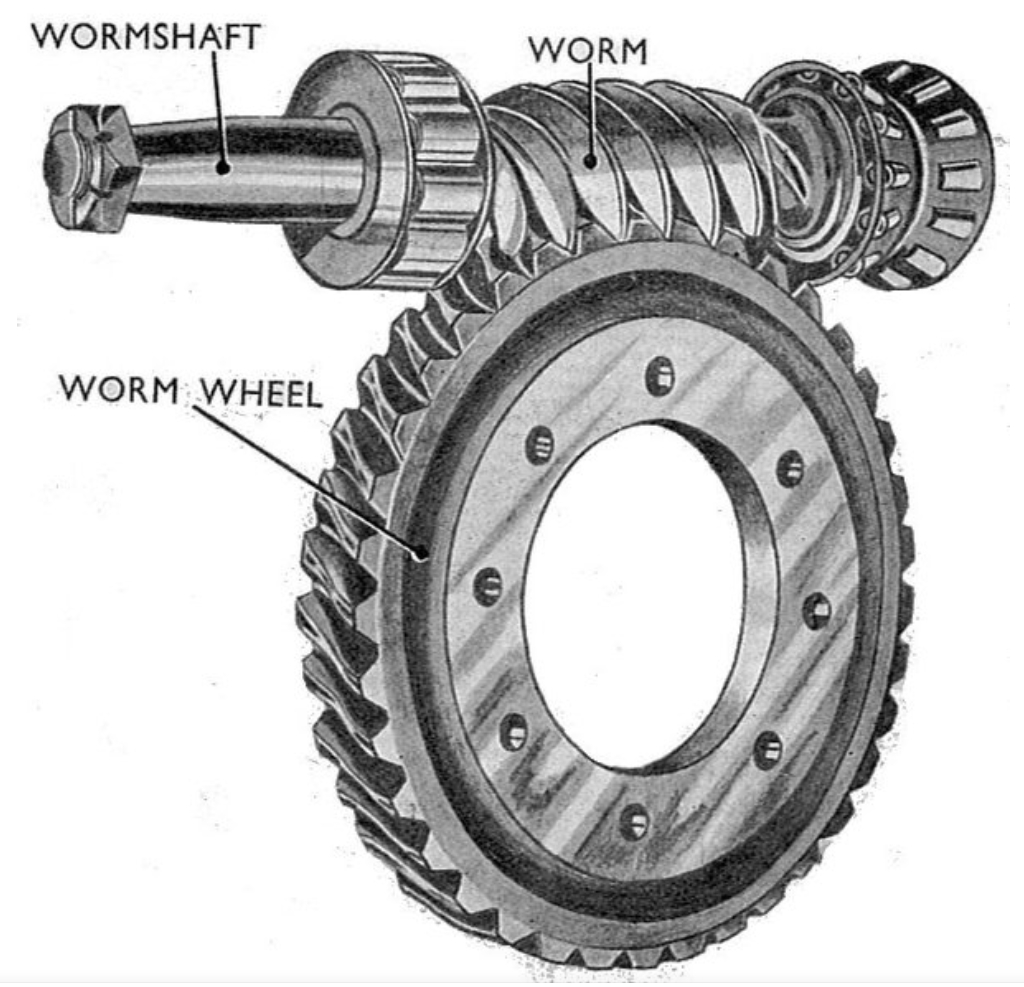
The core principle of this backlash-free worm gear drive revolves around a clever design that integrates two halves of a worm wheel, each equipped with rollers offset from the central plane. By adjusting the relative angular displacement between these halves through an automatic gap-elimination mechanism, the rollers engage with the worm thread surfaces to achieve seamless contact. This configuration ensures that, while individual roller rows may have minimal clearance for smooth operation, the overall system cancels out any backlash, thereby reducing hysteresis and improving transmission accuracy. The worm gear drive thus operates with enhanced lubrication due to the roller arrangement, which minimizes friction and wear. To quantify this, consider the geometry of the worm gear drive: let the offset distance for the rollers be denoted as \( c_2 \), and the worm’s throat diameter coefficient as \( k \). The engagement condition can be expressed through a set of parametric equations derived from spatial gearing theory. For instance, the contact line between the worm and roller can be modeled using vector analysis. If \( \mathbf{r}_w \) represents the worm surface and \( \mathbf{r}_r \) the roller surface, their intersection defines the contact path. A simplified form of the meshing equation is: $$ \Phi(\theta, \phi) = \mathbf{n} \cdot \mathbf{v} = 0 $$ where \( \mathbf{n} \) is the normal vector at the contact point, and \( \mathbf{v} \) is the relative velocity vector between the worm and roller. This equation governs the kinematic behavior of the worm gear drive, ensuring continuous motion transfer without slippage.
To better illustrate the design parameters of this worm gear drive, I have compiled a table summarizing key variables and their typical ranges based on optimization studies. This worm gear drive relies on precise dimensional control to function effectively.
| Parameter | Symbol | Typical Range | Influence on Performance |
|---|---|---|---|
| Roller Offset Distance | \( c_2 \) | 0.5–2.0 mm | Affects backlash elimination and contact stress |
| Roller Radius | \( r_r \) | 3–10 mm | Impacts load capacity and lubrication |
| Worm Throat Diameter Coefficient | \( k \) | 0.3–0.6 | Determines worm size and strength |
| Pressure Angle | \( \alpha \) | 20°–25° | Affects torque transmission and efficiency |
| Number of Rollers | \( N \) | 10–30 | Influences smoothness and load distribution |
Research into this worm gear drive has progressed rapidly, with significant strides in three-dimensional modeling, theoretical analysis, and simulation. In terms of 3D modeling, various software platforms have been employed to create accurate digital representations of the worm gear drive components. Early approaches combined MATLAB with PRO/E to generate high-fidelity worm models, but these lacked parametric flexibility. Later, parameterized modeling based on UG and Pro/Toolkit enabled rapid generation of worm geometries by simply inputting dimensional values. For example, the worm thread surface can be defined mathematically as an envelope of the roller family. Using homogeneous transformation matrices, the worm surface equation for a right-hand thread is: $$ \mathbf{S}_w(u, v) = \mathbf{T}(\theta) \cdot \mathbf{S}_r(u, v) $$ where \( \mathbf{S}_r \) is the roller surface parameterized by \( u \) and \( v \), and \( \mathbf{T} \) is a transformation matrix accounting for the worm’s rotation angle \( \theta \). This parametric approach allows for quick adjustments to design variables, facilitating iterative optimization of the worm gear drive. Additionally, advanced programming interfaces like Visual C++ coupled with SolidWorks API have led to the development of interactive design systems, where users can select parameters from a database to instantly visualize the worm gear drive assembly. Such tools are invaluable for accelerating the design phase of this worm gear drive technology.
Theoretical investigations into this worm gear drive have been extensive, focusing on meshing performance, load distribution, and error analysis. Applying spatial gear meshing principles, researchers have derived fundamental equations that describe the interaction between the worm and rollers. The meshing function for this worm gear drive can be expressed as: $$ f(\psi, \varphi) = \frac{\partial \mathbf{R}}{\partial \psi} \times \frac{\partial \mathbf{R}}{\partial \varphi} \cdot \mathbf{V}_{12} = 0 $$ where \( \mathbf{R} \) is the position vector of the contact point, \( \psi \) and \( \varphi \) are motion parameters, and \( \mathbf{V}_{12} \) is the relative velocity. From this, the contact line equations are obtained, which trace the path of engagement on the worm surface. For the double roller enveloping worm gear drive, the contact lines are typically curved and distributed asymmetrically due to the offset. Moreover, key performance metrics such as the induced normal curvature \( \kappa_n \) and the lubrication angle \( \beta \) have been formulated. The induced curvature affects contact stress and wear, calculated as: $$ \kappa_n = \frac{\kappa_1 \kappa_2 \sin^2 \theta}{\kappa_1 + \kappa_2} $$ where \( \kappa_1 \) and \( \kappa_2 \) are principal curvatures of the worm and roller surfaces, and \( \theta \) is the angle between their principal directions. The lubrication angle, crucial for oil film formation, is given by: $$ \beta = \arctan\left( \frac{V_s}{V_r} \right) $$ with \( V_s \) and \( V_r \) being sliding and rolling velocities, respectively. Optimizing these parameters is essential for enhancing the durability and efficiency of the worm gear drive. To aid in this, multi-objective optimization functions have been developed using genetic algorithms, considering constraints like strength and stiffness. For instance, an objective function might minimize contact stress while maximizing lubrication angle: $$ F = w_1 \sigma_c + w_2 \frac{1}{\beta} $$ where \( \sigma_c \) is the contact stress, and \( w_1, w_2 \) are weighting factors. Such approaches help in selecting optimal design parameters for the worm gear drive.
Error analysis is another critical aspect of worm gear drive research, as real-world installations always deviate from ideal conditions. Studies have modeled the impact of various errors on meshing performance, including axial displacement, center distance variation, roller offset inaccuracies, shaft angle deviations, and pitch angle errors. For example, if the center distance error is denoted as \( \Delta a \), the modified meshing equation becomes: $$ \Phi'(\theta, \phi, \Delta a) = \mathbf{n} \cdot \mathbf{v} + \delta(\Delta a) = 0 $$ where \( \delta \) is a perturbation term. Numerical simulations reveal that center distance error has the most pronounced effect on stress distribution and transmission accuracy in this worm gear drive. A table summarizing error influences can help designers prioritize tolerance controls during manufacturing and assembly of the worm gear drive.
| Error Type | Symbol | Typical Magnitude | Primary Effect on Worm Gear Drive |
|---|---|---|---|
| Center Distance Error | \( \Delta a \) | ±0.05 mm | Increases contact stress and reduces accuracy |
| Axial Displacement Error | \( \Delta x \) | ±0.02 mm | Causes misalignment and uneven wear |
| Shaft Angle Error | \( \Delta \Sigma \) | ±0.1° | Alters contact pattern and lubrication |
| Roller Offset Error | \( \Delta c_2 \) | ±0.01 mm | Affects backlash elimination capability |
| Pitch Angle Error | \( \Delta \gamma \) | ±0.05° | Leads to non-uniform load sharing |
Simulation and machining studies have complemented theoretical work, providing practical insights into the worm gear drive behavior. Finite element analysis (FEA) using software like ANSYS has been employed to assess stress distributions under load and error conditions. For instance, a static structural analysis of the worm gear drive assembly can yield von Mises stress contours, highlighting critical regions prone to failure. The maximum equivalent stress \( \sigma_{eq} \) should satisfy: $$ \sigma_{eq} \leq \frac{\sigma_y}{SF} $$ where \( \sigma_y \) is the yield strength of the material, and \( SF \) is a safety factor. Dynamics simulations have also been conducted to model the multi-degree-of-freedom system, solving equations of motion: $$ \mathbf{M}\ddot{\mathbf{q}} + \mathbf{C}\dot{\mathbf{q}} + \mathbf{K}\mathbf{q} = \mathbf{F}(t) $$ where \( \mathbf{M} \), \( \mathbf{C} \), and \( \mathbf{K} \) are mass, damping, and stiffness matrices, respectively, \( \mathbf{q} \) is the displacement vector, and \( \mathbf{F} \) is the external force. This helps in predicting vibrational modes and stability of the worm gear drive. In terms of machining, computer-aided manufacturing (CAM) techniques have been explored to produce the complex worm profiles. Using UG CAM modules, toolpaths are generated for turning operations, enabling virtual machining before physical production. This reduces trial-and-error and shortens the development cycle for the worm gear drive. However, despite these advances, the machining processes for this worm gear drive remain relatively unstandardized, often relying on customized setups rather than mass-production-ready methods.
Looking ahead, several challenges persist in the development of this worm gear drive technology. First, the optimization of meshing parameters is not fully comprehensive; for example, maximizing the contact line length while minimizing roller offset has not been thoroughly investigated. A holistic design approach that balances kinematics, strength, efficiency, lubrication, and manufacturability is still lacking. Future research should aim to establish integrated design and manufacturing protocols for the worm gear drive, perhaps through digital twin frameworks that simulate performance across the lifecycle. Additionally, material selection and surface treatments could be explored to further enhance the wear resistance of this worm gear drive. The potential for additive manufacturing in producing customized worm gears also warrants attention, as it could revolutionize prototyping and small-batch production. Another promising direction is the development of smart worm gear drives embedded with sensors for real-time monitoring of backlash, temperature, and load, enabling predictive maintenance. These advancements would propel the worm gear drive from a theoretical novelty to a widely adopted solution in precision engineering.
In conclusion, the backlash-free double roller enveloping worm gear drive represents a significant leap forward in transmission technology. Through detailed exploration of its principles, modeling, analysis, and simulation, I have highlighted the key aspects that make this worm gear drive unique. The integration of dual rollers and automatic gap adjustment ensures high precision and reliability, making the worm gear drive suitable for demanding applications. Continued innovation in design optimization, error compensation, and manufacturing techniques will be crucial for realizing the full potential of this worm gear drive. As the industry moves towards greater automation and accuracy, such advanced worm gear drives are poised to play a pivotal role in the next generation of mechanical systems. Ultimately, the journey of refining this worm gear drive underscores the importance of interdisciplinary research, combining mechanics, materials science, and computer engineering to create robust and efficient power transmission solutions.