
In the realm of power transmission, particularly for applications demanding high torque, efficiency, and smooth operation in intersecting axes, the spiral bevel gear and its close relative, the hypoid gear, stand as critical components. Their complex geometry, characterized by curved, oblique teeth, provides superior performance over straight bevel gears, offering smoother engagement, higher load capacity, and reduced noise. However, this very complexity makes their manufacture, especially the finishing processes, a significant engineering challenge. The final finishing operation is paramount as it defines the gear’s surface integrity, geometric accuracy, and ultimately its operational performance and lifespan. This article discusses, from a first-hand perspective, the significant progress made in finishing methodologies for these components, focusing on enhanced techniques for both soft and hard gear teeth.
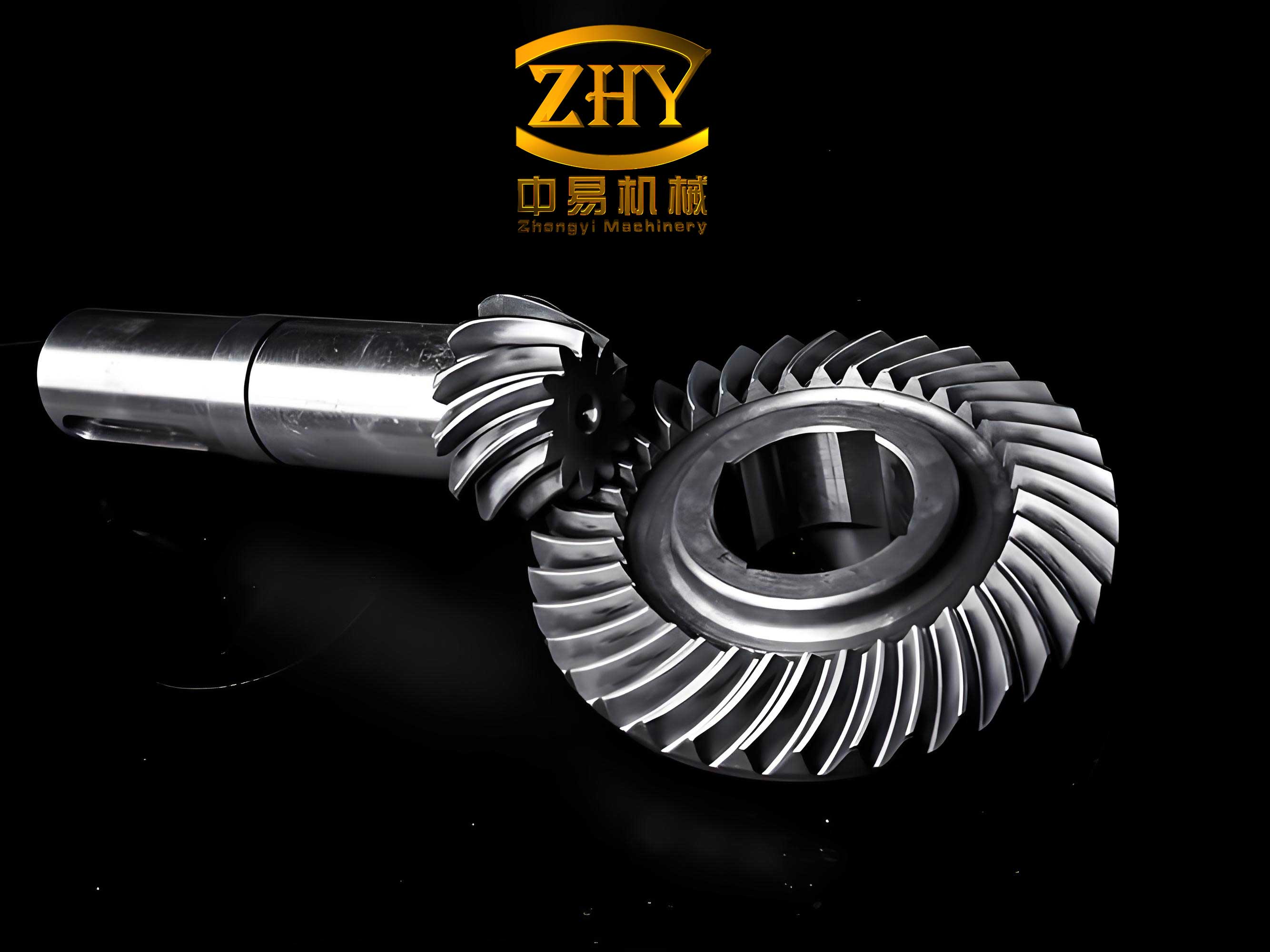
The traditional finishing of spiral bevel gears, often performed on dedicated gear generators, has been revolutionized by the adoption of new tool materials and processes. The relentless pursuit of higher quality, better economy, and the ability to process hardened materials has driven this evolution. Key developments include the use of coated tools in conventional processes, the application of cemented carbide tools for hard finishing, and the introduction of Cubic Boron Nitride (CBN) grinding wheels. These advancements enable manufacturers to correct heat treatment distortions, achieve exceptional surface finishes on both soft and hard teeth, and produce gears with consistently high geometrical accuracy.
The fundamental machining methods for spiral bevel gears can be categorized into two primary systems, both utilizing face-milling cutter heads. The first is the Single-Stage (or Completing) Method, where both sides of a tooth space are finished simultaneously using a cutter head with interlocking inside and outside blades. This method is efficient and commonly used. The second is the Two-Stage (or Fixed Setting) Method, where the concave and convex sides of the teeth are finished separately using dedicated inside and outside cutter heads. This method offers greater flexibility for corrective adjustments. Historically applied to soft gear blanks, these principles now form the basis for advanced hard-finishing operations.
Precision Finishing with Cemented Carbide Tools
One of the most significant leaps forward has been the successful implementation of cemented carbide tools for the finish cutting of case-hardened spiral bevel gears. This process allows for the generation of high-precision gear flanks directly on hardened workpieces (typically 58-62 HRC) using standard gear generating machines with minimal modification. The capability to finish a hardened spiral bevel gear pair effectively stabilizes the geometry against the distortions inherent in the carburizing and quenching process, leading to superior final quality.
Pre-Machining Requirements: A critical prerequisite for successful hard finishing is a consistent and controlled pre-machined condition. The semi-finishing cut, performed on the soft blank, must leave a uniform stock allowance for the final hard-finishing pass. This includes consistent case depth, tooth dimensions, profile form, and tooth depth. Crucially, pre-machining is performed with a cutter head featuring protuberance (or “topping”) blades. These blades create a distinct undercut or root relief in the tooth fillet region, as illustrated conceptually below. The cemented carbide finishing tool then engages only the active flank surfaces, avoiding contact with the hardened and potentially brittle root area. This strategic undercut dramatically extends tool life. While the finishing cycle can be optimized for speed, if fillet finishing is necessary, it can be performed with carbide tools, albeit with a reduction in tool life expectancy.
Concept of Pre-Machining with Protuberance: The semi-finish cut leaves a defined stock on the flank ($S_f$) and creates an undercut in the fillet. The hard-finish cutter removes $S_f$ without touching the pre-cut root.
Production Methodology: The process demands a rigid, high-precision machine tool. Standard generators are well-suited for this task. The workpiece must be clamped precisely and securely, although the cutting forces during hard finishing are generally lower than during roughing. The tooling consists of standard cutter bodies fitted with indexable carbide inserts that are brazed onto the blade bodies. These inserts are ground with specific negative rake angles (both axial and radial) to optimize cutting geometry for hardened material, balancing tool life and surface quality. The typical flank stock removal for finishing ranges from 0.15 mm to 0.30 mm. A two-pass cutting cycle is often recommended for optimal results, with each pass taking a portion of the total stock. Adequate flow of cooling oil directly to the cutting zone is essential.
The following table summarizes key parameters for the cemented carbide hard-finishing process:
| Parameter | Typical Value / Specification |
|---|---|
| Workpiece Hardness | 58 – 62 HRC |
| Flank Stock Allowance ($S_f$) | 0.15 – 0.30 mm |
| Cutting Speed | 20 – 40 m/min |
| Tool Material | Cemented Carbide (e.g., K-type) |
| Tool Geometry | Negative axial and radial rake |
| Blade Re-grind Limit | ~0.1 – 0.15 mm wear land |
| Machine Requirement | High rigidity, precision generator |
Benefits and Performance: The benefits of finishing spiral bevel gears in the hardened state with carbide tools are substantial. The process actively corrects heat treatment distortions such as pitch variation and runout. In production conditions, gear quality consistently achieves AGMA (American Gear Manufacturers Association) Class 12 or better. A significant improvement is observed in surface finish. While soft gear finishing typically achieves an average roughness ($R_z$) of 6-10 µm, hard finishing with carbide tools can yield $R_z$ values of 3-4 µm or lower. The relationship between surface hardness and achievable finish is generally positive; harder surfaces tend to produce a finer finish.
The most profound impact is on gear performance metrics. The enhancement in geometric accuracy directly reduces dynamic loads. The basic formula for bending stress in a spiral bevel gear tooth can be expressed as:
$$
\sigma_F = \frac{F_t}{b \cdot m_n} \cdot Y_F \cdot Y_S \cdot Y_\beta \cdot K_A \cdot K_V \cdot K_{F\beta} \cdot K_{F\alpha}
$$
Where $F_t$ is the tangential load, $b$ is the facewidth, $m_n$ is the normal module, $Y_F$ is the form factor, $Y_S$ is the stress correction factor, $Y_\beta$ is the helix angle factor, $K_A$ is the application factor, $K_V$ is the dynamic factor, $K_{F\beta}$ is the face load factor, and $K_{F\alpha}$ is the transverse load factor. The reduction in pitch errors and improved roughness lower the dynamic factor $K_V$ and influence the load distribution factors ($K_{F\beta}$, $K_{F\alpha}$), leading to a direct reduction in calculated bending stress ($\sigma_F$). For high-speed applications (pitch line velocity > 1500 m/min), stress reductions of 15-20% are plausible. Similarly, the improved surface finish enhances resistance to pitting and micropitting. Although system-dependent, noise levels in rolling tests are consistently observed to be lower for hard-finished spiral bevel gears.
High-Volume Precision: CBN Grinding
While carbide tool finishing is excellent for generating hardened spiral bevel gears, the quest for a high-volume, extremely precise, and non-generative method for hardened gears led to the development of grinding with Cubic Boron Nitride (CBN) superabrasive wheels. This process is particularly suited for high-production environments and offers exceptional consistency.
Process Characteristics: CBN grinding involves adapting standard gear generators with high-speed spindle systems and specialized workholding. Both vitrified-bond and electroplated CBN wheels can be used. Vitrified bonds offer the advantage of being dressable and reusable multiple times, making them economical for large batches. A dedicated dressing station services multiple grinding machines. Due to CBN’s exceptional hardness and thermal conductivity, material removal rates are high, and the “cold grinding” characteristic minimizes the risk of thermal damage (burning) to the gear tooth surface when paired with high-pressure coolant application.
The pre-machining requirements mirror those for carbide hard finishing: a uniform stock allowance and a protuberance-generated root relief. The grinding cycle is remarkably fast. For example, removing a stock of 0.15 mm per flank in a single pass can be achieved in mere seconds per tooth. The resulting surface quality is outstanding, typically achieving $R_z$ values between 1.0 and 2.0 µm. The process is fully compatible with modern spiral bevel gear design and manufacturing philosophies, including single-pass completing methods. The table below outlines a typical CBN grinding application for a spiral bevel gear set.
| Workpiece Data | Specification | Process Data | Specification |
|---|---|---|---|
| Gear Type | Spiral Bevel Gear Set | Machine | Modified High-Speed Generator |
| Design Method | Completing (Single-Stage) | Method | CBN Duplex Grinding |
| Material/Hardness | Case-Hardened Steel, 60 HRC | Wheel Speed | ~80 m/s |
| Total Stock/Flank | 0.15 mm | Coolant | High-Pressure Oil |
| – | – | Cycle Time/Tooth | ~5-8 seconds (including index) |
| – | – | Surface Finish ($R_z$) | 1.0 – 2.0 µm |
Advantages: CBN grinding provides a fast, precise, and highly reliable finishing route for hardened spiral bevel gears. It delivers exceptional geometric accuracy and surface integrity, making it ideal for high-performance, mass-produced gear sets. The process stability ensures consistent quality, which is crucial for applications in automotive, aerospace, and heavy industry. The development of dedicated CBN gear grinding machines is a natural progression of this technology, promising even greater efficiency and capability.
Enhancing Traditional Processes: Coated Tools
Parallel to the development of hard-finishing technologies, significant gains have been made in improving traditional soft gear finishing. The widespread adoption of physical vapor deposition (PVD) coatings, such as Titanium Nitride (TiN) and its variants (TiAlN, TiCN), has dramatically improved the performance of high-speed steel (HSS) cutting tools used in spiral bevel gear generation.
Application and Benefits: Coated tools exhibit markedly increased wear resistance and reduced friction at the chip-tool interface. For spiral bevel gear cutting, this translates directly into two major benefits: extended tool life and improved workpiece surface finish. In many applications, tool life between re-grinds can be increased by 100% or more. The coating also protects the cutting edge during the roughing phase of a completing cycle, ensuring that the tool edges are still sharp and well-defined for the subsequent finishing pass, thereby yielding a superior surface on the soft gear blank.
The geometry of certain cutter heads is particularly favorable for coating. Heads designed for the completing method, where the rake face is not reground during tool maintenance (only the clearance face is ground), preserve the coating on the critical rake surface through multiple re-grinds. This maximizes the return on investment from the coating process. The use of TiN-coated tools in the production of spiral bevel gears is now a proven and cost-effective strategy for boosting productivity and quality in soft gear machining.
Summary and Outlook
The finishing of spiral bevel gears has undergone a transformative evolution. Gear designers and manufacturing engineers now have a powerful portfolio of advanced methods at their disposal to achieve the optimal balance of economy, quality, and performance. The ability to finish the spiral bevel gear in its hardened state—either via generation with robust cemented carbide tools or via high-speed grinding with CBN wheels—represents a paradigm shift. It allows for the correction of thermal distortions, yields exceptional surface integrity, and ultimately produces gears with higher load capacity, efficiency, and longevity. Concurrently, the enhancement of traditional soft-finishing through advanced tool coatings continues to deliver tangible productivity gains.
These advancements collectively address the core demands of modern industry: higher quality, increased reliability, and improved cost-effectiveness. The spiral bevel gear, a component of fundamental importance in mechanical power transmission, benefits directly from these finishing technologies, enabling its use in ever more demanding applications. The future will likely see further integration of these processes, increased automation, and the development of even more sophisticated tool materials and machine tools dedicated to producing the perfect spiral bevel gear.