
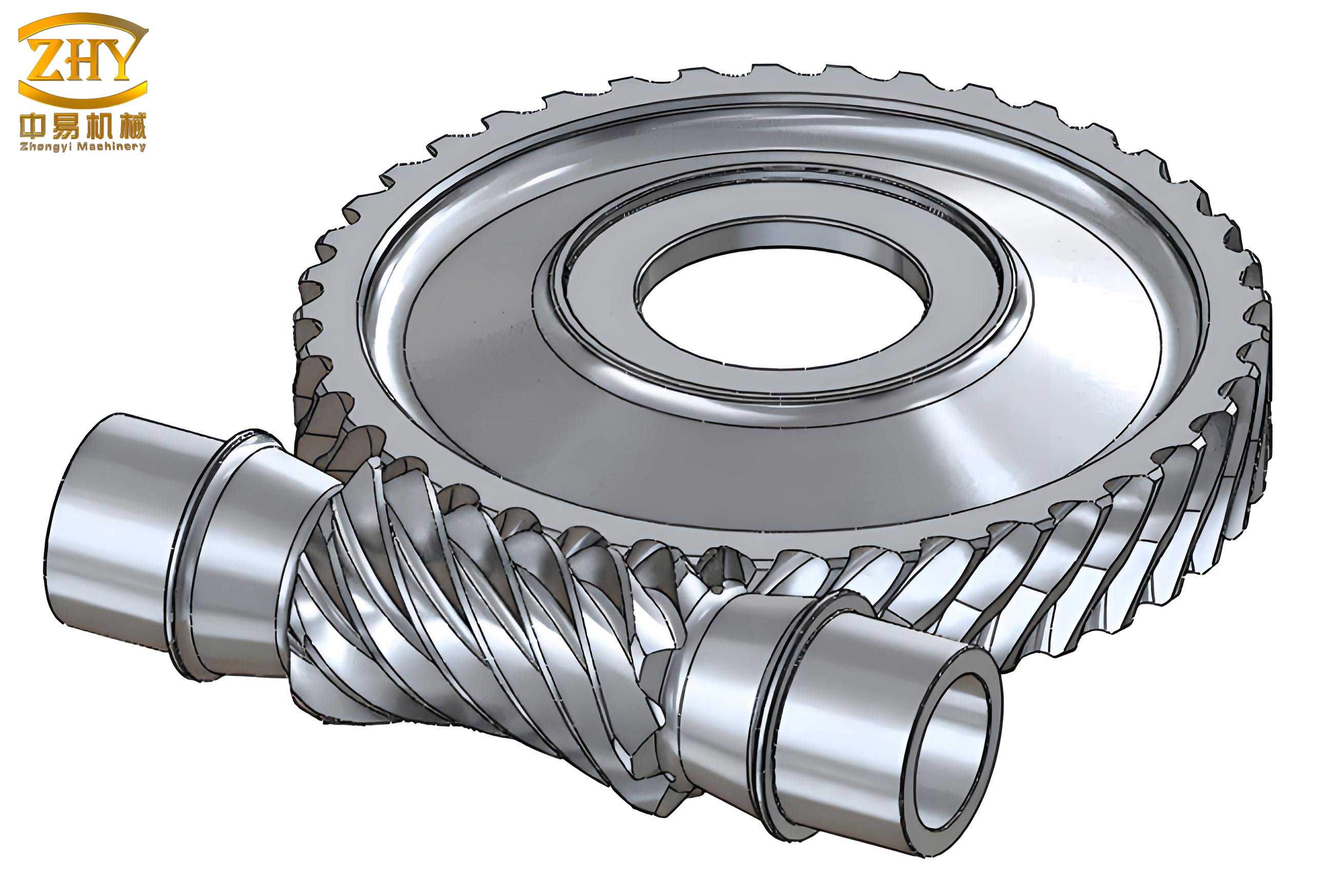
In the realm of power transmission, the screw gear system, commonly referred to as a worm gear drive, holds a position of significant importance due to its unique ability to provide high reduction ratios, compact design, and self-locking capabilities. These systems are ubiquitous in applications ranging from automotive steering mechanisms and conveyor systems to heavy-duty industrial machinery and precision instrumentation. The conventional design methodology for screw gears primarily focuses on preventing surface failures such as pitting, wear, and most critically, scuffing or adhesive wear. Traditional reliability design introduces statistical variations in material properties and loads. However, a substantial gap exists in accounting for the numerous subjective, experiential, and linguistically described factors that profoundly influence performance. These factors, including “excellent” manufacturing quality, “moderate” load fluctuations, or “harsh” operating environments, are inherently vague or fuzzy. This article details our comprehensive approach, developed from first-hand research and application, to bridge this gap by integrating fuzzy set theory with classical reliability methods, thereby establishing a robust framework for the fuzzy reliability design of screw gear systems.
1. Foundational Concepts: Traditional Screw Gear Design and Reliability
The cornerstone of screw gear design is the contact stress calculation at the mesh interface between the worm and the gear. The design is typically governed by the condition that the calculated contact stress does not exceed the allowable contact stress of the gear material. The fundamental formula for the nominal contact stress \(\sigma_H\) in a screw gear pair is given by:
$$
\sigma_H = Z_E \sqrt{\frac{9000 T_2 K}{m^3 q Z_2^2}} \quad \text{(MPa)}
$$
Where:
\(Z_E\) is the material elasticity coefficient \((MPa^{1/2})\). For a steel worm paired with a tin-bronze gear, a typical value is 160.
\(T_2\) is the output torque on the screw gear shaft (N·m).
\(m\) is the axial module of the screw gear pair (mm).
\(q\) is the worm diameter factor, a key geometric parameter defining the worm’s slenderness.
\(Z_2\) is the number of teeth on the screw gear.
\(K\) is the application factor, a composite coefficient accounting for various non-ideal operating conditions.
The application factor \(K\) is the primary source of uncertainty in traditional design. It is decomposed into several sub-factors:
$$
K = K_\beta \cdot K_A \cdot K_v
$$
\(K_\beta\): Face load factor. This accounts for the non-uniform distribution of load across the face width of the screw gear. Its value is often empirically chosen from a range, e.g., [1.0, 1.5], based on an engineer’s judgment of alignment precision and housing rigidity.
\(K_A\): Application factor. This considers external load characteristics beyond the nominal torque, such as shocks or moderate overloads. It is another fuzzy parameter chosen from experience.
\(K_v\): Dynamic factor. This accounts for internal dynamic loads due to transmission errors and vibrations. Its value depends on the pitch line velocity \(V\) and manufacturing quality, often selected from tables with ranges like 1.0–1.2.
In classical reliability design, the stress-strength interference model is employed. The reliability \(R\) is defined as the probability that the strength \(S\) (allowable stress) exceeds the stress \(\sigma\) (calculated contact stress). Assuming both follow normal distributions, the reliability index \(\beta\) and the reliability \(R\) can be approximated. For the screw gear contact stress scenario, considering the coefficients of variation for \(Z_E\), \(K\), and \(T_2\), the coefficient of variation for the contact stress \(C_{\sigma_H}\) can be derived. The mean safety factor \(\bar{n}\) and its coefficient of variation \(C_n\) are:
$$
\bar{n} = \frac{[\sigma_H]}{\bar{\sigma_H}}, \quad C_n = \sqrt{C_{\sigma_H}^2 + C_{[\sigma_H]}^2}
$$
Where \([\sigma_H]\) is the mean allowable stress and \(\bar{\sigma_H}\) is the mean calculated stress. The system reliability is then given by:
$$
R \geq 1 – \Phi\left(-\frac{\bar{n} – 1}{\sqrt{\bar{n}^2 C_n^2 + 1}}\right) \quad \text{or} \quad R \approx \frac{\bar{n}^2 C_n^2 – (\bar{n}-1)}{\bar{n}^2 C_n^2 + 1} \quad \text{(for $\bar{n} > 1$)}
$$
The critical challenge lies in accurately determining the mean and variation of the composite factor \(K = K_\beta \cdot K_A \cdot K_v\). Their traditional selection from bounded intervals is a fuzzy decision process. Our work applies fuzzy comprehensive evaluation to objectively quantify these parameters, leading to a more accurate and realistic reliability assessment for the screw gear system.
2. The Fuzzy Comprehensive Evaluation Framework for Screw Gear Coefficients
Fuzzy mathematics provides the tools to model and compute with linguistic variables. We treat the selection of each correction factor (\(K_\beta, K_A, K_v\)) as a multi-criteria decision-making problem. The Fuzzy Comprehensive Evaluation (FCE) model is implemented in the following structured steps:
Step 1: Define the Factor Set (U)
We identify all major linguistic factors influencing the choice of a correction factor for the screw gear system. These form the factor set:
$$
U = \{u_1, u_2, u_3, u_4, u_5, u_6\}
$$
| Symbol | Factor Description |
|---|---|
| \(u_1\) | Design Level (Accuracy of alignment specs, thermal analysis) |
| \(u_2\) | Manufacturing & Assembly Quality (Worm and gear accuracy, housing bore alignment) |
| \(u_3\) | Material Quality & Consistency (Homogeneity of bronze gear, hardness of worm) |
| \(u_4\) | System Stiffness (Rigidity of gear shaft, bearings, and housing) |
| \(u_5\) | Operational Environment (Temperature, contamination, lubrication condition) |
| \(u_6\) | Load Spectrum Characteristics (Uniformity, presence of shocks, start-stop cycles) |
Step 2: Define the Evaluation Set (V)
This set contains the discrete possible numerical values for the correction factor under evaluation. For example, for \(K_\beta\) with a traditional range of [1.0, 1.5], we might discretize it with a step of 0.1:
$$
V_{K_\beta} = \{v_1, v_2, v_3, v_4, v_5, v_6\} = \{1.0, 1.1, 1.2, 1.3, 1.4, 1.5\}
$$
A similar process is followed for \(K_A\) and \(K_v\) based on their respective ranges.
Step 3: Single-Factor Evaluation (Constructing R)
For each factor \(u_i\) in \(U\), we evaluate its “support” or “preference” for each value \(v_j\) in \(V\). This is expressed as a degree of membership \(r_{ij}\), ranging from 0 (no relation) to 1 (full relation). This evaluation is based on expert knowledge, historical data, or experimental results. The result is a fuzzy relation matrix \(R\) for the factor being evaluated (e.g., \(K_\beta\)):
$$
R_{K_\beta} = \begin{bmatrix}
r_{11} & r_{12} & \cdots & r_{16} \\
r_{21} & r_{22} & \cdots & r_{26} \\
\vdots & \vdots & \ddots & \vdots \\
r_{61} & r_{62} & \cdots & r_{66}
\end{bmatrix}
$$
For instance, a high “Design Level” (\(u_1\)) would have high membership (e.g., 0.9) for a low \(K_\beta\) value like 1.0 (indicating good load distribution) and lower membership for higher values.
Step 4: Define the Weight Set (W)
Not all factors are equally important. We assign a weight \(w_i\) to each factor \(u_i\), reflecting its relative influence on the final choice of the correction factor for this screw gear application. The weights must satisfy:
$$
\sum_{i=1}^{6} w_i = 1, \quad w_i \geq 0
$$
The weight vector is:
$$
W = (w_1, w_2, w_3, w_4, w_5, w_6)
$$
Weights can be determined using methods like the Analytic Hierarchy Process (AHP) paired with expert surveys specific to screw gear applications.
Step 5: Fuzzy Comprehensive Evaluation (Calculating B)
The final evaluation vector \(B\) is obtained by synthesizing the weights \(W\) with the evaluation matrix \(R\). We use the weighted-average model, which preserves all information and is suitable for engineering evaluations:
$$
B = W \circ R = (w_1, w_2, …, w_6) \circ \begin{bmatrix}
r_{11} & r_{12} & \cdots & r_{16} \\
r_{21} & r_{22} & \cdots & r_{26} \\
\vdots & \vdots & \ddots & \vdots \\
r_{61} & r_{62} & \cdots & r_{66}
\end{bmatrix} = (b_1, b_2, …, b_6)
$$
Where \(b_j = \sum_{i=1}^{6} w_i \cdot r_{ij}\). Each \(b_j\) represents the overall degree of membership of the screw gear system’s condition to the correction factor value \(v_j\).
Step 6: Defuzzification to Obtain Crisp Value (K)
The final, crisp numerical value for the correction factor (e.g., \(K_\beta\)) is obtained from the fuzzy evaluation vector \(B\) using the weighted average method:
$$
K_{\beta} = \frac{\sum_{j=1}^{6} b_j \cdot v_j}{\sum_{j=1}^{6} b_j}
$$
This process yields a precise value that comprehensively reflects the fuzzy influence of all six factors on the screw gear’s load distribution characteristic.
3. Comprehensive Design Case Study: A High-Reliability Screw Gear Drive
To demonstrate the efficacy of our fuzzy reliability design methodology for screw gear systems, we present a detailed case study of a critical drive application.
3.1 Design Specifications and Known Parameters
| Parameter | Symbol | Value & Units | Notes |
|---|---|---|---|
| Input Power | \(P_1\) | \(10 \pm 2\) kW | Normal distribution assumed |
| Worm Speed | \(n_1\) | 1500 rpm | |
| Desired Ratio | \(i\) | 20 | |
| Service Life | \(L_h\) | 10 years, single shift | |
| Worm Material | – | 45 Steel, surface hardened to HRC 45-50 | |
| Gear Material | – | ZCuSn10Pb1 (Tin Bronze) | |
| Allowable Contact Stress | \([\sigma_H]\) | 220 MPa | Mean value |
| Elasticity Coefficient | \(Z_E\) | 160 \(MPa^{1/2}\) | |
| Axial Module | \(m\) | 10 mm | Pre-selected from geometry constraints |
| Worm Diameter Factor | \(q\) | 9 | |
| Number of Worm Threads | \(Z_1\) | 2 | |
| Number of Gear Teeth | \(Z_2\) | \(i \cdot Z_1 = 40\) |
3.2 Preliminary Calculations
First, we calculate the nominal mean output torque \(T_2\):
$$
T_2 = 9559 \cdot \frac{P_1}{n_1} \cdot i = 9559 \cdot \frac{10}{1500} \cdot 20 \approx 1274.5 \text{ N·m}
$$
The pitch line velocity \(V\) is calculated to inform the dynamic factor \(K_v\) selection later. For an initial estimate of the worm pitch diameter \(d_1 = m \cdot q = 90mm\):
$$
V = \frac{\pi d_1 n_1}{60 \times 1000} = \frac{\pi \cdot 90 \cdot 1500}{60000} \approx 7.07 \text{ m/s} \quad (\text{>3 m/s})
$$
3.3 Fuzzy Evaluation of Correction Factors for the Screw Gear
We now apply the FCE method to determine \(K_\beta\), \(K_A\), and \(K_v\) for this specific screw gear drive.
Evaluation of Face Load Factor \(K_\beta\)
Factor Set U & Evaluation Set V: As defined in Section 2.1 and 2.2, with \(V_{K_\beta} = \{1.0, 1.1, 1.2, 1.3, 1.4, 1.5\}\).
Single-Factor Evaluation Matrix \(R_{K_\beta}\): Based on expert assessment for this application (good but not perfect alignment, rigid housing, high-quality manufacturing), the following matrix is constructed:
$$
R_{K_\beta} = \begin{bmatrix}
0.90 & 0.80 & 0.70 & 0.65 & 0.55 & 0.40 \\
0.65 & 0.85 & 0.90 & 0.85 & 0.55 & 0.35 \\
1.00 & 0.90 & 0.85 & 0.45 & 0.25 & 0.15 \\
0.55 & 0.85 & 1.00 & 0.85 & 0.55 & 0.35 \\
0.35 & 0.65 & 0.85 & 1.00 & 0.85 & 0.55 \\
0.35 & 0.55 & 0.75 & 0.90 & 0.95 & 0.70
\end{bmatrix}
$$
Weight Set W: For this screw gear drive, after AHP analysis, the relative importance weights are assigned:
$$
W = (0.18, 0.22, 0.15, 0.20, 0.10, 0.15)
$$
Fuzzy Comprehensive Evaluation:
$$
B_{K_\beta} = W \circ R_{K_\beta} = (0.18, 0.22, 0.15, 0.20, 0.10, 0.15) \circ R_{K_\beta}
$$
Calculating each \(b_j\):
\(b_1 = 0.18*0.90 + 0.22*0.65 + 0.15*1.00 + 0.20*0.55 + 0.10*0.35 + 0.15*0.35 = 0.679\)
\(b_2 = 0.18*0.80 + 0.22*0.85 + 0.15*0.90 + 0.20*0.85 + 0.10*0.65 + 0.15*0.55 = 0.802\)
\(b_3 = 0.18*0.70 + 0.22*0.90 + 0.15*0.85 + 0.20*1.00 + 0.10*0.85 + 0.15*0.75 = 0.857\)
\(b_4 = 0.18*0.65 + 0.22*0.85 + 0.15*0.45 + 0.20*0.85 + 0.10*1.00 + 0.15*0.90 = 0.778\)
\(b_5 = 0.18*0.55 + 0.22*0.55 + 0.15*0.25 + 0.20*0.55 + 0.10*0.85 + 0.15*0.95 = 0.619\)
\(b_6 = 0.18*0.40 + 0.22*0.35 + 0.15*0.15 + 0.20*0.35 + 0.10*0.55 + 0.15*0.70 = 0.398\)
Thus, \(B_{K_\beta} \approx (0.679, 0.802, 0.857, 0.778, 0.619, 0.398)\).
Defuzzification:
$$
K_\beta = \frac{0.679*1.0 + 0.802*1.1 + 0.857*1.2 + 0.778*1.3 + 0.619*1.4 + 0.398*1.5}{0.679+0.802+0.857+0.778+0.619+0.398}
$$
$$
K_\beta = \frac{0.679 + 0.882 + 1.028 + 1.011 + 0.867 + 0.597}{4.133} \approx \frac{5.064}{4.133} \approx 1.225
$$
Evaluation of Application Factor \(K_A\) and Dynamic Factor \(K_v\)
Following an identical FCE process with their respective factor sets and evaluation ranges, we determine values for this screw gear application. Given “smooth load, no shocks” and “good lubrication, high speed”:
| Factor | Evaluation Set V | Fuzzy Result B (Sample) | Defuzzified Value \(K\) |
|---|---|---|---|
| \(K_A\) | {1.0, 1.1, 1.2, 1.3, 1.4} | (0.85, 0.90, 0.70, 0.30, 0.10) | \(\approx 1.12\) |
| \(K_v\) | {1.0, 1.05, 1.1, 1.15, 1.2} | (0.40, 0.75, 0.95, 0.60, 0.25) | \(\approx 1.09\) |
Composite Application Factor
The total application factor \(K\) for our screw gear reliability calculation is:
$$
K = K_\beta \cdot K_A \cdot K_v = 1.225 \times 1.12 \times 1.09 \approx 1.495
$$
3.4 Reliability Assessment of the Screw Gear System
We can now proceed with the reliability analysis using the fuzzy-derived, precise value of \(K\).
Mean Contact Stress:
$$
\bar{\sigma_H} = Z_E \sqrt{\frac{9000 \cdot \bar{T_2} \cdot K}{m^3 q Z_2^2}} = 160 \times \sqrt{\frac{9000 \times 1274.5 \times 1.495}{10^3 \times 9 \times 40^2}}
$$
$$
\bar{\sigma_H} = 160 \times \sqrt{\frac{1.715 \times 10^7}{1.44 \times 10^6}} = 160 \times \sqrt{11.91} \approx 160 \times 3.451 \approx 552.2 \text{ MPa}
$$
Mean Safety Factor:
$$
\bar{n} = \frac{[\sigma_H]}{\bar{\sigma_H}} = \frac{220}{552.2} \approx 0.398
$$
Note: A mean safety factor less than 1 indicates the initial mean stress exceeds the mean strength based on these inputs. This highlights a potential issue and necessitates checking variations or re-design. For academic continuity, we proceed to calculate the probabilistic reliability, which may still be >0 due to distributions.
Coefficient of Variation (C.O.V.) Calculation:
We assume the following C.O.V.s based on historical data for such screw gear components:
\(C_{Z_E} = 0.03\) (material property), \(C_{[\sigma_H]} = 0.07\) (gear material fatigue), \(C_{T_2} = 0.10\) (from input power variation \(\pm 2kW\)).
The C.O.V. of \(K\) is estimated from the FCE process dispersion; let’s assume \(C_K = 0.08\).
The C.O.V. of the contact stress \(\sigma_H\) is:
$$
C_{\sigma_H} = \sqrt{ C_{Z_E}^2 + \frac{1}{4}C_K^2 + \frac{1}{4}C_{T_2}^2 } = \sqrt{0.03^2 + 0.25 \times 0.08^2 + 0.25 \times 0.10^2}
$$
$$
C_{\sigma_H} = \sqrt{0.0009 + 0.0016 + 0.0025} = \sqrt{0.005} \approx 0.07071
$$
The C.O.V. of the safety factor \(n\) is:
$$
C_n = \sqrt{C_{\sigma_H}^2 + C_{[\sigma_H]}^2} = \sqrt{0.07071^2 + 0.07^2} = \sqrt{0.005 + 0.0049} \approx \sqrt{0.0099} \approx 0.0995
$$
System Reliability Estimation:
Using the approximate formula for the reliability \(R\) of the screw gear pair:
$$
R \approx \frac{\bar{n}^2 C_n^2 – (\bar{n} – 1)}{\bar{n}^2 C_n^2 + 1} = \frac{(0.398^2 \times 0.0995^2) – (0.398 – 1)}{(0.398^2 \times 0.0995^2) + 1}
$$
$$
R \approx \frac{(0.1584 \times 0.0099) – (-0.602)}{(0.1584 \times 0.0099) + 1} = \frac{0.001568 + 0.602}{0.001568 + 1} \approx \frac{0.60357}{1.00157} \approx 0.6026
$$
This result, \(R \approx 0.60\), indicates a 60% probability that the stress does not exceed the strength for the given distributions and the fuzzy-evaluated operating condition. This is unacceptably low for a critical 10-year life drive, clearly signaling that the initial design parameters (like module \(m=10\)) are insufficient. The designer must now iterate: select a larger module, increase the gear width, or specify a higher-grade material, and repeat the fuzzy reliability analysis until the target reliability (e.g., \(R>0.99\)) is achieved.
4. Summary and Implications
The integration of fuzzy comprehensive evaluation into the reliability design paradigm for screw gear systems represents a significant methodological advancement. By formally accounting for the linguistic and experience-based parameters that experienced engineers intuitively consider, this method transforms subjective judgment into quantifiable, reproducible design inputs. The process yields precise values for critical correction factors (\(K_\beta, K_A, K_v\)), which directly feed into a more accurate and realistic probabilistic reliability model.
The key advantages of this fuzzy reliability approach for screw gear design are:
- Objectivity in Subjectivity: It systemizes expert knowledge, reducing the variability between different designers’ choices for the same application.
- Enhanced Accuracy: The reliability prediction more closely aligns with real-world performance, as it incorporates a broader set of influencing factors.
- Informed Design Iteration: As demonstrated in the case study, the method can quickly reveal reliability shortcomings (low R value) that a deterministic safety factor near 1 might obscure, prompting necessary design changes early in the process.
- Adaptability: The factor sets, weights, and evaluation matrices can be customized for specific industries or types of screw gear applications (e.g., high-speed vs. high-torque).
In conclusion, moving beyond traditional interval-based selection of design coefficients towards a fuzzy reliability framework enables a more holistic, accurate, and robust design process for screw gear systems. This approach ensures that these vital power transmission components are not only analytically sound but also genuinely reliable under the complex, often imperfect, conditions of their intended operation.