
As a researcher focused on gear dynamics and failure analysis, I recognize that gear transmission systems are fundamental components in countless industrial applications, from wind turbines to automotive drivetrains. These systems often operate under complex, variable loads for extended periods. The resulting vibrations can induce damage to internal components, compromising the system’s overall reliability. Among various failure modes, gear tooth cracking is one of the most prevalent and critical. The meshing stiffness of a gear pair is the cornerstone for analyzing its dynamic response and diagnosing fault characteristics. Notably, among all gear faults, tooth cracks have the most pronounced impact on the time-varying meshing stiffness (TVMS). Accurately modeling this effect is therefore paramount for predictive maintenance and ensuring operational safety.
The inherent design of helical gears, with their angled teeth, provides smoother and quieter operation compared to spur gears due to gradual tooth engagement. However, this complexity also makes the analysis of their stiffness, especially under fault conditions, more challenging. While significant research has been conducted on cracked spur gears, models for helical gears often overlook crucial aspects. Many existing approaches do not adequately account for how a crack influences the gear body’s foundation stiffness or neglect the variations in axial stiffness components during the meshing process of helical gears. This gap necessitates a more comprehensive analytical model.
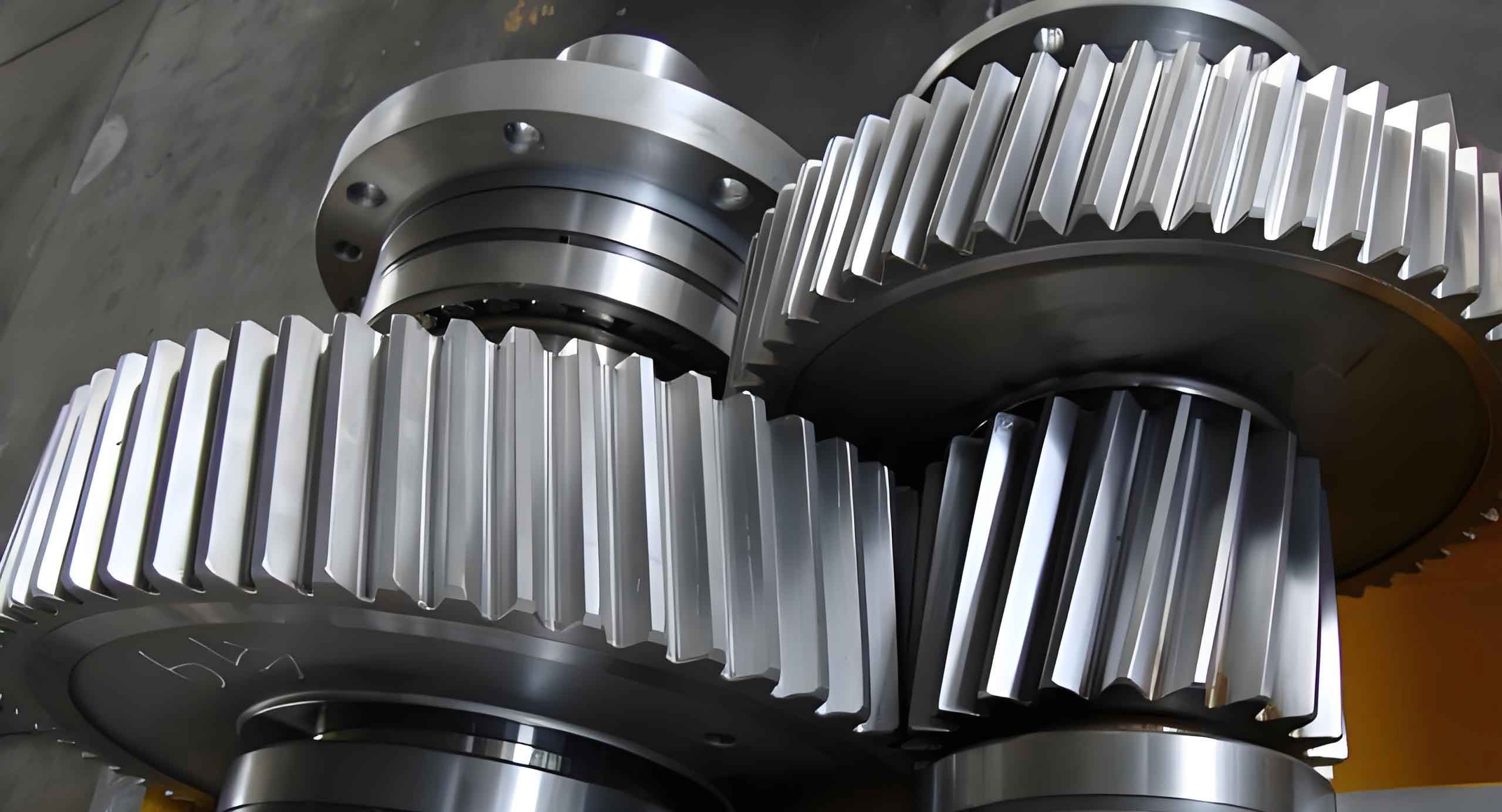
This article presents an improved computational model for the meshing stiffness of cracked helical gear pairs. The model integrates the influence of cracks on both transverse and axial stiffness components, encompassing tooth stiffness and gear foundation stiffness. Furthermore, it explicitly models two typical crack propagation paths observed in helical gears: tooth tip propagation cracks and end face propagation cracks. The analytical results derived from this model are validated against finite element analysis (FEA) simulations, demonstrating its accuracy and effectiveness for health monitoring and dynamic analysis of geared systems.
Mathematical Modeling of Crack Propagation Paths in Helical Gears
Cracks in helical gears can initiate and propagate in various orientations relative to the gear’s axis and tooth face. Two primary, distinct crack propagation modes are considered in this study: the tooth tip propagation crack and the end face propagation crack. To compute the time-varying meshing stiffness, a precise mathematical description of these three-dimensional crack paths is essential.
Spatial Crack Propagation Model
For a tooth tip propagation crack, the flaw initiates at the root fillet and propagates towards the tooth tip, potentially extending along the face width. Conversely, an end face propagation crack starts at one end of the gear face width and propagates inward along the tooth’s depth and potentially across the width. Assuming the crack front follows a parabolic path in space, we can establish a local coordinate system \(o’xyz\) with its origin \(o’\) at the root circle. The \(x\)-axis is along the tooth centerline, the \(y\)-axis is tangent to the root circle, and the \(z\)-axis is parallel to the gear’s face width direction. The crack propagation curve along the face width (\(z\)-direction) can be described by:
$$x(z) = \begin{cases}
l_1 + l_2 \times z^2 / L^2, & z \in [0, L] \\
l_1 + (r_a – r_f – l_1 – \Delta h) \times z^2 / l_3^2, & z \in [0, l_3]
\end{cases}$$
Here, \(l_1\) is the distance from the crack origin to the tooth root, \(l_2\) and \(l_3\) represent distances along the tooth depth and face width, respectively, \(L\) is the total face width, \(r_a\) and \(r_f\) are the addendum and root circle radii, and \(\Delta h\) is a geometric parameter related to the rotation. The crack depth \(q(z)\) varies along \(z\). For a non-penetrating tooth tip crack, the depth decreases linearly from an initial value \(q_0\) at the origin to zero at the crack tip location \(L_c\):
$$q_{n1}(z) = \begin{cases} q_0 \frac{L_c – z}{L_c}, & z \in [0, L_c] \\ 0, & z \in [L_c, L] \end{cases}$$
For a penetrating crack (one that goes through the entire tooth thickness), the depth variation is parabolic:
$$q_{c1}(z) = \sqrt{q_0^2 – \frac{q_0^2 – q_e^2}{l_3} z}, \quad z \in [0, l_3]$$
where \(q_e\) is the final crack depth at the end of the propagation path. Similar formulations with appropriate domain adjustments are applied for end face propagation cracks.
Planar Crack Depth Model (Tooth Profile View)
To calculate stiffness contributions from bending and shear, the effective tooth thickness at any section along the tooth height (\(x\)-direction) must be determined, considering the crack’s encroachment. The crack path in the tooth profile plane (the \(x-y\) plane) is also modeled as a parabola. The effective tooth thickness \(h_{x-effective}\) at a distance \(x\) from the root depends on whether the crack has passed that section. Let \(q\) be the crack length from the starting point \(Q\) to an endpoint \(P\), and \(q_{1max}\) be a critical length. If \(q \le q_{1max}\), the effective thickness is:
$$h_{x-effective} = \begin{cases} 2h_x, & x \le x_P \\ h_x + \frac{y_B – y_P}{(x_B – x_P)^2}(x – x_P)^2 + y_P, & x > x_P \end{cases}$$
If \(q > q_{1max}\), the formulation becomes:
$$h_{x-effective} = \begin{cases} 2h_x, & x < x_{max} \\ h_x – \frac{(x – x_{max})y_Q^2}{x_Q – x_{max}}, & x_{max} \le x \le x_P \\ h_x + \frac{y_B + y_P}{(x_B – x_P)^2}(x – x_P)^2 – y_P, & x > x_P \end{cases}$$
Here, \(h_x\) is half of the ideal uncracked tooth thickness at \(x\), and \(x_P, y_P, x_B, y_B, x_Q, y_Q\) are coordinates defining the crack parabola and tooth boundaries. This model allows for calculating the reduced area \(A_{tx}\) and area moment of inertia \(I_{tx}\) at any cracked section, which are critical for stiffness computation.
| Crack Type | Case | Length \(L_c\) | Initial Depth \(q_s\) | Final Depth \(q_e\) |
|---|---|---|---|---|
| Tooth Tip (Penetrating, Different Length) | 1 | 0.3L | 0.6\(q_{s-total}\) | 0.3\(q_{e-total}\) |
| 2 | 0.6L | 0.6\(q_{s-total}\) | 0.3\(q_{e-total}\) | |
| 3 | 0.9L | 0.6\(q_{s-total}\) | 0.3\(q_{e-total}\) | |
| Tooth Tip (Non-penetrating, Different Depth) | 1 | 0.6L | 0.3\(q_{s-total}\) | 0.15\(q_{e-total}\) |
| 2 | 0.6L | 0.6\(q_{s-total}\) | 0.3\(q_{e-total}\) | |
| 3 | 0.6L | 0.9\(q_{s-total}\) | 0.45\(q_{e-total}\) | |
| End Face (Penetrating, Different Depth) | 1 | L | 0.3\(q_{s-total}\) | 0.15\(q_{e-total}\) |
| 2 | L | 0.6\(q_{s-total}\) | 0.3\(q_{e-total}\) | |
| 3 | L | 0.9\(q_{s-total}\) | 0.45\(q_{e-total}\) |
Methodology: The “Sliced” Gear Approach for Helical Gear Meshing Stiffness
The core methodology for calculating the TVMS of cracked helical gears is the “sliced” gear approach. A helical gear pair is conceptually divided into \(N\) thin slices along its face width. Each slice is treated as a spur gear pair but with a small, specific angular offset relative to its neighbors, corresponding to the helix angle \(\beta\). The total meshing stiffness of the helical gear pair is obtained by summing the contributions from all these slices, considering their respective phase offsets in the meshing cycle.
The offset angle \(\theta_n\) for the \(n\)-th slice is given by:
$$\theta_n = \frac{S’_n H’_n \tan \beta_b}{r_{b1}} = \frac{n L \beta_b}{N r_{b1}}$$
where \(r_{b1}\) is the base circle radius of the pinion, \(\beta_b\) is the base helix angle, and \(L\) is the face width. The normalized time offset \(\Delta T\) for superposition is:
$$\Delta T = \frac{\theta_n}{\Delta \theta} = \frac{\theta_n Z_1}{2\pi}$$
where \(\Delta \theta\) is the angular rotation per meshing period and \(Z_1\) is the number of teeth on the pinion.
Stiffness Components for a “Sliced” Spur Gear Pair
For each spur gear slice \(i\) in contact, the total meshing stiffness is a combination of stiffness from the pinion and the gear. It is derived from the potential energy method, considering several types of deflections. The overall transverse tooth pair stiffness \(k^i_{tt}\) for a slice is found by combining the bending, shear, axial compressive stiffness of both the pinion (p) and gear (g), along with the Hertzian contact stiffness \(k^i_h\):
$$\frac{1}{k^i_{tt}} = \frac{1}{k^i_{bp}} + \frac{1}{k^i_{sp}} + \frac{1}{k^i_{ap}} + \frac{1}{k^i_{bg}} + \frac{1}{k^i_{sg}} + \frac{1}{k^i_{ag}} + \frac{1}{k^i_{h}}$$
The total transverse meshing stiffness \(k^i_t\) for the slice also incorporates the gear body foundation stiffness, which represents the flexibility of the gear structure supporting the tooth:
$$\frac{1}{k^i_t} = \frac{1}{k^i_{tt}} + \frac{1}{\lambda_p k^i_{tf-p}} + \frac{1}{\lambda_g k^i_{tf-g}}$$
Here, \(\lambda_p\) and \(\lambda_g\) are parameters related to the sharing of load among multiple tooth pairs in contact.
1. Transverse Tooth Stiffness of a Cracked Tooth
The bending (\(k_{tb}\)), shear (\(k_{ts}\)), and axial compression (\(k_{ta}\)) stiffnesses of a cracked tooth in the transverse plane are calculated by integrating along the tooth height from the root to the load application point. The integrals account for the reduced cross-sectional area \(A_{tx}\) and moment of inertia \(I_{tx}\) due to the crack, as defined by \(h_{x-effective}\). For example, the bending stiffness is:
$$\frac{1}{k_{tb}} = \int_{0}^{d} \frac{[\cos\alpha_1 (d – x_1) – \sin\alpha_1 h]^2 \cos^2\beta}{E I_{x1}} dx_1 + \int_{0}^{x_C – x_D} \frac{[\cos\alpha_1 (d + x_2) – \sin\alpha_1 h]^2 \cos^2\beta}{E I_{x2}} dx_2$$
where \(\alpha_1\) is the pressure angle at the contact point, \(\beta\) is the helix angle, \(E\) is Young’s modulus, \(d\) is the distance from the tooth root to the critical section, and \(h\) is the moment arm.
2. Transverse Gear Foundation Stiffness with a Crack
The foundation stiffness models the deformation of the gear body near the tooth root. A crack emanating from the root fillet significantly affects this stiffness. The model modifies the effective load angle \(\alpha’\) and the geometric parameter \(S’_f\) based on the crack length ratio \(X = q / L\). The corrected foundation stiffness per unit face width is:
$$\frac{1}{d k_{tf}} = \frac{\cos^2\beta \cos^2\alpha’}{E \cdot dL} \left[ L^* (u’_f / S’_f)^2 + M^*(u’_f / S’_f) + P^*(1 + Q^* \tan^2 \alpha’) \right]$$
where \(L^*, M^*, P^*, Q^*\) are empirical coefficients, and \(u’_f\) is a modified distance parameter that incorporates the crack’s effect.
3. Axial Tooth Stiffness of a Cracked Tooth
For helical gears, the axial component of the mesh force (due to the helix angle) induces additional deformations. The axial bending stiffness \(k_{ab}\) and axial torsional stiffness \(k_{at}\) are calculated similarly, using the appropriate moments and area moments of inertia \(I_{ax}\) and polar moments of inertia \(I_{px}\) for the cracked sections:
$$\frac{1}{k_{ab}} = \int_{0}^{d} \frac{\sin^2\beta (d – x_1)^2}{E I_{ax1}} dx_1 + \int_{0}^{x_C – x_D} \frac{\sin^2\beta (d + x_2)^2}{E I_{ax2}} dx_2$$
$$\frac{1}{k_{at}} = \int_{0}^{d} \frac{h^2 \sin^2\beta}{G I_{px1}} dx_1 + \int_{0}^{x_C – x_D} \frac{h^2 \sin^2\beta}{G I_{px2}} dx_2$$
where \(G\) is the shear modulus.
4. Axial Gear Foundation Stiffness with a Crack
The axial foundation stiffness \(k_{af}\) accounts for the deformation of the gear body under the axial bending moment caused by the axial mesh force component. The stiffness is obtained by integrating along the tooth root circle, considering the cracked section’s moment of inertia \(I_{af}\):
$$\frac{1}{k_{af}} = \int_{0}^{x_D} \frac{\sin^2\beta (d + x_C – x_d)^2}{E I_{af}} dx_d$$
Total Meshing Stiffness of the Cracked Helical Gear Pair
First, the total transverse meshing stiffness \(K_t(\tau)\) and total axial meshing stiffness \(K_a(\tau)\) of the helical gear pair are obtained by summing the contributions from all slices \(n\) and all tooth pairs \(i\) in contact, considering their time offsets \(\Delta T\):
$$K_t(\tau) = \sum_{n=1}^{N} \sum_{i=1}^{cell(e)} k^i_t(\tau + \Delta T)$$
$$K_a(\tau) = \sum_{n=1}^{N} \sum_{i=1}^{cell(e)} k^i_a(\tau + \Delta T)$$
Finally, the total effective meshing stiffness \(K_{total}(\tau)\) of the cracked helical gear pair is determined by combining the transverse and axial stiffnesses in series, as they represent different deformation directions:
$$\frac{1}{K_{total}(\tau)} = \frac{1}{K_t(\tau)} + \frac{1}{K_a(\tau)}$$
This comprehensive formulation ensures that both the transverse (from radial and tangential forces) and axial (from the helix-induced axial force) flexibilities of the cracked helical gears are captured.
| Parameter | Pinion | Gear |
|---|---|---|
| Number of Teeth, \(Z\) | 42 | 43 |
| Face Width, \(L\) (mm) | 30 | 30 |
| Module, \(m_n\) (mm) | 3.5 | 3.5 |
| Pressure Angle, \(\alpha\) (°) | 22.5 | 22.5 |
| Helix Angle, \(\beta\) (°) | 17 | 17 |
| Young’s Modulus, \(E\) (Pa) | 2.068e11 | 2.068e11 |
| Poisson’s Ratio, \(\nu\) | 0.3 | 0.3 |
Results and Discussion: Meshing Stiffness Under Different Crack Conditions
The proposed model is applied to a typical double-helical gear pair with parameters listed in the table above. The meshing stiffness is calculated for various crack scenarios, and the results are compared against Finite Element Analysis (FEA) simulations to validate the model’s accuracy.
Tooth Tip Propagation Cracks
The figure below illustrates the TVMS for helical gears with penetrating tooth tip cracks that extend to different locations along the face width (Cases 1-3 in first table). The results clearly show that the reduction in meshing stiffness is directly related to the effective crack area. A crack propagating further across the face width (larger \(L_c\)) creates a larger weakened volume, leading to a more significant decrease in stiffness, particularly during the single-tooth contact region where the load is borne by a single, potentially cracked, tooth.
For non-penetrating cracks of varying depths (Cases 1-3 in second table), a similar trend is observed: deeper cracks cause greater stiffness reduction. However, the effect is less severe than for penetrating cracks of comparable length because the uncracked ligament of material still provides some load-carrying capacity. The analytical results from the proposed model show excellent agreement with the FEA simulations across all cases, confirming the model’s capability to capture the effect of crack geometry on stiffness.
End Face Propagation Cracks
End face cracks present a different geometry. Here, a crack initiates at one end face and propagates inward. For penetrating end face cracks of different depths (Cases 1-3 in third table), the stiffness reduction is substantial. A critical finding is that, for comparable crack lengths and depths, an end face propagation crack generally has a more significant impact on the meshing stiffness than a tooth tip propagation crack. This is because the end face crack typically affects a larger contiguous area of the tooth root region—the area of highest bending stress—throughout a significant portion of the meshing cycle. The effective cracked region is larger, leading to a more pronounced loss of stiffness.
Again, the analytical model’s predictions align closely with the FEA results. The model successfully replicates the characteristic “dip” in the stiffness curve that becomes more pronounced and wider as the crack depth increases. This dip corresponds to the meshing phase where the cracked section of the tooth is fully engaged and bearing load.
Conclusion
This article has presented an advanced and improved analytical model for calculating the time-varying meshing stiffness of cracked helical gear pairs. The model’s key advancement lies in its comprehensive integration of both transverse and axial stiffness components, each further decomposed into tooth stiffness and gear foundation stiffness, all modified by the presence of a crack. Explicit mathematical formulations for two realistic crack propagation paths—tooth tip and end face propagation—have been developed and integrated into the stiffness calculation framework using the “sliced” gear approach.
The primary conclusions derived from the analysis are as follows. First, the degree of meshing stiffness reduction in helical gears is predominantly governed by the effective crack area. Larger crack regions, achieved through greater propagation length or depth, result in more substantial stiffness degradation. Second, under conditions of similar crack length and depth, end face propagation cracks generally induce a more severe reduction in meshing stiffness compared to tooth tip propagation cracks. This is attributed to the larger effective area of the tooth root region being compromised by the end face crack. Finally, the close agreement between the stiffness curves obtained from the proposed analytical model and those from detailed finite element simulations validates the model’s accuracy and effectiveness. This model serves as a robust tool for predicting the dynamic behavior of helical gear systems operating under crack conditions, facilitating improved fault diagnosis and prognosis strategies in critical machinery.