
In the realm of mechanical engineering, helical gears are indispensable components for motion and power transmission due to their superior load capacity and smoother operation compared to spur gears. However, the dynamic behavior of helical gear systems is profoundly influenced by the time-varying mesh stiffness, which is a primary excitation source for vibrations and noise. Accurate computation of this stiffness is paramount for reliable dynamic analysis and noise reduction in helical gear applications. Traditional methods, such as the potential energy approach, often lack precision for helical gears due to simplifications like ignoring the misalignment between the root circle and base circle. In this study, I propose a corrected algorithm based on the potential energy method to enhance the accuracy of time-varying mesh stiffness calculation for helical gears. Additionally, I investigate the effects of key parameters—helix angle, normal module, tooth number, face width, and normal pressure angle—on the mesh stiffness behavior, providing insights for optimal helical gear design.
The calculation of mesh stiffness for helical gears involves multiple deformation components: Hertzian contact, bending, shear, axial compression, and fillet foundation deformations. The potential energy method, effective for spur gears, is extended to helical gears using a slice-integral technique. Each helical gear tooth is sliced along its width into thin segments, each approximated as a spur gear, and the total stiffness is obtained through integration. However, when the root circle and base circle do not coincide, the conventional model introduces errors. My corrected algorithm addresses this by establishing a non-uniform cantilever beam model that accounts for the actual geometry, leading to more accurate stiffness expressions for helical gears.
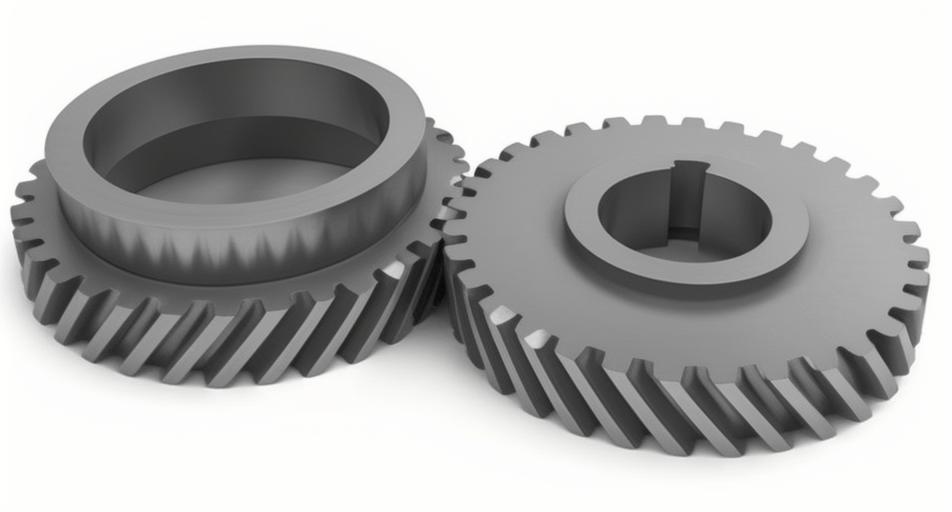
The time-varying contact line length in helical gears is crucial for stiffness computation. Depending on whether the transverse contact ratio is greater or less than the overlap ratio, the contact line length varies. For a single tooth, the maximum contact line length \(L_{\text{max}}\) is given by:
$$L_{\text{max}} = \begin{cases} B / \cos \beta_b & \text{if } \varepsilon_\alpha > \varepsilon_\beta \\ \varepsilon_\alpha P_{bt} / \sin \beta_b & \text{if } \varepsilon_\alpha < \varepsilon_\beta \end{cases}$$
where \(B\) is the face width, \(\beta_b\) is the base helix angle, \(P_{bt}\) is the transverse base pitch, and \(\varepsilon_\alpha\) and \(\varepsilon_\beta\) are the transverse and overlap contact ratios, respectively. The instantaneous contact line length \(L\) during a mesh cycle is expressed as:
$$L = \begin{cases} \frac{L_{\text{max}}}{\varepsilon_1 t_z} t & t \in [0, \varepsilon_1 t_z] \\ L_{\text{max}} & t \in [\varepsilon_1 t_z, \varepsilon_2 t_z] \\ \frac{L_{\text{max}}}{\varepsilon_1} \left( \varepsilon_1 + \varepsilon_2 – \frac{t}{t_z} \right) & t \in [\varepsilon_2 t_z, (\varepsilon_1 + \varepsilon_2) t_z] \end{cases}$$
with \(\varepsilon_1 = \min(\varepsilon_\alpha, \varepsilon_\beta)\), \(\varepsilon_2 = \max(\varepsilon_\alpha, \varepsilon_\beta)\), and \(t_z\) as the mesh period. This variation directly impacts the stiffness of helical gears.
For the stiffness components, the Hertzian contact stiffness \(k_h\) for helical gears is derived as:
$$k_h = \frac{\pi E L}{4(1 – \nu^2)}$$
where \(E\) is Young’s modulus and \(\nu\) is Poisson’s ratio. The bending stiffness \(k_b\), shear stiffness \(k_s\), and axial compressive stiffness \(k_a\) are calculated using the slice-integral method. When the base circle radius is greater than the root circle radius, the corrected bending stiffness for a helical gear slice is:
$$k_b = \sum_{i=1}^{N} \left[ \int_{\alpha_2}^{-\alpha_1′} \frac{3(\alpha_2 – \alpha) \cos \alpha}{2E [\sin \alpha + (\alpha_2 – \alpha) \cos \alpha]^3 \Delta y} \left(1 + \cos \alpha_1′ [(\alpha_2 – \alpha) \sin \alpha – \cos \alpha] \right)^2 d\alpha + \int_{0}^{r_b – r_f} \frac{3 \left( [d(y) + x_1] \cos \alpha_1′ – h(y) \sin \alpha_1′ \right)^2}{2E h_{x1}^3 \Delta y} dx_1 \right]^{-1}$$
Here, \(N\) is the number of slices, \(\Delta y = l/N\), \(l\) is the component of contact line length along the tooth width, \(\alpha_1’\) and \(\alpha_2\) are angular parameters depending on the slice position, \(d(y)\) and \(h(y)\) are geometric functions, and \(h_{x1}\) is the distance from a point on the root fillet to the gear centerline. Similarly, the shear stiffness is:
$$k_s = \sum_{i=1}^{N} \left[ \int_{\alpha_2}^{-\alpha_1′} \frac{1.2(1 + \nu)(\alpha_2 – \alpha) \cos \alpha \cos^2 \alpha_1′}{E [\sin \alpha + (\alpha_2 – \alpha) \cos \alpha] \Delta y} d\alpha + \int_{0}^{r_b – r_f} \frac{1.2 \cos^2 \alpha_1′}{G A_{x1} \Delta y} dx_1 \right]^{-1}$$
and the axial compressive stiffness is:
$$k_a = \sum_{i=1}^{N} \left[ \int_{\alpha_2}^{-\alpha_1′} \frac{(\alpha_2 – \alpha) \cos \alpha \sin^2 \alpha_1′}{2E [\sin \alpha + (\alpha_2 – \alpha) \cos \alpha] \Delta y} d\alpha + \int_{0}^{r_b – r_f} \frac{\sin^2 \alpha_1′}{E A_{x1} \Delta y} dx_1 \right]^{-1}$$
where \(G\) is the shear modulus, and \(A_{x1}\) is the cross-sectional area. When the base circle radius is less than the root circle radius, the integration limits are adjusted to avoid overestimation. The fillet foundation stiffness \(k_f\) for helical gears is:
$$k_f = \sum_{i=1}^{N} \left[ \frac{\cos^2 \alpha_1′}{E \Delta y} \left( L^* \left( \frac{u_f}{S_f} \right)^2 + M^* \left( \frac{u_f}{S_f} \right) + P^* (1 + Q^* \tan^2 \alpha_1′) \right) \right]^{-1}$$
with \(L^*, M^*, P^*, Q^*\) as coefficients derived from polynomial approximations based on gear geometry. The total mesh stiffness \(k\) for a helical gear pair is then the combination of these components in parallel:
$$k = \left( \frac{1}{k_h} + \frac{1}{k_{b1} + k_{s1} + k_{a1} + k_{f1}} + \frac{1}{k_{b2} + k_{s2} + k_{a2} + k_{f2}} \right)^{-1}$$
where subscripts 1 and 2 denote the driving and driven helical gears, respectively.
To validate the corrected algorithm, I compared its results with the ISO 6336-1-2006 standard and finite element method (FEM) simulations. Two helical gear pairs were analyzed: one with a base circle radius greater than the root circle radius (e.g., 20 teeth) and another with the opposite (e.g., 60 teeth), both with a helix angle of 15°, normal module of 3 mm, face width of 30 mm, and other standard parameters. The errors in single tooth mesh stiffness maximum \(C’\) and average mesh stiffness \(C_{\gamma m}\) are summarized below.
| Method | \(C’\) (10^8 N/m) | Error for \(C’\) (%) | \(C_{\gamma m}\) (10^8 N/m) | Error for \(C_{\gamma m}\) (%) |
|---|---|---|---|---|
| ISO Standard | 3.61 | 0.00 | 4.94 | 0.00 |
| Finite Element Method | 3.55 | 1.66 | 5.17 | 4.66 |
| Traditional Potential Energy Method | 4.01 | 11.10 | 5.60 | 13.40 |
| Proposed Correction Algorithm | 3.65 | 1.11 | 5.12 | 3.64 |
For the case where the base circle radius is less than the root circle radius, the results are:
| Method | \(C’\) (10^8 N/m) | Error for \(C’\) (%) | \(C_{\gamma m}\) (10^8 N/m) | Error for \(C_{\gamma m}\) (%) |
|---|---|---|---|---|
| ISO Standard | 4.34 | 0.00 | 6.60 | 0.00 |
| Finite Element Method | 4.36 | 0.46 | 6.83 | 3.48 |
| Traditional Potential Energy Method | 3.48 | 19.80 | 5.30 | 19.70 |
| Proposed Correction Algorithm | 4.42 | 1.84 | 6.74 | 2.12 |
The proposed algorithm shows significantly lower errors compared to the traditional potential energy method, demonstrating its improved accuracy for helical gear mesh stiffness calculation. The alignment with ISO and FEM results validates the correction for both geometric scenarios.
Next, I investigated the influence of various parameters on the mesh stiffness of helical gears. The base helical gear pair had the following parameters: normal module \(m_n = 4\) mm, helix angle \(\beta = 15°\), tooth numbers \(z_1 = z_2 = 50\), face width \(B = 50\) mm, normal pressure angle \(\alpha_n = 20°\), and no profile shift. Each parameter was varied individually to analyze its effect on contact ratios, single tooth stiffness, and total mesh stiffness fluctuation \(\Delta C_\gamma\).
The helix angle \(\beta\) is a critical parameter for helical gears. As \(\beta\) increases, the transverse contact ratio \(\varepsilon_\alpha\) decreases slightly, while the overlap ratio \(\varepsilon_\beta\) increases, leading to a higher total contact ratio \(\varepsilon_\gamma\). The contact ratios for different helix angles are:
| Helix Angle \(\beta\) (°) | Transverse Contact Ratio \(\varepsilon_\alpha\) | Overlap Ratio \(\varepsilon_\beta\) | Total Contact Ratio \(\varepsilon_\gamma\) |
|---|---|---|---|
| 6 | 1.741 | 0.416 | 2.157 |
| 9 | 1.723 | 0.622 | 2.346 |
| 12 | 1.699 | 0.827 | 2.526 |
| 15 | 1.668 | 1.030 | 2.698 |
| 18 | 1.630 | 1.230 | 2.860 |
| 21 | 1.586 | 1.426 | 3.012 |
The mesh stiffness fluctuation \(\Delta C_\gamma\) varies with \(\beta\). When \(\varepsilon_\beta\) is near an integer (e.g., \(\beta = 15°\) with \(\varepsilon_\beta \approx 1.030\)), \(\Delta C_\gamma\) is minimized, whereas when \(\varepsilon_\gamma\) is near an integer, \(\Delta C_\gamma\) peaks. This indicates that for helical gears, stiffness fluctuation is more sensitive to the overlap ratio than the total contact ratio. The single tooth mesh stiffness maximum remains relatively stable, but the engagement duration changes based on the ratio of \(\varepsilon_\alpha\) to \(\varepsilon_\beta\), affecting the relative time of the engaging-in section.
The normal module \(m_n\) and tooth number \(z\) are interrelated, especially when the center distance is fixed. Increasing \(z\) (and decreasing \(m_n\) accordingly) raises both \(\varepsilon_\alpha\) and \(\varepsilon_\beta\), with \(\varepsilon_\beta\) growing faster. This increases the relative engagement time and slightly elevates the average mesh stiffness due to higher contact ratios. The single tooth stiffness maximum shows little change. When \(\varepsilon_\beta\) is near an integer (e.g., \(z = 50\)), \(\Delta C_\gamma\) is low; when \(\varepsilon_\gamma\) is near an integer (e.g., \(z = 70\)), \(\Delta C_\gamma\) is high. The relationship can be summarized as:
$$C_{\gamma m} \propto \varepsilon_\gamma, \quad \Delta C_\gamma \propto f(\varepsilon_\beta, \varepsilon_\gamma)$$
where \(f\) denotes a functional dependence on contact ratios.
Face width \(B\) directly affects the overlap ratio \(\varepsilon_\beta\) for helical gears, as \(\varepsilon_\beta = B \tan \beta / ( \pi m_n )\). Increasing \(B\) boosts \(\varepsilon_\beta\), thereby extending the engagement time and enhancing the single tooth mesh stiffness due to reduced deformations. The average mesh stiffness \(C_{\gamma m}\) rises almost linearly with \(B\), while \(\Delta C_\gamma\) is minimized when \(\varepsilon_\beta\) is near an integer. For instance, with \(B = 50\) mm and \(\beta = 15°\), \(\varepsilon_\beta = 1.030\), resulting in low stiffness fluctuation. The stiffness components scale inversely with \(B\) for individual slices, but the total stiffness increases due to more slices in parallel.
Normal pressure angle \(\alpha_n\) influences tooth geometry: higher \(\alpha_n\) thickens the tooth root and increases the contact curvature radius. This raises the single tooth mesh stiffness maximum but reduces \(\varepsilon_\alpha\), leaving \(\varepsilon_\beta\) unchanged. The average mesh stiffness does not vary monotonically with \(\alpha_n\), as the increase in single tooth stiffness counteracts the decrease in contact ratio. The fluctuation \(\Delta C_\gamma\) remains consistently low across different \(\alpha_n\) values, as \(\varepsilon_\beta\) is unaffected. The bending stiffness, for example, can be expressed as:
$$k_b \approx \frac{E B}{\int F(\alpha_n, \text{geometry}) d\alpha}$$
where \(F\) is a function that increases with \(\alpha_n\), reflecting the geometric effect.
To quantify the parametric effects, I performed a series of calculations varying each parameter systematically. The results for mesh stiffness fluctuation \(\Delta C_\gamma\) and average stiffness \(C_{\gamma m}\) are summarized below for key parameter ranges.
| Parameter Variation | Range | Effect on \(\Delta C_\gamma\) | Effect on \(C_{\gamma m}\) |
|---|---|---|---|
| Helix Angle \(\beta\) | 6° to 21° | Minimized when \(\varepsilon_\beta \approx\) integer; maximized when \(\varepsilon_\gamma \approx\) integer | Nearly constant |
| Tooth Number \(z\) (with adjusted \(m_n\)) | 30 to 80 | Low when \(\varepsilon_\beta \approx\) integer; high when \(\varepsilon_\gamma \approx\) integer | Slight increase with \(z\) |
| Face Width \(B\) | 30 mm to 80 mm | Minimized when \(\varepsilon_\beta \approx\) integer | Linear increase |
| Normal Pressure Angle \(\alpha_n\) | 15° to 25° | Consistently low | Non-monotonic, slight variation |
The underlying mechanism for these trends lies in the contact line dynamics of helical gears. The time-varying contact line length \(L(t)\) determines the load distribution and deformation energy. For instance, the total potential energy \(U\) for a helical gear pair can be approximated as:
$$U = \int_0^L \left( \frac{F^2}{2k_h} + \frac{F^2}{2k_b(y)} + \frac{F^2}{2k_s(y)} + \frac{F^2}{2k_a(y)} + \frac{F^2}{2k_f(y)} \right) dy$$
where \(F\) is the mesh force, and \(k_b(y)\), etc., are stiffness components per slice. Minimizing stiffness fluctuation involves optimizing \(L(t)\) through parameter selection to smooth the energy variation.
In practical helical gear design, the proposed correction algorithm offers a reliable tool for predicting mesh stiffness without extensive FEM simulations. By accurately modeling the root-circle and base-circle misalignment, it enables precise calculation of stiffness excitation, which is vital for dynamic analysis. The parametric study reveals that designers should aim for overlap ratios near integers to reduce stiffness fluctuation and enhance system stability, contrary to the common focus solely on total contact ratio. For example, selecting a helix angle that yields \(\varepsilon_\beta \approx 1\) or 2 can significantly lower vibration levels in helical gear transmissions.
In conclusion, this study presents a corrected algorithm for computing the time-varying mesh stiffness of helical gears, addressing limitations of the traditional potential energy method. The algorithm incorporates detailed geometric considerations and validates well against ISO standards and finite element analysis. Through extensive parametric investigation, I have demonstrated how helix angle, module, tooth number, face width, and pressure angle influence the stiffness behavior of helical gears. Key findings include the importance of overlap ratio in controlling stiffness fluctuation and the non-intuitive relationship between total contact ratio and vibration excitation. These insights contribute to the optimal design of helical gear systems for reduced noise and improved dynamic performance. Future work could extend this approach to include effects of manufacturing errors, such as misalignments or profile modifications, further enhancing the accuracy for real-world helical gear applications.