
As a researcher deeply involved in gear transmission theory, I have focused on developing practical solutions for complex gear systems. One particularly intriguing system is the offset swing cone drive, a type of spatial planetary mechanism. This drive offers unique advantages, including a simple structure, a high transmission ratio, excellent efficiency, and significant load-bearing capacity, leading to its growing application in various fields. The core of this mechanism is a pair of offset internal straight bevel gears. However, the complex tooth surface geometry and the lack of viable manufacturing methods have long been significant obstacles. The primary challenge stems from the fact that the internal bevel gear, when developed on its back cone, equates to an internal spur gear with a concave tooth profile. Conventional straight bevel gear generators operate on the “plane generating gear” principle, which inherently produces convex teeth. To bridge this gap, my research delves into the meshing theory of this specific gear pair and proposes a novel manufacturing approach: form-cutting the large gear (internal bevel gear) and generating the small gear (external bevel gear) with a modified, crowned tooth surface. This method is grounded in second-order generation theory, aiming to create a localized conjugate contact pattern, theoretically a point contact, with ideal second-order meshing characteristics at a specified reference point to ensure superior transmission performance and meshing quality. In this article, I will elaborate on this new method for machining internal bevel gear pairs using a standard bevel gear planer, demonstrating how machine tool adjustments can control both the position and the shape of the contact pattern.
The fundamental challenge in manufacturing the internal member of this gear pair is its concave tooth form. Standard generating methods are not directly applicable. Therefore, my proposed solution begins with a non-generative, form-cutting process for the internal bevel gear. This involves effectively removing the generating motion between the imaginary crown gear (the cradle) and the workpiece on a standard bevel gear planer.
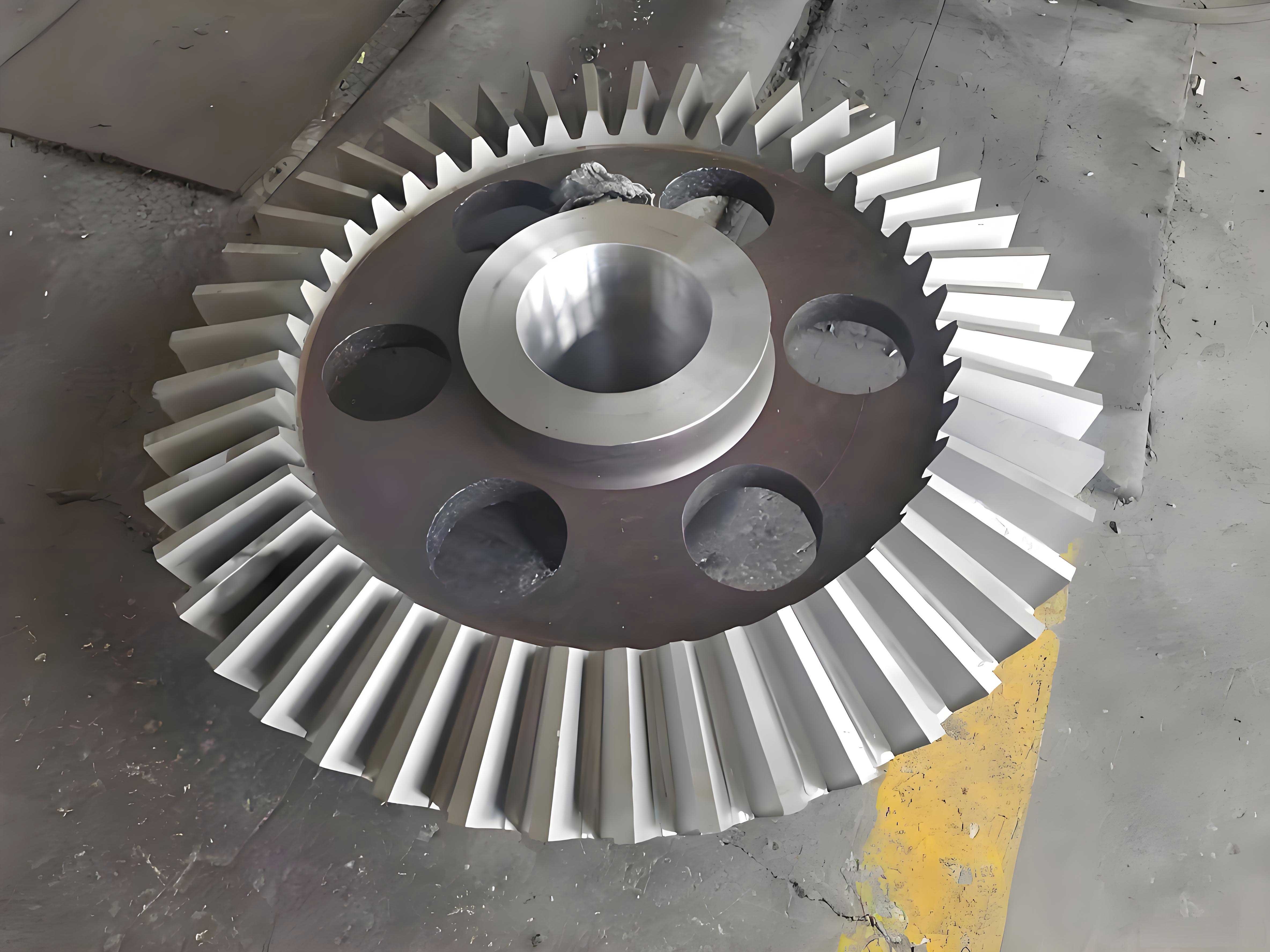
Consider a fixed coordinate system \( S_g \) attached to the imaginary generating gear and another \( S_2 \) attached to the workpiece (the internal gear). A secondary fixed frame \( S_t \) is established on the tooth surface of the generating gear. The planar surface \( \Sigma_t \), formed by the reciprocating cutting tool, represents the generating gear’s tooth surface, also known as the imaginary tool surface. Its vector equation in \( S_t \) is:
$$ \mathbf{r}_t^{(t)} = (u, v, 0)^T $$
where \( u \) and \( v \) are parameters on \( \Sigma_t \).
Transforming this equation from \( S_t \) to \( S_2 \) yields the tooth surface equation of the large (internal) gear:
$$ \mathbf{r}_2^{(2)} = M_{2t} \mathbf{r}_t^{(t)} = (x_2, y_2, z_2)^T $$
where \( M_{2t} \) is the transformation matrix from \( S_t \) to \( S_2 \). After simplification, the resulting surface is explicitly a plane, confirming that the large gear is a tapered internal bevel gear with a planar tooth flank, denoted as \( \Sigma_2 \).
Machining the External Pinion: Theoretical Surface and Crown Modification
The small gear (external pinion), denoted as \( \Sigma_1 \), is to be generated using the principle of a plane generating gear, but with crucial modifications to achieve a crowned profile for localized contact with \( \Sigma_2 \).
Theoretical Generated Surface
In the standard generation process, we define fixed coordinate systems \( S_g, S_1 \) and moving systems \( S_c, S_p \) for the cradle and workpiece, respectively. An auxiliary moving frame \( S_t \) is attached to the generating gear tooth surface. The tool surface contact line equation is transformed into \( S_1 \) and combined with the kinematic equation of generation. The theoretical tooth surface of the pinion, before modification, is given by:
$$ \mathbf{r}_1^{(1)}(u, v, \phi_c) = M_{1c}(\phi_c) M_{ct} \mathbf{r}_t^{(t)}(u, v) $$
where \( \phi_c \) is the cradle rotation angle (the generating motion parameter), and \( M_{1c}, M_{ct} \) are transformation matrices. This surface, if fully conjugated, would theoretically lead to line contact, which is sensitive to misalignment.
Second-Order Geometry at the Reference Point
The core of the new method is to intentionally create a localized bearing contact by modifying the pinion tooth surface based on second-order analysis. Let us select a reference point \( M \) on the pinion surface \( \Sigma_1 \) and its conjugate point on the gear surface \( \Sigma_2 \). We introduce three independent parameters to control the second-order meshing behavior at \( M \):
1. \( \alpha_1 \): The rate of change of the instantaneous transmission ratio (\( d i_{12} / d t \)).
2. \( \beta_1 \): The angle between the contact path tangent and the pitch cone element (toe-to-heel line).
3. \( \ell \): The major axis length of the instantaneous contact ellipse projected onto the tooth length direction.
These three parameters uniquely determine the second-order characteristics of \( \Sigma_1 \). According to gear meshing theory, when the reference point \( M \) is located on the pitch cone element, the following relationships hold concerning the relative normal curvatures and torsion:
$$ k_n^{(12)} = k_n^{(1)} – k_n^{(2)} $$
$$ \tau_g^{(12)} = \tau_g^{(1)} – \tau_g^{(2)} $$
The values of \( k_n^{(12)} \) and \( \tau_g^{(12)} \) are governed by the chosen \( \alpha_1, \beta_1, \ell \) and the kinematics at \( M \). Since \( \Sigma_2 \) is a plane (\( k_n^{(2)} = 0, \tau_g^{(2)} = 0 \)), we can directly solve for the required principal curvatures and directions of \( \Sigma_1 \) at \( M \) to achieve the desired localized contact pattern. This calculated surface is then approximated by a crowned tooth generated through specific machine tool adjustments.
Analysis and Implementation of Crown Modification
To produce a crowned (barreled) tooth profile on the pinion, the basic generating process must be altered by changing the so-called “rolling” or “machine” cone relative to the theoretical design cone. This results in the apex of the cutting cone \( O_c \) being offset from the apex of the theoretical design cone \( O_1 \). The crown amount is controlled by this offset. The key machine tool adjustment parameters for this purpose are summarized below:
| Adjustment Parameter | Symbol | Definition & Effect | Typical Calculation/Value |
|---|---|---|---|
| Cone Apex Offset | \( \Delta X \) | Distance between machine cone apex \( O_c \) and design cone apex \( O_1 \). Positive increases crown. | \( \Delta X \approx \kappa R_{e1} \), where \( \kappa \) is crown coefficient (0.01-0.02), \( R_{e1} \) is outer cone distance. |
| Machine Center to Back (MCB) | \( \Delta E_m \) | Radial setting of the workpiece. Changes with \( \Delta X \). | \( \Delta E_m = \Delta X \sin \delta_1′ \) \( \Delta X_m = \Delta X \cos \delta_1′ \) (axial shift). |
| Crown Amount | \( \Delta_{cr} \) | Deviation from a straight element at tooth ends. | \( \Delta_{cr} \approx \frac{b^2}{8 R_m} \tan(\Delta \delta_1) \), where \( b \) is face width, \( R_m \) is mean cone distance. |
| Machine Root Angle Change | \( \Delta \gamma_m \) | Adjustment to the root angle setting on the machine. | \( \Delta \gamma_m = \arctan(\Delta X / R_{e1}) \). |
| Ratio of Roll (Change) | \( i_m \) | Modified rolling ratio between cradle and workpiece. | \( i_m = \frac{\sin(\delta_1′ + \Delta \gamma_m)}{\sin \delta_1′} i \) (where \( i \) is design ratio). |
| Blank Offset (Swivel) | \( \Delta J \) | Vertical displacement of the workpiece. Retreat is positive. | \( \Delta J = -\Delta X_m \sin \gamma_1 \). |
| Tool Tilt (Setting Angle) | \( \lambda_t \) | Angular adjustment of the cutting tool. | \( \lambda_t = \arctan\left( \frac{s}{2R_{e1} \sin \alpha_0} \right) – \Delta \gamma_m \), where \( s \) is tooth thickness, \( \alpha_0 \) is tool pressure angle. |
| Tool Lateral Shift | \( \Delta q \) | Horizontal displacement of the tool blade. Moving away from center is positive. | \( \Delta q = \Delta J / \tan \alpha_0 \). |
To derive the mathematical model of the crowned pinion tooth surface \( \Sigma_1^c \), we establish coordinate systems. Let \( S_f(O_f; x_f, y_f, z_f) \) be the fixed machine frame. Another moving frame \( S_c(O_c; x_c, y_c, z_c) \) is attached to the cradle/tool. The unit vectors describing the tool surface orientation in \( S_c \) are:
$$ \mathbf{t} = (-\sin \alpha_0, 0, -\cos \alpha_0)^T \quad \text{(tooth profile direction)} $$
$$ \mathbf{n} = (\cos \alpha_0, 0, -\sin \alpha_0)^T \quad \text{(surface normal)} $$
where \( \alpha_0 \) is the tool pressure angle. Let \( \phi_c \) be the cradle rotation angle and \( l \) be a parameter along the tooth length from the center. The position vector of a point on the tool edge in \( S_c \) is \( \mathbf{r}_c^{(c)}(l) \). Incorporating all machine adjustments \( (\Delta X, \Delta J, \Delta q, \lambda_t, \Delta \gamma_m) \), the transformation to the fixed frame \( S_f \) is:
$$ \mathbf{r}_f^{(f)}(l, \phi_c) = M_{fc}(\phi_c, \Delta \gamma_m) \left[ \mathbf{r}_c^{(c)}(l) + \begin{pmatrix} \Delta q \\ 0 \\ 0 \end{pmatrix} \right] + \begin{pmatrix} 0 \\ \Delta J \\ \Delta X_m \end{pmatrix} $$
Here, \( M_{fc} \) is a composite rotation matrix accounting for cradle rotation \( \phi_c \) and the modified root angle \( \gamma_m = \gamma_1 + \Delta \gamma_m \). The generated crowned surface \( \Sigma_1^c \) is the envelope of this family of curves, satisfying the equation of meshing \( \mathbf{n}_c \cdot \mathbf{v}_c^{(cf)} = 0 \), where \( \mathbf{v}_c^{(cf)} \) is the relative velocity. Eliminating \( \phi_c \) using this condition yields the final crowned pinion surface equation \( \mathbf{r}_1^c(l) \).
Design Considerations and Parameter Calculation Example
The described method inherently produces a localized bearing contact. The length of this contact zone relative to the full face width, often termed the contact ratio \( \epsilon_L \), is a critical design parameter, typically aimed for \( \epsilon_L \approx 0.6 – 0.8 \). The crown amount \( \Delta_{cr} \) is usually controlled within a range related to the module \( m_n \), such as \( 0 < \Delta_{cr} \leq 0.02 m_n \) or \( \Delta_{cr} = 0.01 b \) for finer control.
Let us consider a numerical example to illustrate the adjustment calculation. Assume an offset swing cone drive pair with the following basic design parameters:
| Parameter | Symbol | Gear (Internal) | Pinion (External) |
|---|---|---|---|
| Number of Teeth | \( z \) | \( z_2 = 42 \) | \( z_1 = 40 \) |
| Shaft Angle | \( \Sigma \) | \( \Sigma = 90^\circ \) (This configuration is a special case often referred to as miter gears) | |
| Module (at large end) | \( m \) | \( m = 4 \, \text{mm} \) | |
| Face Width | \( b \) | \( b = 30 \, \text{mm} \) | |
| Pitch Cone Angle | \( \delta \) | \( \delta_2 = 46.4^\circ \) | \( \delta_1 = 43.6^\circ \) |
| Outer Cone Distance | \( R_e \) | \( R_{e2} \approx 115.7 \, \text{mm} \) | \( R_{e1} \approx 115.7 \, \text{mm} \) |
| Root Angle | \( \gamma \) | \( \gamma_2 = 3.0^\circ \) | \( \gamma_1 = 3.0^\circ \) |
For the pinion crown modification, we choose a crown coefficient \( \kappa = 0.015 \). The machine adjustments are calculated step-by-step:
- Cone Apex Offset: \( \Delta X = \kappa R_{e1} = 0.015 \times 115.7 = 1.736 \, \text{mm} \).
- Machine Root Angle Change: \( \Delta \gamma_m = \arctan(\Delta X / R_{e1}) = \arctan(1.736 / 115.7) \approx 0.86^\circ \). Thus, \( \gamma_m = \gamma_1 + \Delta \gamma_m = 3.86^\circ \).
- Machine Center to Back (MCB):
$$ \Delta E_m = \Delta X \sin \delta_1′ = 1.736 \times \sin(43.6^\circ) \approx 1.195 \, \text{mm} $$
$$ \Delta X_m = \Delta X \cos \delta_1′ = 1.736 \times \cos(43.6^\circ) \approx 1.256 \, \text{mm} $$ - Crown Amount Estimation (at tooth ends):
Mean cone distance \( R_m = R_{e1} – b/2 = 115.7 – 15 = 100.7 \, \text{mm} \).
$$ \Delta_{cr} \approx \frac{b^2}{8 R_m} \tan(\Delta \gamma_m) = \frac{30^2}{8 \times 100.7} \times \tan(0.86^\circ) \approx 0.017 \, \text{mm} $$
This value is within the acceptable range (\( < 0.02m = 0.08 \, \text{mm} \)). - Blank Offset (Swivel): \( \Delta J = -\Delta X_m \sin \gamma_1 = -1.256 \times \sin(3.0^\circ) \approx -0.066 \, \text{mm} \).
- Tool Lateral Shift (assuming \( \alpha_0 = 20^\circ \)): \( \Delta q = \Delta J / \tan \alpha_0 = -0.066 / \tan(20^\circ) \approx -0.181 \, \text{mm} \).
These calculated parameters would be set on the bevel gear planer to generate the crowned pinion. The contact pattern on the test gear pair must then be inspected and the parameters (especially \( \Delta X \) and \( \Delta \gamma_m \)) fine-tuned iteratively to achieve the optimal size, shape, and location of the bearing contact. It is important to note that while the example uses a \( 90^\circ \) shaft angle (miter gears), the method is fully applicable to any shaft angle required for offset swing cone drives.
Conclusion and Outlook
The novel machining method presented here offers a practical solution for manufacturing the critical internal bevel gear pair used in offset swing cone drives. By combining form-cutting for the internal gear with a second-order theory-based crown modification for the external pinion, the challenges associated with concave tooth generation are overcome. The method leverages standard bevel gear planers, making it accessible. The derived adjustment formulas provide a direct pathway to control the second-order contact characteristics, enabling the design of a robust localized bearing pattern that is less sensitive to assembly errors and load-induced deflections. This approach is not limited to swing cone drives but can also be adapted for other applications requiring high-performance, non-standard bevel gear sets, including specific configurations of highly loaded miter gears. Future work will involve extensive manufacturing trials and loaded transmission testing to fully validate the predicted contact patterns, dynamic performance, and load capacity of gear pairs produced with this methodology.