
The hypoid bevel gear is a critical and widely used transmission component in vehicle powertrains. However, the design and manufacturing of hypoid bevel gears are among the most complex tasks in gear engineering. The design process encompasses three main areas: overall geometrical parameter design, tooth surface parameter design, and machine tool setting calculation. Traditional methods for determining the geometrical parameters of hypoid bevel gears, such as following the 150-step Gleason calculation sheet, often involve numerous reference numbers and sequential calculations. This approach, while effective, can obscure the underlying design principles from the engineer, making the process seem like a “black box.” Mastering the fundamental principles of hypoid bevel gear geometry is paramount to achieving high-quality designs. This article introduces and elaborates on a new, more intuitive geometrical design method based on a clear understanding of the pitch cone relationship. This methodology streamlines the determination of both pitch cone parameters and the subsequent geometric structural parameters of the hypoid gear pair.
The core of hypoid bevel gear geometry lies in the relationship between its two pitch cones. These cones are in tangency and contact along a line, and they also serve as the reference cones for defining the gear blank dimensions. The complete geometrical relationship is illustrated in the figures below, which are essential for understanding the derivation of our fundamental equations.
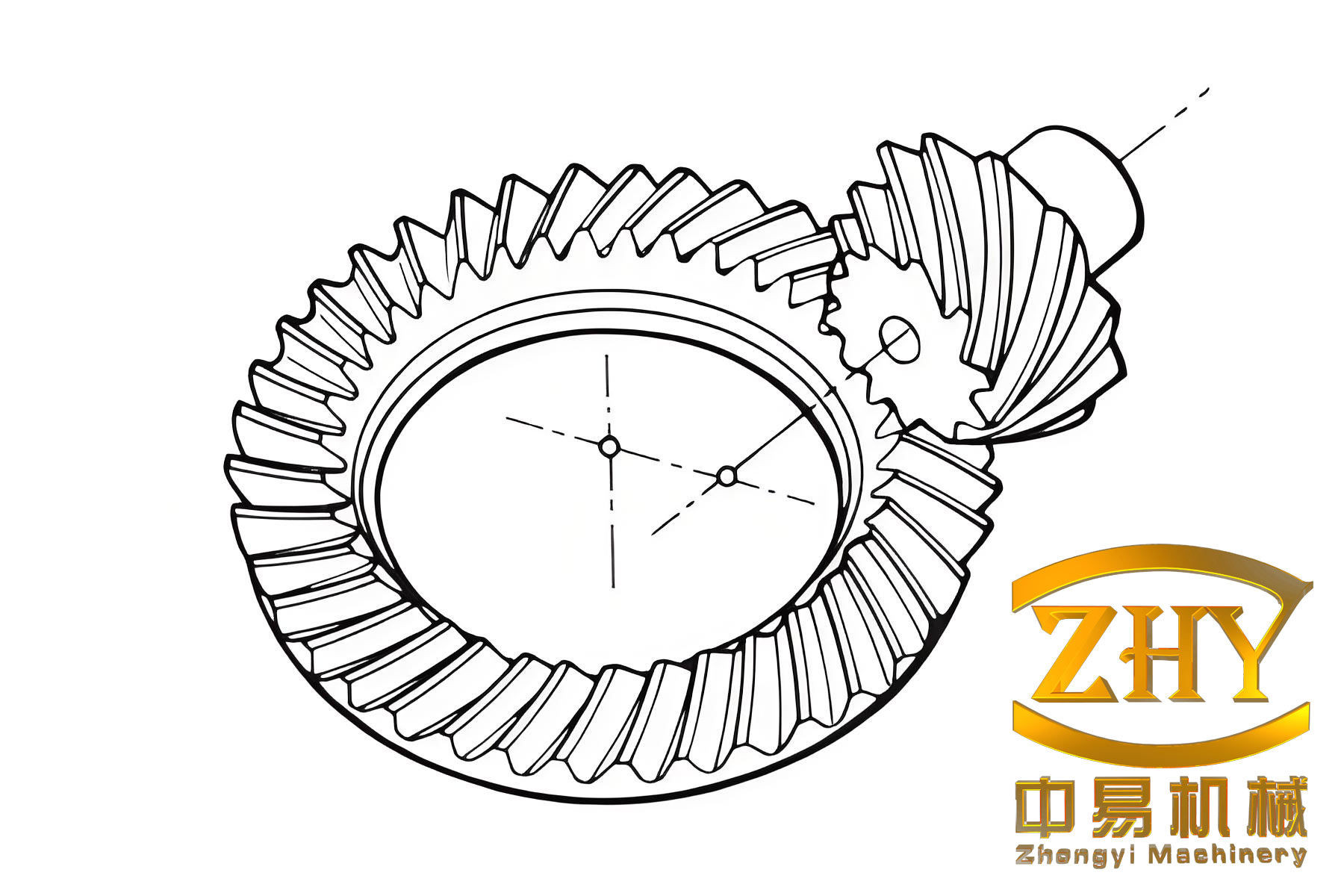
In the established model, $a_1$ and $a_2$ represent the axes of the pinion and gear, respectively. The shortest distance between these two skewed axes is the offset, denoted as $E$. The angle between the axes is the shaft angle, $\Sigma$. The pitch cones contact at point $P$. The radii at this point are the pitch radii: $r_1$ for the pinion and $r_2$ for the gear. The pitch angles are $\delta_1$ and $\delta_2$. The pitch plane $T$ is tangent to both cones at $P$. A line through $P$, perpendicular to plane $T$, intersects the axes at points $K_1$ and $K_2$. The axial section of the pinion, plane $\pi_1$, is defined by line $K_1K_2$ and axis $a_1$. Similarly, the gear axial section $\pi_2$ is defined by $K_1K_2$ and $a_2$. The angle between the projection of the pinion axis onto the pitch plane and the pitch line is the spiral angle $\beta_1$; for the gear, it is $\beta_2$. A crucial intermediate parameter is the offset angle $\epsilon$, defined in the pitch plane.
Through detailed spatial geometric analysis of these relationships, we can derive a set of fundamental equations that govern the pitch cone geometry of a hypoid bevel gear pair. These equations are the foundation of the new design method:
$$
\sin \theta = \frac{\cos \delta_1 \sin \epsilon}{\sin \Sigma}
$$
$$
\sin \gamma = \frac{\cos \delta_2 \sin \epsilon}{\sin \Sigma}
$$
$$
E = \frac{(r_1 \cos \delta_2 + r_2 \cos \delta_1) \sin \epsilon}{\sin \Sigma}
$$
$$
\cos \Sigma = \cos \delta_1 \cos \delta_2 \cos \epsilon – \sin \delta_1 \sin \delta_2
$$
$$
\beta_1 = \beta_2 + \epsilon
$$
$$
\frac{z_2}{z_1} = \frac{r_2 \cos \beta_2}{r_1 \cos \beta_1}
$$
The last four equations above are particularly critical and are collectively referred to as the Fundamental Equation Set for Hypoid Pitch Cone Parameters. This set contains seven primary variables: $r_1$, $r_2$, $\delta_1$, $\delta_2$, $\beta_1$, $\beta_2$, and $\epsilon$. For a given gear pair, the offset $E$, shaft angle $\Sigma$, and tooth counts $z_1$ and $z_2$ are typically known design constraints. With four equations and seven unknowns, we have three degrees of freedom. The selection of these three free variables is strategic. In this methodology, we choose the gear pitch radius $r_2$, the gear pitch angle $\delta_2$, and the pinion mean spiral angle $\beta_1$ as the primary design variables. The offset angle $\epsilon$ is treated as an iterative variable. The solution process involves assuming an initial value for $\epsilon$ within the plausible range $[0, \beta_1]$ and using a numerical root-finding algorithm, such as the bisection method, to solve the equation set for the remaining parameters ($r_1$, $\delta_1$, $\beta_2$). This approach is computationally stable and guarantees a solution.
Once the pitch cone parameters are determined, additional parameters defining the axial locations of the cone apexes are needed. The distance from the gear pitch cone apex $O_2$ to the crossing point of its axis with the common perpendicular $C_2$ is $G_2$, and for the pinion, it is $G_1$. They can be calculated as follows. First, auxiliary variables $Q_2$, $\theta$, and $\gamma$ are used:
$$
Q_2 = \frac{E}{\tan \gamma \sin \Sigma}
$$
$$
G_2 = \frac{r_2}{\sin \delta_2 \cos \delta_2} – Q_2 = \frac{r_2}{\sin \delta_2 \cos \delta_2} – \frac{E}{\tan \gamma \sin \Sigma}
$$
$$
G_1 = \frac{r_1}{\sin \delta_1 \cos \delta_1} – \frac{E}{\tan \theta \sin \Sigma}
$$
Alternatively, $G_1$ can be found from the consistent geometric relation:
$$
\frac{E}{\cos \delta_1 \cos \delta_2 \sin \epsilon} \sin \Sigma = G_1 \sin \delta_1 + G_2 \sin \delta_2
$$
The determination of pitch cone parameters can thus be summarized in the following procedural table:
| Step | Parameter/Action | Equation / Method | Note |
|---|---|---|---|
| 1 | Input Fixed Parameters | $E, \Sigma, z_1, z_2$ | Design constraints. |
| 2 | Choose Free Variables | $r_2$, $\delta_2$, $\beta_1$ | Primary design choices. |
| 3 | Iterative Variable | $\epsilon$ (initial guess in [0, $\beta_1$]) | Solved for numerically. |
| 4 | Solve Fundamental Set | Eqs. for $\cos \Sigma$, $\beta_1=\beta_2+\epsilon$, $z_2/z_1$, and $E$ | Find $r_1$, $\delta_1$, $\beta_2$. Bisection method is reliable. |
| 5 | Calculate Auxiliary Angles | $\gamma = \arcsin(\frac{\cos \delta_2 \sin \epsilon}{\sin \Sigma})$, $\theta = \arcsin(\frac{\cos \delta_1 \sin \epsilon}{\sin \Sigma})$ | For apex location calculations. |
| 6 | Determine Apex Locations | $G_2 = \frac{r_2}{\sin \delta_2 \cos \delta_2} – \frac{E}{\tan \gamma \sin \Sigma}$, $G_1$ from Eq. (7) or (6) | Locates pitch cone vertices along axes. |
Following the establishment of the pitch cone geometry, the next phase is the design of the geometric structural parameters. These parameters define the actual blank dimensions of the hypoid bevel gear, including the tip and root cone angles, the axial locations of these cones, and the resulting face widths and outer dimensions. A fundamental principle guiding this phase is that, ignoring clearance, the pinion tip cone should be tangent to the gear root cone, and the pinion root cone should be tangent to the gear tip cone. This principle ensures meshing without interference and allows us to treat these cone pairs as if they were pitch cones of imaginary hypoid bevel gear pairs, applying the same fundamental geometrical relationships.
First, we determine the gear’s tip and root cone parameters based on its defined addendum and dedendum. The gear mean cone distance is $R_2 = r_2 / \sin \delta_2$. The gear tip angle $\alpha_{a2}$ and root angle $\alpha_{f2}$ are calculated from the pitch angle and the gear’s own face angle $\Gamma_{a2}$ and root angle $\Gamma_{f2}$: $\delta_{a2} = \delta_2 + \Gamma_{a2}$ and $\delta_{f2} = \delta_2 – \Gamma_{f2}$. The axial distances from the crossing point $C_2$ to the gear tip and root cone apexes ($O_{d2}$ and $O_{c2}$) are crucial and are given by:
$$
G_{a2} = G_2 – \frac{R_2 \sin \Gamma_{a2} – h_{a2} \cos \Gamma_{a2}}{\sin \delta_{a2}}
$$
$$
G_{f2} = G_2 + \frac{R_2 \sin \Gamma_{f2} – h_{f2} \cos \Gamma_{f2}}{\sin \delta_{f2}}
$$
where $h_{a2}$ and $h_{f2}$ are the gear mean addendum and dedendum, respectively.
The determination of the pinion’s corresponding parameters is more involved, as it relies on the tangency condition with the gear’s cones. We consider the pinion tip cone and gear root cone as a pair. For this imaginary pair, we assume the gear’s “pitch” point remains at the same radius $r_2$ but its “pitch” angle is now $\delta_{f2}$. We calculate an equivalent offset distance $Q_{f2}$ from the gear axis to a new reference point:
$$
Q_{f2} = \frac{\cos \Gamma_{f2}}{\cos \delta_{f2}} R_2 – G_2
$$
From this, we can find an equivalent auxiliary angle $\gamma_f$ and then an equivalent offset angle $\epsilon_{cf}$ for this imaginary pair:
$$
\tan \gamma_f = \frac{E}{Q_{f2} \sin \Sigma}, \quad \sin \epsilon_{cf} = \frac{\sin \gamma_f \sin \Sigma}{\cos \delta_{f2}}
$$
Applying the fundamental relationship $\cos \Sigma = \cos \delta_{a1} \cos \delta_{f2} \cos \epsilon_{cf} – \sin \delta_{a1} \sin \delta_{f2}$, we can solve for the pinion tip angle $\delta_{a1}$. Subsequently, the distance $G_{a1}$ from pinion tip cone apex to crossing point $C_1$ is found by applying the apex location formula to this imaginary pair and then subtracting the clearance term:
$$
G_{a1} = \frac{1}{\sin \delta_{a1}} \left( \frac{E}{\cos \delta_{a1} \cos \delta_{f2} \sin \epsilon_{cf}} \sin \Sigma – G_{f2} \sin \delta_{f2} – c \right)
$$
where $c$ is the desired clearance.
The process for the pinion root cone is perfectly analogous, using the gear tip cone ($\delta_{a2}$, $G_{a2}$) as the mating cone. We define $Q_{a2} = \frac{\cos \Gamma_{a2}}{\cos \delta_{a2}} R_2 – G_2$, then $\tan \gamma_a = \frac{E}{Q_{a2} \sin \Sigma}$, and $\sin \epsilon_{ca} = \frac{\sin \gamma_a \sin \Sigma}{\cos \delta_{a2}}$. The pinion root angle $\delta_{f1}$ is solved from $\cos \Sigma = \cos \delta_{f1} \cos \delta_{a2} \cos \epsilon_{ca} – \sin \delta_{f1} \sin \delta_{a2}$. Finally, its apex location is:
$$
G_{f1} = \frac{1}{\sin \delta_{f1}} \left( \frac{E}{\cos \delta_{f1} \cos \delta_{a2} \sin \epsilon_{ca}} \sin \Sigma – G_{a2} \sin \delta_{a2} – c \right)
$$
Other important structural parameters like the crown-to-crossing distances ($Z_{a1}$, $Z_{a2}$), which are essential for housing design, can be easily derived from the cone angles and apex locations. For the gear:
$$
Z_{a2} = \frac{R_{e2} – (G_2 – G_{a2}) \cos \delta_2}{\cos \Gamma_{a2}} \cos \delta_{a2} – G_{a2}
$$
where $R_{e2} = R_2 + b_2/2$ is the gear outer cone distance and $b_2$ is the gear face width. A similar formula applies for the pinion crown distance $Z_{a1}$.
The entire sequence for calculating the geometric structural parameters of a hypoid bevel gear pair is systematized in the following table. This table serves as a practical design calculation sheet derived from the new methodology.
| Parameter Group | Symbol | Formula / Calculation Step | Description |
|---|---|---|---|
| Gear Cone Parameters | $\delta_{a2}$ | $\delta_2 + \Gamma_{a2}$ | Gear tip (face) angle. |
| $R_2$ | $r_2 / \sin \delta_2$ | Gear mean cone distance. | |
| $G_{a2}$ | $G_2 – \frac{R_2 \sin \Gamma_{a2} – h_{a2} \cos \Gamma_{a2}}{\sin \delta_{a2}}$ | Distance from crossing point $C_2$ to gear tip apex. | |
| $\delta_{f2}$ | $\delta_2 – \Gamma_{f2}$ | Gear root angle. | |
| $G_{f2}$ | $G_2 + \frac{R_2 \sin \Gamma_{f2} – h_{f2} \cos \Gamma_{f2}}{\sin \delta_{f2}}$ | Distance from crossing point $C_2$ to gear root apex. | |
| $Z_{a2}$ | $\frac{R_{e2} – (G_2 – G_{a2}) \cos \delta_2}{\cos \Gamma_{a2}} \cos \delta_{a2} – G_{a2}$ | Gear crown to crossing point distance. | |
| Pinion Cone Parameters (via Gear Root Cone) | $Q_{f2}$ | $\frac{\cos \Gamma_{f2}}{\cos \delta_{f2}} R_2 – G_2$ | Auxiliary distance for imaginary pair (pinion tip/gear root). |
| $\gamma_f$ | $\arctan( E / (Q_{f2} \sin \Sigma) )$ | Auxiliary angle. | |
| $\epsilon_{cf}$ | $\arcsin( \sin \gamma_f \sin \Sigma / \cos \delta_{f2} )$ | Equivalent offset angle for imaginary pair. | |
| $\delta_{a1}$ | Solve: $\cos \Sigma = \cos \delta_{a1} \cos \delta_{f2} \cos \epsilon_{cf} – \sin \delta_{a1} \sin \delta_{f2}$ | Pinion tip angle. | |
| $G_{a1}$ | $\frac{1}{\sin \delta_{a1}} \left( \frac{E}{\cos \delta_{a1} \cos \delta_{f2} \sin \epsilon_{cf}} \sin \Sigma – G_{f2} \sin \delta_{f2} – c \right)$ | Distance from crossing point $C_1$ to pinion tip apex. | |
| $Q_{a2}$ | $\frac{\cos \Gamma_{a2}}{\cos \delta_{a2}} R_2 – G_2$ | Auxiliary distance for imaginary pair (pinion root/gear tip). | |
| $\gamma_a$ | $\arctan( E / (Q_{a2} \sin \Sigma) )$ | Auxiliary angle. | |
| $\epsilon_{ca}$ | $\arcsin( \sin \gamma_a \sin \Sigma / \cos \delta_{a2} )$ | Equivalent offset angle for imaginary pair. | |
| $\delta_{f1}$ | Solve: $\cos \Sigma = \cos \delta_{f1} \cos \delta_{a2} \cos \epsilon_{ca} – \sin \delta_{f1} \sin \delta_{a2}$ | Pinion root angle. | |
| $G_{f1}$ | $\frac{1}{\sin \delta_{f1}} \left( \frac{E}{\cos \delta_{f1} \cos \delta_{a2} \sin \epsilon_{ca}} \sin \Sigma – G_{a2} \sin \delta_{a2} – c \right)$ | Distance from crossing point $C_1$ to pinion root apex. | |
| Pinion Crown | $Z_{a1}$ | $\frac{R_{e1} – (G_1 – G_{a1}) \cos \delta_1}{\cos \Gamma_{a1}} \cos \delta_{a1} – G_{a1}$ | Pinion crown to crossing point distance. ($R_{e1}=R_1+b_1/2$) |
To validate the effectiveness and practicality of this new geometrical design method for hypoid bevel gears, let’s consider a numerical example. A hypoid gear pair is specified with the following basic data: pinion teeth $z_1=7$, gear teeth $z_2=38$, offset $E=35 \text{ mm}$, shaft angle $\Sigma=90^\circ$. Using the pitch cone determination method with chosen free variables $r_2=165.5893 \text{ mm}$, $\delta_2=77.3591667^\circ$, and $\beta_1=45^\circ$, the solution yields: $r_1=33.9231 \text{ mm}$, $\delta_1=12.3758333^\circ$, $\beta_2=33.0593469^\circ$, and $\epsilon=11.9406531^\circ$. Further given data for structural calculation includes clearance $c=2.021 \text{ mm}$, gear face angle $\Gamma_{a2}=0.6636146^\circ$, gear root angle $\Gamma_{f2}=4.4413744^\circ$, gear mean addendum $h_{a2}=1.708531 \text{ mm}$, dedendum $h_{f2}=13.455399 \text{ mm}$, gear face width $b_2=45 \text{ mm}$, and pinion face width $b_1=50 \text{ mm}$.
Applying the formulas from the structural parameter design tables produces the following complete set of geometrical parameters. The calculations are straightforward and follow a clear logical sequence, demonstrating the method’s reliability.
| Calculated Parameter | Symbol | Value | Unit |
|---|---|---|---|
| Gear Mean Cone Distance | $R_2$ | 169.7027159 | mm |
| Gear Tip Angle | $\delta_{a2}$ | 78.0227813 | ° |
| Distance $C_2$ to Gear Tip Apex | $G_{a2}$ | 29.9864511 | mm |
| Gear Root Angle | $\delta_{f2}$ | 72.9177923 | ° |
| Distance $C_2$ to Gear Root Apex | $G_{f2}$ | 29.9632504 | mm |
| Pinion Tip Angle | $\delta_{a1}$ | 16.7308875 | ° |
| Distance $C_1$ to Pinion Tip Apex | $G_{a1}$ | -91.7577835 | mm |
| Pinion Root Angle | $\delta_{f1}$ | 11.7253356 | ° |
| Distance $C_1$ to Pinion Root Apex | $G_{f1}$ | -117.0804749 | mm |
| Gear Crown to Crossing Distance | $Z_{a2}$ | 36.8907355 | mm |
| Pinion Crown to Crossing Distance | $Z_{a1}$ | 183.7756172 | mm |
In conclusion, the geometrical design of hypoid bevel gears is significantly complex due to the axis offset. A deep comprehension of the spatial relationships between the pitch cones and other defining cones is the key to flexible and high-quality design. The methodology presented here demystifies this process by establishing a clear set of fundamental equations derived directly from the pitch cone geometry of the hypoid bevel gear pair. This system of equations allows for the reliable and convenient determination of all pitch cone parameters through a well-defined numerical procedure with carefully chosen free variables. Furthermore, by applying the same fundamental geometrical principles to the imaginary cone pairs formed by the tip and root cones (under the tangency condition), we can derive a complete and elegant set of formulas for all necessary geometric structural parameters. This new method, validated by the example, provides a solid theoretical foundation and a practical, systematic calculation framework for the geometrical design of hypoid bevel gears, enhancing both understanding and design efficiency.