
Introduction:
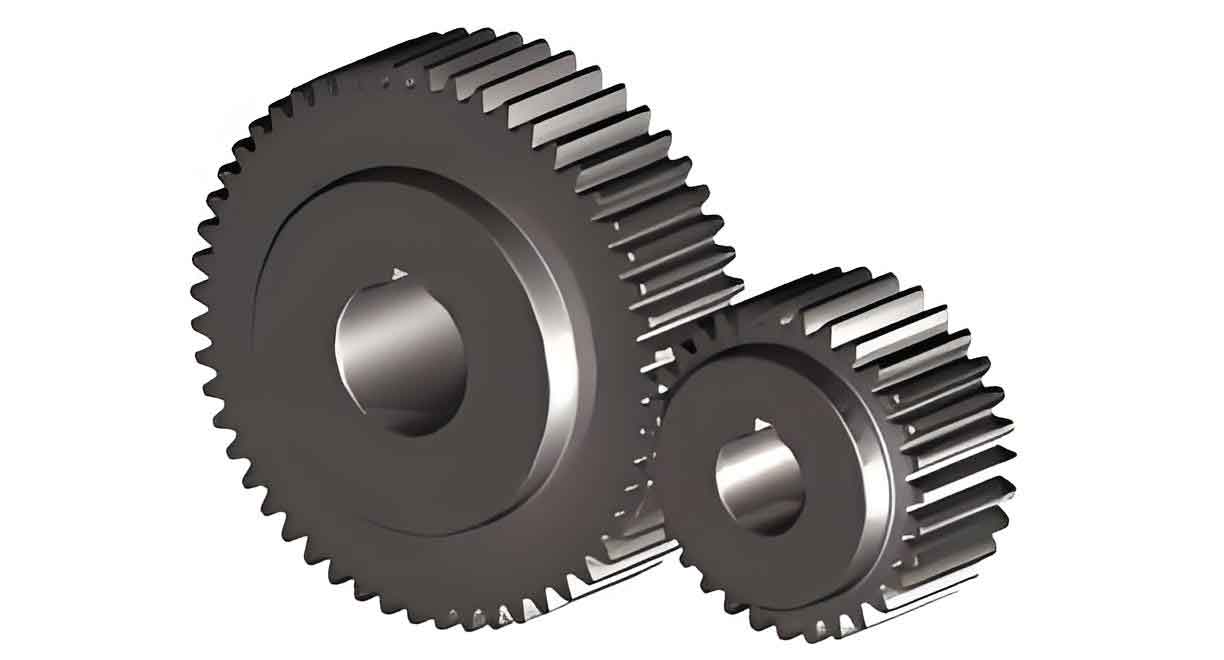
The contact stress within the transmission process of involute spur gears, particularly focusing on modified gears with displacement. Spur gears are one of the most common types of gears used in mechanical systems due to their high efficiency, long lifespan, and stable transmission ratio. However, the performance and lifespan of these gears are highly dependent on their contact stress during operation.
Theoretical Background:
Contact stress plays a pivotal role in determining the longevity and reliability of gear systems. This section elaborates on the Hertzian stress theory, which is fundamental in gear analysis. By applying Hertz’s formulas, I calculate the maximum contact stress during gear meshing and examine the variations in contact stress depending on factors like gear tooth number, transmission ratio, and displacement coefficient.
The maximum contact stress can be derived from the following formula:σHi=KFnπb(1ρ1i+1ρ2i)\sigma_{H_i} = \frac{K F_n}{\pi b \left(\frac{1}{\rho_{1i}} + \frac{1}{\rho_{2i}}\right)}σHi=πb(ρ1i1+ρ2i1)KFn
Where:
- σHi\sigma_{H_i}σHi is the contact stress at any point iii.
- FnF_nFn is the normal force.
- ρ1i\rho_{1i}ρ1i and ρ2i\rho_{2i}ρ2i represent the radii of curvature of the two meshing teeth at point iii.
Contact Stress and Tooth Number:
A crucial finding from this analysis is that the ratio of the maximum contact stress to the node contact stress (referred to as the stress ratio) is sensitive to the number of teeth on the small gear (denoted as Z1Z_1Z1) and the transmission ratio (denoted as uuu).
Stress Ratio Behavior:
- For small gear tooth number Z1Z_1Z1 greater than 17: As the number of teeth increases, the stress ratio decreases.
- For Z1Z_1Z1 less than 17: The stress ratio increases with the increase in the number of teeth.
- When Z1=17Z_1 = 17Z1=17: The stress ratio reaches its maximum value.
The formula for the stress ratio is:λ=σHmaxσHP=utan2α′(1+u)tanα′−tanα1+2π\lambda = \frac{\sigma_{H_{\text{max}}}}{\sigma_{H_P}} = \frac{u \tan^2 \alpha’}{(1 + u) \tan \alpha’ – \tan \alpha_1 + 2\pi}λ=σHPσHmax=(1+u)tanα′−tanα1+2πutan2α′
Stress Ratio with Transmission Ratio:
Transmission ratio uuu also significantly affects the stress ratio. As uuu increases, the stress ratio increases, which indicates a higher potential for gear failure if the maximum contact stress exceeds the material strength.
Design Considerations:
In gear design, particularly for spur gears, the design criterion often involves ensuring that the maximum contact stress is at least 8% higher than the node contact stress. This threshold ensures that gears are sufficiently robust for operation under high loads. Based on the stress ratio analysis, precise contact strength calculations are required when the stress ratio exceeds 8%.
Table 1: Conditions for Precise Contact Fatigue Strength Design
| Small Gear Teeth Number (Z1) | Transmission Ratio (u ≥) | Stress Ratio (λ ≥) |
|---|---|---|
| 23 | 11.2 | 1.080 |
| 22 | 5.3 | 1.080 |
| 21 | 4.3 | 1.083 |
| 20 | 3.2 | 1.080 |
| 19 | 2.6 | 1.081 |
| 18 | 2.2 | 1.082 |
| 17 | 1.8 | 1.080 |
Numerical Example and Finite Element Verification:
In the practical application, the design of a gear pair with input power of 10 kW, a transmission ratio of 3, and a small gear speed of 960 rpm is analyzed. The example uses alloy steel for the small gear and carbon steel for the large gear. The parameters include elastic modulus values, Poisson’s ratio, and a load correction coefficient.
The result of this analysis using the finite element method (FEM) validates the calculated stress ratio:
- The maximum stress at the interface of the gears, using FEM simulations, is in close agreement with the theoretical calculations.
Conclusion:
The study concludes that the maximum contact stress of involute spur gears in modified gear transmissions can be accurately calculated using the derived formulas. The contact stress ratio serves as a crucial factor in determining the reliability and lifespan of the gear system. A stress ratio greater than 8% between the maximum and node contact stress necessitates precise design considerations to avoid premature gear failure.
This research contributes valuable insights into the design and failure prediction of spur gears, offering a practical approach to ensuring the strength and longevity of gear systems in industrial applications.