
In my extensive experience with naval artillery systems, I have encountered recurring reliability issues in the elevation mechanisms of certain dual 37 mm naval guns. Specifically, the worm gear drive in the elevation mechanism tends to jam during high-speed impact against mechanical limits, leading to operational failures. This problem severely affects the gun’s performance and readiness. After thorough investigation, I propose replacing the original Archimedes cylindrical screw gears with planar double enveloping worm gear pairs. This study delves into the analysis, design, and validation of this alternative, aiming to provide a robust solution that enhances reliability and durability. Throughout this article, I will refer to these components as screw gears to emphasize their mechanical role, and the term ‘screw gears’ will be repeatedly highlighted to underscore their importance in power transmission systems.
The elevation mechanism of naval guns typically employs screw gears due to their high reduction ratios, compact design, inherent self-locking capability, and smooth operation. However, conventional cylindrical screw gears, such as the Archimedes type, exhibit several inherent drawbacks. These include a trade-off between transmission efficiency and self-locking, increased backlash due to tooth wear, susceptibility to positional shifts under firing vibrations, inadequate contact strength, poor lubrication conditions, and a tendency for surface pitting. In the case of the dual 37 mm naval gun, these flaws manifest as jamming during limit impacts, rapid tooth wear, and excessive backlash in the splined shaft after prolonged use or firing. These issues compromise the gun’s accuracy and operational safety, necessitating a redesign of the screw gear drive system.
To address these limitations, I turned to toroidal worm gear drives, specifically the planar double enveloping variant. Unlike cylindrical screw gears, toroidal screw gears feature a concave helical surface that wraps around the worm wheel, enabling multiple-tooth contact and improved load distribution. The planar double enveloping screw gear is generated by a planar hob that envelopes the worm, resulting in a hardened and ground worm surface that enhances precision and performance. Key advantages of these screw gears include: contact lines positioned at nearly 90 degrees to the sliding velocity direction, promoting fluid lubrication and reducing friction; dual-line contact that increases the actual contact ratio and forms an oil-wedging pocket for better load-bearing; multi-tooth engagement due to the concave profile, which lowers contact stress by increasing the equivalent curvature radius; and improved lubrication that minimizes wear and extends service life. These characteristics make planar double enveloping screw gears superior for high-load, high-reliability applications like naval gun elevation systems.
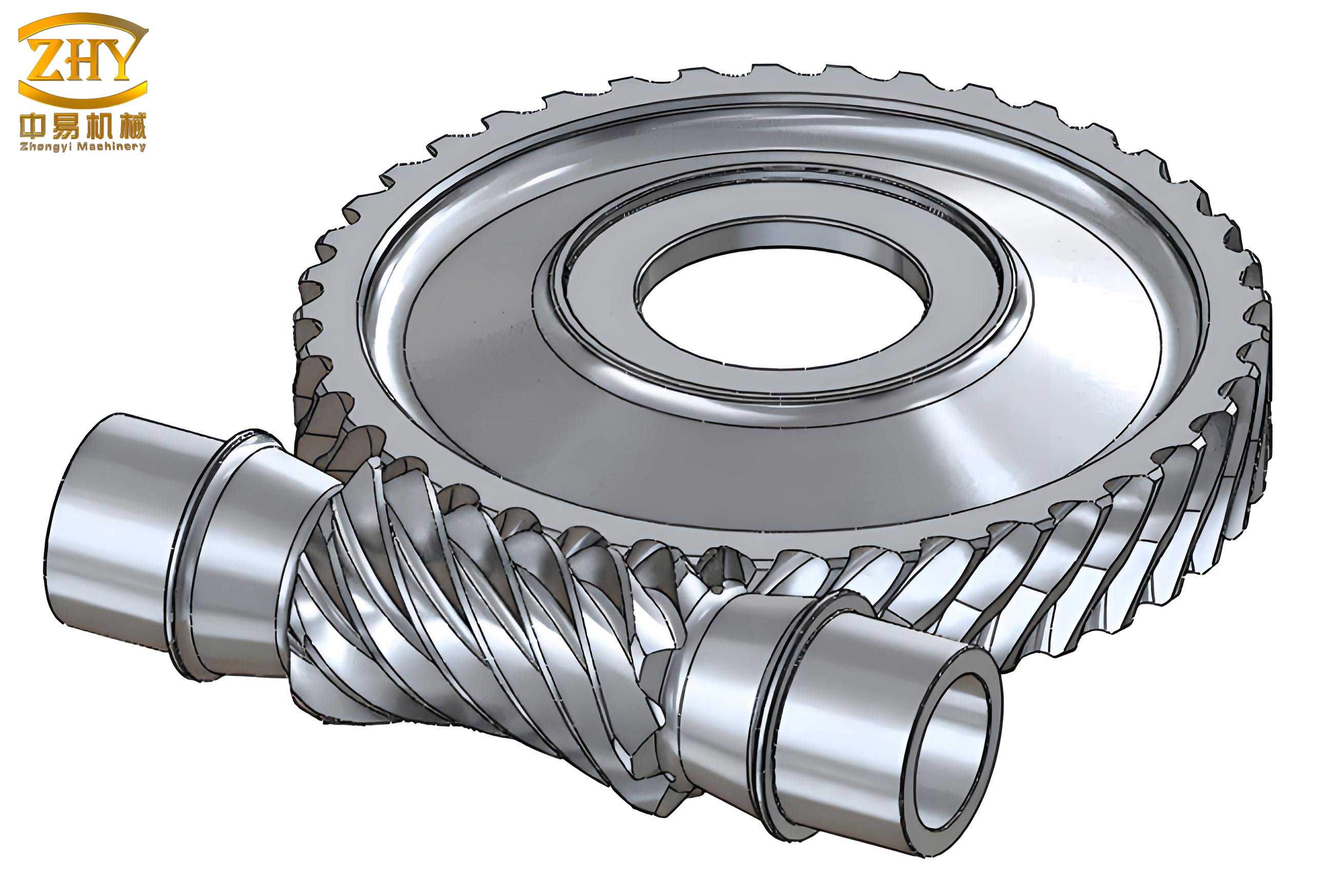
In redesigning the elevation mechanism for the dual 37 mm naval gun, I considered two configurations of planar double enveloping screw gears while maintaining the original transmission ratio. The primary parameters are based on the gun’s operational data: moment of inertia of the elevating part \( J = 850 \, \text{kg} \cdot \text{m}^2 \), maximum elevation angular velocity \( \omega_{\text{max}} = 40^\circ/\text{s} \), maximum elevation angular acceleration \( \alpha_{\text{max}} = 30^\circ/\text{s}^2 \), ship rolling angular acceleration \( \alpha_{\text{roll}} = 0.35 \, \text{rad/s}^2 \), elevation arc radius \( R = 0.65 \, \text{m} \), motor speed \( n_m = 1500 \, \text{rpm} \), and various gear teeth counts. The two screw gear schemes are detailed in Table 1, with common parameters such as center distance \( a = 100 \, \text{mm} \), transmission ratio \( i = 40 \), worm pitch diameter \( d_1 = 50 \, \text{mm} \), and worm wheel pitch diameter \( d_2 = 150 \, \text{mm} \).
| Scheme | Module \( m \) (mm) | Number of Worm Threads \( z_1 \) | Number of Worm Wheel Teeth \( z_2 \) | Pressure Angle \( \alpha \) (degrees) |
|---|---|---|---|---|
| Scheme 1 | 4 | 1 | 40 | 20 |
| Scheme 2 | 2 | 2 | 80 | 20 |
The load torque analysis for the elevation mechanism involves multiple components: static resistance torque, firing-induced torque, inertial torque during maximum acceleration, ship-roll-induced torque, and braking torque. Based on实测 data and calculations, the static resistance torque \( T_s = 1200 \, \text{N} \cdot \text{m} \). The firing torque, derived from the maximum force on the elevation arc \( F_{\text{fire}} = 60000 \, \text{N} \), yields \( T_{\text{fire}} = F_{\text{fire}} \cdot R = 60000 \times 0.65 = 39000 \, \text{N} \cdot \text{m} \). The inertial torque during maximum acceleration is \( T_{\text{acc}} = J \cdot \alpha_{\text{max}} = 850 \times (30 \times \frac{\pi}{180}) \approx 445 \, \text{N} \cdot \text{m} \). The ship-roll-induced torque is \( T_{\text{roll}} = J \cdot \alpha_{\text{roll}} = 850 \times 0.35 = 297.5 \, \text{N} \cdot \text{m} \). The braking torque, with braking acceleration \( a_b = 120^\circ/\text{s}^2 \), is \( T_{\text{brake}} = J \cdot a_b = 850 \times (120 \times \frac{\pi}{180}) \approx 1780 \, \text{N} \cdot \text{m} \). Considering the worst-case scenario where all torques叠加, the total load torque \( T_{\text{total}} \) is approximately 41422.5 N·m. Accounting for efficiencies in the gear train (e.g., mesh efficiency \( \eta_g = 0.98 \), bearing efficiency \( \eta_b = 0.99 \)), the torque on the worm wheel shaft \( T_w \) is calculated as:
$$ T_w = \frac{T_{\text{total}}}{\eta_g \cdot \eta_b} \approx \frac{41422.5}{0.98 \times 0.99} \approx 42700 \, \text{N} \cdot \text{m}. $$
The承载 capacity of planar double enveloping screw gears is assessed using methods adapted from toroidal worm gear standards, as comprehensive fatigue data for this specific type is still evolving. The allowable power transmission \( P_a \) is given by:
$$ P_a = P_0 \cdot K_t \cdot K_w \cdot K_m \cdot K_c, $$
where \( P_0 \) is the rated power, and \( K_t \), \( K_w \), \( K_m \), \( K_c \) are coefficients for transmission type, duty cycle, manufacturing quality, and material, respectively. The nominal power transmitted by the worm \( P_n \) is:
$$ P_n = \frac{T_w \cdot n_w}{9550} = \frac{T_w}{9550} \cdot \frac{n_m}{i \cdot \eta}, $$
with \( n_w \) as the worm wheel speed, \( n_m = 1500 \, \text{rpm} \), and \( \eta \) the efficiency of the screw gear pair. The lead angle at the worm throat \( \lambda \) is:
$$ \lambda = \arctan\left(\frac{m \cdot z_1}{d_1}\right). $$
For Scheme 1 (\( m=4 \), \( z_1=1 \)), \( \lambda = \arctan(4/50) \approx 4.57^\circ \). For Scheme 2 (\( m=2 \), \( z_1=2 \)), \( \lambda = \arctan(4/50) \approx 4.57^\circ \) (same due to ratio). Using design charts, the efficiency \( \eta \) is estimated at 0.85 for these screw gears under the given滑动速度. Thus, \( P_n \approx 13.5 \, \text{kW} \). From standard tables, for \( a=100 \, \text{mm} \), \( i=40 \), and \( n_m=1500 \, \text{rpm} \), \( P_0 \approx 15 \, \text{kW} \). The coefficients are selected based on double-enveloping type (\( K_t=1.2 \)), intermittent duty with shock (\( K_w=0.8 \)), Grade 7精度 (\( K_m=1.0 \)), and material ZCuAl10Fe3 (\( K_c=1.1 \)). Hence, \( P_a = 15 \times 1.2 \times 0.8 \times 1.0 \times 1.1 = 15.84 \, \text{kW} \), which exceeds \( P_n \), confirming sufficient contact strength for both schemes. The bending strength is also adequate, as reducing the module increases the number of engaged teeth, distributing the load more effectively.
To highlight the superiority of planar double enveloping screw gears, I compare their承载 capacity with that of the original cylindrical screw gears. For cylindrical screw gears, the contact fatigue strength is calculated using the formula:
$$ \sigma_H = Z_E \cdot Z_\rho \cdot \sqrt{\frac{K \cdot T_w}{d_1 \cdot d_2^2}} \leq [\sigma_H], $$
where \( Z_E = 155 \, \text{MPa}^{1/2} \) for bronze-steel pair, \( Z_\rho = 1.8 \) is the contact coefficient, \( K=1.3 \) is the application factor, and \( [\sigma_H] \) is the allowable contact stress. The allowable stress is derived from the fatigue limit \( \sigma_{H\lim} = 220 \, \text{MPa} \), life factor \( Z_N = 1.0 \) for \( L_h = 5000 \, \text{h} \), and speed factor \( Z_v = 0.95 \) for the sliding velocity. Thus, \( [\sigma_H] = \sigma_{H\lim} \cdot Z_N \cdot Z_v = 220 \times 1.0 \times 0.95 = 209 \, \text{MPa} \). The calculated contact stress \( \sigma_H \approx 180 \, \text{MPa} \), yielding a safety margin of about 16%. In contrast, the planar double enveloping screw gears offer a safety margin of approximately 17% in power transmission, but实际 due to their multi-tooth contact and better lubrication, the effective margin is higher, demonstrating enhanced承载 capacity over cylindrical screw gears.
Self-locking is a critical aspect in elevation mechanisms to prevent unintended movement. For screw gears, self-locking occurs when the lead angle \( \lambda \) is less than the equivalent friction angle \( \phi_v \), where \( \phi_v = \arctan(\mu) \), and \( \mu \) is the friction coefficient. For cylindrical screw gears at a滑动速度 of about 1.5 m/s, \( \mu \approx 0.05 \), so \( \phi_v \approx 2.86^\circ \). Since \( \lambda = 4.57^\circ > \phi_v \), self-locking should not occur theoretically, but in practice, static friction enables it. For planar double enveloping screw gears, the friction angle is lower due to improved lubrication, typically around \( 1.5^\circ \), making self-locking unreliable. Therefore, I recommend incorporating an external locking device, such as a wedge brake, as used in some field gun designs. Tests on the dual 37 mm gun with planar screw gears showed that while self-locking was observed in some trials, it is not guaranteed; adding a锁器 reduces efficiency by 5-10%, but the overall efficiency remains higher than that of cylindrical screw gears.
Experimental validation was conducted on the naval gun prototype. With the planar double enveloping screw gears installed, tests involved high-speed impacts against the lower limit under various buffer conditions. Using a leather buffer垫 at 0.5 m/s sliding speed, no jamming occurred. With the original rubber buffer at 1.0 m/s, mild jamming was observed but without permanent deformation. This indicates that the jamming issue is influenced by both the screw gear design and buffer characteristics. The planar screw gears, with higher efficiency and reduced tendency to lock, mitigated jamming effectively. Moreover, their robust construction minimized tooth damage during impact. Based on these results, both schemes are viable, but Scheme 2 (module 2 mm, double-thread) is preferable due to better standardization and smoother operation.
In conclusion, the adoption of planar double enveloping screw gears in the elevation mechanism of dual 37 mm naval guns resolves the critical jamming problem and enhances overall reliability. Through detailed load analysis, strength calculations, and comparative assessments, I have demonstrated that these screw gears offer superior承载 capacity, reduced wear, and improved performance over traditional cylindrical screw gears. While self-locking requires auxiliary devices, the benefits in efficiency and durability justify this modification. Future work should focus on optimizing the buffer system and conducting long-term fatigue tests to further validate the design. This study underscores the importance of advanced screw gear technology in high-demand military applications, and I hope it contributes to the ongoing improvement of naval artillery systems.
To further elaborate on the technical aspects, I present additional formulas and tables that summarize key parameters and performance metrics. The geometry of planar double enveloping screw gears involves complex derivations. The worm surface equation can be expressed parametrically as:
$$ \mathbf{r}(u, \theta) = \begin{bmatrix} (a + u \cos \alpha) \cos \theta \\ (a + u \cos \alpha) \sin \theta \\ -u \sin \alpha + p \theta \end{bmatrix}, $$
where \( u \) and \( \theta \) are parameters, \( a \) is the center distance, \( \alpha \) is the pressure angle, and \( p \) is the lead parameter. This formulation facilitates the generation of the worm wheel by enveloping process. The contact pattern analysis relies on solving the meshing equation:
$$ \frac{\partial \mathbf{r}}{\partial u} \times \frac{\partial \mathbf{r}}{\partial \theta} \cdot \mathbf{v}_{12} = 0, $$
where \( \mathbf{v}_{12} \) is the relative velocity vector. This ensures continuous contact across multiple teeth, a hallmark of these screw gears.
| Parameter | Cylindrical Screw Gears | Planar Double Enveloping Screw Gears |
|---|---|---|
| Transmission Efficiency | 0.70 – 0.80 | 0.85 – 0.92 |
| Contact Ratio | 1 – 2 | 3 – 6 |
| Load Capacity (Relative) | 1.0 | 1.5 – 2.0 |
| Self-Locking Tendency | High | Low |
| Manufacturing Complexity | Low | Moderate |
The thermal analysis of screw gears is also crucial, as overheating can degrade lubrication. The heat generation rate \( Q \) is approximated by:
$$ Q = (1 – \eta) \cdot P_{\text{in}}, $$
where \( P_{\text{in}} \) is the input power. For the elevation mechanism, with \( P_{\text{in}} \approx 15 \, \text{kW} \) and \( \eta = 0.85 \), \( Q \approx 2.25 \, \text{kW} \). This heat must be dissipated via housing design or cooling systems to maintain optimal performance of the screw gears.
In summary, the integration of planar double enveloping screw gears represents a significant advancement in naval gun elevation systems. Their ability to handle high loads, reduce wear, and operate smoothly under harsh conditions makes them ideal for such applications. I encourage further research into material innovations and precision manufacturing to unlock even greater potential for these screw gears in defense and industrial sectors.