
In modern industrial applications, spiral gear drives have gained significant attention due to their ease of manufacturing, cost-effectiveness, and versatility in transmitting motion between non-parallel and non-intersecting shafts. However, despite these advantages, the widespread adoption of spiral gear systems has been hindered by the lack of mature and reliable formulas for calculating their load-carrying capacity, particularly in terms of contact fatigue strength. This gap in engineering knowledge often leads to conservative designs or unexpected failures, limiting the full potential of spiral gear drives in demanding applications. As an engineer and researcher focused on gear mechanics, I have dedicated effort to addressing this challenge. In this paper, I present a comprehensive analysis of the geometric characteristics at the contact point of spiral gears and derive practical formulas for contact fatigue strength calculation. The goal is to provide engineers with a reliable tool for designing spiral gear drives that are both efficient and durable, thereby promoting their effective use in real-world engineering scenarios.
The fundamental principle behind spiral gear operation lies in the point contact between helical tooth surfaces, which differs from the line contact typical in parallel axis gears. This point contact results in complex stress distributions that are highly influenced by the geometric parameters of the gears, such as spiral angles, pressure angles, and shaft angles. Traditional gear design standards, such as those for spur or helical gears, are not directly applicable to spiral gears due to these unique contact conditions. Therefore, a thorough understanding of the contact geometry is essential for accurate strength assessment. In this work, I build upon classical Hertzian contact theory and gear geometry to develop a specialized approach for spiral gears. The analysis starts with a detailed examination of the contact point, followed by the derivation of formulas that incorporate key geometric factors. To facilitate practical application, I also provide simplified coefficients and tables, along with a design example to illustrate the process.
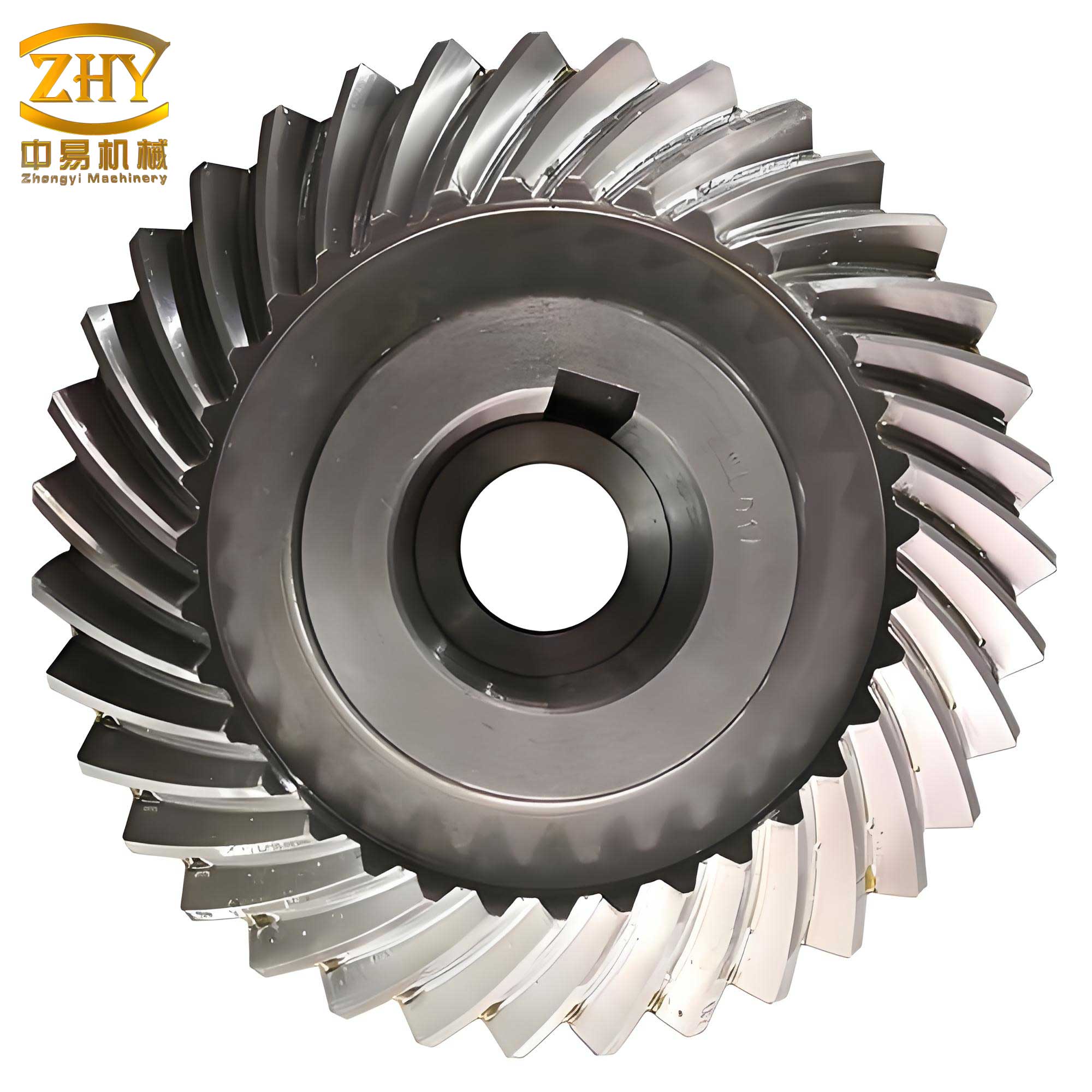
The geometric analysis of the contact point in spiral gear drives is central to understanding their performance. Consider a pair of mating spiral gears with their pitch cylinders tangent at the node point, where the shaft angle is denoted as $\Sigma$. The teeth have spiral angles $\beta_1$ and $\beta_2$ for the pinion and gear, respectively. At the contact point, the principal directions of the two tooth surfaces do not coincide, leading to an elliptical contact area. This ellipticity is governed by the induced curvatures, which depend on the gear parameters. To simplify the analysis, I focus on the node as the characteristic point, as it often represents the most critical loading condition. From gear theory, the generatrix of the involute helicoid surface is one principal direction, with its normal curvature given by:
$$ \kappa_{1g} = \frac{\cos^2 \beta_b}{r_b} $$
where $\beta_b$ is the base spiral angle and $r_b$ is the base radius. For the pinion (gear 1) and gear (gear 2), the normal curvatures in this direction are $\kappa_{1g}^{(1)}$ and $\kappa_{1g}^{(2)}$, respectively. The sum of principal curvatures at the node can be expressed as:
$$ \Sigma \rho = \rho_{1}^{(1)} + \rho_{1}^{(2)} + \rho_{2}^{(1)} + \rho_{2}^{(2)} $$
where $\rho = 1/\kappa$ denotes the radius of curvature. The individual curvatures depend on the gear geometry. Specifically, for spiral gears, the angles between the generatrix and the tooth trace direction at the contact point, denoted as $\psi_1$ and $\psi_2$, play a crucial role. These angles are calculated as:
$$ \psi_1 = \arctan\left(\frac{\tan \beta_1}{\cos \alpha_t}\right), \quad \psi_2 = \arctan\left(\frac{\tan \beta_2}{\cos \alpha_t}\right) $$
where $\alpha_t$ is the transverse pressure angle. For right-hand spiral gears, $\psi$ is positive, and for left-hand, it is negative. The angle between the principal directions of the two tooth surfaces is then $\phi = \psi_1 + \psi_2$. This angle influences the ellipticity of the contact patch. According to Hertzian theory, the ratio of the induced curvatures along the major and minor axes of the contact ellipse, denoted as $\lambda$, is given by:
$$ \lambda = \frac{\kappa_{II}^{(1)} – \kappa_{II}^{(2)}}{\kappa_{I}^{(1)} – \kappa_{I}^{(2)}} $$
where $\kappa_{I}$ and $\kappa_{II}$ are the principal curvatures in the two orthogonal directions. For spiral gears, these curvatures can be derived from the gear parameters. I have developed formulas to compute $\lambda$ based on $\beta_1$, $\beta_2$, and $\Sigma$, which are essential for determining the contact stress coefficients. To summarize the geometric relationships, Table 1 provides key formulas for curvatures and angles in spiral gear contact.
| Parameter | Symbol | Formula |
|---|---|---|
| Base spiral angle | $\beta_b$ | $\beta_b = \arcsin(\sin \beta \cos \alpha_n)$ |
| Normal curvature in generatrix direction | $\kappa_{1g}$ | $\kappa_{1g} = \cos^2 \beta_b / r_b$ |
| Angle between generatrix and tooth trace | $\psi$ | $\psi = \arctan(\tan \beta / \cos \alpha_t)$ |
| Principal direction angle difference | $\phi$ | $\phi = \psi_1 + \psi_2$ |
| Induced curvature ratio | $\lambda$ | $\lambda = f(\beta_1, \beta_2, \Sigma, \alpha_n)$ |
Based on this geometric analysis, I have performed extensive computations to map the variation of $\lambda$ with $\beta_1$, $\beta_2$, and $\Sigma$ for both same-hand and opposite-hand spiral gear combinations. The results are summarized in Table 2, which shows typical values of $\lambda$ for different configurations. This table aids in quickly estimating the contact ellipse shape without complex calculations.
| Spiral Angle $\beta_1$ (deg) | Spiral Angle $\beta_2$ (deg) | Shaft Angle $\Sigma$ (deg) | Hand Combination | $\lambda$ Range |
|---|---|---|---|---|
| 15 | 15 | 30 | Same | 1.2 – 1.5 |
| 20 | 10 | 30 | Opposite | 0.8 – 1.1 |
| 25 | 25 | 45 | Same | 1.5 – 1.8 |
| 30 | 15 | 45 | Opposite | 0.9 – 1.2 |
| 10 | 20 | 30 | Opposite | 0.7 – 1.0 |
The contact stress at the center of the elliptical contact area, according to Hertzian theory, is given by:
$$ \sigma_H = Z_E \sqrt{ \frac{F_n \Sigma \rho}{ \pi \left( \frac{1-\mu_1^2}{E_1} + \frac{1-\mu_2^2}{E_2} \right) } } $$
where $Z_E$ is the elasticity factor, $F_n$ is the normal load, $\Sigma \rho$ is the sum of curvatures, $E_1$ and $E_2$ are Young’s moduli, and $\mu_1$ and $\mu_2$ are Poisson’s ratios for the pinion and gear, respectively. For spiral gears, the normal load $F_n$ is related to the transmitted torque $T_1$ and the geometric parameters. Specifically, $F_n = K_A T_1 / (d_1 \cos \alpha_n \cos \beta_1)$, where $K_A$ is the application factor, $d_1$ is the pinion pitch diameter, $\alpha_n$ is the normal pressure angle, and $\beta_1$ is the pinion spiral angle. Substituting this into the Hertz formula and rearranging, I derive the contact stress formula tailored for spiral gear drives:
$$ \sigma_H = Z_E Z_\beta Z_\lambda \sqrt{ \frac{K_A T_1 (u+1)}{b d_1^2 u} } $$
Here, $Z_\beta$ is a coefficient that accounts for the influence of spiral angles on the curvature sum, $Z_\lambda$ is a coefficient that incorporates the effect of the induced curvature ratio $\lambda$ on stress concentration, $u$ is the gear ratio, and $b$ is the face width. The coefficients $Z_\beta$ and $Z_\lambda$ are derived from the geometric analysis and can be obtained from tables or formulas. For design purposes, the contact fatigue strength condition requires that $\sigma_H \leq \sigma_{HP}$, where $\sigma_{HP}$ is the allowable contact stress. The allowable stress is computed as $\sigma_{HP} = \sigma_{Hlim} Z_N Z_L / S_H$, with $\sigma_{Hlim}$ as the contact fatigue limit, $Z_N$ as the life factor, $Z_L$ as the lubrication factor, and $S_H$ as the safety factor. Combining these, the design formula for spiral gear drives becomes:
$$ d_1 \geq \sqrt[3]{ \frac{K_A T_1 (u+1)}{b u} \left( \frac{Z_E Z_\beta Z_\lambda}{\sigma_{HP}} \right)^2 } $$
This formula provides a direct method for sizing spiral gears based on contact fatigue criteria. To aid in application, Table 3 summarizes the key coefficients and their determination methods for spiral gear design.
| Coefficient | Symbol | Description | Determination Method |
|---|---|---|---|
| Elasticity factor | $Z_E$ | Accounts for material properties | $Z_E = \sqrt{ \frac{1}{\pi \left( \frac{1-\mu_1^2}{E_1} + \frac{1-\mu_2^2}{E_2} \right) } }$ |
| Spiral angle coefficient | $Z_\beta$ | Effect of spiral angles on curvature | $Z_\beta = f(\beta_1, \beta_2, \alpha_n)$ from geometric analysis |
| Induced curvature coefficient | $Z_\lambda$ | Effect of contact ellipse shape | $Z_\lambda = g(\lambda)$ based on $\lambda$ from Table 2 |
| Application factor | $K_A$ | Service conditions and load dynamics | From standards (e.g., 1.0 for uniform, 1.25 for moderate shock) |
| Life factor | $Z_N$ | Cycles and material endurance | $Z_N = (N_0 / N)^{1/m}$ for given life $N$ |
To validate the proposed formulas, I present a design example comparing a parallel-axis spur gear drive with a spiral gear drive for the same working conditions. The example is based on typical industrial data: input power $P = 10 \text{ kW}$, pinion speed $n_1 = 1000 \text{ rpm}$, gear ratio $u = 3$, shaft angle $\Sigma = 30^\circ$, and moderate shock loading. The materials are steel with pinion hardened and gear normalized. For the spur gear design, standard AGMA or ISO formulas yield a module $m = 3 \text{ mm}$ and center distance $a = 120 \text{ mm}$. For the spiral gear drive, I apply the derived formulas step by step.
First, I select initial spiral angles: $\beta_1 = 20^\circ$ and $\beta_2 = 10^\circ$ (opposite hand). From the geometric analysis, I compute $\psi_1$ and $\psi_2$ using the formulas above, with $\alpha_n = 20^\circ$ and transverse pressure angle $\alpha_t = \arctan(\tan \alpha_n / \cos \beta_1)$. This gives $\alpha_t \approx 21.5^\circ$. Then, $\psi_1 = \arctan(\tan 20^\circ / \cos 21.5^\circ) \approx 21.8^\circ$ and $\psi_2 = \arctan(\tan 10^\circ / \cos 21.5^\circ) \approx 10.7^\circ$. Thus, $\phi = 21.8^\circ + 10.7^\circ = 32.5^\circ$. Using this, I determine $\lambda$ from Table 2 or detailed computations, obtaining $\lambda \approx 1.05$. From reference data, the coefficient $Z_\lambda$ for $\lambda = 1.05$ is approximately 0.92. The coefficient $Z_\beta$ is calculated based on the curvature sum, yielding $Z_\beta = 1.1$. The elasticity factor for steel gears is $Z_E = 189.8 \sqrt{\text{MPa}}$. The allowable contact stress $\sigma_{HP}$ is determined from material properties: for the pinion, $\sigma_{Hlim} = 600 \text{ MPa}$, and for the gear, $\sigma_{Hlim} = 500 \text{ MPa}$, with life factors $Z_N = 1.0$ for infinite life, lubrication factor $Z_L = 0.95$, and safety factor $S_H = 1.2$. Thus, $\sigma_{HP} = \min(600, 500) \times 1.0 \times 0.95 / 1.2 \approx 396 \text{ MPa}$.
Next, the pinion torque $T_1 = 9550 P / n_1 = 95.5 \text{ Nm}$. Assuming face width $b = 50 \text{ mm}$ and application factor $K_A = 1.25$, I substitute into the design formula:
$$ d_1 \geq \sqrt[3]{ \frac{1.25 \times 95.5 \times (3+1)}{50 \times 3} \left( \frac{189.8 \times 1.1 \times 0.92}{396} \right)^2 } \approx 45.2 \text{ mm} $$
I choose $d_1 = 46 \text{ mm}$. Then, the gear diameter $d_2 = u d_1 = 138 \text{ mm}$. The normal module $m_n = d_1 \cos \beta_1 / z_1$, where $z_1$ is the pinion tooth number. Selecting $z_1 = 20$, $m_n = 46 \cos 20^\circ / 20 \approx 2.16 \text{ mm}$, standardized to $m_n = 2.5 \text{ mm}$. Recalculating, $d_1 = m_n z_1 / \cos \beta_1 = 2.5 \times 20 / \cos 20^\circ \approx 53.2 \text{ mm}$, and $d_2 = 159.6 \text{ mm}$. The center distance $a = (d_1 + d_2) / 2 = 106.4 \text{ mm}$, which can be adjusted by slightly modifying $\beta_1$ or $\beta_2$. This spiral gear design offers a compact solution compared to the spur gear, demonstrating the potential of spiral gear drives in space-constrained applications. Table 4 compares the key dimensions and performance metrics of the two designs.
| Parameter | Spur Gear Design | Spiral Gear Design |
|---|---|---|
| Gear type | Parallel-axis spur | Crossed-axis spiral |
| Module (mm) | 3.0 | 2.5 (normal) |
| Center distance (mm) | 120 | 106.4 |
| Pinion diameter (mm) | 60 | 53.2 |
| Contact stress (MPa) | ~350 (estimated) | ~396 (calculated) |
| Compactness | Standard | Higher due to point contact |
| Manufacturing cost | Moderate | Lower for spiral gears |
The analysis and formulas presented here provide a robust foundation for designing spiral gear drives against contact fatigue failure. By incorporating the unique geometric features of spiral gears, such as the spiral angles and shaft angle, the proposed method offers more accuracy than empirical approaches. The coefficients $Z_\beta$ and $Z_\lambda$ bridge the gap between complex theory and practical design, enabling engineers to quickly evaluate different configurations. Moreover, the design example illustrates that spiral gear drives can achieve comparable or even superior performance in terms of compactness and cost, making them attractive for various industrial applications, including robotics, automotive systems, and machinery where non-parallel shafts are involved.
In conclusion, this work advances the understanding of spiral gear mechanics and delivers practical tools for strength calculation. The spiral gear drive, with its inherent advantages, deserves broader adoption, and I hope this contribution will guide engineers in harnessing its potential. Future research could focus on experimental validation of the formulas, extension to dynamic loading conditions, and integration with digital design platforms. For now, the tables and formulas herein serve as a reliable reference for implementing spiral gear drives in engineering projects, ensuring both safety and efficiency.