
In the field of gear manufacturing, the precision of straight bevel gears is critical for ensuring efficient power transmission and longevity in mechanical systems. As an engineer specializing in gear design and metrology, I have extensively studied the various factors that contribute to profile errors in straight bevel gears. This article delves into a comprehensive analysis of these errors, their root causes, theoretical foundations, and practical correction methodologies. The focus will remain on the straight bevel gear, a fundamental component in many industrial applications, and I will employ numerous formulas and tables to systematize this knowledge. Understanding and mitigating profile errors is not merely an academic exercise but a vital practice for enhancing the performance and reliability of these gears.
The tooth profile of a straight bevel gear is essentially a segment of an involute curve generated on its equivalent (virtual) cylindrical gear. Any deviation from this ideal involute form constitutes a profile error. These errors can manifest in various patterns, each indicative of specific issues in the manufacturing process, primarily during gear cutting on machines like bevel gear planers. In my experience, categorizing these errors systematically is the first step toward effective correction. Broadly, profile errors in straight bevel gears can be classified into systematic errors, which are consistent and predictable, and random errors, which arise from unpredictable factors like machine vibration or tool wear. However, the visible manifestations are more diverse.
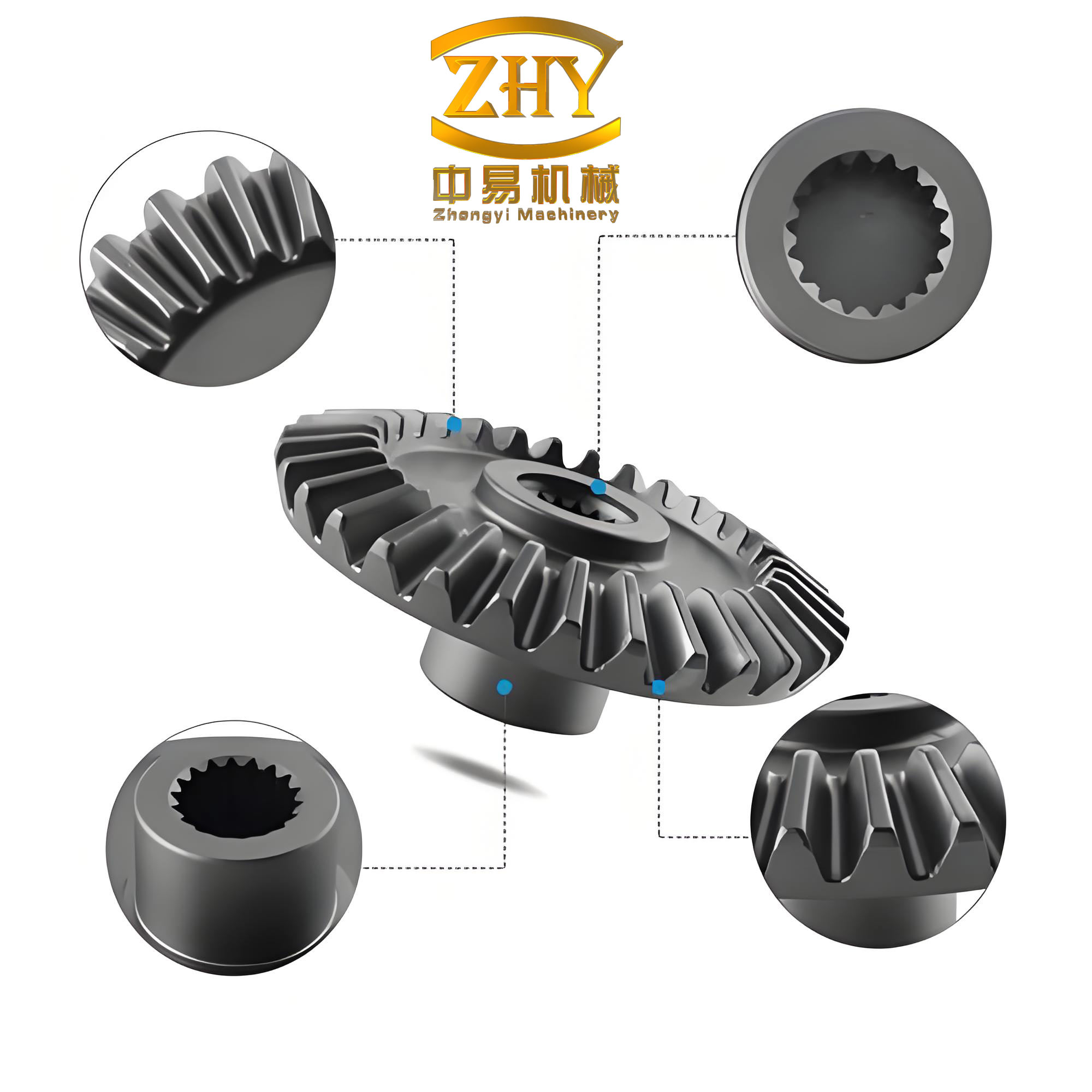
Let me first detail the common forms of profile errors observed in straight bevel gears and their typical causes. A thorough grasp of this relationship is essential for any diagnostician.
| Error Form | Description | Primary Causes |
|---|---|---|
| Top-flared and root-thinned (近似方形) | The tooth profile is wider at the tip and thinner at the root. The extreme case resembles a trapezoid or near-square shape. |
|
| Top-thinned and root-flared (近似三角形) | The tooth profile is thinner at the tip and wider at the root. The extreme case resembles a triangle. |
|
| One-side error | One flank (left or right) conforms to specifications, while the opposite flank is either too full (pressure angle too large) or too lean (pressure angle too small). |
|
| Saw-tooth profile | The profile surface exhibits a jagged, non-smooth finish. |
|
| Localized errors at tip/root | Concavity or convexity specifically at the tooth tip or root, often varying between the toe and heel of the gear. |
|
| Profile bulge at pitch circle | The profile is correct at tip and root but bulges outward near the pitch circle region. |
|
| Variable error per tooth | Measured profile error values differ from one tooth to another around the gear. |
|
The manufacturing of a straight bevel gear on a planer is based on the generating principle, simulating the meshing of a virtual crown gear (the tool) with a virtual cylindrical gear (the equivalent gear of the straight bevel gear). Consequently, any factor that alters the base circle radius of this equivalent gear will induce a profile error. This is the core theoretical insight for analyzing errors in a straight bevel gear. The profile error, denoted as $\Delta f_f$, is fundamentally the maximum error in the arc length of the base circle over the active profile range. Since the involute profile is defined by its base circle, an error $\Delta r_{0T}$ in the base circle radius of the equivalent gear translates directly to an error in the curvature radius of the involute at any point.
To quantify this, we start with the展开角 (spread angle) at the tooth tip of the equivalent gear, $\phi_{eT}$, which defines the angular extent of the active involute profile:
$$
\phi_{eT} = \frac{2\pi \varepsilon \cos \delta}{z}
$$
where $\varepsilon$ is the contact ratio, $\delta$ is the pitch cone angle of the workpiece (straight bevel gear), and $z$ is the number of teeth. The linear profile error $\Delta f_f$ is then the product of the base circle radius error and this angular spread (in radians):
$$
\Delta f_f = \Delta r_{0T} \cdot \phi_{eT} = \Delta r_{0T} \cdot \frac{2\pi \varepsilon \cos \delta}{z}
$$
This equation, $\Delta f_f = \frac{2\pi \varepsilon \cos \delta}{z} \Delta r_{0T}$, is the foundational formula for all subsequent correction calculations. Every adjustment method ultimately seeks to compensate for or eliminate $\Delta r_{0T}$.
With the theory established, I will now explain the primary correction methods in detail. Each method targets specific error patterns by mechanically adjusting machine settings, which in turn alters the effective base circle radius $\Delta r_{0T}$.
Correction Method 1: Adjusting the Sector Gear Force Arm Length
This correction is applied when the profile error is symmetric on both flanks—either top-flared/root-thinned or top-thinned/root-flared. Adjusting the force arm length $L$ changes the effective rolling radius during generation. The relationship is derived from the geometry of the generating mechanism. A change in force arm adjustment angle $\Delta \delta$ (in radians) causes a change in the equivalent pitch radius $\Delta r_T = L \sin(\Delta \delta)$. The corresponding change in equivalent base radius is $\Delta r_{0T} = \Delta r_T \cos \alpha = L \sin(\Delta \delta) \cos \alpha$, where $\alpha$ is the standard pressure angle (e.g., 20°). Substituting into the fundamental profile error formula yields:
$$
\Delta f_f = L \sin(\Delta \delta) \cos \alpha \cdot \frac{2\pi \varepsilon \cos \delta}{z}
$$
For practical adjustments where $\Delta \delta$ is small and measured in degrees, we use:
$$
\Delta f_f = \frac{0.0174 \cdot 2\pi \varepsilon L \Delta \delta^\circ \cos \alpha \cos \delta}{z}
$$
where $\Delta \delta^\circ$ is in degrees. This formula allows calculation of the required force arm adjustment $\Delta \delta^\circ$ for a measured profile error $\Delta f_f$.
| Observed Symmetric Error | Required Action | Key Formula Variable Change |
|---|---|---|
| Top-flared and root-thinned | Decrease sector gear force arm length $L$ | $\Delta \delta^\circ$ negative |
| Top-thinned and root-flared | Increase sector gear force arm length $L$ | $\Delta \delta^\circ$ positive |
Correction Method 2: Adjusting the Tool (Cutter) Pressure Angle
This method addresses errors on a single flank of the straight bevel gear tooth. It involves adjusting the pressure angle of either the upper or lower cutting tool independently by shifting the wedge in the tool holder. Each increment of wedge movement typically changes the working pressure angle by about 20 arcminutes. The direct effect of a tool pressure angle error $\Delta \alpha$ (in radians) on the profile error can be derived from the geometry of tool-workpiece engagement at the pitch line. The relationship is:
$$
\Delta f_f = \pi m \varepsilon \sin \alpha \cdot \Delta \alpha
$$
where $m$ is the module of the straight bevel gear. This formula shows that the profile error is proportional to the module, contact ratio, and the sine of the pressure angle. Therefore, for a measured single-flank error $\Delta f_f$, the required pressure angle adjustment $\Delta \alpha$ (in radians) is:
$$
\Delta \alpha = \frac{\Delta f_f}{\pi m \varepsilon \sin \alpha}
$$
It is crucial to maintain a consistent tool rake angle (typically 12°) during regrinding, as variations here can inadvertently alter the effective working pressure angle and introduce new errors. Using a dedicated tool grinding fixture is highly recommended.
Correction Method 3: Adjusting the Tool Installation Length
When the tooth height is correct but the profile shows symmetric top-flared/root-thinned errors (or vice versa), adjusting the projection length of the cutting tool $\Delta h$ is effective. To maintain constant tooth depth, the workpiece spindle must be moved axially by a compensating amount $\Delta A = \frac{\Delta h}{\sin \delta_H}$, where $\delta_H$ is the workpiece cutting angle (root angle). The geometry relating tool length change to base radius change is more complex, involving the machine center and tool orientation. The change in the equivalent pitch radius at the generating plane is $\Delta r = \Delta h \cos(\delta – \gamma)$, where $\gamma$ is the machine setting angle (often the root angle complement). The equivalent cylindrical gear radius change is $\Delta r_T = \Delta r / \cos \delta = \Delta h \cos(\delta – \gamma) / \cos \delta$. Thus, the base circle radius change is:
$$
\Delta r_{0T} = \Delta r_T \cos \alpha = \frac{\Delta h \cos(\delta – \gamma) \cos \alpha}{\cos \delta}
$$
Substituting into the master profile error formula gives:
$$
\Delta f_f = \frac{\Delta h \cos(\delta – \gamma) \cos \alpha}{\cos \delta} \cdot \frac{2\pi \varepsilon \cos \delta}{z} = \frac{2\pi \varepsilon \Delta h \cos(\delta – \gamma) \cos \alpha}{z}
$$
This provides a direct link between the tool length adjustment $\Delta h$ and the resulting profile error correction $\Delta f_f$. A similar principle applies to correcting errors by adjusting the tool carriage’s final forward position and correspondingly shifting the workpiece spindle.
To synthesize these correction strategies for a straight bevel gear, a systematic troubleshooting flowchart is invaluable. The table below integrates error symptoms with the primary correction method, considering the symmetry of the error.
| Step | Observed Symptom | Check/Measurement | Probable Cause & Recommended Correction | Governing Formula for Quantification |
|---|---|---|---|---|
| 1 | Uniform error on both flanks. | Measure $\Delta f_f$ across several teeth. |
Top-flared/root-thinned: Excessive generating radius. Correct by decreasing sector force arm $L$ or shortening tool length $\Delta h$ (with spindle compensation). Top-thinned/root-flared: Insufficient generating radius. Correct by increasing $L$ or lengthening $\Delta h$. |
Use $\Delta f_f = \frac{0.0174 \cdot 2\pi \varepsilon L \Delta \delta^\circ \cos \alpha \cos \delta}{z}$ or $\Delta f_f = \frac{2\pi \varepsilon \Delta h \cos(\delta – \gamma) \cos \alpha}{z}$ |
| 2 | Error on one flank only. | Measure $\Delta f_f$ separately for left and right flanks. | Incorrect pressure angle for the tool cutting that flank. Adjust the specific tool’s pressure angle via its wedge setting. | Use $\Delta \alpha = \frac{\Delta f_f}{\pi m \varepsilon \sin \alpha}$ |
| 3 | Random variation per tooth or saw-tooth finish. | Check runout, tool edges, and machine dynamics. | Eccentric mounting, tool sharpness, cutting parameters, or machine vibration. Correct by balancing workpiece, sharpening tools, optimizing feeds/speeds, and checking machine alignment. | Not directly formula-based; requires process control. |
| 4 | Localized tip/root concavity/convexity. | Inspect tool geometry and swing limits. | Tool tip width, cutting edge length, or insufficient roll angle. Correct by modifying tool geometry or adjusting machine roll settings. | Geometric checks rather than formulaic. |
The mathematical framework for straight bevel gear error analysis can be further generalized. Consider the total differential of the profile error function. Since $\Delta f_f$ depends on multiple machine setup parameters $ (L, \alpha_{tool}, h, \text{etc.})$, a small change in profile error can be expressed as:
$$
d(\Delta f_f) = \frac{\partial (\Delta f_f)}{\partial L} dL + \frac{\partial (\Delta f_f)}{\partial \alpha_{tool}} d\alpha_{tool} + \frac{\partial (\Delta f_f)}{\partial h} dh + \cdots
$$
For instance, from our derived formulas:
$$
\frac{\partial (\Delta f_f)}{\partial L} = \frac{0.0174 \cdot 2\pi \varepsilon \Delta \delta^\circ \cos \alpha \cos \delta}{z}, \quad \frac{\partial (\Delta f_f)}{\partial (\Delta \alpha)} = \pi m \varepsilon \sin \alpha, \quad \frac{\partial (\Delta f_f)}{\partial h} = \frac{2\pi \varepsilon \cos(\delta – \gamma) \cos \alpha}{z}
$$
This partial derivative approach is useful for sensitivity analysis, showing which parameter has the greatest influence on the profile error for a specific straight bevel gear design. For high-volume production of straight bevel gears, establishing such sensitivity coefficients can streamline the setup and correction process.
Beyond the basic corrections, advanced considerations for minimizing profile errors in straight bevel gears include thermal effects during cutting, material homogeneity, and long-term machine tool wear. For example, the formula for error due to thermal expansion of the workpiece or tooling might introduce an additional term. If the base circle radius has a thermal component $\Delta r_{0T}^{thermal} = r_{0T} \cdot \lambda \cdot \Delta T$, where $\lambda$ is the coefficient of thermal expansion and $\Delta T$ is temperature change, then the thermally induced profile error $\Delta f_f^{thermal}$ is:
$$
\Delta f_f^{thermal} = r_{0T} \cdot \lambda \cdot \Delta T \cdot \frac{2\pi \varepsilon \cos \delta}{z}
$$
While often secondary, such effects can be significant in precision applications. Furthermore, the design of the straight bevel gear itself influences error sensitivity. Gears with a higher number of teeth $z$ or a smaller pitch cone angle $\delta$ tend to have smaller inherent profile error magnitudes for a given $\Delta r_{0T}$, as seen in the denominator and cosine terms of the master formula.
In conclusion, the analysis and correction of profile errors in straight bevel gears is a methodical engineering discipline rooted in the kinematics of gear generation. The key is to recognize the error pattern, relate it to the underlying base circle radius error $\Delta r_{0T}$ of the virtual gear, and apply the appropriate quantitative correction using the formulas for force arm, tool angle, or tool length adjustment. Mastery of these techniques ensures that manufactured straight bevel gears meet stringent accuracy standards, leading to quieter, more efficient, and more durable gear drives. The consistent application of these principles, coupled with rigorous machine maintenance and tool management, forms the cornerstone of quality assurance in straight bevel gear production. As manufacturing technology evolves, the fundamental relationships explored here remain vital for diagnosing and solving precision challenges in these essential mechanical components.