
Electric drills are essential tools for drilling into materials like metal, plastic, and wood, valued for their portability and versatility in construction and decoration. This article investigates gear shaving-induced failures through a case study of a 320W light-duty drill operating at 3,000 rpm with a single-stage gear system. The original design used a large gear (47 teeth, 40Cr steel, module 0.6 mm, hardened) and small gear (5 teeth, 35CrMo steel, hardened). Field failures revealed severe tooth-tip wear on both gears, with the small gear exhibiting complete tip rounding and the large gear showing localized distortion on five teeth.
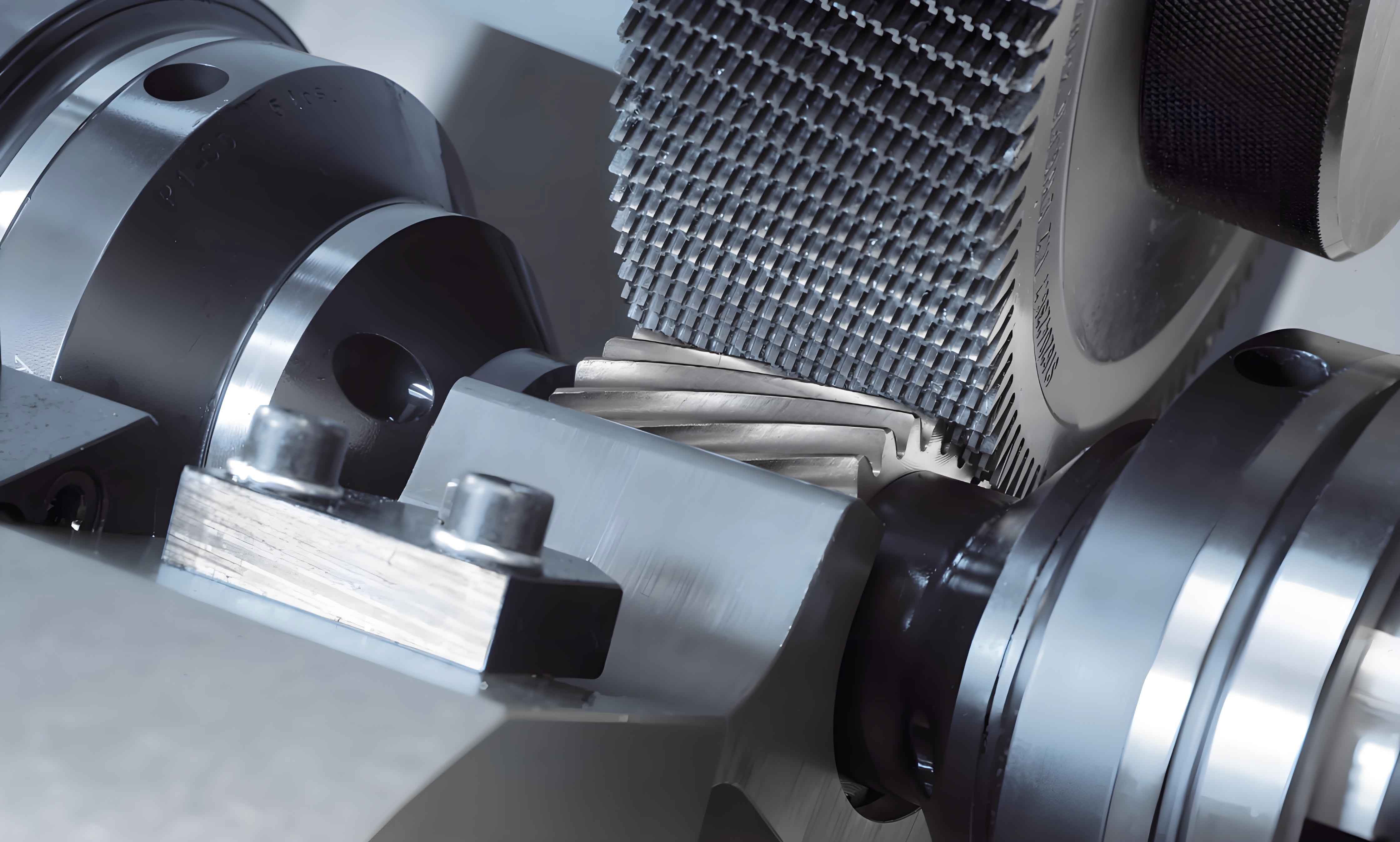
Failure Mechanism Analysis
Gear shaving occurs when dynamic loads exceed design thresholds, causing momentary disengagement and sliding between meshing teeth. The contact stress during re-engagement produces abrasive wear at tooth tips. For this drill, the primary failure driver was insufficient overlap ratio due to low module size. The overlap ratio is calculated as:
$$\epsilon_\gamma = \frac{\sqrt{r_{a1}^2 – r_{b1}^2} + \sqrt{r_{a2}^2 – r_{b2}^2} – a \sin\alpha}{p_b}$$
where \(r_a\) = tip radius, \(r_b\) = base radius, \(a\) = center distance, \(\alpha\) = pressure angle, and \(p_b\) = base pitch. Original parameters yielded \(\epsilon_\gamma = 1.05\), below the critical threshold of 1.1 for shock loads. Under screw-locking operations exceeding 320W, dynamic forces triggered gear shaving through cyclic sliding contact.
Material and Heat Treatment Assessment
Chemical analysis confirmed material compliance, but hardness was suboptimal for the large gear. Comparative data is shown below:
| Component | Parameter | Specification | Measured |
|---|---|---|---|
| Large Gear (40Cr) | Surface Hardness (HRC) | 42–46 | 41–43 |
| Core Hardness (HRC) | 28–32 | 26–30 | |
| Small Gear (35CrMo) | Surface Hardness (HRC) | 48–52 | 51–51.5 |
| Case Depth (mm) | 0.8–1.0 | 0.9–1.0 |
Metallography revealed tempered martensite surfaces and sorbite-ferrite cores in both gears, confirming proper heat treatment. However, the large gear’s low hardness reduced its resistance to gear shaving deformation under impact loads. Stress analysis showed peak contact stresses reaching 1,850 MPa during overloads, exceeding the 1,600 MPa endurance limit for 40Cr at HRC 43.
Design Optimization to Mitigate Gear Shaving
Key modifications were implemented to eliminate gear shaving susceptibility:
- Module Increase: Enhanced from 0.6 mm to 0.7 mm, improving bending strength via:
$$\sigma_b = \frac{F_t}{b m_n Y_F Y_S Y_\beta}$$
where \(F_t\) = tangential force, \(b\) = face width, \(m_n\) = module, \(Y_F\) = form factor, \(Y_S\) = stress correction factor, \(Y_\beta\) = helix angle factor. - Tooth Count Adjustment: Large gear reduced to 39 teeth, small gear to 4 teeth, maintaining original ratio (9.75:1) while boosting overlap ratio to \(\epsilon_\gamma = 1.22\).
- Hardness Enhancement: Large gear surface hardness increased to HRC 45–50 with case depth ≥0.9 mm.
Validation Results
Modified drills endured 200+ hours of accelerated testing at 150% rated load, with post-test inspection showing:
- Zero tooth-tip wear or distortion
- Contact stress reduced to 1,450 MPa
- No gear shaving evidence even at 4,000 rpm overspeed tests
Field deployments confirmed 3× longer service life in wood-drilling applications. This demonstrates that module optimization, combined with hardness control, effectively suppresses gear shaving by strengthening tooth geometry and improving meshing stability.