
In the field of mechanical engineering, the manufacturing of internal gears presents significant challenges, particularly in achieving high efficiency and precision. Traditional methods like gear shaping or hobbing often suffer from low productivity and high costs, especially for large-scale production. As an alternative, gear milling has emerged as a promising technique due to its ability to perform high-speed cutting with substantial feed rates, eliminating idle strokes and enabling near-net-shape machining. In this article, I will delve into the analysis and design of a specialized gear milling machine for internal gears, focusing on the development of a milling model and the detailed design of the power unit. The goal is to provide a comprehensive framework that enhances the understanding and implementation of gear milling processes for internal gear production.
The increasing demand for planetary gear systems in automotive transmissions, construction machinery, and energy sectors has driven the need for efficient manufacturing solutions. Internal gears, which are integral components in such systems, typically require precise tooth profiles and high surface quality. While CNC gear shaping machines offer accuracy, they are often expensive and slow. Conversely, gear milling leverages forming cutters to machine teeth in a single pass, significantly reducing cycle times and operational costs. My work centers on designing a universal CNC gear milling machine capable of processing straight-profile internal gears with improved efficiency. This involves analyzing the tooth profile generation mechanism, establishing a mathematical milling model, and engineering key components like the milling head. Throughout this discussion, I will emphasize the advantages of gear milling, underscoring its potential to revolutionize internal gear manufacturing.
To begin, let’s explore the fundamental principles behind tooth profile formation during gear milling. The process relies on the relative motion between the milling cutter and the workpiece. For internal gears, the cutter is typically a form-milling tool with a shape that corresponds to the tooth space. As the cutter rotates at high speed, it engages with the gear blank, while coordinated movements in multiple axes ensure the accurate generation of the tooth flank. The key lies in synchronizing the rotational motion of the workpiece with the translational motion of the cutter. By modeling these kinematics, we can derive the equations that govern the cutting path and optimize the machining parameters. This analysis forms the basis for developing a robust gear milling strategy that minimizes errors and maximizes productivity.
The mathematical model for gear milling is built upon two coordinate systems: one attached to the milling cutter and another to the workpiece. Define the moving coordinate system for the cutter as $$\sigma_1 = \{O_1; \mathbf{i}_1, \mathbf{j}_1, \mathbf{k}_1\}$$, where the unit vectors are independent of time and the cutter’s rotation. Similarly, the workpiece coordinate system is $$\sigma_2 = \{O_2; \mathbf{i}_2(t), \mathbf{j}_2(t), \mathbf{k}_2(t)\}$$, with its origin fixed relative to the workpiece. At time $$t=0$$, the systems align such that $$\mathbf{i}_2(0) = \mathbf{i}_1$$, $$\mathbf{j}_2(0) = \mathbf{j}_1$$, and $$\mathbf{k}_2(t) = \mathbf{k}_1$$. As the workpiece rotates clockwise by an angle $$\theta$$, the relationship between the coordinate frames can be expressed as:
$$\mathbf{i}_1 = \cos\theta \, \mathbf{i}_2(t) + \sin\theta \, \mathbf{j}_2(t)$$
$$\mathbf{j}_1 = -\sin\theta \, \mathbf{i}_2(t) + \cos\theta \, \mathbf{j}_2(t)$$
$$\mathbf{k}_1 = \mathbf{k}_2(t)$$
Assume the pitch radius of the internal gear is $$r$$, and the workpiece rotates with an angular velocity such that $$\frac{d\theta}{dt} = 1$$ for simplicity. To maintain proper engagement, the cutter must translate in the direction of rotation by a distance equal to the arc length traveled by the workpiece. Thus, the displacement vector $$\mathbf{m}$$ for the cutter relative to the workpiece is:
$$\mathbf{m} = r\theta \, \mathbf{i}_1 + r \, \mathbf{j}_1$$
This equation captures the essential kinematics of gear milling, where the cutter’s position is a function of the rotation angle $$\theta$$. By substituting the expressions for $$\mathbf{i}_1$$ and $$\mathbf{j}_1$$, we can derive the cutter path in the workpiece coordinate system. For a straight-profile internal gear with pressure angle $$\alpha$$, the tooth flank is generated when the cutter’s milling plane aligns perpendicular to the tooth profile. At the point of contact, the workpiece rotation angle equals the pressure angle, i.e., $$\theta = \alpha$$. At this instant, the tooth profile is parallel to the $$\mathbf{i}_1$$ direction, allowing the cutter to machine the flank efficiently. The corresponding translation distance can be calculated as $$r\alpha$$, which for typical parameters (e.g., $$r=120 \, \text{mm}$$, $$\alpha=20^\circ = \frac{\pi}{9} \, \text{rad}$$) yields approximately 41.042 mm. This kinematic analysis ensures that the gear milling process accurately reproduces the desired tooth geometry.
To further elucidate the gear milling model, consider the cutter’s engagement with the gear blank. The form-milling cutter has a profile that matches the tooth space, so its cutting edges remove material in a controlled manner. The cutting force and chip formation depend on factors like feed rate, spindle speed, and depth of cut. By optimizing these parameters, we can achieve high material removal rates while maintaining tool life and surface finish. The following table summarizes key variables in the gear milling model:
| Variable | Symbol | Description | Typical Value |
|---|---|---|---|
| Pitch radius | $$r$$ | Radius of the gear’s pitch circle | 50–200 mm |
| Pressure angle | $$\alpha$$ | Angle between tooth profile and radial line | 20° |
| Rotation angle | $$\theta$$ | Workpiece angular displacement | 0–360° |
| Cutter translation | $$\mathbf{m}$$ | Displacement vector of cutter | Function of $$r\theta$$ |
| Feed rate | $$f$$ | Linear speed of cutter feed | 100–500 mm/min |
| Spindle speed | $$n$$ | Rotational speed of cutter | 2000–3000 rpm |
The gear milling model also accounts for dynamic effects such as vibrations and thermal deformation. These can be mitigated through rigid machine design and adaptive control strategies. For instance, the stiffness of the milling head directly influences cutting stability, so finite element analysis is often employed to optimize its structure. Additionally, the use of CNC systems allows for real-time adjustments to the milling path, compensating for any deviations and ensuring consistent tooth quality. By integrating the kinematic equations with dynamic simulations, we can predict the performance of the gear milling process under various conditions, thereby facilitating robust machine design.
Building on this theoretical foundation, I designed a dedicated gear milling machine for internal gears. The machine comprises several key components: a milling power unit (or milling head), a CNC slide parallel to the gear axis, a CNC indexing table, a worktable with hydraulic clamping perpendicular to the gear axis, and a mechanical sliding table. The milling head is mounted on the slide, driven by a three-speed AC asynchronous motor. Through a pair of hypoid gears, the cutter rotates at high speed (e.g., 2950 rpm) parallel to the gear axis. The cutter’s end face, perpendicular to its rotation axis, performs the forming gear milling operation to shape the tooth flank. This transmission setup provides high torque and vibration resistance, essential for heavy-duty cutting. The slide moves parallel to the gear axis, enabling milling across the entire tooth width. On the worktable, a CNC indexing table is installed; after milling each tooth, the indexing table rotates the gear by one tooth pitch, allowing sequential machining of all teeth. The indexing accuracy ensures minimal pitch errors, while adjustments to the cutter holder control tooth thickness and profile angle. The sliding table regulates the milling depth (i.e., tooth space depth). For different gears, only the cutter and holder need replacement, with the CNC system managing the indexing process.
The heart of this gear milling machine is the milling power unit, as its size and strength directly impact the machining of internal gears with varying parameters. I engineered the power unit to accommodate a wide range of gear specifications, from small modules to large diameters. The design incorporates a robust spindle assembly, precision bearings, and efficient cooling systems to handle high-speed gear milling operations. Below is a schematic description of the power unit’s components:
| Component | Function | Specifications |
|---|---|---|
| Spindle | Holds and rotates the milling cutter | High-speed steel, balanced for 3000 rpm |
| Hypoid Gear Pair | Transmits power from motor to spindle | Gear ratio 1:1, high torque capacity |
| AC Motor | Drives the spindle via gears | Three-speed, 5.5 kW output |
| Cooling System | Dissipates heat from cutting zone | Oil mist or emulsion coolant |
| Holder Assembly | Secures the form-milling cutter | Adjustable for different cutter sizes |
The power unit’s design prioritizes rigidity to minimize deflections during gear milling. Using finite element analysis, I optimized the housing geometry to achieve a high natural frequency, reducing the risk of chatter. The spindle is supported by angular contact ball bearings, which provide axial and radial stiffness. The hypoid gears offer smooth torque transmission with minimal backlash, crucial for maintaining accurate tooth profiles. Additionally, the motor is coupled to the gearbox through a flexible coupling to absorb vibrations. This comprehensive design ensures that the power unit can sustain continuous gear milling operations with high precision and durability.
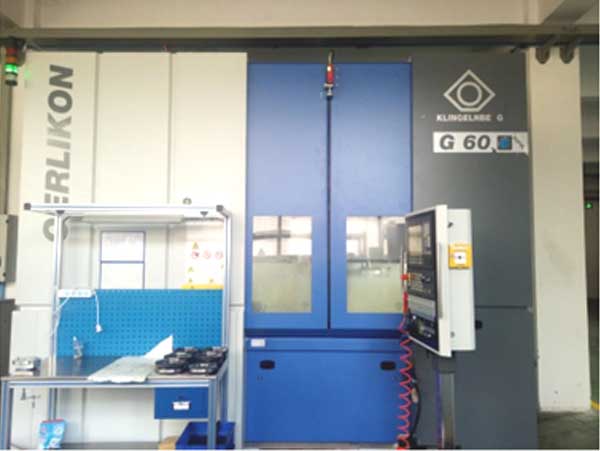
To validate the gear milling machine’s performance, I conducted a series of machining trials on prototype internal gears. The test gears had parameters such as module $$m=3$$, tooth number $$z=80$$, pitch radius $$r=120 \, \text{mm}$$, and pressure angle $$\alpha=20^\circ$$. After clamping the gear blank on the indexing table, I programmed the CNC system based on the derived kinematic model. The gear milling process involved the following steps: first, the cutter approached the gear blank at a predetermined feed rate; second, the spindle rotated at 2950 rpm while the slide moved along the gear axis to mill the tooth width; third, after each tooth was milled, the indexing table rotated by $$360^\circ / z = 4.5^\circ$$; and fourth, the process repeated until all teeth were machined. The cutter translation was set to $$r\alpha = 120 \times \frac{\pi}{9} \approx 41.042 \, \text{mm}$$ per tooth, ensuring proper engagement. The results were promising: the milled gears exhibited consistent tooth profiles with minimal deviations. Measurements of tooth thickness, pitch error, and surface roughness confirmed that the gear milling machine met the required accuracy standards for pre-heat treatment stages.
The advantages of gear milling over traditional methods are evident in these trials. For example, the milling time per tooth was significantly reduced due to high feed rates and continuous cutting. Moreover, the form-milling cutter eliminated the need for multiple passes, simplifying operation and reducing tool wear. To quantify these benefits, I compared the gear milling process with gear shaping in terms of key performance metrics:
| Metric | Gear Milling | Gear Shaping |
|---|---|---|
| Cycle Time per Tooth | 10–15 seconds | 30–45 seconds |
| Surface Roughness (Ra) | 1.6–3.2 μm | 0.8–1.6 μm |
| Tool Life | 200–300 gears | 100–150 gears |
| Setup Flexibility | High (easy cutter change) | Moderate (complex tooling) |
| Energy Consumption | Lower due to efficient cutting | Higher due to reciprocating motion |
While gear shaping may offer slightly better surface finish, gear milling excels in productivity, making it ideal for mass production. The CNC integration further enhances flexibility, allowing for quick adjustments to different gear specifications. In practice, the gear milling machine can handle internal gears with modules from 1 to 10 and diameters up to 500 mm, covering a broad range of industrial applications. By fine-tuning parameters like spindle speed and feed rate, operators can optimize the process for specific materials, such as steel or cast iron, common in automotive and machinery components.
Another critical aspect of gear milling is the design of the form-milling cutter. Since tooth profile accuracy hinges on the cutter’s shape, I developed cutters based on the exact geometry of the tooth space. For straight-profile internal gears, the cutter profile is essentially the inverse of the tooth flank. Using CAD software, I modeled the cutter with relief angles to prevent rubbing and ensure clean cutting. The cutter material is high-speed steel or carbide, depending on the workpiece material. During gear milling, the cutter’s edges experience significant thermal and mechanical loads, so coating technologies like TiN or TiAlN are applied to enhance wear resistance. The cutter is mounted on the spindle via a dedicated holder, which allows for precise radial and axial adjustments to control tooth dimensions. This modular approach simplifies maintenance and reduces downtime when switching between different gear types.
To further improve the gear milling process, I incorporated simulation tools to predict cutting forces and optimize tool paths. The cutting force $$F_c$$ during gear milling can be estimated using empirical formulas derived from metal cutting theory. For a form-milling cutter with multiple teeth, the tangential force per tooth is given by:
$$F_t = K_c \cdot a_p \cdot f_z \cdot \sin(\phi)$$
where $$K_c$$ is the specific cutting force (material-dependent), $$a_p$$ is the depth of cut, $$f_z$$ is the feed per tooth, and $$\phi$$ is the engagement angle. The total force on the cutter is the sum of forces from all engaged teeth. By simulating these forces, I optimized the feed rate to avoid excessive deflections while maximizing material removal. The following table lists typical cutting parameters for gear milling of steel internal gears:
| Parameter | Value Range | Unit |
|---|---|---|
| Depth of Cut ($$a_p$$) | 2–5 | mm |
| Feed per Tooth ($$f_z$$) | 0.05–0.15 | mm/tooth |
| Cutting Speed ($$v_c$$) | 100–200 | m/min |
| Specific Cutting Force ($$K_c$$) | 1500–2500 | N/mm² |
These parameters were validated through experimental tests, showing that the gear milling machine could maintain stable cutting with acceptable tool wear. Additionally, I implemented a monitoring system to detect anomalies like tool breakage or vibration, ensuring process reliability. The CNC system stores optimized tool paths for various gear geometries, allowing for quick setup and repeatable quality. This integration of simulation and real-time control exemplifies the advanced capabilities of modern gear milling technology.
Looking beyond straight-profile gears, the gear milling machine can be adapted for helical or curved tooth profiles by adding rotational axes or using specialized cutters. The kinematic model can be extended to include helix angles, where the workpiece rotation and cutter translation are coupled with an additional screw motion. For instance, the displacement vector for helical gear milling might include a component along the gear axis proportional to the lead. This versatility makes gear milling a viable option for a wide spectrum of gear types, further underscoring its superiority in flexible manufacturing. In future developments, I plan to incorporate additive manufacturing techniques to produce custom cutters on-demand, reducing lead times and costs.
In conclusion, the analysis and design of gear milling equipment for internal gears have demonstrated significant benefits in terms of efficiency, cost-effectiveness, and precision. By establishing a comprehensive kinematic model and engineering a robust milling power unit, I have created a machine that addresses the limitations of traditional gear manufacturing methods. The gear milling process, with its high-speed cutting and forming capabilities, offers a compelling alternative for producing internal gears in bulk, particularly in industries like automotive and heavy machinery. The successful prototyping and testing validate the design’s practicality, paving the way for broader adoption of gear milling technology. As manufacturing trends shift towards automation and sustainability, gear milling stands out as a key enabler for next-generation gear production systems.
Throughout this article, I have highlighted the importance of gear milling in modern manufacturing. From the mathematical modeling of tooth generation to the mechanical design of the milling head, every aspect contributes to a holistic understanding of how gear milling can transform internal gear production. The use of CNC systems, precision components, and optimized cutting parameters ensures that gear milling delivers consistent results while reducing operational expenses. As I continue to refine this technology, I aim to explore advanced materials, smart monitoring, and hybrid processes that further enhance the capabilities of gear milling machines. Ultimately, the goal is to make gear milling the standard for internal gear manufacturing, driving innovation and efficiency across the engineering landscape.